論文解説
Do Probing and Steering Favor the Same Directions Within and Across Language Models?
プロービングとステアリングは同じ方向を選好するか:言語モデル内部とモデル間での比較
- 課題 言語モデルで概念を読み取るプローブの方向が、同じ概念を操るステアリングの方向としても最適かは自明ではありません。
- 手法 平均差と共分散調整をつなぐ正規化判別方向の族を作り、固定した中立テキストの副作用のもとで、プローブのAUROCとステアリング効果を同時に測定します。
- 結果 6つのモデルと概念の組み合わせすべてで、プローブの最適点はλ≈τ付近にあり、ステアリングの最適点はそれより平均差寄りにありました。モデル間の転送では、プローブは81–91%を維持しましたが、平均差のステアリング効果は12組中11組で維持率が低くなりました。
プローブとステアリングは同じ方向を選ぶのか
言語モデルの隠れ状態にある一つの方向は、概念が存在するかを読み取るプローブにも、モデルをその概念の側へ押すステアリングにも使えます。ステアリングの手法は、プローブの方向をそのまま再利用することが多いです。しかし、概念を最もよく読み取れる方向が、概念を最もよく変える方向と同じだという保証はありません。この論文は、その差を同じモデル内とモデル間の両方で確認します。
著者らは、プローブの方向とステアリングの方向を一つの正規化された判別方向の族として結びつけます。一方の端は共分散を反映したFisher判別方向で、もう一方の端は平均差Δμです。二つの役割を同じ族の上で比べることで、どの地点が各役割に有利かを知ることができます。
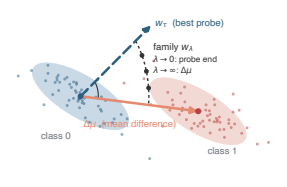
Figure 1 : Hidden states of one layer of LLM A. ∆µ joins the two class means; the best probe wτ is tilted away from it by the within-class covariance, and the family wλ runs between them. Probing reads w⊤h; steering adds a∥h∥w. The paper also asks how these two transfer across language models.
出典 · CC BY 4.0 · Afshin Sadeghi, Daniel Becker · Do Probing and Steering Favor the Same Directions Within and Across Language Models? · 論文の図を引用 · 元のPDFの2ページ目から図の部分を抽出しています。正規化された判別方向の族と固定の副作用
推定用のsubsetで、平均差Δμ=μ1−μ0と合同クラス内共分散ΣWを計算します。サンプル数が次元より少ないため、ΣWは特異行列になります。そこで逆行列の代わりに、正規化族wλ=(ΣW+λI)^(-1)Δμを使います。λが大きくなると方向はΔμ/∥Δμ∥に近づき、λが小さくなると共分散調整は大きくなります。著者らは、モデル間で比較できるように、λをτ=tr(ΣW)/dの単位で表しました。
同じ単位ベクトルをプローブとして使うときはheld-out AUROCで、ステアリングとして使うときは加算的な介入T(h;w,a)=h+a∥h∥wで評価します。ステアリング効果は、中立文で測ったnext-token KL副作用Kがκ0に達する地点で読み取ります。強い押し出しは対象の概念以外にもモデルを変えてしまうため、方向同士を同じ副作用の時点で比べるための設計です。
モデル間の転送の法則
二つのモデルの隠れ状態を、中立テキスト上でリッジ回帰によって合わせたアフィン写像で結びます。ステアリングの方向は差分ベクトルなので、順方向の写像δB=MA→B δで移します。プローブは線形関数なので、逆写像の転置wA→B=M⊤B→A wAで移します。著者らは、これらをそれぞれステアリング法則、プローブ法則と呼んでいます。
対照群として直交Procrustes写像を使い、二つの法則が同じベクトルを与えるようにしました。これにより、法則の選択そのものが結果に影響するかを確認します。写像は概念のテキストを見ないため、転送された方向が目標モデルで機能する度合いは、二つのモデルが該当する方向をどれだけ対応づけられるかに依存します。
同じモデル内で分かれる最適点
ステアリングのplateauは6つのケースすべてで、プローブのplateauより右側にありました。そのためH1aは成立しました。
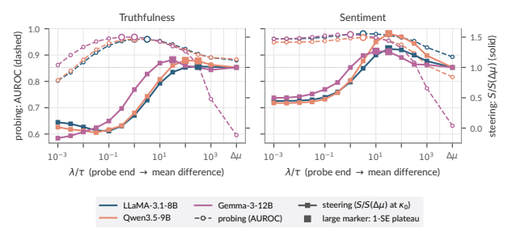
Figure 2 : Probing (dashed, held-out AUROC, left axis) and steering relative to ∆µ (solid, right axis) along the family; large markers mark the one-standard-error plateaus. Probing is best near λ=τ , steering further toward∆µ.
出典 · CC BY 4.0 · Afshin Sadeghi, Daniel Becker · Do Probing and Steering Favor the Same Directions Within and Across Language Models? · 論文の図を引用 · 元のPDFの7ページ目から図の部分を抽出しています。感情では、プローブの最適点がすでにΔμに近い位置にあり、H1bは3つのモデルで成立しました。一方、真実性では、どの中間方向もΔμより明らかに良いステアリングを得られませんでした。H1bは3つのモデルすべてで成立しませんでした。この結果は、ステアリング最適の位置と安定性が概念、層、演算子、テキストによって変わるという著者らの解釈と合います。
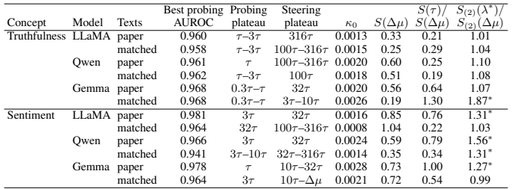
Table 2 : RQ1 with the paper’s texts and with matched probe and steering texts (∗: H1b holds). κ0 in nats; S(∆µ) is the held-out effect of ∆µ at κ0, in nats of answer margin for truthfulness and in log-odds for sentiment. H1a holds in every case.
出典 · CC BY 4.0 · Afshin Sadeghi, Daniel Becker · Do Probing and Steering Favor the Same Directions Within and Across Language Models? · 論文の図を引用 · 元のPDFの17ページ目から図の部分を抽出しています。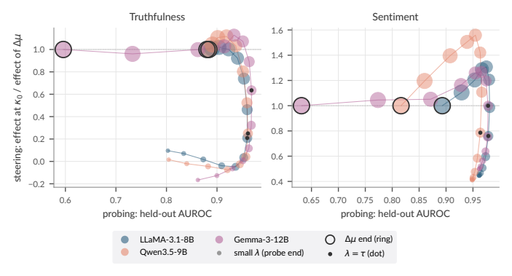
Figure 7 : Each direction of the family at its probing AUROC (horizontal) and its steering effect relative to∆µ(vertical). No curve ends in the upper right corner, so no direction is best at both.
出典 · CC BY 4.0 · Afshin Sadeghi, Daniel Becker · Do Probing and Steering Favor the Same Directions Within and Across Language Models? · 論文の図を引用 · 元のPDFの29ページ目から図の部分を抽出しています。モデル間転送におけるプローブとステアリングの差
プローブ法則で移したプローブは、目標モデル自身のプローブのAUROCのうち、偶然を超える分を81–91%維持しました。一方、ステアリング法則で移した平均差は、目標モデル自身のΔμのステアリング効果を44–93%の維持にとどまり、12組中11組でρprobeより低くなりました。事前に定めた基準では分類されるのは3組だけで、残りの9組は決まりませんでした。したがって、この結果は3つのモデルで見られた傾向として読むべきです。
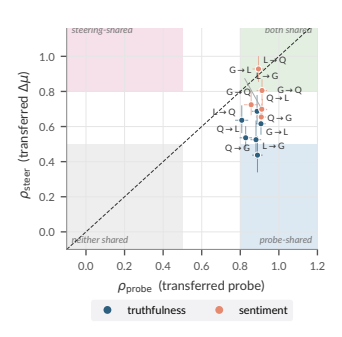
Figure 3 : H1c: ρprobe (horizontal) and ρsteer (vertical) per ordered pair and concept. Most pairs lie below the diagonal.
出典 · CC BY 4.0 · Afshin Sadeghi, Daniel Becker · Do Probing and Steering Favor the Same Directions Within and Across Language Models? · 論文の図を引用 · 元のPDFの8ページ目から図の部分を抽出しています。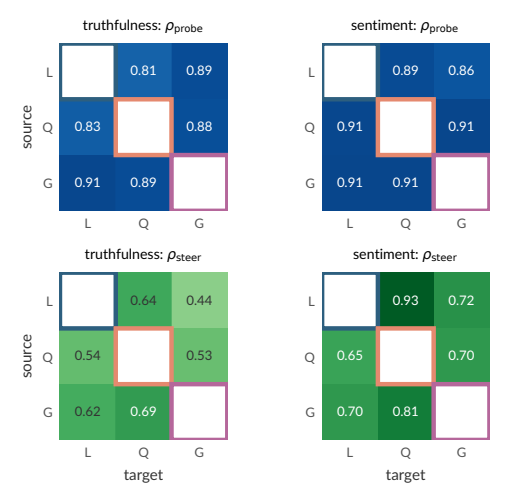
Figure 8 : ρprobe (top) and ρsteer (bottom) for each source (rows) and target (columns); darker cells are higher. Probing values are uniformly high, steering values lower and uneven.
出典 · CC BY 4.0 · Afshin Sadeghi, Daniel Becker · Do Probing and Steering Favor the Same Directions Within and Across Language Models? · 論文の図を引用 · 元のPDFの31ページ目から図の部分を抽出しています。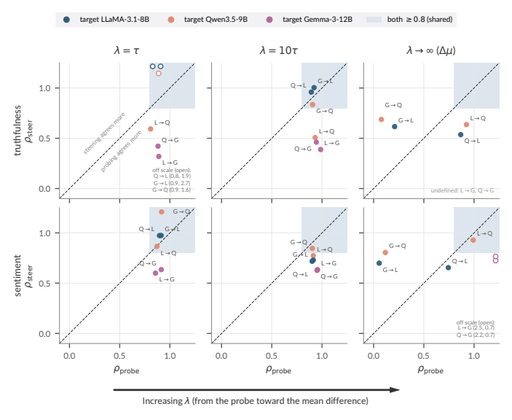
Figure 9 : ρprobe (horizontal) and ρsteer (vertical), both computed at λ=τ (left), 10τ (middle) and ∆µ (right). Probes transfer well except at the ∆µ end with Gemma, and steering transfer depends on the point of the family.
出典 · CC BY 4.0 · Afshin Sadeghi, Daniel Becker · Do Probing and Steering Favor the Same Directions Within and Across Language Models? · 論文の図を引用 · 元のPDFの32ページ目から図の部分を抽出しています。著者らは、プローブとステアリングでは対応する法則が異なる点と、写像が中立テキストに合わせて作られた点をあわせて挙げています。写像は概念のテキストへの適合が弱いため、ステアリングの損失の一部はモデルではなく写像から生じうると考えています。
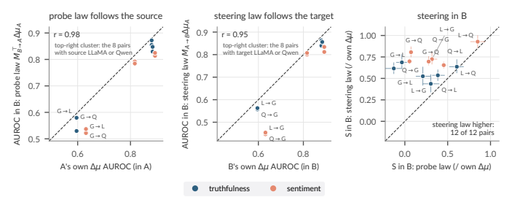
Figure 10 : Probing after the probe law (left) and after the steering law (middle), and steering after each law (right), for each model pair and concept, with the pairs that involve Gemma labelled in the first two panels. The probe law keeps what a direction reads, and the steering law keeps where it pushes.
出典 · CC BY 4.0 · Afshin Sadeghi, Daniel Becker · Do Probing and Steering Favor the Same Directions Within and Across Language Models? · 論文の図を引用 · 元のPDFの32ページ目から図の部分を抽出しています。棄権の方向へのステアリングと答えへの到達可能性
PopQAで、greedyの答えとサンプリングした答えを比べて、事例を分けました。棄権の方向へのステアリングは、不確かな誤答(C2)で棄権を大きく増やしました。
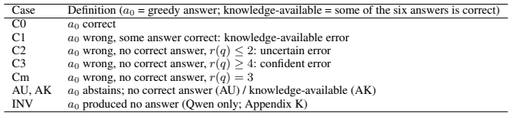
Table 5 : Cases used in RQ2, defined from the model’s own answers.
出典 · CC BY 4.0 · Afshin Sadeghi, Daniel Becker · Do Probing and Steering Favor the Same Directions Within and Across Language Models? · 論文の図を引用 · 元のPDFの20ページ目から図の部分を抽出しています。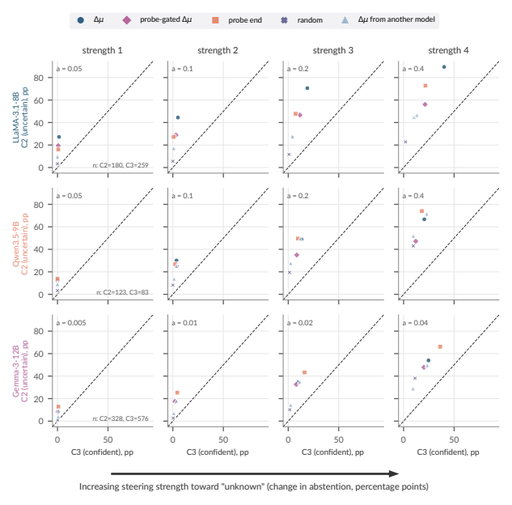
Figure 12 : Change in abstention (pp) on confident errors (C3, horizontal) and uncertain errors (C2, vertical) for each model (rows) and strength (columns). All points lie above the diagonal.
出典 · CC BY 4.0 · Afshin Sadeghi, Daniel Becker · Do Probing and Steering Favor the Same Directions Within and Across Language Models? · 論文の図を引用 · 元のPDFの34ページ目から図の部分を抽出しています。ゲートつきステアリングは、Qwenでのみ事前に定めたH2c基準を通過しました。この結果は、PopQAの質問と単一レイヤーの設定で得られたものです。レイヤーに応じたH2b(iii)とH2cの変化は確認していません。
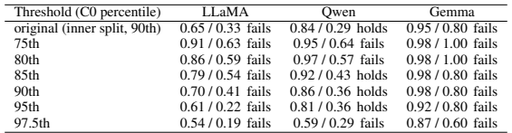
Table 7 : Gating at the strength of ∆µ for different thresholds: share of ∆µ’s abstention gain on C2 kept / share of its cost on C0 paid, and the H2c verdict (kept≥0.8and paid≤0.5).
出典 · CC BY 4.0 · Afshin Sadeghi, Daniel Becker · Do Probing and Steering Favor the Same Directions Within and Across Language Models? · 論文の図を引用 · 元のPDFの22ページ目から図の部分を抽出しています。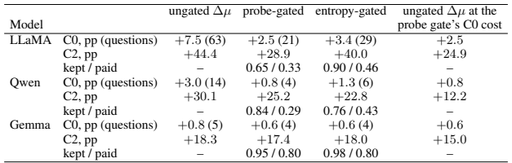
Table 8 : H2c with two gates and at matched cost, all with ∆µ at its anchor strength, composed from the saved runs. C0: over-abstention on correct answers, in percentage points, with the number of questions in brackets (845, 472 and 644 C0 questions); C2: abstention gained on uncertain errors; kept and paid as in the H2c rule (gain kept ≥0.8 , cost paid ≤0.5 ). The last column is ungated ∆µ at the strength whose C0 cost equals the probe gate’s.
出典 · CC BY 4.0 · Afshin Sadeghi, Daniel Becker · Do Probing and Steering Favor the Same Directions Within and Across Language Models? · 論文の図を引用 · 元のPDFの22ページ目から図の部分を抽出しています。残された制約
結果は3つの概念、3つのモデル、主分析レイヤーの1つに限られます。モデル間の組み合わせは十二組ありますが、モデルを共有しているため独立した確認ではありません。一つのモデルの特性が複数の組に同時に現れます。この研究は単一方向と加算・回転の演算のみを扱い、部分空間、非線形プローブ、スパースオートエンコーダの特徴は扱っていません。
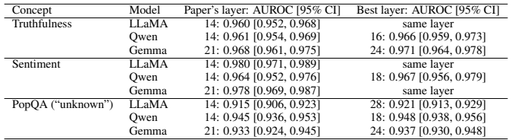
Table 12 : Held-out AUROC of the best direction at the paper’s layer and at the best layer of the sweep, with 95% intervals. The intervals overlap in every case.
出典 · CC BY 4.0 · Afshin Sadeghi, Daniel Becker · Do Probing and Steering Favor the Same Directions Within and Across Language Models? · 論文の図を引用 · 元のPDFの26ページ目から図の部分を抽出しています。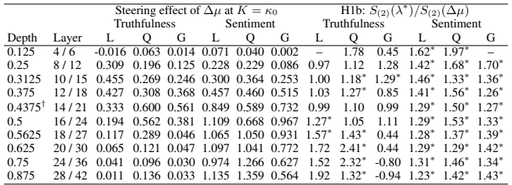
Table 13 : Steering effect of ∆µ at each layer’s κ0 (left) and the H1b ratio (right) across depths (L = LLaMA, Q = Qwen, G = Gemma; ∗: H1b holds; †: the paper’s depth). H1b holds for sentiment wherever∆µsteers, for truthfulness only at some layers.
出典 · CC BY 4.0 · Afshin Sadeghi, Daniel Becker · Do Probing and Steering Favor the Same Directions Within and Across Language Models? · 論文の図を引用 · 元のPDFの26ページ目から図の部分を抽出しています。真実性の評価はTruthfulQAの一つだけで行われ、方向の計算と評価が同じデータセットを使うため、中間方向による利得をテスト分布への適合から切り分けられません。RQ2のラベルはサンプリングに基づくため、答えに到達可能かを示すだけで、モデルが事実を知っているかは言えません。
論文情報
- 著者
- Afshin Sadeghi, Daniel Becker
- 学会・ジャーナル
- arXiv · プレプリント
- 公開日
- 2026年11月14日
- 登録日
- 2026年11月17日
- 更新日
- 2026年11月14日
- バージョン
- v1
- arXiv
- 2611.19499
- カテゴリ
- cs.CL · cs.AI · cs.LG
- ライセンス
- CC BY 4.0
- 掲載内容
- 論文情報・解説・論文の図
この解説は、Refivuの韓国語解説をAIで翻訳したものです。不正確な翻訳や誤りが含まれる可能性があります。論文と図の利用条件は各出典に従います。
アブストラクト
A direction in a language model's hidden state can be used to probe whether a concept is present or to steer the model toward it. Although probe directions are often reused for steering, the direction that best detects a concept need not be the one that best changes it. We study this distinction in three instruction-tuned models from different families. We construct a one-parameter family of directions ranging from a covariance-adjusted discriminant to the mean difference, and evaluate probing and additive steering, which adds the direction to the hidden state, along the family at a fixed side effect. For truthfulness and sentiment, in every model, the best probe is not the best steering direction: steering consistently favors directions closer to the mean difference. This separation holds across 59 of 60 layer-model-concept combinations in a layer sweep, with matched probe and steering texts in all six model-concept combinations, and under a rotation-based steering operator. The exact steering optimum is less stable: for sentiment, an intermediate direction produces a 27-56% stronger steering effect than the mean difference, but this gain shrinks or disappears with matched texts and depends on the layer and the operator. The two roles also transfer differently across models. A probe transferred by a linear map fitted on neutral text retains 81-91% of the target model's above-chance probing performance, while the transferred mean difference retains less of its steering effect in 11 of 12 model pairs. This is a consistent tendency, although our predefined criteria classify only three pairs, and nine remain inconclusive. Finally, as an application on PopQA, steering toward "unknown" increases abstention by 18-44 percentage points on uncertain errors, versus 2-5 on confident errors, while rarely correcting errors in cases where a correct answer is reachable.
この論文を引用
Afshin Sadeghi, Daniel Becker (2026). Do Probing and Steering Favor the Same Directions Within and Across Language Models?. arXiv:2611.19499v1. https://arxiv.org/abs/2611.19499v1
BibTeX
@misc{sadeghi2026probing,
  title = {{Do Probing and Steering Favor the Same Directions Within and Across Language Models?}},
  author = {Afshin Sadeghi and Daniel Becker},
  year = {2026},
  eprint = {2611.19499},
  archivePrefix = {arXiv},
  url = {https://arxiv.org/abs/2611.19499v1}
}