論文解説
What Transfers Across Cuneiform? Script-Level Substrate and Language-Specific Regularities via Segmentation and Representation
楔形文字で何が転移するのか:分割と表現を通じた文字レベルの基盤と言語別の規則性
- 課題 楔形文字の統計的規則のうち、文字体系が共有する部分と言語固有の部分を切り分けるのは難しいです。
- 手法 単語境界の課題でTP分割とMorfessor分割を比較し、UnicodeとLatinの表現を結び付けて品詞分類に用います。
記号列から単語境界を見つける難しさ
楔形文字の記録は、多くの場合単語の境界がない記号の連続として残っています。ラテン文字転写では、研究者が音価をあらかじめ決めて境界を入れるため、その解釈が計算分析の前に入り込んでしまいます。この論文は、どの統計的規則が文字体系全体に共通し、どの規則が個々の言語に属するのかを切り分けるために、同じ分解の問いを分割手法と表現方式という二組の検証手段で確かめます。
この研究の対象はAkkadian、Sumerian、Elamiteです。著者らは、Hittiteを4番目の評価言語としてではなく、基盤違反のストレステストとして使っています。
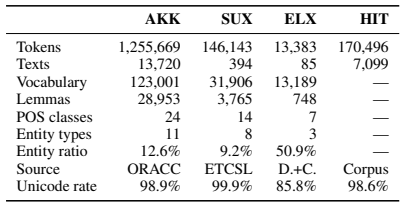
Table 1 : Dataset statistics. AKK = Akkadian, SUX = Sumerian, ELX = Elamite, HIT = Hittite (Yavasan and Gordin, 2024). The ELX token count comprises 13K lemma-dictionary entries plus the Utu-našu run- ning corpus; segmentation experiments train on run- ning text only (§3), and an expanded 871-document Elamite corpus is analyzed in Appendix A.14. Hittite serves exclusively as the substrate-violation stress test (§4.1.3), so annotation-dependent rows do not apply.
出典 · CC BY 4.0 · Chuanjun Zhou, Adam G Anderson · What Transfers Across Cuneiform? Script-Level Substrate and Language-Specific Regularities via Segmentation and Representation · 論文の図を引用 · 元のPDFの4ページ目から図の部分を抽出しています。TPとMorfessorの分割方式
転移確率(TP)は、現在の記号c_iから次の記号c_{i+1}へ移る条件付き確率P(c_{i+1}|c_i)が閾値θより低いとき、境界を予測します。このbigram確率は分割済みの学習コーパスから推定され、単純な共起回数ではなく、単位記号の頻度で正規化した遷移構造を用います。著者らは、この正規化こそHomburg and Chiarcos(2016)の非正規化bigramベースラインに欠けていた部分だと説明しています。
Morfessorは単語頻度データからMDL基準により下位単語の語彙を学習し、新しい記号列にはViterbiデコーディングを適用します。TPと異なりパラメータ化された語彙を学習するため、分割性能は学習した語彙が対象コーパスをどれだけカバーするかに左右されます。既定のcorpusweightは1.0です。
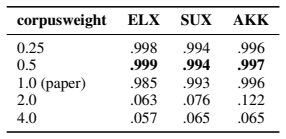
Table 13 : In-language 5-fold CV F1 by corpusweight. Bold = source-side selected value.
出典 · CC BY 4.0 · Chuanjun Zhou, Adam G Anderson · What Transfers Across Cuneiform? Script-Level Substrate and Language-Specific Regularities via Segmentation and Representation · 論文の図を引用 · 元のPDFの16ページ目から図の部分を抽出しています。言語内の単語境界性能
5-fold held-out交差検証では、TPはAkkadianでF1 0.971、Sumerianで0.972、Elamiteで0.989を記録しました。Morfessorは同じ条件で、Akkadianで0.997、Sumerianで0.993、Elamiteで0.985を記録しました。両方法とも、既存の辞書ベースMaxMatchのF1 0.74を23点以上上回りました。ただし言語内の差は小さく、AkkadianとSumerianではMorfessorの優位が統計的に有意でした。Elamiteでは、TPの優位は有意ではありませんでした。
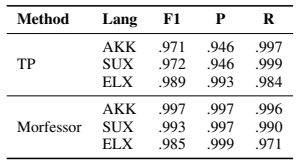
Table 2 : Word boundary inference (5-fold held-out CV). Both dictionary-free methods exceed the prior dictionary-based MaxMatch baseline (Homburg and Chiarcos, 2016) (F1 = 0.74 on Middle Babylonian) by more than 23 F1 points. Morfessor’s slight in- language edge does not generalize to cross-language transfer (Table 3).
出典 · CC BY 4.0 · Chuanjun Zhou, Adam G Anderson · What Transfers Across Cuneiform? Script-Level Substrate and Language-Specific Regularities via Segmentation and Representation · 論文の図を引用 · 元のPDFの5ページ目から図の部分を抽出しています。言語間転移での差
言語内の性能が近くても、言語間転移では差が大きく開きました。Akkadianで学習したTPは、SumerianとElamiteを対象としたときにF1 0.967と0.992を記録し、Morfessorは0.981と0.984を記録しました。小規模な転移元であるElamiteで学習させると、TPはAkkadianで0.959、Sumerianで0.969を維持しましたが、Morfessorは0.304と0.267に下がりました。
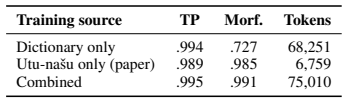
Table 16 : Elamite segmentation by training source, evaluated on identical held-out running-text folds.
出典 · CC BY 4.0 · Chuanjun Zhou, Adam G Anderson · What Transfers Across Cuneiform? Script-Level Substrate and Language-Specific Regularities via Segmentation and Representation · 論文の図を引用 · 元のPDFの16ページ目から図の部分を抽出しています。著者らは、Morfessorの崩壊を言語の同一性よりも語彙の網羅性の問題として解釈しています。14通りの転移元サイズ構成では、網羅性と転移F1のPearson rは0.91でした。また、対象のSumerian語彙をElamiteの記号リストに制限すると、AKK対象の転移は0.283に低下しました。この因果的な解釈は、本実験設計の条件の範囲内で読む必要があります。
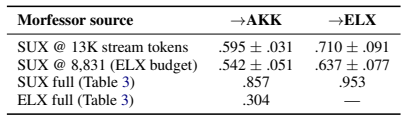
Table 4 : Matched-size transfer control. Shrinking the Sumerian source to the Elamite budget costs 32 points (→AKK), yet at the same budget the Elamite source sits a further 24 points lower: size and composition both matter, and neither alone explains the collapse.
出典 · CC BY 4.0 · Chuanjun Zhou, Adam G Anderson · What Transfers Across Cuneiform? Script-Level Substrate and Language-Specific Regularities via Segmentation and Representation · 論文の図を引用 · 元のPDFの6ページ目から図の部分を抽出しています。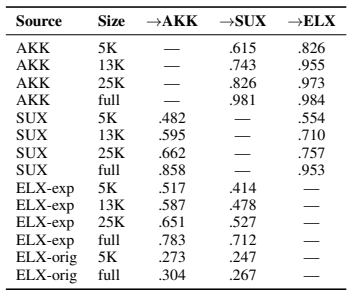
Table 15 : Morfessor zero-shot transfer across the source-size grid (mean over 5 seeds; seed std≤.091, typically≤.03). ELX-exp = the 871-document ex- panded corpus (Appendix A.14).
出典 · CC BY 4.0 · Chuanjun Zhou, Adam G Anderson · What Transfers Across Cuneiform? Script-Level Substrate and Language-Specific Regularities via Segmentation and Representation · 論文の図を引用 · 元のPDFの16ページ目から図の部分を抽出しています。Akkadianの学習曲線
Akkadianの学習トークン数を1Kから1.26Mまで減らしたり増やしたりして、TPとMorfessorを比べました。TPは1KトークンでF1 0.961を示し、1.26Mでも0.967にとどまりました。Morfessorは1Kで0.67、5Kで0.92を記録し、約10KトークンでTPと同程度に達しました。この曲線はAkkadianでのみ実施されたため、他の言語やコーパスサイズでも同じ形が現れるという主張は確認されていません。
Hittiteで見えた基盤違反
Hittiteは、Akkadogramと Sumerogramが文字の途中に挿入されるコーパスのため、記号の連続性が崩れる条件を試すのに使われました。外来文字のロゴグラム比率は既定のヒューリスティックで34.7%でした。TPはF1 0.619を記録し、Morfessorは0.918を記録しました。3言語の平均と比べると、TPは35点、Morfessorは8点低下しました。著者らは、この差はTPが文字内部の遷移の安定性に依存し、Morfessorが語彙単位の繰り返しに依存するためだと解釈しています。
Latinと Unicodeの表現の結合
品詞分類では、Latin転写、Unicode楔形文字、そして両表現の文字n-gram特徴を連結した表現を比較しました。形態統語タスク12件のうち11件で、連結表現が有意に優れており、例外はAkkadianの固有表現タイプ分類でした。
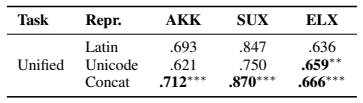
Table 5 : POS classification (F1-macro, n-gram LR). Significance markers are paired-bootstrapp-values comparing Concat against the better of Latin and Uni- code within each column: ∗∗∗p <0.01; ∗∗p <0.02. Concatenation wins across all three languages. Sepa- rated grammatical-vs-entity results in Appendix A.2.
出典 · CC BY 4.0 · Chuanjun Zhou, Adam G Anderson · What Transfers Across Cuneiform? Script-Level Substrate and Language-Specific Regularities via Segmentation and Representation · 論文の図を引用 · 元のPDFの8ページ目から図の部分を抽出しています。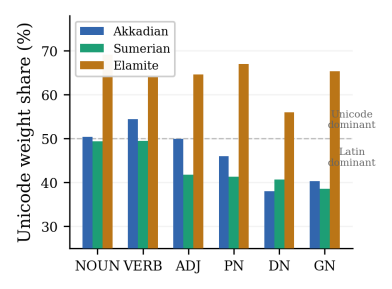
Figure 3 : Unicode feature weight share by POS cat- egory. Elamite is Unicode-dominant; Akkadian and Sumerian show balanced contributions for open-class words but Latin dominance for entities and closed-class items.
出典 · CC BY 4.0 · Chuanjun Zhou, Adam G Anderson · What Transfers Across Cuneiform? Script-Level Substrate and Language-Specific Regularities via Segmentation and Representation · 論文の図を引用 · 元のPDFの14ページ目から図の部分を抽出しています。Elamiteのコーパスと適用範囲
分割の基盤に関する主張は、評価に用いたORACC Neo-Assyrian、ETCSL文学Sumerian、Elamite辞書およびUtu-našuコーパスの範囲に限って読む必要があります。他の方言、ジャンル、歴史段階への一般化は、まだ答えの出ていない問いです。
論文情報
- 著者
- Chuanjun Zhou, Adam G Anderson
- 学会・ジャーナル
- arXiv · プレプリント
- 公開日
- 2026年11月14日
- 登録日
- 2026年11月17日
- 更新日
- 2026年11月14日
- バージョン
- v1
- arXiv
- 2611.19094
- DOI
- 10.18653/2026.emnlp-main.2169
- カテゴリ
- cs.CL
- ライセンス
- CC BY 4.0
- 掲載内容
- 論文情報・解説・論文の図
この解説は、Refivuの韓国語解説をAIで翻訳したものです。不正確な翻訳や誤りが含まれる可能性があります。論文と図の利用条件は各出典に従います。
アブストラクト
Cuneiform recorded typologically unrelated languages for more than three millennia, raising a natural question: which of its statistical regularities are properties of the shared writing system, and which belong to individual languages? We answer this with two probe pairs targeting the same script-versus-language decomposition. The first compares two unsupervised, dictionary-free segmentation methods: transitional probability (TP), grounded in infant statistical-learning research, and Morfessor. To our knowledge, this is the first systematic evaluation of dictionary-free segmentation on cuneiform; the only prior published baseline relies on a hand-built dictionary (Max-Match, F1 = 0.74). Both our methods reach F1 > 0.97 within language (Morfessor reaches F1 > 0.99 on Akkadian and Sumerian), exceeding MaxMatch by more than 23 F1 points, but diverge sharply in cross-language transfer: TP holds F1 > 0.95 across all six language pairs, while Morfessor collapses to F1 = 0.27 from the 13K-token Elamite source. A learning curve and a Hittite stress test (34.7% foreign-script logograms, where TP drops 35 points and Morfessor only 8) further isolate the two underlying mechanisms. The second probe pair extends the same decomposition to representations: concatenating Unicode and Latin features improves classification in 11 of 12 morphosyntactic tasks (p < 0.01). We release CUNEI-TOOLS and a three-language benchmark.
この論文を引用
Chuanjun Zhou, Adam G Anderson (2026). What Transfers Across Cuneiform? Script-Level Substrate and Language-Specific Regularities via Segmentation and Representation. arXiv:2611.19094v1. https://doi.org/10.18653/2026.emnlp-main.2169
BibTeX
@article{zhou2026what,
  title = {{What Transfers Across Cuneiform? Script-Level Substrate and Language-Specific Regularities via Segmentation and Representation}},
  author = {Chuanjun Zhou and Adam G Anderson},
  year = {2026},
  eprint = {2611.19094},
  archivePrefix = {arXiv},
  doi = {10.18653/2026.emnlp-main.2169},
  url = {https://arxiv.org/abs/2611.19094v1}
}