논문 해설
Planning with Learned Entity Prompts for Abstractive Summarization
학습된 개체 프롬프트를 활용한 추상적 요약 계획
- 연구 문제 추상적 요약은 입력에 없는 내용을 만드는 환각 문제가 있고, 신경 요약은 내용 계획이 약합니다. 이 논문은 엔티티 체인을 중간 계획으로 붙여 학습하는 FROST를 제안합니다.
- 연구 방법 FROST는 참조 요약 앞에 엔티티 체인을 붙여 엔티티 계획과 요약을 한 디코더로 순서대로 생성하도록 학습합니다. 추론 시 예측된 엔티티 계획을 수정해 환각을 줄이는 드롭 프롬프트를 사용합니다.
- 주요 결과 FROST(ECPP)는 XSum에서 최고 ROUGE를 보고하고 엔티티 계획 지표를 개선합니다. 드롭 프롬프트와 데이터 필터링은 faithfulness를 높이지만 필터링된 데이터 설정에서는 드롭 프롬프트의 효과가 제한적입니다.
요약 생성의 근거 부족 문제
추상적 요약(abstractive summarization)은 입력 문서에 없는 내용을 만들어내는 환각(hallucination) 문제를 자주 보입니다. 기존 신경 요약 모델은 Transformer 기반 seq2seq 구조와 어텐션으로 입력과 요약을 정렬하지만, 전통적 요약 방식이 가졌던 내용 계획(content planning)과 근거 있는 생성은 신경 요약에서 충분히 이루어지지 않았습니다. 이 논문은 요약 앞에 엔티티 체인(entity chain), 즉 요약에 등장하는 엔티티를 순서대로 나열한 중간 계획을 두어 이 간극을 다룹니다. 여기서 엔티티는 고유명사, 날짜, 숫자를 넓게 포함합니다.
엔티티 체인을 붙여 학습하는 FROST 목적함수
FROST는 참조 요약 앞에 엔티티 체인을 [ENTITYCHAIN] 표지와 함께 붙인 증강 목표(c; s)를 만들고, 같은 디코더가 엔티티 체인 c를 먼저 생성한 뒤 요약 s를 이어서 생성하도록 표준 최대우도 목적으로 학습합니다. 입력 문서 d는 인코더가 받으며, 학습 목표는 p(c|d)와 p(s|c,d)를 따로 모델링하지 않고 연결된 시퀀스를 한 번에 생성하는 방식입니다. 엔티티 체인은 학습 때 참조 요약에서 추출되므로, 모델은 생성된 요약이 그 계획에 근거하도록 학습됩니다. 저자들은 엔티티 계획을 먼저 예측하면 엔티티 수준의 어휘적 응집성(lexical cohesion)과 일관성을 학습하게 되어, 엔티티 특이성과 엔티티 순서가 개선될 것이라고 가설을 세웁니다.
이 가설은 저자의 동기이며, 실험 결과는 아래 검증 절에서 다룹니다.
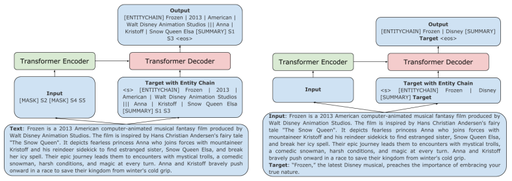
Figure 1 : Pretraining and finetuning for abstractive summarization with entity chains.
원문 · CC BY 4.0 · Shashi Narayan, Yao Zhao, Joshua Maynez, Gonçalo Simoes, Vitaly Nikolaev, Ryan McDonald · Planning with Learned Entity Prompts for Abstractive Summarization · 원문 그림 인용 · 원본 PDF 2쪽에서 그림 영역을 추출했습니다.PEGASUS 기반 pre-training과 요약 수준 계획
pre-training 단계에서는 PEGASUS의 gap-sentence 방식을 변형합니다. 입력 문서에서 자기 ROUGE로 중요한 문장을 최대 n개 선택해 가상의 요약으로 삼고, 선택한 문장 앞에 그 문장의 엔티티 체인을 붙여 나머지 문서로부터 생성하도록 학습합니다. 실험 설정에서 n은 5로 고정되었습니다. 요약 단위 계획과 문장 단위 계획을 비교한 결과, 저자들은 전체 요약의 엔티티 체인을 먼저 생성하는 요약 수준 계획이 CNN/DailyMail의 RL-Sum, R2-EPlan, ENTF1에서 문장 수준 계획보다 우수하다고 보고합니다. 이 비교는 CNN/DailyMail 검증 세트와 large 모델의 fine-tuning 설정에 한정됩니다.
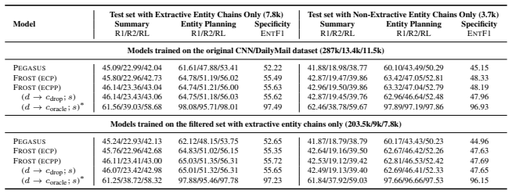
Table 9 : Detailed results for ablations on sentence-level vs summary-level entity chains in Figure 3. We report results on CNN/DailyMail validation set.
원문 · CC BY 4.0 · Shashi Narayan, Yao Zhao, Joshua Maynez, Gonçalo Simoes, Vitaly Nikolaev, Ryan McDonald · Planning with Learned Entity Prompts for Abstractive Summarization · 원문 그림 인용 · 원본 PDF 18쪽에서 그림 영역을 추출했습니다.모델 구성과 데이터셋
실험은 base 모델(L=12, H=768, F=3072, A=12, 223M 파라미터)과 large 모델(L=16, H=1024, F=4096, A=16, 568M 파라미터)을 사용합니다. pre-training은 C4와 HugeNews 코퍼스를 쓰며, fine-tuning은 CNN/DailyMail, XSum, SAMSum, BillSum에서 수행됩니다. 엔티티는 CoNLL-2003으로 학습한 BERT 기반 태거와 정규표현식으로 추출합니다. pre-training 데이터는 전체 문서에 엔티티를 주석하지만, fine-tuning 데이터는 참조 요약에만 주석합니다. 최적화에는 Adafactor를 사용하며 설정표는 부록 Table 6과 Table 7에 제시됩니다.
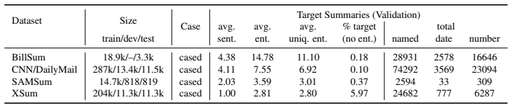
Table 1 : Abstractive summarization datasets studied in this work. We report on their train/validation/test sizes and how they were processed (cased/uncased). To better understand the effect of summary planning with entity chains, we report on average number of sentences (avg. sent.), average number of entities (avg. ent.) and average number of unique entities (avg. uniq. ent.), per target in validation sets. We also report on total number of named entities, date and number in target summaries.
원문 · CC BY 4.0 · Shashi Narayan, Yao Zhao, Joshua Maynez, Gonçalo Simoes, Vitaly Nikolaev, Ryan McDonald · Planning with Learned Entity Prompts for Abstractive Summarization · 원문 그림 인용 · 원본 PDF 5쪽에서 그림 영역을 추출했습니다.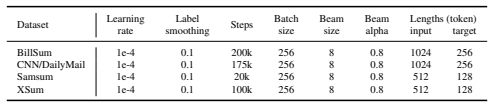
Table 7 : Hyperparameters used for finetuning PEGASUS and FROST models on summarization datasets.
원문 · CC BY 4.0 · Shashi Narayan, Yao Zhao, Joshua Maynez, Gonçalo Simoes, Vitaly Nikolaev, Ryan McDonald · Planning with Learned Entity Prompts for Abstractive Summarization · 원문 그림 인용 · 원본 PDF 16쪽에서 그림 영역을 추출했습니다.요약 성능과 엔티티 계획의 비교
CNN/DailyMail, XSum, SAMSum, BillSum의 테스트 세트에서 FROST(ECPP)는 pre-training과 fine-tuning을 모두 FROST 목적으로 수행한 설정입니다. XSum에서 FROST(ECPP)는 47.80/25.06/39.76의 ROUGE 점수를 보고하며, 저자들은 이를 XSum의 최고 ROUGE 결과로 제시합니다. CNN/DailyMail에서는 FROST(ECPP)가 45.11/22.11/42.01을 기록하지만, CTRLsum의 45.65/22.35/42.50보다 낮습니다. 엔티티 계획 지표와 ENTF1은 여러 데이터셋에서 PEGASUS(ours)보다 개선되었다고 보고되며, 이 개선은 같은 실험 표 안에서 측정된 값에 근거합니다.
이 결과는 ROUGE와 엔티티 지표를 함께 읽어야 하며, 요약 품질 전반을 하나의 점수로 대신하지 않습니다.
드롭 프롬프트와 데이터 필터링으로 환각 줄이기
환각 제어는 두 방식으로 이루어집니다. 첫째, 데이터 필터링은 참조 요약의 엔티티 체인이 모두 입력 문서에 있는 예제만 남겨 XSum 학습 세트를 62.7k로 줄입니다. 둘째, 드롭 프롬프트는 FROST(ECPP)가 예측한 엔티티 체인에서 입력 문서에 없는 엔티티를 제거한 뒤 그 수정된 계획으로 디코더를 프롬프트하여 요약을 다시 생성합니다. 저자들은 드롭 프롬프트가 전체 데이터로 학습한 모델에서 특히 효과적이라고 보고하며, 추출 가능한 엔티티 체인 테스트 세트의 ENTPREC을 높인다고 보고합니다. 반면 이미 필터링된 데이터로 학습한 모델에는 드롭 프롬프트가 faithfulness를 개선하지 않는다고 보고합니다.
이 결과는 필터링된 학습 세트의 설정에서 얻은 것입니다.
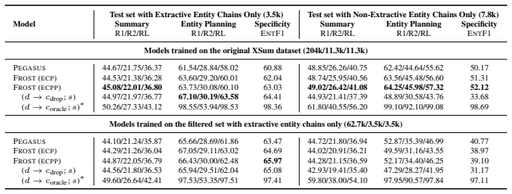
Table 3 : Performance on XSum summaries when models are trained on the dataset with extractive entity chains only (data filtering, the bottom block) and when novel entities are dropped from the predicted entity chains using the drop-prompt mechanism (cdrop). Results with ∗ are with oracle entity chain prompts. We report results on the filtered test set with extractive entity chains only (3.5k) and the rest of the test set with novel entities in the targets (7.8k). Best results are bold faced.
원문 · CC BY 4.0 · Shashi Narayan, Yao Zhao, Joshua Maynez, Gonçalo Simoes, Vitaly Nikolaev, Ryan McDonald · Planning with Learned Entity Prompts for Abstractive Summarization · 원문 그림 인용 · 원본 PDF 9쪽에서 그림 영역을 추출했습니다.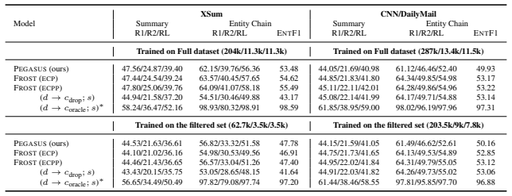
Table 12 : Results on the full test sets. Controlling hallucinations by training models on the dataset with extractive entity chains only (the bottom block) and by modifying the predicted entity chains to keep only the supported entities (cdrop). Results with ∗ are with oracle entity chain prompts. All the results are reported on the full test sets.
원문 · CC BY 4.0 · Shashi Narayan, Yao Zhao, Joshua Maynez, Gonçalo Simoes, Vitaly Nikolaev, Ryan McDonald · Planning with Learned Entity Prompts for Abstractive Summarization · 원문 그림 인용 · 원본 PDF 19쪽에서 그림 영역을 추출했습니다.Faithfulness 평가와 그 해석 범위
Faithfulness는 자동 지표인 Entailment와 ENTPREC, 그리고 사람 평가로 측정되었습니다. ENTPREC은 예측 요약의 엔티티가 입력 문서에 있는 비율을 나타내며, Entailment는 요약이 문서를 함의하는 확률입니다. 데이터 필터링과 드롭 프롬프트를 함께 쓴 설정에서 추출 가능한 테스트 세트의 ENTPREC은 0.943, 사람 평가 faithfulness는 4.41로 보고됩니다. 다만 저자들은 필터링된 데이터에서 Entailment 점수가 faithfulness 향상과 항상 일치하지 않아 Entailment가 이 설정에서 신뢰할 수 있는 지표가 아니라고 해석합니다. 이 해석은 저자의 관찰이며 모든 데이터셋으로 일반화된 결론이 아닙니다.
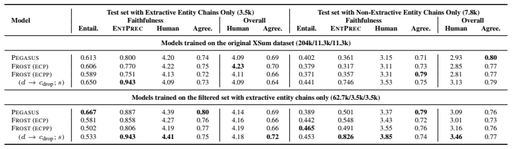
Table 4 : Faithfulness assessment using automatic (Entailment and E NTPREC) and human evaluations, and over- all quality assessment by humans for models presented in Table 3. Following Durmus et al. (2020), agreement (Agree.) is computed by taking the percentage of the annotators that annotate the majority class for the given (document, summary) pair. Best results are bold faced.
원문 · CC BY 4.0 · Shashi Narayan, Yao Zhao, Joshua Maynez, Gonçalo Simoes, Vitaly Nikolaev, Ryan McDonald · Planning with Learned Entity Prompts for Abstractive Summarization · 원문 그림 인용 · 원본 PDF 10쪽에서 그림 영역을 추출했습니다.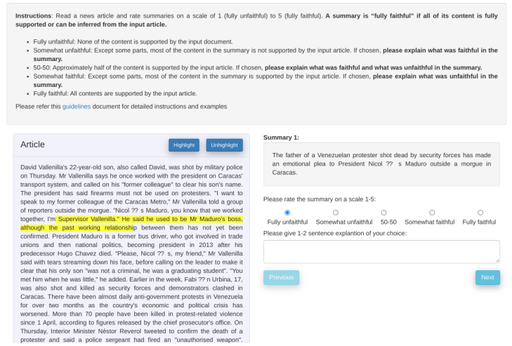
Figure 8 : Instructions for human evaluations for faithfulness.
원문 · CC BY 4.0 · Shashi Narayan, Yao Zhao, Joshua Maynez, Gonçalo Simoes, Vitaly Nikolaev, Ryan McDonald · Planning with Learned Entity Prompts for Abstractive Summarization · 원문 그림 인용 · 원본 PDF 16쪽에서 그림 영역을 추출했습니다.한계와 적용 범위
FROST의 계획 목적은 그 자체로 faithfulness를 보장하지 않습니다. 계획이 참조 요약의 엔티티에서 추출되므로 참조 요약에 노이즈가 있으면 예측 계획도 노이즈를 가질 수 있습니다. 또한 드롭 프롬프트는 전체 데이터로 학습한 모델에서 효과가 있었지만, 필터링된 데이터로 학습한 모델에서는 향상이 보고되지 않았습니다. 본 논문의 CNN/DailyMail 결과에서 CTRLsum과 GSum은 ROUGE 점수가 더 높습니다. 저자들은 CTRLsum과 GSum이 CNN/DailyMail에서 약간 더 나은 성능을 보이는 반면, 제안 방법은 학습 목표만 바꾸고 추가 파라미터를 쓰지 않는다는 점을 장점으로 봅니다.
논문 정보
- 저자
- Shashi Narayan, Yao Zhao, Joshua Maynez, Gonçalo Simoes, Vitaly Nikolaev, Ryan McDonald
- 학회·저널
- arXiv · 프리프린트
- 최초 공개일
- 2021년 4월 15일
- 등록일
- 2026년 11월 6일
- 수정일
- 2021년 9월 5일
- 버전
- v2
- arXiv
- 2104.07606
- 분류
- cs.CL
- 원문 이용 조건
- CC BY 4.0
- 제공 범위
- 논문 정보, 해설, 허용된 원문 그림
AI 해설은 논문 원문과 별개의 설명이며 오류가 있을 수 있습니다. 원문과 그림은 각 출처의 이용 조건과 따로 표시된 권리를 따릅니다.
초록
We introduce a simple but flexible mechanism to learn an intermediate plan to ground the generation of abstractive summaries. Specifically, we prepend (or prompt) target summaries with entity chains -- ordered sequences of entities mentioned in the summary. Transformer-based sequence-to-sequence models are then trained to generate the entity chain and then continue generating the summary conditioned on the entity chain and the input. We experimented with both pretraining and finetuning with this content planning objective. When evaluated on CNN/DailyMail, XSum, SAMSum and BillSum, we demonstrate empirically that the grounded generation with the planning objective improves entity specificity and planning in summaries for all datasets, and achieves state-of-the-art performance on XSum and SAMSum in terms of Rouge. Moreover, we demonstrate empirically that planning with entity chains provides a mechanism to control hallucinations in abstractive summaries. By prompting the decoder with a modified content plan that drops hallucinated entities, we outperform state-of-the-art approaches for faithfulness when evaluated automatically and by humans.
원문 인용
Shashi Narayan, Yao Zhao, Joshua Maynez, Gonçalo Simoes, Vitaly Nikolaev, Ryan McDonald (2021). Planning with Learned Entity Prompts for Abstractive Summarization. arXiv:2104.07606v2. https://arxiv.org/abs/2104.07606v2
BibTeX
@misc{narayan2021planning,
  title = {{Planning with Learned Entity Prompts for Abstractive Summarization}},
  author = {Shashi Narayan and Yao Zhao and Joshua Maynez and Gonçalo Simoes and Vitaly Nikolaev and Ryan McDonald},
  year = {2021},
  eprint = {2104.07606},
  archivePrefix = {arXiv},
  url = {https://arxiv.org/abs/2104.07606v2}
}