논문 해설
Feature Learning beyond the Lazy-Rich Dichotomy: Insights from Representational Geometry
lazy regime과 풍부 학습의 이분법을 넘어서: 표현 기하학을 통한 특징 학습 통찰
- 연구 문제 신경망 학습을 lazy regime과 rich regime의 이분법으로만 보면 학습 알고리즘, 구조, 데이터에 따른 특징 학습의 차이를 놓칩니다.
- 연구 방법 과제 관련 매니폴드를 평균장 매니폴드 용량과 유효 기하 측도로 분석하여 특징 학습의 풍부함과 단계, 전략을 구분합니다.
- 주요 결과 2층 신경망과 VGG-11 실험에서 매니폴드 용량은 학습 규모 계수에 따른 특징 학습 정도를 추적했습니다. 한 번의 경사 하강 단계에 대한 이론에서도 용량은 학습률에 따라 단조적으로 변합니다.
학습 영역 이분법을 넘는 질문
신경망 학습은 흔히 lazy regime과 rich regime으로 나뉩니다. lazy regime에서는 신경망이 무작위 특징 모델처럼 동작하고, rich regime에서는 과제에 필요한 특징을 능동적으로 학습합니다. 기존 방법은 가중치 변화, 활성화된 뉴런, 신경 접선 커널(NTK)과 선형화 모델의 차이 같은 지표로 이 구분을 확인해 왔습니다. 그러나 원문은 특징 학습이 이 이분법보다 훨씬 다양하며, 학습 알고리즘·구조·데이터 특성에 따라 서로 다른 귀납 편향이 생긴다고 지적합니다. 또한 신경과학에서는 시냅스 가중치 변화를 정밀하게 추적하기 어려워 가중치보다 신경 표현에 기반한 틀이 필요합니다.
이 논문은 과제 관련 매니폴드의 기하 구조를 통해 특징 학습을 살펴보는 틀을 제안합니다.
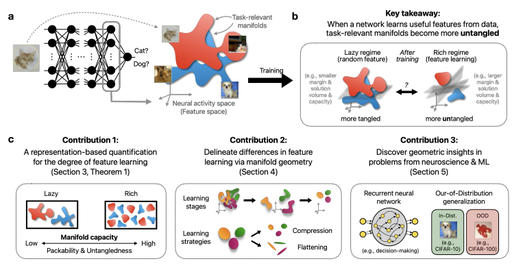
Figure 1 : Schematic illustration. a, We propose to investigate feature learning via the geometry of task-relevant manifolds. Here task-relevant manifolds refer to the collection of activity patterns (of a certain layer) to the same task condition (e.g., the same label class). b, Specifically, we found that the degree of manifold untangling (quantified by manifold capacity, Definition 2.1 and Defi- nition B.3) tracks the degree of richness in feature learning. c, Three main contributions of this paper. More details in the corresponding section.
원문 · CC BY 4.0 · Chi-Ning Chou, Hang Le, Yichen Wang, SueYeon Chung · Feature Learning beyond the Lazy-Rich Dichotomy: Insights from Representational Geometry · 원문 그림 인용 · 원본 PDF 2쪽에서 그림 영역을 추출했습니다.매니폴드 용량과 기하 측도
이 논문은 과제 관련 매니폴드를 같은 과제 조건(예: 같은 클래스)에 속한 활동 패턴의 점 구름으로 봅니다. 각 클래스 매니폴드는 그 클래스 입력의 표현을 감싸는 볼록 껍질로 정의됩니다. 매니폴드 용량은 이 매니폴드들을 무작위 투영과 무작위 이분법으로 선형 분리할 수 있는지를 평균 사례로 측정하며, 값이 클수록 매니폴드가 더 잘 패킹되어 분리 가능합니다. 시뮬레이션 기반 용량은 확률 추정과 이진 탐색이 필요해 계산 비용이 큽니다. 그래서 원문은 평균장 버전의 용량 αM을 사용하며, 이를 이차 계획법과 앵커 점으로 추정합니다. 앵커 점은 무작위 투영과 이분법에 대응하는 서포트 벡터 역할을 하고, 이를 중심 부분과 축 부분으로 분해하면 매니폴드 차원 DM, 반지름 RM, 중심 정렬 ρcM, 축 정렬 ρaM, 중심-축 정렬 ψM 같은 유효 기하 측도가 얻어집니다.
원문은 근사적으로 αM ≈ (1 + R_M^{-2}) / D_M 관계가 있다고 보고합니다.
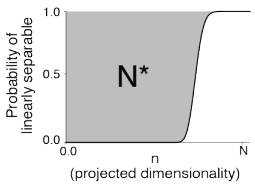
Figure 2 : Simulated capacity.
원문 · CC BY 4.0 · Chi-Ning Chou, Hang Le, Yichen Wang, SueYeon Chung · Feature Learning beyond the Lazy-Rich Dichotomy: Insights from Representational Geometry · 원문 그림 인용 · 원본 PDF 5쪽에서 그림 영역을 추출했습니다.
Figure 9 : Effective manifold dimension tracks the ground truth dimension of uncorrelated isotropic Gaussian clouds. Note that the higher the dimension, the smaller capacity, as discussed in
원문 · CC BY 4.0 · Chi-Ning Chou, Hang Le, Yichen Wang, SueYeon Chung · Feature Learning beyond the Lazy-Rich Dichotomy: Insights from Representational Geometry · 원문 그림 인용 · 원본 PDF 28쪽에서 그림 영역을 추출했습니다.
Figure 10 : Effective manifold radius tracks the ground truth radius of uncorrelated isotropic Gaus- sian clouds. Note that the higher the radius, the smaller capacity, as discussed in
원문 · CC BY 4.0 · Chi-Ning Chou, Hang Le, Yichen Wang, SueYeon Chung · Feature Learning beyond the Lazy-Rich Dichotomy: Insights from Representational Geometry · 원문 그림 인용 · 원본 PDF 28쪽에서 그림 영역을 추출했습니다.
Figure 11 : Effective manifold center alignment tracks the ground truth center correlations of isotropic Gaussian clouds. Note that the higher the center alignment, the smaller capacity, as discussed in
원문 · CC BY 4.0 · Chi-Ning Chou, Hang Le, Yichen Wang, SueYeon Chung · Feature Learning beyond the Lazy-Rich Dichotomy: Insights from Representational Geometry · 원문 그림 인용 · 원본 PDF 28쪽에서 그림 영역을 추출했습니다.
Figure 12 : Effective manifold axis alignment tracks the ground truth axis correlations of isotropic Gaussian clouds. Note that the higher the axis alignment, the higher capacity, as discussed in Fig- ure 3c. Also, in the large axis correlations regime, the effective dimension decreases.
원문 · CC BY 4.0 · Chi-Ning Chou, Hang Le, Yichen Wang, SueYeon Chung · Feature Learning beyond the Lazy-Rich Dichotomy: Insights from Representational Geometry · 원문 그림 인용 · 원본 PDF 30쪽에서 그림 영역을 추출했습니다.용량이 풍부함의 정도를 추적하는지 확인
논문은 먼저 2층 비선형 신경망과 CIFAR-10에서 학습한 VGG-11, ResNet-18을 대상으로, 역규모 계수 ¯η로 lazy regime과 rich regime을 보간하여 실험합니다. 2층 신경망은 무작위 가우시안 점 구름을 분류하도록 학습되며, 분석은 마지막 층의 테스트 표현에서 수행됩니다. 원문은 이 설정에서 학습이 풍부할수록 매니폴드가 더 잘 풀리고 용량이 특징 학습 정도를 추적한다고 보고합니다. 가중치 변화, 정확도, NTK-레이블 정렬, 표현-레이블 정렬 같은 기존 지표와 비교하면, 2층 신경망 실험에서 매니폴드 용량이 규모 계수의 차이를 더 잘 구분했다고 보고합니다. 또한 초기화 단계에서 입력 차원을 달리했을 때에도 용량이 초기 특징의 풍부함 차이를 구분했다고 원문은 말합니다.
이 비교는 저자가 선택한 합성 설정과 조건에 한정된 관찰입니다.
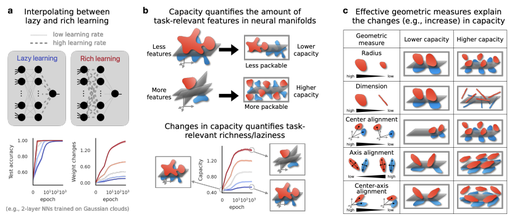
Figure 3 : Our methods. a, Top: We adopt the method from (Chizat et al., 2019) which interpolates lazy and rich learning via adjusting a scale factor of learning rate. Bottom: Test accuracy increases during both lazy and rich training, however, the network’s weights would not change much during lazy training. b, Top: Higher capacity means that the neural representational space can pack more manifolds (Definition 2.1). Bottom: We propose to use changes of capacity across training to study task-relevant richness/laziness in feature learning (Section 3). Top: we consider the setting in (Chizat et al., 2019) where VGG-11 was trained on CIfAR-10. An inverse scale factor was introduced to interpolate between lazy and rich training, where smaller value (blue) corresponds to lazier learning and larger value corresponds to richer learning (red). Bottom: we show that the changes in capacity faithfully tracks the degree of richness in feature learning.c, Effective geometric measures drive the capacity value, providing mechanistic descriptors to study representational changes in feature learning. Center-axis alignment has a more complex relationship with capacity, discussed Section B.4.
원문 · CC BY 4.0 · Chi-Ning Chou, Hang Le, Yichen Wang, SueYeon Chung · Feature Learning beyond the Lazy-Rich Dichotomy: Insights from Representational Geometry · 원문 그림 인용 · 원본 PDF 7쪽에서 그림 영역을 추출했습니다.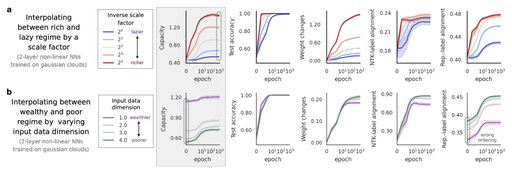
Figure 4 : Capacity as a measure for the degree of feature learning. See Section D.1 for the ex- perimental setup. a, We interpolated between lazy and rich regime in 2-layer NNs trained to classify Gaussian clouds. We found that capacity could tell the difference between the underly- ing scale parameter better than the other conventional methods. b, We fixed a scale parameter and initialized the input Gaussian clouds with different dimensions (the higher the poorer the ini- tial representations are for each class). We found that capacity could tell the difference in the amount of tasks-relevant features at initialization than other conventional methods. Specifically, the representation-label alignment would characterize the wrong ordering of wealthiness in initial features.
원문 · CC BY 4.0 · Chi-Ning Chou, Hang Le, Yichen Wang, SueYeon Chung · Feature Learning beyond the Lazy-Rich Dichotomy: Insights from Representational Geometry · 원문 그림 인용 · 원본 PDF 8쪽에서 그림 영역을 추출했습니다.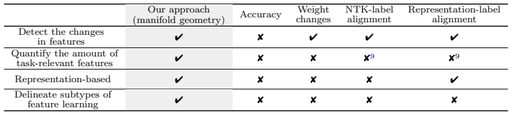
Table 1 : Comparison with conventional measures used in lazy versus rich learning.
원문 · CC BY 4.0 · Chi-Ning Chou, Hang Le, Yichen Wang, SueYeon Chung · Feature Learning beyond the Lazy-Rich Dichotomy: Insights from Representational Geometry · 원문 그림 인용 · 원본 PDF 10쪽에서 그림 영역을 추출했습니다.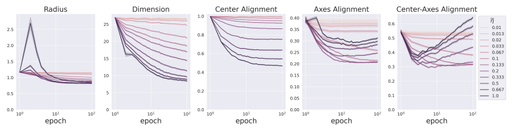
Figure 14 : Manifold capacity and geometry for VGG-11 models trained with different η
원문 · CC BY 4.0 · Chi-Ning Chou, Hang Le, Yichen Wang, SueYeon Chung · Feature Learning beyond the Lazy-Rich Dichotomy: Insights from Representational Geometry · 원문 그림 인용 · 원본 PDF 47쪽에서 그림 영역을 추출했습니다.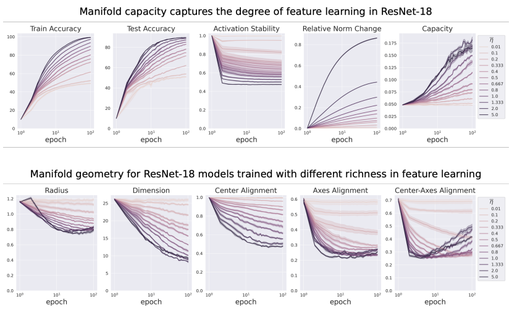
Figure 15 : Manifold capacity and geometry of ResNet-18 models trained with different scale factor.
원문 · CC BY 4.0 · Chi-Ning Chou, Hang Le, Yichen Wang, SueYeon Chung · Feature Learning beyond the Lazy-Rich Dichotomy: Insights from Representational Geometry · 원문 그림 인용 · 원본 PDF 47쪽에서 그림 영역을 추출했습니다.한 번의 경사 하강 단계에 대한 이론 결과
이론 분석은 2층 완전연결 신경망 f(x) = (1/√N) a⊤σ(W⊤x)를 대상으로 합니다. 은닉 가중치 W는 무작위로 초기화된 뒤 제곱 손실 경사 하강으로 한 번 갱신되고, 읽기 가중치 a는 고정됩니다. 입력과 레이블은 숨겨진 방향 β*와 연결된 교사-학생 설정에서 생성됩니다. 원문은 비례 점근 극한(학습 샘플 수, 입력 차원, 은닉 뉴런 수가 같은 비율로 무한대로 감)에서 한 번의 경사 하강 갱신이 랭크-1 행렬로 근사되며, 학습률 η가 과제 관련 정보의 양을 재는 기준이 된다고 설명합니다. 정리 3.1은 매니폴드 용량 α가 η에 따라 단조적으로 변하고, 예측 정확도와 증가하는 가역 함수로 연결된다고 제시합니다.
원문은 이 결과가 회귀에서 분류로의 확장이며 가우시안 등가 모델의 증명 도구가 필요하다고 밝힙니다. 따라서 이 결과는 한 번의 경사 하강 단계와 그 점근 조건에 한정됩니다.
신경 회로 편향과 분포 외 일반화로의 확장
논문은 같은 틀을 두 응용에 적용합니다. 첫째, 표준 신경과학 과제 perceptual decision making에서 순환 신경망(RNN)의 초기 가중치 랭크를 특이값 분해로 조절해 학습을 비교합니다. 원문에 따르면 최종 에폭의 매니폴드 용량은 초기 랭크가 달라도 비슷하지만, 초기 용량 차이가 학습 동역학을 구분하고 기하 구조는 크게 다릅니다. 작은 초기 랭크에서는 반지름이 크고 차원이 작은 방향으로, 큰 초기 랭크에서는 반대 방향으로 조직됩니다. 둘째, CIFAR-10에서 학습한 모델의 마지막 층 표현 위에 CIFAR-100 선형 탐침을 학습하여 분포 외 일반화를 평가합니다. 초고풍부 학습 영역(¯η 약 1.0)에서 CIFAR-100 정확도가 급격히 떨어지며, 이는 매니폴드 반지름 확장과 중심-축 정렬 증가로 설명된다고 보고합니다.
ResNet-18에서는 실패가 반지름보다 차원 증가와 더 관련된다고 원문은 밝힙니다.
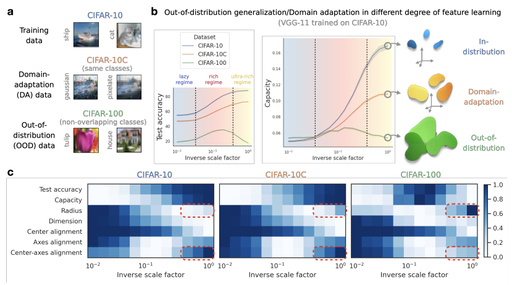
Figure 7 : Out of distribution generalization. a, CIfAR-10c as a domain adaptation (DA) dataset and CIfAR-100 as an OOD dataset. b, Test accuracy improves for CIfAR-10 and CIfAR-10C as the training becomes richer and richer while the linear probe accuracy for CIfAR-100 would drastically drop in the ultra-rich training regime. c, Effective manifold geometry of CIfAR-100 reveals that the expansion of manifold radius and the increase of center-axis alignment explain the failure of OOD generalization in the ultra-rich regime. The color is normalized for each row respectively.
원문 · CC BY 4.0 · Chi-Ning Chou, Hang Le, Yichen Wang, SueYeon Chung · Feature Learning beyond the Lazy-Rich Dichotomy: Insights from Representational Geometry · 원문 그림 인용 · 원본 PDF 13쪽에서 그림 영역을 추출했습니다.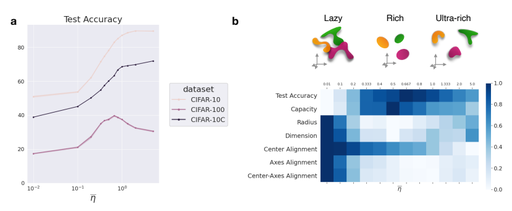
Figure 17 : OOD performance and effective geometric measure of ResNet-18 models trained with different scale factor.
원문 · CC BY 4.0 · Chi-Ning Chou, Hang Le, Yichen Wang, SueYeon Chung · Feature Learning beyond the Lazy-Rich Dichotomy: Insights from Representational Geometry · 원문 그림 인용 · 원본 PDF 49쪽에서 그림 영역을 추출했습니다.계산 비용과 이론 적용 범위
저자들은 시뮬레이션 기반 매니폴드 용량이 확률 추정과 이진 탐색에 의존해 계산 비용이 크고 하이퍼파라미터 선택이 필요하다고 밝힙니다. 그래서 본문은 평균장 정의와 이차 계획법 기반 추정을 사용합니다. 이론 결과는 한 번의 경사 하강 단계만 다루며, 여러 단계에서는 가우시안 등가성 단계가 성립하지 않을 수 있다고 원문이 밝힙니다. 실험은 주로 특정 모델(2층 신경망, VGG-11, ResNet-18, RNN)과 특정 데이터셋(합성 점 구름, CIFAR-10, CIFAR-100, CIFAR-10C)에서 수행되었으므로, 다른 아키텍처와 과제로의 일반화는 원문이 확인한 범위를 넘습니다.
논문 정보
- 저자
- Chi-Ning Chou, Hang Le, Yichen Wang, SueYeon Chung
- 학회·저널
- arXiv · 프리프린트
- 최초 공개일
- 2025년 3월 23일
- 등록일
- 2026년 10월 31일
- 수정일
- 2025년 7월 11일
- 버전
- v2
- arXiv
- 2503.18114
- 분류
- cs.LG · cs.NE · q-bio.NC
- 원문 이용 조건
- CC BY 4.0
- 제공 범위
- 논문 정보, 해설, 허용된 원문 그림
AI 해설은 논문 원문과 별개의 설명이며 오류가 있을 수 있습니다. 원문과 그림은 각 출처의 이용 조건과 따로 표시된 권리를 따릅니다.
초록
Integrating task-relevant information into neural representations is a fundamental ability of both biological and artificial intelligence systems. Recent theories have categorized learning into two regimes: the rich regime, where neural networks actively learn task-relevant features, and the lazy regime, where networks behave like random feature models. Yet this simple lazy-rich dichotomy overlooks a diverse underlying taxonomy of feature learning, shaped by differences in learning algorithms, network architectures, and data properties. To address this gap, we introduce an analysis framework to study feature learning via the geometry of neural representations. Rather than inspecting individual learned features, we characterize how task-relevant representational manifolds evolve throughout the learning process. We show, in both theoretical and empirical settings, that as networks learn features, task-relevant manifolds untangle, with changes in manifold geometry revealing distinct learning stages and strategies beyond the lazy-rich dichotomy. This framework provides novel insights into feature learning across neuroscience and machine learning, shedding light on structural inductive biases in neural circuits and the mechanisms underlying out-of-distribution generalization.
원문 인용
Chi-Ning Chou, Hang Le, Yichen Wang, SueYeon Chung (2025). Feature Learning beyond the Lazy-Rich Dichotomy: Insights from Representational Geometry. arXiv:2503.18114v2. https://arxiv.org/abs/2503.18114v2
BibTeX
@misc{chou2025feature,
  title = {{Feature Learning beyond the Lazy-Rich Dichotomy: Insights from Representational Geometry}},
  author = {Chi-Ning Chou and Hang Le and Yichen Wang and SueYeon Chung},
  year = {2025},
  eprint = {2503.18114},
  archivePrefix = {arXiv},
  url = {https://arxiv.org/abs/2503.18114v2}
}