논문 해설
StereoSpike: Depth Learning with a Spiking Neural Network
StereoSpike: 스파이킹 신경망을 이용한 깊이 학습
- 연구 문제 이벤트 카메라 스테레오 입력으로 픽셀별 깊이를 완전 스파이킹 신경망이 회귀할 수 있는지를 다룹니다.
- 연구 방법 좌우 이벤트를 50 ms 스파이크 히스토그램으로 바꾸고, 무상태 McCulloch-Pitts 뉴런을 쓰는 스파이킹 U-Net 유사 구조를 대리 기울기로 학습합니다.
- 주요 결과 MVSEC 실내 split 1에서 Binocular 모델은 16.5 cm MDE를 보고하며, 동등 구조 ANN보다 테스트 오차가 낮고 스파이크 페널티로 발화율을 줄일 수 있습니다.
깊이 추정 문제와 SNN의 한계
깊이 추정은 자율주행의 내비게이션이나 로봇의 물체 조작에 쓰이는 중요한 비전 과제입니다. 이 논문은 이벤트 카메라 두 대의 스트림을 입력으로 받아 장면의 픽셀별 깊이를 직접 회귀하는 문제를 다룹니다. 이벤트 카메라는 로그 휘도 변화가 임계값에 도달할 때 스파이크를 내보내 희소한 출력을 만들며, 스파이킹 신경망(SNN)은 이 희소 출력과 잘 맞습니다. 그러나 기존 연구는 SNN을 대규모 회귀 과제에 완전히 적용한 사례가 드물었고, 기존 깊이 추정 모델의 다수는 조밀한 출력이나 높은 파라미터 수에 의존했습니다. 본 연구는 이 간극을 StereoSpike라는 완전 스파이킹 U-Net 유사 구조로 다룹니다.
StereoSpike의 입력 표현과 뉴런 모델
좌우 카메라의 스파이크는 50 ms 시간 창에서 픽셀별로 ON과 OFF 극성을 나누어 누적되며, 두 카메라 텐서는 채널 방향으로 연결되어 4채널 입력이 됩니다. 뉴런은 McCulloch and Pitts 모델을 사용합니다. 가중합이 임계값에 도달하면 Heaviside 계단 함수로 이진 스파이크를 내보내며, 매 시간 단계마다 막전위를 휴지값 V_reset으로 재설정하여 무상태로 동작합니다. 이 방식은 일반적인 IF 모델에서 막전위의 암묵적 순환을 제거한 형태입니다. Heaviside 함수의 기울기는 거의 모든 곳에서 0이므로, 학습에는 arctan 함수의 도함수를 대리 기울기로 사용합니다. 입력을 정규화하지 않고 원시 스파이크 수를 그대로 입력하는 것도 뉴로모픽 하드웨어에서 정수 스파이크를 유지하기 위한 선택으로 설명됩니다.
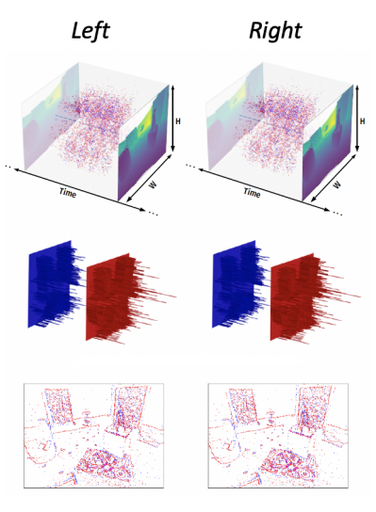
Figure 1 . (top): ON and OFF events are binned, per-pixel, within time windows of 50 ms. Frames displayed on the temporal axis are the ground-truth depth maps, provided by the LIDAR at 20 Hz. (middle): This operation results in a 2-channel histogram of spikes, containing integer spike counts at every pixel and for each polarity. (bottom): Such spike frames are commonly visualized according to the following convention: pixels reporting at least one ON event are colored in red, those reporting OFF events in blue, and those reporting both types in pink.
원문 · CC BY 4.0 · Ulysse Rançon, Javier Cuadrado-Anibarro, Benoit R. Cottereau, Timothée Masquelier · StereoSpike: Depth Learning with a Spiking Neural Network · 원문 그림 인용 · 원본 PDF 4쪽에서 그림 영역을 추출했습니다.스파이킹 U-Net 구조와 출력 방식
모델은 완전 합성곱 U-Net 유사 구조로, 인코더에서 2칸 간격 합성곱으로 해상도를 절반으로 줄이고 병목에서는 SEW 잔차 블록 두 개를 ADD 연결로 결합합니다. 디코더는 전치 합성곱 대신 최근접 이웃 업샘플링 뒤 합성곱을 사용합니다. 이는 체커보드 아티팩트를 피하고 정수 스파이크 수를 유지하기 위한 선택입니다. 출력은 여러 스케일의 중간 예측 층에서 나온 스파이크가 막전위를 바꾸는 출력 I-뉴런 풀에 모이는 방식입니다. 이 구조는 출력 뉴런에 들어가는 스파이크 수를 늘려 SNN의 표현력 부족을 줄이려는 설계입니다. 모든 합성곱은 7×7 커널의 분리형이며 편향과 배치 정규화를 사용하지 않습니다.
대리 기울기 학습과 손실 구성
학습 손실은 깊이 회귀 항 L_regression과 평활화 정규화 항 L_smooth를 λ = 0.5로 결합한 형태입니다. 이 손실은 4개의 예측 층 출력 모두에 적용됩니다. 학습은 SpikingJelly의 대리 기울기 방법으로 수행되며, 네트워크가 한 단계 추론만 하므로 BPTT가 아닌 일반 역전파를 사용합니다. 과적합을 줄이기 위해 무작위 수평 뒤집기와 time mirror 증강을 적용하며, time mirror는 시간 순서를 뒤집고 ON과 OFF 채널을 바꾸는 이 논문의 제안 기법입니다. 옵티마이저는 Adam이며 30 epoch 학습 중 학습률을 나누는 시점과 배치 크기 1은 실험 설정으로 보고됩니다.
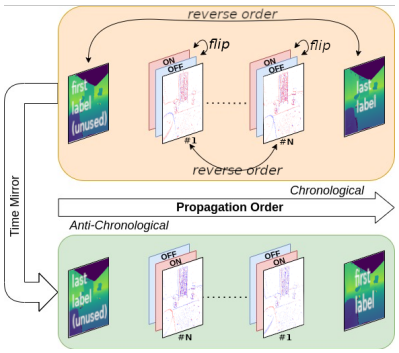
Figure 3 . ”Time Mirror” data augmentation technique. The events generated between the timestamps of two consecutive labels are cumulated into N ON-OFF frames of temporal duration T and concatenated channel-wise. In the case of this study, N = 1 and T = 50 ms. A sequence in anti-chronological order is a piece of data as valid as the original in chronological order. To reverse the order of a DVS sequence, event timestamps must be reversed –therefore translating into an inversion of the order of the histograms– but event polarities must be switched as well.
원문 · CC BY 4.0 · Ulysse Rançon, Javier Cuadrado-Anibarro, Benoit R. Cottereau, Timothée Masquelier · StereoSpike: Depth Learning with a Spiking Neural Network · 원문 그림 인용 · 원본 PDF 6쪽에서 그림 영역을 추출했습니다.MVSEC 실내와 야외 평가
실험은 MVSEC 데이터셋의 실내 flying 시퀀스와 야외 시퀀스에서 수행되었으며, 평가지표는 센티미터 단위의 Mean Depth Error(MDE)입니다. 실내 split 1의 테스트 MDE는 Binocular 모델에서 16.5 cm로 보고되며, 이는 DDES의 27.8 cm(무제한 cut-off 기준)보다 낮습니다. 다만 저자들은 DDES 등 비교 모델이 같은 조건으로 다시 학습된 것이 아님을 표의 수치 구성으로 보여 줍니다. 야외에서는 E2Depth보다 여러 cut-off 거리에서 낮은 MDE를 보이며, 파라미터 수는 25배 적게 보고됩니다. 단안 모델도 일관되게 E2Depth보다 낮은 오차를 보입니다.
이는 이 설정의 결과이며 다른 데이터셋이나 과제에서 같은 우위를 보장하지 않습니다.

Table 1 . Comparison of StereoSpike’s performances with the state-of-the-art. Our philosophy values solving the accuracy-deployability
원문 · CC BY 4.0 · Ulysse Rançon, Javier Cuadrado-Anibarro, Benoit R. Cottereau, Timothée Masquelier · StereoSpike: Depth Learning with a Spiking Neural Network · 원문 그림 인용 · 원본 PDF 7쪽에서 그림 영역을 추출했습니다.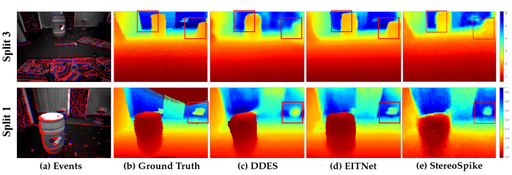
Figure 4 . Qualitative comparison of our method with other state-of-the-art approaches. We selected the same input frames and run our model to infer depth from this data; Event ground-truth and other prediction images were borrowed and adapted from [39] [1]. The top row corresponds to frame #1700 of indoor flying3 and frame #980 of indoor flying1 sequences. The pixelated aspect of our predictions comes from the Nearest-Neighbor interpolation in the prediction layer from very-low to full scale. Even so, it can be seen that our fully spiking network captures the scene just as well as a cutting edge ANN using a heavy framework and 3D convolutions. DTC-SPADE [44] is not represented here as the authors did not use the same colormap as other studies and did not publish their code. We tried but were still unable to faithfully reproduce their rendering. The above figure was obtained by using reversed JET colormap in the natural metric depth
원문 · CC BY 4.0 · Ulysse Rançon, Javier Cuadrado-Anibarro, Benoit R. Cottereau, Timothée Masquelier · StereoSpike: Depth Learning with a Spiking Neural Network · 원문 그림 인용 · 원본 PDF 7쪽에서 그림 영역을 추출했습니다.중간 예측 층과 skip connection 절제
중간 예측 층 절제에서는 1~4번 예측 층을 모두 사용한 모델이 MDE 16.5±0.3 cm로 가장 낮고, 층을 줄일수록 오차가 18.1, 19.3, 20.1 cm로 늘어납니다. 가장 낮은 층 하나만 사용한 모델은 고전적 인코더-디코더 구성에 해당합니다. skip connection을 제거하면 학습 손실은 낮아지지만 테스트 MDE는 16.5 cm에서 17.1 cm로 높아집니다. 따라서 이 결과는 skip connection이 이 설정에서 정규화 효과를 가진다는 해석을 뒷받침하지만, 제거 실험이 성능을 향상시켰다는 뜻은 아닙니다.
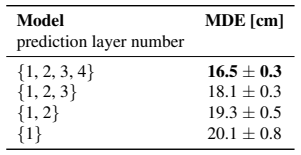
Table 2 . Test Mean Depth Error (MDE) on split 1 ofindoor flying sequence. Reported errors are averaged and provided with stan- dard deviations over three randomized training trials. Prediction layers are depicted by a number ∈ { 1, 2, 3, 4}, where 1 and 4 are the top- and bottom- level prediction layers, respectively.
원문 · CC BY 4.0 · Ulysse Rançon, Javier Cuadrado-Anibarro, Benoit R. Cottereau, Timothée Masquelier · StereoSpike: Depth Learning with a Spiking Neural Network · 원문 그림 인용 · 원본 PDF 8쪽에서 그림 영역을 추출했습니다.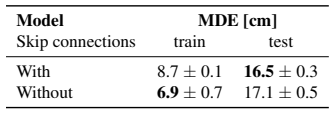
Table 3 . Test MDE on split 1 of indoor flying sequence. Entries are averaged over three randomized training trials.
원문 · CC BY 4.0 · Ulysse Rançon, Javier Cuadrado-Anibarro, Benoit R. Cottereau, Timothée Masquelier · StereoSpike: Depth Learning with a Spiking Neural Network · 원문 그림 인용 · 원본 PDF 8쪽에서 그림 영역을 추출했습니다.동등 구조 ANN과의 비교
동등 구조 ANN은 IF 노드를 Sigmoid, Tanh, LeakyReLU 같은 일반 활성화 함수로 바꾸고 최근접 이웃 업샘플링을 쌍선형 업샘플링으로 바꾸며 배치 정규화와 학습 가능한 편향을 추가한 모델입니다. 실내 split 1에서 SNN의 테스트 MDE 16.5 cm는 ANN들의 26.0~28.1 cm보다 낮지만, 학습 MDE는 SNN이 8.7 cm로 ANN의 6.9~8.2 cm보다 높습니다. 저자들은 이를 SNN의 이진 출력이 과적합을 억제하는 정규화 효과로 해석합니다. 이 해석은 본 설정의 관찰에 근거하며, 다른 정규화 기법과의 비교는 본 논문에서 수행되지 않았습니다.
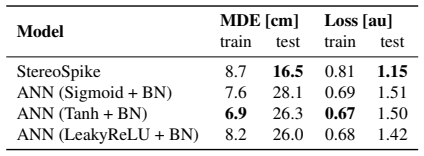
Table 4 . Comparative evaluation of our SNN vs equivalent ANN models on split 1 of indoor flying sequence. Entries are averaged over three randomized training trials. Our fully spiking network surpasses by a large margin all of its analog relatives.
원문 · CC BY 4.0 · Ulysse Rançon, Javier Cuadrado-Anibarro, Benoit R. Cottereau, Timothée Masquelier · StereoSpike: Depth Learning with a Spiking Neural Network · 원문 그림 인용 · 원본 PDF 8쪽에서 그림 영역을 추출했습니다.스파이크 페널티와 발화율
발화율을 낮추기 위해 저자들은 텐서의 평균 제곱 스파이크 값을 벌점으로 주는 Lspikes 항을 추가했습니다. 이 항은 병목과 skip connection 텐서에 적용되며, 페널티 가중치가 0.1인 모델은 기준 모델보다 MDE가 1 cm 미만 높아지면서 스파이크 수는 약 5배 적다고 보고됩니다. 기준 모델에서는 디코더 합성곱의 평균 발화율이 23.5%, 인코더가 8.1%로 나타났습니다. 5% 미만 밀도는 희소 행렬 연산에 효율적이라고 일반적으로 알려져 있으나, 이 논문의 하드웨어 효율은 측정된 값이 아니라 저자들의 제안입니다.
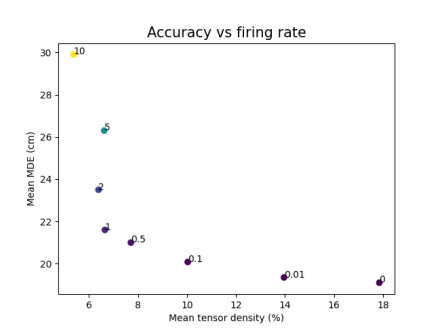
Figure 5 . Test accuracy as a function of the mean firing rate. Mean firing rate is calculated as the average of the density of all acti- vation (spike) tensors calculated within the network during infer- ence. Labels correspond to the weight of the spike penalization loss in comparison to the objective loss. Unconstrained models generally perform better than models trained while encouraging sparsity. High weight values for the spike penalization loss do not always result, on average, in higher sparsity. Gradient descent on a non-convex problem does not always find the global minimum, and as such a penalization weight of 2 can result in both higher error and density than with a weight of 1.
원문 · CC BY 4.0 · Ulysse Rançon, Javier Cuadrado-Anibarro, Benoit R. Cottereau, Timothée Masquelier · StereoSpike: Depth Learning with a Spiking Neural Network · 원문 그림 인용 · 원본 PDF 9쪽에서 그림 영역을 추출했습니다.양자화와 배포 가능성
Akida 칩의 8비트 가중치 제한을 고려하여 저자들은 PyTorch의 사후 정적 양자화를 적용했습니다. 가중치는 8비트 부호 없는 정수로 표현되며, 실내 flying split 1에서 MDE는 17.1 cm로 보고됩니다. 이는 양자화 인식 학습을 수행하지 않은 결과이며, 저자들은 양자화 인식 학습이 더 나을 것으로 예상합니다. FLOPs 비교는 저비트 활성과 Heaviside 계산의 차이를 고려해 본문 표에 포함하지 않았다고 설명됩니다.
적용 범위와 한계
저자들은 StereoSpike가 SNN의 순환성과 DVS의 높은 시간 해상도를 활용하지 않는다고 명시합니다. 모델은 상태 없는 피드포워드 구조이므로 깊이 추정이 대부분 비시간적 과제라는 가정 아래 설계되었습니다. 또한 이벤트 카메라 입력에 대한 결과는 MVSEC의 실내와 야외 설정에 한정되어 보고되며, 정수 스파이크 수가 최대 3인 중간 텐서를 소형 칩에서 처리하는 문제는 추가 설계가 필요합니다. 이러한 제약은 본 논문이 확인한 범위를 구분하기 위한 것이며, 다른 하드웨어에서의 성능은 검증되지 않았습니다.
논문 정보
- 저자
- Ulysse Rançon, Javier Cuadrado-Anibarro, Benoit R. Cottereau, Timothée Masquelier
- 학회·저널
- arXiv · 프리프린트
- 최초 공개일
- 2021년 9월 28일
- 등록일
- 2026년 11월 6일
- 수정일
- 2022년 11월 3일
- 버전
- v3
- arXiv
- 2109.13751
- DOI
- 10.1109/access.2022.3226484
- 분류
- cs.CV · cs.AI · cs.LG · cs.NE
- 원문 이용 조건
- CC BY 4.0
- 제공 범위
- 논문 정보, 해설, 허용된 원문 그림
AI 해설은 논문 원문과 별개의 설명이며 오류가 있을 수 있습니다. 원문과 그림은 각 출처의 이용 조건과 따로 표시된 권리를 따릅니다.
초록
Depth estimation is an important computer vision task, useful in particular for navigation in autonomous vehicles, or for object manipulation in robotics. Here we solved it using an end-to-end neuromorphic approach, combining two event-based cameras and a Spiking Neural Network (SNN) with a slightly modified U-Net-like encoder-decoder architecture, that we named StereoSpike. More specifically, we used the Multi Vehicle Stereo Event Camera Dataset (MVSEC). It provides a depth ground-truth, which was used to train StereoSpike in a supervised manner, using surrogate gradient descent. We propose a novel readout paradigm to obtain a dense analog prediction -- the depth of each pixel -- from the spikes of the decoder. We demonstrate that this architecture generalizes very well, even better than its non-spiking counterparts, leading to state-of-the-art test accuracy. To the best of our knowledge, it is the first time that such a large-scale regression problem is solved by a fully spiking network. Finally, we show that low firing rates (<10%) can be obtained via regularization, with a minimal cost in accuracy. This means that StereoSpike could be efficiently implemented on neuromorphic chips, opening the door for low power and real time embedded systems.
원문 인용
Ulysse Rançon, Javier Cuadrado-Anibarro, Benoit R. Cottereau, Timothée Masquelier (2021). StereoSpike: Depth Learning with a Spiking Neural Network. arXiv:2109.13751v3. https://doi.org/10.1109/access.2022.3226484
BibTeX
@article{ranon2021stereospike,
  title = {{StereoSpike: Depth Learning with a Spiking Neural Network}},
  author = {Ulysse Rançon and Javier Cuadrado-Anibarro and Benoit R. Cottereau and Timothée Masquelier},
  year = {2021},
  eprint = {2109.13751},
  archivePrefix = {arXiv},
  doi = {10.1109/access.2022.3226484},
  url = {https://arxiv.org/abs/2109.13751v3}
}