논문 해설
On the Local Complexity of Linear Regions in Deep ReLU Networks
심층 ReLU 네트워크에서 선형 영역의 국소 복잡도에 관하여
- 연구 문제 ReLU 네트워크의 데이터 근처 선형 영역 밀도를 국소 복잡도로 정의하고, 그것이 표현 학습·적대적 강건성·가중치 노름과 어떻게 연결되는지 이론과 MNIST 실험으로 검토합니다.
- 연구 방법 바이어스에 가우시안 노이즈를 더한 파라미터 분포에서 선형 영역 경계의 기대 부피를 정의하고, 이를 뉴런별 기울기 항으로 계산하여 국소 rank·총 변동·표현 비용과 상계 관계를 세웁니다.
- 주요 결과 국소 복잡도는 층별 국소 rank로 상계되고 총 변동의 하계로 연결됩니다. MNIST 실험에서는 학습 후기에 국소 복잡도와 총 변동이 감소하는 동안 적대적 강건성이 증가했습니다.
연구 질문: 선형 영역 분포와 표현 학습
ReLU 네트워크는 입력 공간을 선형 영역으로 나눕니다. 이 논문은 학습 후기에 데이터 근처의 선형 영역 수가 줄어드는 관찰을 출발점으로 삼습니다. 저자들은 이 현상을 표현 학습과 적대적 강건성에 연결하는 질문을 제기합니다. 이를 위해 데이터 분포 위에서 선형 영역의 밀도를 재는 국소 복잡도(local complexity, LC)를 정의합니다. 국소 복잡도는 바이어스에 가우시안 노이즈를 더한 파라미터 분포에서 비선형 궤적의 기대 부피로 정의되는 밀도 f(x)의 데이터 분포 기대값입니다.
국소 복잡도의 계산 방법
Theorem 2는 국소 복잡도를 뉴런별 항의 합으로 계산합니다. 각 뉴런 z_i에 대해 입력에 대한 기울기 노름 ∥∇z_i(x)∥², 바이어스 노이즈가 만드는 가우시안 밀도 ρ_{b_i}(z_i(x)), 그리고 뉴런이 좋은(good) 경우의 지시함수 1_{z_i is good at x}의 곱을 기대값으로 취합니다. 좋은 뉴런은 입력에서 출력까지 이어지는 활성 뉴런 경로를 가진 뉴런입니다. Corollary 3은 좋은 뉴런 지시함수를 제거한 상계와, 노름의 하계를 제공합니다. 이 경계들은 기울기 항에 집중하기 위한 도구로 쓰입니다.
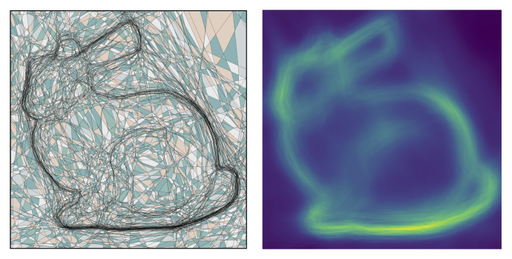
Figure 1 . Left: Linear regions of a trained neural network over a two-dimensional input domain. The nonlinear locus is shown in black and linear regions are colored at random. Right: Heat map of the numerically estimated local complexity density function f (x) over the same domain. Precise details are provided in Appendix B.1. The figure shows that our definition of local complexity, as well as the equations derived in Theorem 2, are consistent with our interpretation of this quantity as a local density of non-linearity over the input space.
원문 · CC BY 4.0 · Niket Patel, Guido Montufar · On the Local Complexity of Linear Regions in Deep ReLU Networks · 원문 그림 인용 · 원본 PDF 4쪽에서 그림 영역을 추출했습니다.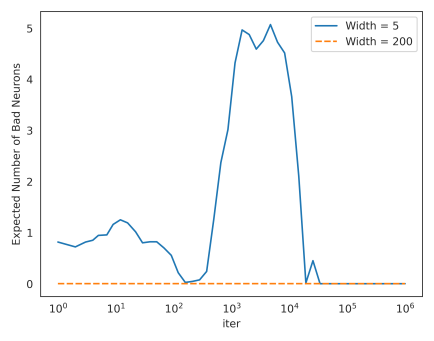
Figure 10 . Here, we plot the empirically observed value of the number of neurons which are not good, B, for an MLP during training on MNIST. Both networks have depth 4, and we can see that for the wider network B = 0 at all timesteps.
원문 · CC BY 4.0 · Niket Patel, Guido Montufar · On the Local Complexity of Linear Regions in Deep ReLU Networks · 원문 그림 인용 · 원본 PDF 33쪽에서 그림 영역을 추출했습니다.국소 rank와 국소 복잡도의 관계
국소 rank는 l번째 층의 특징 다양체 위에서 입력 자코비안의 근사 rank를 기대값으로 취한 양입니다. 근사 rank는 특이값 중 임계값 ϵ 이상인 개수로 정의됩니다. Theorem 5는 임의의 ϵ > 0에 대해 국소 복잡도가 층별 국소 rank의 제곱근 항과 ϵ² n_l 항의 합으로 상계된다고 보입니다. 따라서 저차원 특징 표현을 학습하는 네트워크는 국소 rank가 작아 국소 복잡도도 낮을 수 있음을 뒷받침합니다. 합성 가우시안 데이터의 4층 MLP 실험에서 국소 rank와 국소 복잡도가 학습 후기에 함께 떨어지는 모습이 관찰되었습니다.
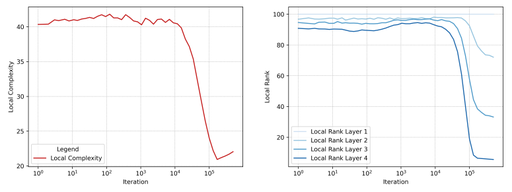
Figure 2 . Relation between the local rank (10) at intermediate layers and the local complexity (2) of linear regions in the terminal phase of training. We train a 4 layer MLP with 200 neurons per layer to estimate a map between two multivariate Gaussians with a random cross-covariance matrix. More information can be found in Appendix B.2.
원문 · CC BY 4.0 · Niket Patel, Guido Montufar · On the Local Complexity of Linear Regions in Deep ReLU Networks · 원문 그림 인용 · 원본 PDF 6쪽에서 그림 영역을 추출했습니다.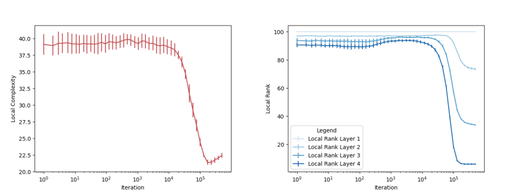
Figure 7 . Here we run the same experiment as in Figure 2, 6 times, each with a different cross-covariance matrix. We demonstrate that this effect is consistent by plotting standard deviation error bars on each collected data point. We find a Pearson’s correlation coefficient of 0.852 between the local complexity and the local rank at layer 2, and a Pearson’s correlation coefficient of 0.957 and 0.985 at layers 3 and 4 respectfully.
원문 · CC BY 4.0 · Niket Patel, Guido Montufar · On the Local Complexity of Linear Regions in Deep ReLU Networks · 원문 그림 인용 · 원본 PDF 31쪽에서 그림 영역을 추출했습니다.총 변동과 적대적 강건성
총 변동(total variation, TV)은 데이터 분포 위에서 네트워크 입력 기울기 노름의 기대값입니다. TV가 낮으면 데이터 주변에서 함수가 거의 상수에 가깝게 평탄해집니다. Proposition 6은 분류 여유 N(x̄)>γ와 데이터 밀도 하한 c_ϵ를 두고, TV ≤ c_ϵγ이면 B_ϵ(x̄) 안에 적대적 예시가 없다고 보입니다. Theorem 7은 TV에 층별 Lipschitz 상수 최댓값을 곱한 항이 국소 복잡도의 하계 역할을 함을 보이며, 조건은 ∥N(·)∥의 상수와 노이즈 항을 포함합니다. 따라서 이 결과는 국소 복잡도와 TV의 관계를 정량화하지만 모든 학습 궤적에서 두 값이 같은 방향으로 움직인다는 뜻은 아닙니다.
표현 비용과 가중치 노름
표현 비용 R(f)는 함수 f를 정확히 계산하는 네트워크 파라미터의 최소 Frobenius 노름입니다. Proposition 8은 국소 복잡도가 표현 비용과 층 수, 입력 차원, 층 너비의 함수로 상계된다고 보입니다. 이 결과는 가중치 감쇠로 파라미터 노름을 줄이면 선형 영역의 단순화가 일어날 수 있다는 해석의 근거가 됩니다. 원문은 이 관계를 가중치 감쇠 계수 λ와 연결하는 Corollary 10을 비공식 형태로 제시하며, 이는 rich 학습 단계에서 파라미터 노름이 Θ((log 1/λ)^{1/L})이라는 가정에 기대는 결과입니다.
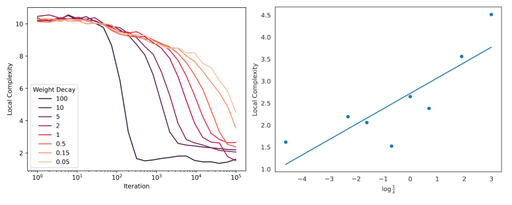
Figure 13 . Here we demonstrate a correlation between the weight decay parameter and the drop in local complexity late in training. On the left, we note that this drop appears to come earlier for higher values of the weight decay parameter. On the right, we plot the bounding quantity from (18) on the x-axis, and the local complexity at the end of training on the y-axis. We also plot a linear regression, and observe an R2 = 0.6972. In these experiments, we consider a shallow 2 layer MLP, with a hidden-layer dimension of 1000. This network is trained on a subset of MNIST with the Adam optimizer and learning rate 1e − 4.
원문 · CC BY 4.0 · Niket Patel, Guido Montufar · On the Local Complexity of Linear Regions in Deep ReLU Networks · 원문 그림 인용 · 원본 PDF 35쪽에서 그림 영역을 추출했습니다.MNIST 학습 후기 실험
Figure 3의 실험은 MNIST 전체 클래스에서 추출한 1000장의 부분집합으로 4층 MLP를 학습합니다. 각 층은 200개 뉴런을 가지며, 초기화 스케일은 표준 He 초기화의 2배입니다. 이 설정에서 학습 후기에 기대 총 변동과 국소 복잡도가 감소하는 동안 적대적 강건성이 증가했다고 보고됩니다. 이 결과는 해당 설정의 관찰이며, 초기화 스케일을 달리한 실험에서는 두 양의 상관이 약해지는 것으로 부록에 보고됩니다.
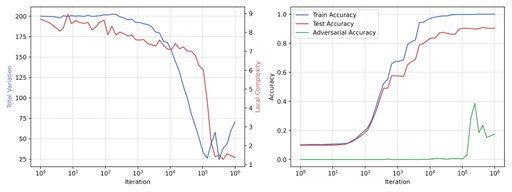
Figure 3 . Drop in the expected total variation (7) and local complexity (2) of a network in the terminal phase of training. We find that this corresponds to an increase in the adversarial robustness of our network. Here we train a 4 layer MLP with 200 neurons in each layer on a subset of 1000 images across all classes in the MNIST dataset. We use an initialization scale that is 2x the standard He initialization. More information and an ablation on the initialization scale is available in Appendix B.3.
원문 · CC BY 4.0 · Niket Patel, Guido Montufar · On the Local Complexity of Linear Regions in Deep ReLU Networks · 원문 그림 인용 · 원본 PDF 7쪽에서 그림 영역을 추출했습니다.한계와 적용 범위
저자들은 Theorem 7이 학습 중 총 변동과 국소 복잡도의 관계를 완전히 설명하지 않을 수 있다고 밝힙니다. 또한 Figure 8 부근의 결과에서는 총 변동이 항상 국소 복잡도와 함께 줄지 않아 경계의 조임 정도에 질문이 남습니다. 증명 기법은 ReLU 활성화에 초점을 맞추며, 일반 조각별 선형 활성화로의 확장은 향후 과제로 남습니다. 국소 복잡도가 일반화 간극을 직접 제어하는지도 열린 질문으로 남아 있습니다.
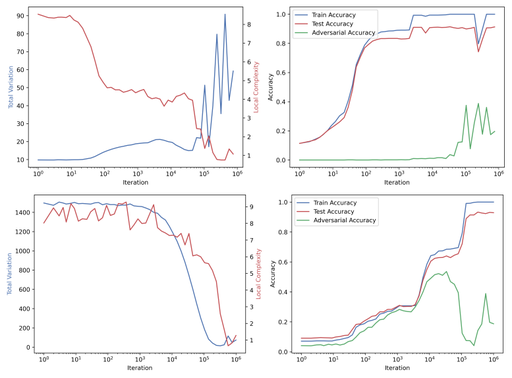
Figure 8 . Here we demonstrate the results of training an MLP on a subset of the MNIST dataset with the standard He initialization (Top) and 3x the regular He initialization. This model has the same architecture as that in Figure 3.
원문 · CC BY 4.0 · Niket Patel, Guido Montufar · On the Local Complexity of Linear Regions in Deep ReLU Networks · 원문 그림 인용 · 원본 PDF 32쪽에서 그림 영역을 추출했습니다.논문 정보
- 저자
- Niket Patel, Guido Montufar
- 학회·저널
- arXiv · 프리프린트
- 최초 공개일
- 2024년 12월 24일
- 등록일
- 2026년 10월 31일
- 수정일
- 2025년 7월 14일
- 버전
- v3
- arXiv
- 2412.18283
- 분류
- cs.LG
- 원문 이용 조건
- CC BY 4.0
- 제공 범위
- 논문 정보, 해설, 허용된 원문 그림
AI 해설은 논문 원문과 별개의 설명이며 오류가 있을 수 있습니다. 원문과 그림은 각 출처의 이용 조건과 따로 표시된 권리를 따릅니다.
초록
We define the local complexity of a neural network with continuous piecewise linear activations as a measure of the density of linear regions over an input data distribution. We show theoretically that ReLU networks that learn low-dimensional feature representations have a lower local complexity. This allows us to connect recent empirical observations on feature learning at the level of the weight matrices with concrete properties of the learned functions. In particular, we show that the local complexity serves as an upper bound on the total variation of the function over the input data distribution and thus that feature learning can be related to adversarial robustness. Lastly, we consider how optimization drives ReLU networks towards solutions with lower local complexity. Overall, this work contributes a theoretical framework towards relating geometric properties of ReLU networks to different aspects of learning such as feature learning and representation cost.
원문 인용
Niket Patel, Guido Montufar (2024). On the Local Complexity of Linear Regions in Deep ReLU Networks. arXiv:2412.18283v3. https://arxiv.org/abs/2412.18283v3
BibTeX
@misc{patel2024local,
  title = {{On the Local Complexity of Linear Regions in Deep ReLU Networks}},
  author = {Niket Patel and Guido Montufar},
  year = {2024},
  eprint = {2412.18283},
  archivePrefix = {arXiv},
  url = {https://arxiv.org/abs/2412.18283v3}
}