논문 해설
Is K-fold cross validation the best model selection method for Machine Learning?
K-겹 교차 검증은 머신러닝의 최적 모델 선택 방법인가?
- 연구 문제 K-fold 교차검증 정확도는 소표본과 이질적 데이터에서 실제 위험을 과소평가하고 위양성을 늘릴 수 있습니다.
- 연구 방법 K-fold CV의 경험적 위험에 PAC-Bayesian 편차 상한을 더한 K-fold CUBV 검정을 제안합니다.
- 주요 결과 귀무 실험에서 K-fold CV 기반 검정은 위양성이 허용 수준을 넘었고, K-fold CUBV는 유의수준 이하의 검정력으로 보수적으로 작동했습니다.
K-fold 교차검증 기반 검정의 문제
이 논문은 K-fold 교차검증(CV)의 정확도가 머신러닝 성능을 평가하는 표준적인 방법으로 쓰이지만, 소표본과 이질적인 데이터에서는 실제 위험을 과소평가하고 위양성을 늘릴 수 있다는 문제를 다룹니다. 원문은 CV 오차가 폴드 분할과 학습 파라미터에 강하게 의존하여 실험실마다 서로 다른 결과가 나온다고 설명합니다.
이 문제는 통계적 검정 관점에서 중요합니다. 기존의 permutation 검정은 CV 정확도를 검정 통계량으로 사용하지만, 단일 표본에서 얻은 폴드 분포가 귀무 분포를 편향되게 모델링할 수 있습니다. 따라서 논문은 CV 정확도를 그대로 신뢰하기보다, 실제 위험의 상한을 함께 평가하는 방법이 필요하다고 주장합니다.
K-fold CUBV의 상한 계산
제안된 K-fold CUBV는 K-fold CV로 경험적 위험 R_N(f_N)을 추정하고, 여기에 집중 부등식에서 얻은 편차항 Δ(N, F, Q)를 더한 상한으로 실제 위험을 평가합니다. 원문은 η 확률 수준에서 R(f_N) = R_N(f_N) + Δ(N, F, Q) ≤ η 형태의 기준을 사용해 귀무가설을 기각할지 판단합니다.
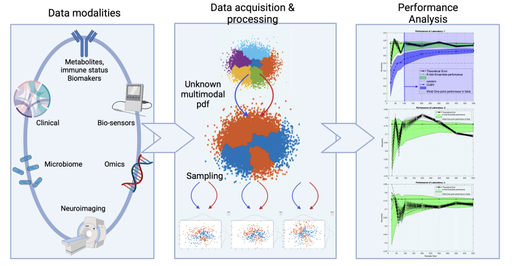
Figure 2 : Performance of K-fold CV in common experimental designs. Typical large biobanks include data across modalities including neuroimaging, biosensors, genetic, clinical, omics, etc. data. A set of synthetic and real MRI samples, obtained from Nc sources and expressed as n dimensional features, are analysed. The theoretical error achieved by a (linear) classifier can be assessed by resubstitution on the infinite population (pdf). Then, the K-fold CV error is estimated by (theoretically) sampling this pdf (M times) or by (realistically) permuting the learning folds using a single realization of the sample ( F times). The proposed CUBV test rejects the null-hypothesis in the blue-shaded area.
원문 · CC BY 4.0 · Juan M Gorriz, R. Martin Clemente, F Segovia, J Ramirez, A Ortiz, J. Suckling · Is K-fold cross validation the best model selection method for Machine Learning? · 원문 그림 인용 · 원본 PDF 7쪽에서 그림 영역을 추출했습니다.Δ 항은 PAC-Bayesian 편차로 정의됩니다. 원문 식은 Δ(N, F, Q) ≡ |γR_N(f) − ln(1 − R(f) + R(f)e^γ)|이며, 선형 분류기에서 Q를 N(0,1)^n에 대한 dropout 형태로 두면 D_KL(Q||Q_u) = (1−δ)/2 ||ω||²로 제시됩니다. 이 상한은 최악의 경우 분석으로 설명되며, 기준 확률 η는 고전적 검정의 유의수준 α와 같은 의미가 아니라고 원문은 밝힙니다.
귀무 실험에서의 위양성 통제
귀무 실험은 두 집단이 동일한 가우시안 분포에서 추출되어 Cohen의 d가 0인 설정입니다. 이 설정에서 K-fold CV 기반 permutation 검정은 허용 수준을 넘는 위양성률을 보였다고 원문은 보고합니다. 원문은 이 결과가 특히 소표본과 낮은 차원에서 두드러진다고 설명합니다.
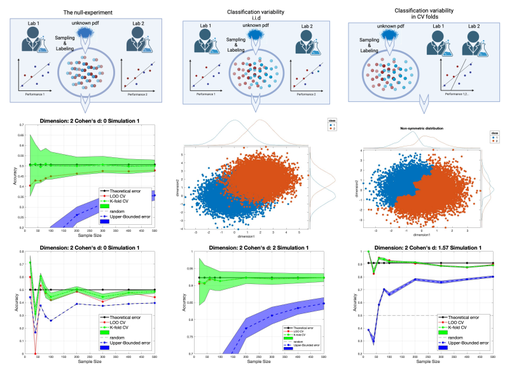
Figure 1 : Left Column: Null distribution of accuracy values using K-fold CV (in green font) obtained from sampling the pdf (middle) and permuting the fold distribution (bottom). In blue we show the proposed K-fold CUBV method to control FP in this null experiment. Note that in this example dimension n = 2 and Cohen’s d = 0. Middle column: example of a classification problem using linear decision functions and samples drawn from two Gaussian pdfs with Cohen’s d = 2 similar to the problem described in section 2.2.1. Averaged accuracy and its standard deviation versus sample size are displayed in green font for the standard K-fold CV ,K = 10. The theoretical error achieved by linear classifiers and the whole dataset ( 2 ∗ 104 samples) in this problem is displayed by the black line. Right column: Example of a classification problem with a single sample generated following the procedure described in [37] and a F = 100-fold accuracy distribution for K = 10.
원문 · CC BY 4.0 · Juan M Gorriz, R. Martin Clemente, F Segovia, J Ramirez, A Ortiz, J. Suckling · Is K-fold cross validation the best model selection method for Machine Learning? · 원문 그림 인용 · 원본 PDF 5쪽에서 그림 영역을 추출했습니다.같은 귀무 설정에서 K-fold CUBV는 유의수준 이하의 검정력을 보였고, 그 결과 위양성 통제 측면에서 보수적인 것으로 보고되었습니다. 다만 이 결과는 원문에서 선형 SVM과 제시된 시뮬레이션 설정에서 얻은 것이며, 모든 분류기나 모든 데이터 구조로 넓힌 결론은 아닙니다.
탐지에 필요한 시행 수와 적용 범위
MC 평가에서 K-fold CV 기반 탐지에 필요한 시행 횟수는 작은 효과 크기에서 표본 수의 약 7배로 보고되었습니다. 예를 들어 원문은 N = 500일 때 M ∼ 3700을 제시합니다. 이 비교는 CUBV가 적은 표본으로도 유의한 탐지를 얻을 수 있다는 저자들의 해석과 함께 제시됩니다.
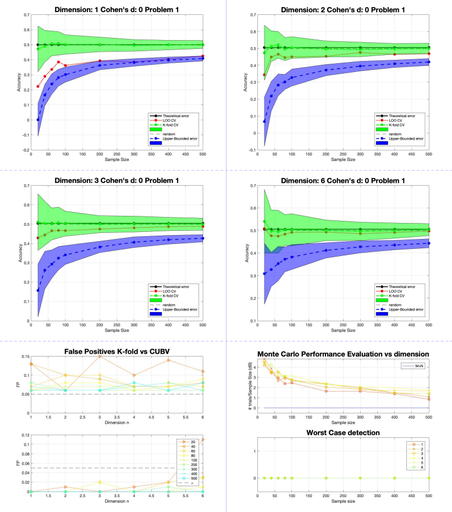
Figure 3 : Examples of performance, FP rates and MC performance evaluation across independent (multi-sample) experiments
원문 · CC BY 4.0 · Juan M Gorriz, R. Martin Clemente, F Segovia, J Ramirez, A Ortiz, J. Suckling · Is K-fold cross validation the best model selection method for Machine Learning? · 원문 그림 인용 · 원본 PDF 12쪽에서 그림 영역을 추출했습니다.원문의 결과는 선형 분류기와 제한된 시뮬레이션 조건, 그리고 ADNI 기반 MRI 데이터의 실험 설정에서 얻어졌습니다. 따라서 이 결과는 K-fold CUBV가 여러 조건에서 보수적인 검정으로 작동함을 보여 주는 증거이며, 모든 머신러닝 모델이나 모든 신경영상 데이터에 대한 일반적 보장은 아닙니다.
해석과 한계
원문은 K-fold CUBV가 위양성 통제와 검정력 사이의 절충이라고 설명합니다. 즉 위양성을 줄이는 대가로 실제 효과를 탐지하는 능력이 제한될 수 있으며, 원문도 CUBV가 기준을 넘지 못한 조건에서는 효과를 놓칠 수 있다고 밝힙니다.
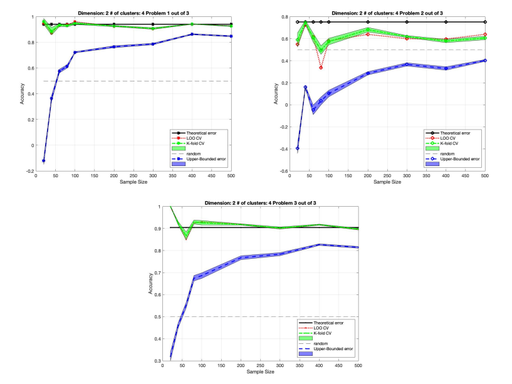
Figure 14 : Examples of classical permutation tests based on regular CV and CUBV decisions depending on sample variability and classifier complexity. Note that whenever there is a clear deviation between the green and black lines or a high variability in K-fold CV is obtained, the CUBV decision is below 0.5 and thus the test does not reject the null hypothesis. This decision is warning that the green curve values obtained cannot be extrapolated to other experiments thus the analysis by another laboratory could be providing substantially different outcomes, specially in problem 2 out of 3.
원문 · CC BY 4.0 · Juan M Gorriz, R. Martin Clemente, F Segovia, J Ramirez, A Ortiz, J. Suckling · Is K-fold cross validation the best model selection method for Machine Learning? · 원문 그림 인용 · 원본 PDF 30쪽에서 그림 영역을 추출했습니다.또한 결과는 선형 SVM과 제시된 가우시안 혼합 시뮬레이션 및 MRI 분석 설정에 묶여 있습니다. 원문에 나오지 않은 다른 분류기, 다른 데이터 모달리티, 다른 학습 설정으로 결과를 일반화하면 안 됩니다.
논문 정보
- 저자
- Juan M Gorriz, R. Martin Clemente, F Segovia, J Ramirez, A Ortiz, J. Suckling
- 학회·저널
- arXiv · 프리프린트
- 최초 공개일
- 2024년 1월 29일
- 등록일
- 2026년 11월 6일
- 수정일
- 2024년 11월 8일
- 버전
- v2
- arXiv
- 2401.16407
- DOI
- 10.1016/j.inffus.2026.104404
- 분류
- stat.ML · cs.LG · eess.IV · eess.SP
- 원문 이용 조건
- CC BY 4.0
- 제공 범위
- 논문 정보, 해설, 허용된 원문 그림
AI 해설은 논문 원문과 별개의 설명이며 오류가 있을 수 있습니다. 원문과 그림은 각 출처의 이용 조건과 따로 표시된 권리를 따릅니다.
초록
As a technique that can compactly represent complex patterns, machine learning has significant potential for predictive inference. K-fold cross-validation (CV) is the most common approach to ascertaining the likelihood that a machine learning outcome is generated by chance, and it frequently outperforms conventional hypothesis testing. This improvement uses measures directly obtained from machine learning classifications, such as accuracy, that do not have a parametric description. To approach a frequentist analysis within machine learning pipelines, a permutation test or simple statistics from data partitions (i.e., folds) can be added to estimate confidence intervals. Unfortunately, neither parametric nor non-parametric tests solve the inherent problems of partitioning small sample-size datasets and learning from heterogeneous data sources. The fact that machine learning strongly depends on the learning parameters and the distribution of data across folds recapitulates familiar difficulties around excess false positives and replication. A novel statistical test based on K-fold CV and the Upper Bound of the actual risk (K-fold CUBV) is proposed, where uncertain predictions of machine learning with CV are bounded by the worst case through the evaluation of concentration inequalities. Probably Approximately Correct-Bayesian upper bounds for linear classifiers in combination with K-fold CV are derived and used to estimate the actual risk. The performance with simulated and neuroimaging datasets suggests that K-fold CUBV is a robust criterion for detecting effects and validating accuracy values obtained from machine learning and classical CV schemes, while avoiding excess false positives.
원문 인용
Juan M Gorriz, R. Martin Clemente, F Segovia, J Ramirez, A Ortiz, J. Suckling (2024). Is K-fold cross validation the best model selection method for Machine Learning?. arXiv:2401.16407v2. https://doi.org/10.1016/j.inffus.2026.104404
BibTeX
@article{gorriz2024fold,
  title = {{Is K-fold cross validation the best model selection method for Machine Learning?}},
  author = {Juan M Gorriz and R. Martin Clemente and F Segovia and J Ramirez and A Ortiz and J. Suckling},
  year = {2024},
  eprint = {2401.16407},
  archivePrefix = {arXiv},
  doi = {10.1016/j.inffus.2026.104404},
  url = {https://arxiv.org/abs/2401.16407v2}
}