논문 해설
From Classification to Generation: Vision-Language Models for Roman Imperial Coin Description
분류에서 생성으로: 로마 제국 주화 설명을 위한 Vision-Language 모델
- 연구 문제 로마 제정기 주화 설명은 범례와 도상을 카탈로그 유형에 맞추는 과정이며, 기존 분류 방식은 미리 정한 레이블 집합에 의존합니다.
- 연구 방법 Qwen3-VL-8B를 과제별 QLoRA 어댑터로 미세조정하여 주화 범례와 도상 설명을 텍스트로 생성합니다.
- 주요 결과 앞면 범례 전사에서 전체 테스트 세트 NLD 0.19를 기록해 GPT-4.1의 0.33보다 낮았습니다.
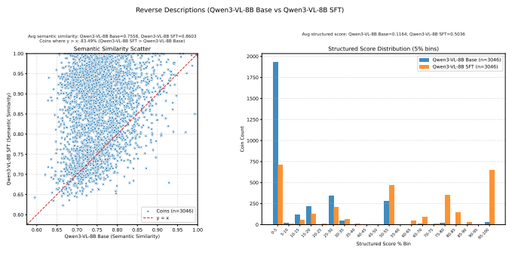
Fig. 9 . Comparison of the fine-tuned Qwen model and the Qwen base model on reverse-description generation. Left: per- sample semantic similarity. Right: distribution of structured scores.
원문 · CC BY 4.0 · Pedro Lourenco, Ognjen Arandjelović · From Classification to Generation: Vision-Language Models for Roman Imperial Coin Description · 원문 그림 인용 · 원본 PDF 18쪽에서 그림 영역을 추출했습니다.로마 제정기 주화 기술의 어려움
로마 제정기 주화를 카탈로그에 대응시키려면 앞면과 뒷면의 범례를 읽고 도상을 식별해야 합니다. 기존 연구는 이 과정의 일부를 미리 정한 레이블 집합에 대한 분류로 풀어 왔습니다. 발행 권위자 식별, 범례 인식, 카탈로그 유형 분류, 뒷면 모티프 인식이 여기에 해당합니다. 이런 방식은 참조 클래스 집합과 예시 이미지가 충분해야 하므로, 수만 개의 주화 유형 중 상당수가 적은 표본만 가진 상황에서는 제약이 큽니다. 이 논문은 주화 설명을 이미지에서 텍스트를 생성하는 문제로 바꾸어 다룹니다.
생성형 공식화와 QLoRA fine-tuning
이 연구는 네 가지 과제를 이미지에서 텍스트를 생성하는 문제로 정의했습니다. 앞면과 뒷면 범례 전사, 앞면과 뒷면 도상 설명이 그 과제입니다. 모든 과제는 같은 Qwen3-VL-8B-Instruct 백본을 쓰고, 과제마다 별도의 LoRA 어댑터를 학습합니다. 백본은 4비트 양자화된 상태로 동결되며 저랭크 어댑터만 학습됩니다. 학습 데이터는 ACSearch의 경매 기록을 gpt-4.1-mini로 구조화한 뒤 범례 검증과 정규화를 거쳐 만들었습니다. 범례는 원문 설명의 부분 문자열일 때만 채택했습니다.

Fig. 1 . Sample images from the dataset, each showing both sides of a single coin.
원문 · CC BY 4.0 · Pedro Lourenco, Ognjen Arandjelović · From Classification to Generation: Vision-Language Models for Roman Imperial Coin Description · 원문 그림 인용 · 원본 PDF 2쪽에서 그림 영역을 추출했습니다.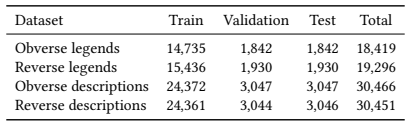
Table 1 . Final dataset sizes after filtering and splitting.
원문 · CC BY 4.0 · Pedro Lourenco, Ognjen Arandjelović · From Classification to Generation: Vision-Language Models for Roman Imperial Coin Description · 원문 그림 인용 · 원본 PDF 8쪽에서 그림 영역을 추출했습니다.범례 전사 결과
앞면 범례 전사에서 미세조정된 모델은 전체 테스트 세트에서 NLD 0.19와 F5 0.81을 기록했습니다. 같은 조건의 GPT-4.1은 NLD 0.33과 F5 0.63이었습니다. 학습에 없던 범례로 구성한 부분집합에서도 fine-tuning 모델의 NLD는 0.45, GPT-4.1은 0.49였고, F5는 각각 0.58과 0.52였습니다. 뒷면 범례에서도 같은 방향의 차이가 나타났습니다. 다만 두 분할 사이의 격차는 자주 등장하는 범례에 대한 친숙함이 일부 기여했음을 보여 줍니다.
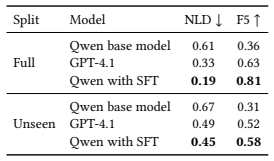
Table 2 . Obverse legend transcription results. Lower NLD is better; higher F5 is better.
원문 · CC BY 4.0 · Pedro Lourenco, Ognjen Arandjelović · From Classification to Generation: Vision-Language Models for Roman Imperial Coin Description · 원문 그림 인용 · 원본 PDF 12쪽에서 그림 영역을 추출했습니다.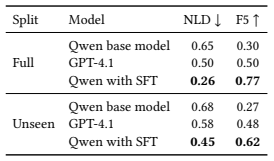
Table 3 . Reverse legend transcription results. Lower NLD is better; higher F5 is better.
원문 · CC BY 4.0 · Pedro Lourenco, Ognjen Arandjelović · From Classification to Generation: Vision-Language Models for Roman Imperial Coin Description · 원문 그림 인용 · 원본 PDF 12쪽에서 그림 영역을 추출했습니다.도상 설명 결과와 구조적 점수
뒷면 도상 설명은 의미 유사도와 구조적 점수로 평가했습니다. 의미 유사도는 미세조정된 bi-encoder로 계산했습니다. 구조적 점수는 주요 개체와 주요 대상이 생성 텍스트에 나타나는지를 셉니다. fine-tuning 모델은 의미 유사도 0.86과 구조적 점수 0.50을 기록했고, GPT-4.1은 각각 0.79와 0.20이었습니다. 의미 유사도 차이는 상대적으로 작았고, 구조적 점수 차이가 더 컸습니다.
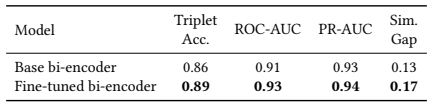
Table 4 . Bi-encoder performance before and after fine-tuning
원문 · CC BY 4.0 · Pedro Lourenco, Ognjen Arandjelović · From Classification to Generation: Vision-Language Models for Roman Imperial Coin Description · 원문 그림 인용 · 원본 PDF 17쪽에서 그림 영역을 추출했습니다.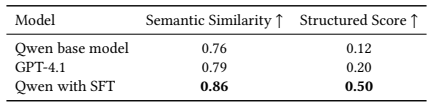
Table 5 . Reverse-description generation results.
원문 · CC BY 4.0 · Pedro Lourenco, Ognjen Arandjelović · From Classification to Generation: Vision-Language Models for Roman Imperial Coin Description · 원문 그림 인용 · 원본 PDF 17쪽에서 그림 영역을 추출했습니다.라벨 출처와 평가 범위의 한계
학습과 평가 라벨은 경매 기록에서 파생되어 용어와 세부 수준이 일관되지 않습니다. 그래서 결과는 모델 출력과 이 라벨의 일치도를 측정한 것입니다. 실험은 단일 기반 모델과 단일 학습 실행으로 이루어졌으므로 백본, 모델 규모, 초기화에 대한 민감도는 확인되지 않았습니다.
논문 정보
- 저자
- Pedro Lourenco, Ognjen Arandjelović
- 학회·저널
- arXiv · 프리프린트
- 최초 공개일
- 2026년 11월 10일
- 등록일
- 2026년 11월 13일
- 수정일
- 2026년 11월 10일
- 버전
- v1
- arXiv
- 2611.14821
- 분류
- cs.CV
- 원문 이용 조건
- CC BY 4.0
- 제공 범위
- 논문 정보, 해설, 허용된 원문 그림
AI 해설은 논문 원문과 별개의 설명이며 오류가 있을 수 있습니다. 원문과 그림은 각 출처의 이용 조건과 따로 표시된 권리를 따릅니다.
초록
Cataloguing a Roman Imperial coin involves reading its legends and identifying its imagery in order to match it to an entry in the standard reference catalogue. Previous work has automated individual parts of this process, such as identifying the issuer or recognizing reverse motifs, by formulating each part as a classification task over a predefined set of labels. We instead formulate coin description as image-to-text generation and adapt an open-weight vision-language model (VLM), Qwen3-VL-8B-Instruct, to four tasks: transcribing the obverse and reverse legends, and describing the obverse and reverse imagery. To obtain training data, we convert approximately 30,000 auction records into structured image-text pairs. We separate the two sides of each coin, extract and normalize legends and descriptions, and standardize obverse descriptions against a bust-type taxonomy. We then train a separate low-rank adapter for each task on a single 20GB GPU, and evaluate each task with metrics that we define to capture the key components of numismatic descriptions. The adapted models outperform both the unadapted base model and GPT-4.1 on all four tasks, reducing the normalized edit distance of legend transcriptions by over 40% relative to GPT-4.1. The improvement is smaller, but still present, on legends absent from the training data.
원문 인용
Pedro Lourenco, Ognjen Arandjelović (2026). From Classification to Generation: Vision-Language Models for Roman Imperial Coin Description. arXiv:2611.14821v1. https://arxiv.org/abs/2611.14821v1
BibTeX
@misc{lourenco2026from,
  title = {{From Classification to Generation: Vision-Language Models for Roman Imperial Coin Description}},
  author = {Pedro Lourenco and Ognjen Arandjelović},
  year = {2026},
  eprint = {2611.14821},
  archivePrefix = {arXiv},
  url = {https://arxiv.org/abs/2611.14821v1}
}