논문 해설
Interpreting Random Forests: Comparing Surrogate Models and Rule Extraction Methods
랜덤 포레스트 해석하기: 대리 모델과 규칙 추출 방법 비교
- 연구 문제 RF는 예측력이 높지만 앙상블 구조 때문에 해석이 어렵고, 목적에 맞는 대리 모델이나 규칙 추출 방법을 고르기 어렵습니다.
- 주요 결과 회귀에서는 SLIM이, 분류에서는 inTrees가 가장 강한 일반 성능을 보였고, 예측 유사성이 높아도 구조 유사성은 따로 확인해야 했습니다.
RF 해석의 선택 문제
랜덤 포레스트(RF)는 비선형 효과와 상호작용을 잘 표현하지만, 여러 트리의 앙상블 구조 때문에 예측이 어떻게 만들어지는지 이해하기 어렵습니다. 이 때문에 RF를 해석 가능한 근사 모델로 바꾸는 방법이 여럿 제안되었습니다. 문제는 이 방법들이 서로 다른 목표를 갖는다는 데 있습니다. 어떤 방법은 RF의 예측을 잘 재현하고, 어떤 방법은 RF가 실제로 쓰는 변수나 결정 구조를 보존하며, 또 다른 방법은 규칙 수를 줄이는 데 집중합니다. 따라서 예측 유사성이 높은 모델이 RF의 설명으로 적합하다고 단정하기 어렵습니다. 이 논문은 대리 모델과 규칙 추출 방법을 함께 비교해 목적별 선택 기준을 얻으려고 합니다.
비교 대상 방법의 작동 방식
비교 대상은 오라클 코칭 방식의 선형 모델, OC-CART, GUIDE, SLIM, MOB, CTree와 같은 대리 트리, RF 트리를 직접 쓰는 MRT와 ART, 규칙 추출 방법인 inTrees, SIRUS, Node Harvest, RuleFit입니다. 오라클 코칭은 RF의 예측값을 학습 목표로 삼아 해석 가능한 모델을 맞추는 방식이며, 예측 수준의 유사성만 확보할 뿐 결정 구조가 같다는 보장은 없습니다. MRT는 RF의 기존 트리 중 다른 트리들과의 평균 거리가 가장 작은 트리를 고르고, ART는 RF와의 트리 거리를 줄이도록 분할을 하나씩 골라 새 대표 트리를 만듭니다. inTrees는 RF 트리의 경로에서 규칙을 뽑아 오차·커버리지·길이에 따라 정렬합니다.
저자들은 이 차이가 예측 재현과 구조 재현 사이의 트레이드오프를 만든다고 설명합니다.
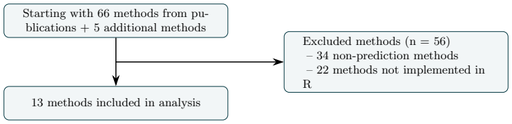
Figure 1 : A flowchart showing the selection of methods for the comparison study.
원문 · CC BY 4.0 · Lea L. Mairhöfer, Jonathan B. Krause, Björn-Hergen Laabs, Silke Szymczak · Interpreting Random Forests: Comparing Surrogate Models and Rule Extraction Methods · 원문 그림 인용 · 원본 PDF 12쪽에서 그림 영역을 추출했습니다.시뮬레이션과 벤치마크 설계
모든 방법이 모든 과제를 지원하지는 않아서, 회귀 전용 구현이나 분류 전용 구현에 따라 결과가 가능한 범위가 달라집니다. 결과는 중앙값 기준의 순위로 요약되었습니다.
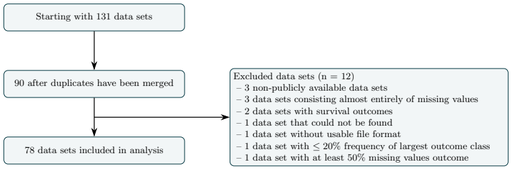
Figure 2 : A flowchart showing the selection of data sets for the comparison study.
원문 · CC BY 4.0 · Lea L. Mairhöfer, Jonathan B. Krause, Björn-Hergen Laabs, Silke Szymczak · Interpreting Random Forests: Comparing Surrogate Models and Rule Extraction Methods · 원문 그림 인용 · 원본 PDF 12쪽에서 그림 영역을 추출했습니다.회귀와 분류의 주요 결과
회귀에서는 SLIM이 예측 유사성과 테스트 성능에서 가장 강한 일반적 성능을 보였습니다. 선형 모델은 선형 효과가 강한 설정에서 RF와 잘 맞았고, 비교 성능이 비슷하면 단일 전역 계수로 더 단순하게 해석할 수 있었습니다. 분류에서는 inTrees가 벤치마크 전체에서 가장 강했고, CTree와 OC-CART가 유용한 대안으로 제시되었습니다. ART는 가장 간결한 표현을 만들었습니다. 구조 유사성에서는 회귀의 NH와 SIRUS, 분류 시뮬레이션의 MRT가 RF의 변수 사용과 가깝게 나타났습니다. 이는 예측 순위가 가장 좋은 구조적 설명을 보장하지 않는다는 결과입니다.
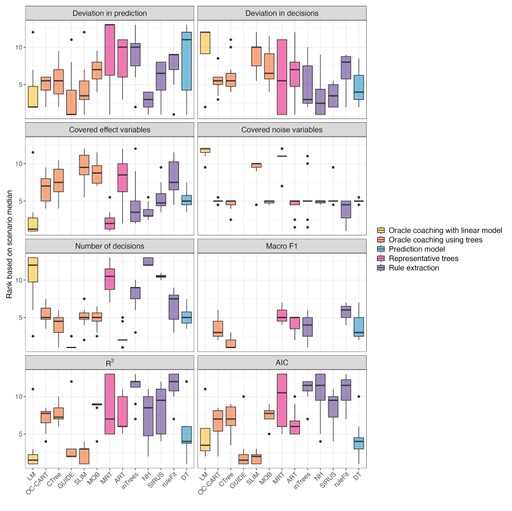
Figure 3 : Ranks of methods across simulation scenarios for each performance measure (facets), with lower ranks indicating better performance. Within each scenario, the median performance across 100 repetitions was calculated for each method, and methods were then ranked according to these medians. Boxplots summarize the resulting ranks across scenarios. Methods are displayed on the x-axis and colored by method type: oracle coaching using a linear model, oracle coaching using tree-based methods, representative trees, rule extraction methods, and the decision tree (DT) as a prediction model.
원문 · CC BY 4.0 · Lea L. Mairhöfer, Jonathan B. Krause, Björn-Hergen Laabs, Silke Szymczak · Interpreting Random Forests: Comparing Surrogate Models and Rule Extraction Methods · 원문 그림 인용 · 원본 PDF 23쪽에서 그림 영역을 추출했습니다.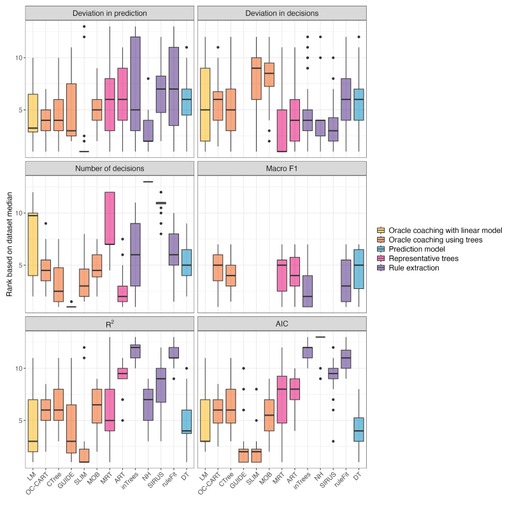
Figure 4 : Ranks of methods across benchmark data sets for each performance measure (facets), with lower ranks indicating better performance. Within each data set, the median performance across 10- fold CV was calculated for each method, and methods were then ranked according to these medians. Boxplots summarize the resulting ranks across data sets. Methods are displayed on the x-axis and colored by method type: oracle coaching using a linear model, oracle coaching using tree-based methods, representative trees, rule extraction methods, and the decision tree (DT) as a prediction model.
원문 · CC BY 4.0 · Lea L. Mairhöfer, Jonathan B. Krause, Björn-Hergen Laabs, Silke Szymczak · Interpreting Random Forests: Comparing Surrogate Models and Rule Extraction Methods · 원문 그림 인용 · 원본 PDF 25쪽에서 그림 영역을 추출했습니다.결과 해석의 한계
일부 방법은 분류를 지원하지 않았고, 실행 시간 제한과 수치 오류, 빈 변수 선택, 보지 못한 요인 수준 등으로 결과가 빠진 경우가 있었습니다. 따라서 평균 결과는 방법마다 다른 과제 집합에 대한 것입니다. 원래 비교 조건상 모든 방법에 같은 탐색 예산을 준 것은 아니며, 데이터별 하이퍼파라미터 최적화는 수행하지 않았습니다. 가지치기를 하지 않은 트리를 썼기 때문에 가지치기가 있었다면 순위가 달라질 수 있다고 저자들은 봅니다. 예측 유사성만으로 RF를 설명했다고 해석하면 안 된다는 것이 저자들의 핵심 결론입니다.
논문 정보
- 저자
- Lea L. Mairhöfer, Jonathan B. Krause, Björn-Hergen Laabs, Silke Szymczak
- 학회·저널
- arXiv · 프리프린트
- 최초 공개일
- 2026년 11월 14일
- 등록일
- 2026년 11월 17일
- 수정일
- 2026년 11월 14일
- 버전
- v1
- arXiv
- 2611.19471
- 분류
- stat.ME · cs.LG · stat.ML
- 원문 이용 조건
- CC BY 4.0
- 제공 범위
- 논문 정보, 해설, 허용된 원문 그림
AI 해설은 논문 원문과 별개의 설명이며 오류가 있을 수 있습니다. 원문과 그림은 각 출처의 이용 조건과 따로 표시된 권리를 따릅니다.
초록
Random forests (RFs) often achieve high prediction performance, but their ensemble structure can be difficult to interpret. Surrogate models and rule extraction methods offer interpretable approximations, yet guidance on selecting an appropriate method for a specific research question remains limited. We compared 12 methods for interpreting RFs, with a decision tree as a prediction-oriented reference, across 11 simulation settings and 67 benchmark datasets for regression and classification. Evaluation addressed prediction and structural similarity to the RF, model complexity, prediction performance, and runtime. Simulations additionally assessed explainability using known effect and noise variables. No method performed best across all objectives. For regression, SLIM provided the strongest general performance for prediction similarity or performance on test data, while a linear model offered a simpler global interpretation of linear effects when performance was comparable. For classification, inTrees achieved the strongest overall benchmark performance, with CTree and OC-CART providing useful alternatives. ART consistently produced the most compact representations. NH and SIRUS offered strong structural similarity for regression, while MRT most closely reproduced RF variable usage in the classification simulations, illustrating that prediction-oriented rankings do not necessarily identify the best structural explanation. Outcome-type restrictions, runtime limits, and method-specific failures reduced result availability for several approaches and should be considered alongside performance when selecting a method. Method selection should therefore be guided by the outcome type, anticipated data structure, and intended interpretability objective. Prediction similarity alone is insufficient for explaining an RF and should be considered jointly with structural similarity and model complexity.
원문 인용
Lea L. Mairhöfer, Jonathan B. Krause, Björn-Hergen Laabs, Silke Szymczak (2026). Interpreting Random Forests: Comparing Surrogate Models and Rule Extraction Methods. arXiv:2611.19471v1. https://arxiv.org/abs/2611.19471v1
BibTeX
@misc{mairhfer2026interpreting,
  title = {{Interpreting Random Forests: Comparing Surrogate Models and Rule Extraction Methods}},
  author = {Lea L. Mairhöfer and Jonathan B. Krause and Björn-Hergen Laabs and Silke Szymczak},
  year = {2026},
  eprint = {2611.19471},
  archivePrefix = {arXiv},
  url = {https://arxiv.org/abs/2611.19471v1}
}