논문 해설
Grokking Can Be Steered: Selecting Desirable Solutions By Choice Of Learning Rule
Grokking은 조종될 수 있다: 학습 규칙 선택으로 바람직한 해 고르기
- 연구 문제 Grokking에서 같은 알고리즘을 배운 해라도 그것을 구현하는 뉴런 회로의 크기는 무엇이 정하는지가 불분명합니다.
- 연구 방법 신용 할당과 옵티마이저의 조합인 학습 규칙을 바꾸고, 뉴런별 신용 크기를 균등화하여 회로 참여율을 측정합니다.
grokking에서 회로 크기가 정해지는 질문
Grokking은 학습 데이터를 거의 완벽히 맞춘 뒤 한참 지나서야 테스트 정확도가 오르는 현상입니다. 같은 모듈러 덧셈 알고리즘을 배우더라도 그 해를 구현하는 뉴런 회로의 크기가 얼마나 되는지는 기존 연구에서 명확하지 않았습니다. 회로가 과제 자체에 의해 집중되는지, 아니면 학습 절차에 의해 집중되는지 구분하기 어렵다는 점이 이 연구의 출발점입니다. 저자들은 학습 규칙, 즉 신용 할당 알고리즘과 옵티마이저의 조합이 이 회로 크기를 정한다는 가설을 세웠습니다.
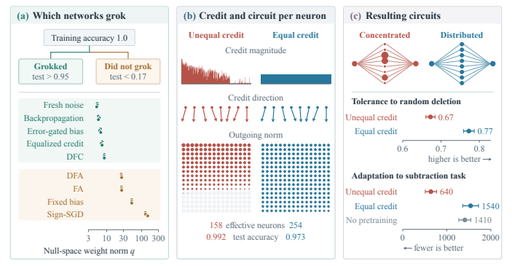
Figure 1 : The learning rule selects whether a network groks, how many neurons implement the grokked algorithm, and the resulting robustness and adaptation.(a)All runs fit the training set, and only some then generalize to the held-out pairs. Each dot is one seed and shows the null-space weight normqat the end of training (Section 4.3).(b)First hidden layer of two networks that share data and initialization. The credit of a neuron is the gradient of its incoming weights. Under backpropagation with Adam the credit is unequal (top row, relative to the layer mean and averaged over training), and neurons that receive little credit end with small outgoing weights. Credit equalization makes the magnitudes equal before the gradient enters the optimizer (Adam) and keeps every gradient’s direction (middle row, schematic). Dots show the256neurons in the order of the top row, with area proportional to the outgoing norm. Effective counts are for this seed, and the three-seed means are154and254.(c)Tolerance is the normalized area under the curve of test accuracy against the fraction of randomly deleted neurons. Adaptation is the number of epochs to test accuracy0.9on subtraction, starting from the addition network or from scratch (without pretraining). The network drawings are schematic,µ±σare over ten seeds (Table 22 and Appendix E.1).
원문 · CC BY 4.0 · Pascal Sager, Benjamin Grewe, Pau Vilimelis Aceituno, Thilo Stadelmann · Grokking Can Be Steered: Selecting Desirable Solutions By Choice Of Learning Rule · 원문 그림 인용 · 원본 PDF 2쪽에서 그림 영역을 추출했습니다.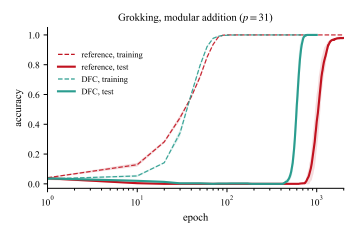
Figure 4 : Training (dashed) and test (solid) accuracy for the reference and DFC on modular addi- tion (p= 31), three seeds with shared initializations, evaluated every10epochs; bands show one standard deviation across seeds, and the DFC runs end at epoch1000. Both fit the training set first and generalize hundreds of epochs later.
원문 · CC BY 4.0 · Pascal Sager, Benjamin Grewe, Pau Vilimelis Aceituno, Thilo Stadelmann · Grokking Can Be Steered: Selecting Desirable Solutions By Choice Of Learning Rule · 원문 그림 인용 · 원본 PDF 15쪽에서 그림 영역을 추출했습니다.신용 등화와 참여율 측정
신용은 한 뉴런의 입력 가중치 gradient 노름으로 정의됩니다. 신용 등화는 각 뉴런의 gradient 크기를 평균 쪽으로 옮기되 방향은 유지하며, 이 보정을 Adam에 넣기 전에 적용합니다. 회로 집중도는 첫 번째 은닉층 뉴런의 외향 가중치 노름으로 계산한 참여율 PR로 측정합니다. PR은 1/n에서 1 사이의 값을 가지며, 모든 노름이 같으면 1이 됩니다. 저자들은 이 지표로 기준 학습 규칙과 뉴런별로 신용을 맞춘 변형을 비교했습니다.
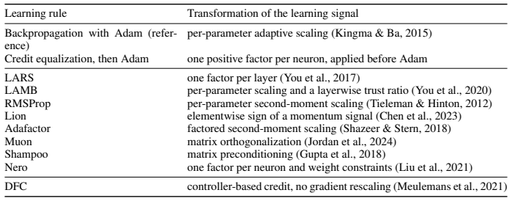
Table 1 : Learning rules under test, grouped by how they transform the learning signal. Rules that enter only Section 4.3 are not listed. Settings are given in Appendix A.
원문 · CC BY 4.0 · Pascal Sager, Benjamin Grewe, Pau Vilimelis Aceituno, Thilo Stadelmann · Grokking Can Be Steered: Selecting Desirable Solutions By Choice Of Learning Rule · 원문 그림 인용 · 원본 PDF 5쪽에서 그림 영역을 추출했습니다.
Table 2 : Rescaling only the non-gradient term of each neuron’s update reproduces credit equaliza- tion in all three cases. Equalizing the gradients while holding each neuron’s ratio of credit to that term fixed keeps the circuit concentrated for the decay and the gain and removes about half of the effect forϵ(circuit participation, five seeds per cell). For the gain, equalization and rescaling act on the gain and the outgoing weights as well as the incoming rows; equalizing the incoming rows alone gives0.364. Update equations and details in Appendices C.6, F.5 and F.7.
원문 · CC BY 4.0 · Pascal Sager, Benjamin Grewe, Pau Vilimelis Aceituno, Thilo Stadelmann · Grokking Can Be Steered: Selecting Desirable Solutions By Choice Of Learning Rule · 원문 그림 인용 · 원본 PDF 7쪽에서 그림 영역을 추출했습니다.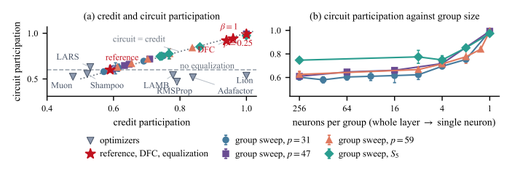
Figure 3 : Circuit participation under different transformations of the learning signal.(a)Circuit participation against credit participation for the reference, DFC, credit equalization atβ= 0.25and β= 1, the group-size sweep on four tasks and seven optimizers. Credit participation is measured on the signal listed in Table 4.(b)Circuit participation against the number of neurons that share one normalization factor, on modular addition at three moduli and onS 5. Error bars show one standard deviation across three seeds.
원문 · CC BY 4.0 · Pascal Sager, Benjamin Grewe, Pau Vilimelis Aceituno, Thilo Stadelmann · Grokking Can Be Steered: Selecting Desirable Solutions By Choice Of Learning Rule · 원문 그림 인용 · 원본 PDF 8쪽에서 그림 영역을 추출했습니다.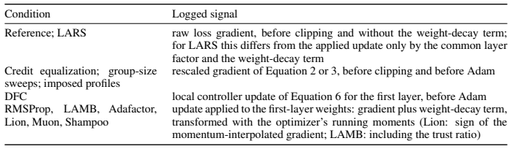
Table 4 : Signal on which credit participation is measured, per condition. All signals are for the first hidden layer, with one row per neuron.
원문 · CC BY 4.0 · Pascal Sager, Benjamin Grewe, Pau Vilimelis Aceituno, Thilo Stadelmann · Grokking Can Be Steered: Selecting Desirable Solutions By Choice Of Learning Rule · 원문 그림 인용 · 원본 PDF 16쪽에서 그림 영역을 추출했습니다.뉴런 삭제와 새 연산 적응의 차이
분산된 회로는 무작위 뉴런 삭제에 더 잘 견뎠습니다. 반면 집중된 회로는 더 많이 가지치기되었고, 뺄셈 과제로 옮길 때 약 두 배 빠르게 적응했습니다. 이 적응 이득은 사용되지 않은 뉴런이 많은 집중 회로에서 주로 나왔다고 저자들은 해석합니다. 이 비교는 모듈러 덧셈 구성에서 얻은 결과이며, 다른 과제 전반으로 확대된 결과는 아닙니다.
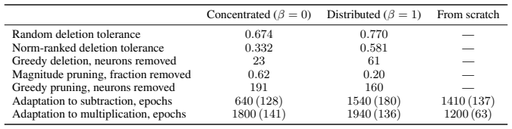
Table 3 : Deletion tolerance and adaptation of the concentrated and the distributed circuit on modular addition (p= 31). Means over three seeds for deletion, five for pruning to test accuracy0.9(Ap- pendix E.1), ten for subtraction and five for multiplication, with standard deviations in parentheses (Table 22).
원문 · CC BY 4.0 · Pascal Sager, Benjamin Grewe, Pau Vilimelis Aceituno, Thilo Stadelmann · Grokking Can Be Steered: Selecting Desirable Solutions By Choice Of Learning Rule · 원문 그림 인용 · 원본 PDF 9쪽에서 그림 영역을 추출했습니다.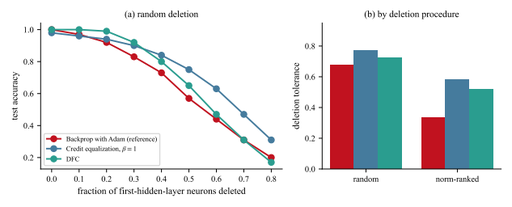
Figure 6 : Neuron deletion for the reference, full credit equalization (β= 1) and DFC on modular addition (p= 31, three seeds).(a)Test accuracy against the fraction of randomly deleted first- hidden-layer neurons.(b)Deletion tolerance, the normalized area under the accuracy curve over the deletion fractions, under random and norm-ranked deletion.
원문 · CC BY 4.0 · Pascal Sager, Benjamin Grewe, Pau Vilimelis Aceituno, Thilo Stadelmann · Grokking Can Be Steered: Selecting Desirable Solutions By Choice Of Learning Rule · 원문 그림 인용 · 원본 PDF 26쪽에서 그림 영역을 추출했습니다.
Table 15 : Deletion tolerance under random and norm-ranked deletion (modular addition,p= 31, three seeds). Norm-ranked deletion removes neurons in decreasing order of outgoing norm.
원문 · CC BY 4.0 · Pascal Sager, Benjamin Grewe, Pau Vilimelis Aceituno, Thilo Stadelmann · Grokking Can Be Steered: Selecting Desirable Solutions By Choice Of Learning Rule · 원문 그림 인용 · 원본 PDF 26쪽에서 그림 영역을 추출했습니다.
Table 20 : Fine-tuning from addition to subtraction with the reference rule or with full credit equal- ization, for a concentrated and a distributed source network (modular addition,p= 31, five seeds; standard deviations in parentheses). Adaptation time is the number of epochs to test accuracy0.9, evaluated every20epochs.
원문 · CC BY 4.0 · Pascal Sager, Benjamin Grewe, Pau Vilimelis Aceituno, Thilo Stadelmann · Grokking Can Be Steered: Selecting Desirable Solutions By Choice Of Learning Rule · 원문 그림 인용 · 원본 PDF 29쪽에서 그림 영역을 추출했습니다.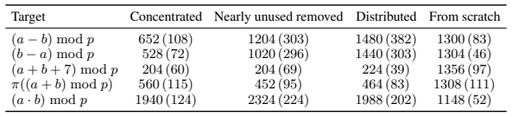
Table 21 : Adaptation from addition to five targets, in epochs to test accuracy0.9(modular addition source,p= 31, five seeds; standard deviations in parentheses). The third column is the concentrated network with its nearly unused neurons removed.
원문 · CC BY 4.0 · Pascal Sager, Benjamin Grewe, Pau Vilimelis Aceituno, Thilo Stadelmann · Grokking Can Be Steered: Selecting Desirable Solutions By Choice Of Learning Rule · 원문 그림 인용 · 원본 PDF 30쪽에서 그림 영역을 추출했습니다.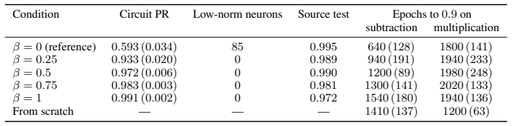
Table 22 : Fine-tuning from addition to a new operation, with standard deviations in parentheses. Subtraction results forβ= 0,0.25,1and from scratch use ten seeds; the intermediate settings and all multiplication results use five. Adaptation time is the number of epochs to test accuracy0.9. Low-norm neurons have an outgoing norm below one tenth of the layer mean.
원문 · CC BY 4.0 · Pascal Sager, Benjamin Grewe, Pau Vilimelis Aceituno, Thilo Stadelmann · Grokking Can Be Steered: Selecting Desirable Solutions By Choice Of Learning Rule · 원문 그림 인용 · 원본 PDF 30쪽에서 그림 영역을 추출했습니다.이론과 실험의 적용 범위
이론은 적응형 정규화가 없는 단순화된 선형 모델에 한정되며, 비선형 네트워크와 옵티마이저에 대한 결과는 경험적입니다. 알고리즘 검사는 모듈러 덧셈에서만 수행되었습니다. 적응 이득은 네트워크 구조를 새 은닉 조합이 필요한 목표에서 나타났고, 판독층만 바꾼 목표에서는 나타나지 않았습니다.
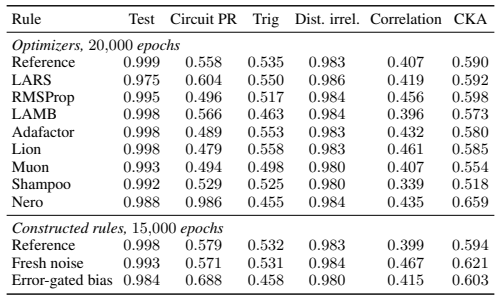
Table 7 : Algorithm checks for the remaining grokking rules (modular addition,p= 31, three seeds, one shared data split). Trig: fraction of logit variance explained by the(a+b−c)basis. Distance irrelevance: the statistic of Zhong et al. (2023), above0.6for clock networks and below0.6for pizza networks. Correlation and CKA: agreement with the reference trained in the same way, across initializations; the reference rows give its agreement with itself. The optimizers are trained for 20,000epochs and the constructed rules for15,000, each with its own reference. The seeds share one data split, so the values differ slightly from Table 13, whose seeds use different splits.
원문 · CC BY 4.0 · Pascal Sager, Benjamin Grewe, Pau Vilimelis Aceituno, Thilo Stadelmann · Grokking Can Be Steered: Selecting Desirable Solutions By Choice Of Learning Rule · 원문 그림 인용 · 원본 PDF 19쪽에서 그림 영역을 추출했습니다.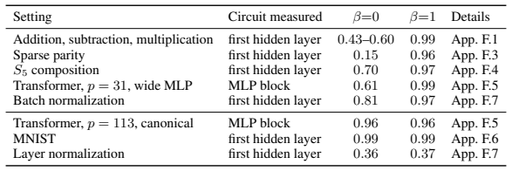
Table 24 : Circuit participation of the reference (β=0) and under full credit equalization (β=1) across the tested settings. Test accuracies and seed counts are given in the cited subsections. Sparse parity and MNIST show no grokking delay. The last three settings are unchanged: two start from a distributed circuit, and with layer normalization the reference is concentrated.
원문 · CC BY 4.0 · Pascal Sager, Benjamin Grewe, Pau Vilimelis Aceituno, Thilo Stadelmann · Grokking Can Be Steered: Selecting Desirable Solutions By Choice Of Learning Rule · 원문 그림 인용 · 원본 PDF 31쪽에서 그림 영역을 추출했습니다.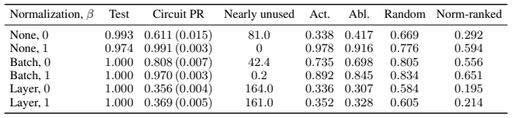
Table 30 : Normalization layers after each hidden linear map (modular addition,p= 31, five seeds; standard deviations in parentheses). Columns as in Table 12.
원문 · CC BY 4.0 · Pascal Sager, Benjamin Grewe, Pau Vilimelis Aceituno, Thilo Stadelmann · Grokking Can Be Steered: Selecting Desirable Solutions By Choice Of Learning Rule · 원문 그림 인용 · 원본 PDF 35쪽에서 그림 영역을 추출했습니다.논문 정보
- 저자
- Pascal Sager, Benjamin Grewe, Pau Vilimelis Aceituno, Thilo Stadelmann
- 학회·저널
- arXiv · 프리프린트
- 최초 공개일
- 2026년 11월 14일
- 등록일
- 2026년 11월 17일
- 수정일
- 2026년 11월 14일
- 버전
- v1
- arXiv
- 2611.19477
- 분류
- cs.LG
- 원문 이용 조건
- CC BY 4.0
- 제공 범위
- 논문 정보, 해설, 허용된 원문 그림
AI 해설은 논문 원문과 별개의 설명이며 오류가 있을 수 있습니다. 원문과 그림은 각 출처의 이용 조건과 따로 표시된 권리를 따릅니다.
초록
During grokking, a network transitions from memorization to generalization, yet what shapes the neural implementation (circuit) of the generalizing solution and specifically the number of participating neurons (its size) remains unclear. We find that the learning rule, the combination of credit assignment algorithm and optimizer, controls this: On modular addition, every learning rule we study that groks recovers the same Fourier-based algorithm, yet implemented by circuits that differ in size. Why? A neuron stays in use when its credit is large relative to the non-gradient term of its own update, and this single condition unifies three routes to unused neurons: the coupled weight decay, Adam's $ε$ and the decay of a trainable per-neuron gain. Equalizing the magnitude of credit assigned to each neuron, or scaling each neuron's weight decay by its credit, expands the effective circuit size, measured from the outgoing weights, from 60% to 99% of the layer's neurons at similar training and test accuracy. We vary which neurons share one equalization factor, from the whole layer to individual neurons, and find that the circuit stays concentrated for groups of eight or more and fully distributes only when every neuron has its own factor. Credit magnitudes are usually set by the normalization of standard optimizers: Nero, which normalizes per neuron, distributes the computation, whereas Adam and seven others, including RMSProp, Muon, and Shampoo, use other normalization schemes and retain small, concentrated circuits. Distributed circuits tolerate neuron deletion better, while concentrated circuits can be pruned further and transfer about twice as fast to a task that recombines the same features, largely by recruiting their unused neurons. Learning rule choice thus steers circuit size, trading robustness against compressibility and transfer speed without changing the learned algorithm.
원문 인용
Pascal Sager, Benjamin Grewe, Pau Vilimelis Aceituno, Thilo Stadelmann (2026). Grokking Can Be Steered: Selecting Desirable Solutions By Choice Of Learning Rule. arXiv:2611.19477v1. https://arxiv.org/abs/2611.19477v1
BibTeX
@misc{sager2026grokking,
  title = {{Grokking Can Be Steered: Selecting Desirable Solutions By Choice Of Learning Rule}},
  author = {Pascal Sager and Benjamin Grewe and Pau Vilimelis Aceituno and Thilo Stadelmann},
  year = {2026},
  eprint = {2611.19477},
  archivePrefix = {arXiv},
  url = {https://arxiv.org/abs/2611.19477v1}
}