논문 해설
ParseBench-2: Severity-Aware Evaluation of Document Parsing
ParseBench-2: 문서 파싱을 위한 심각도 인식 평가
- 연구 문제 기존 파싱 지표는 전체 출력 유사도 평균이나 단순 규칙 통과율로 계산되어, 숫자 한 개의 사실 오류가 점수에 충분히 반영되지 않는 경우가 있습니다.
- 연구 방법 사람이 정한 심각도 정책을 테스트 시나리오로 고정하고, 지표 구현을 반복 수정해 정책 목표에 맞춥니다.
- 주요 결과 ParseBench-2 지표는 여섯 묶음 모두에서 벤치마크 지표 가운데 가장 높은 PCS를 기록했고, 치명적 시나리오의 96%에서 목표 하락을 충족했습니다.
기존 파싱 지표가 놓치는 오류
문서 파싱 결과를 평가하는 지표는 전체 출력의 유사도를 평균내는 방식이 많습니다. 이렇게 하면 긴 페이지에서 숫자 하나가 바뀌어도 점수가 거의 움직이지 않습니다. 반대로 HTML 태그처럼 값과 헤더 관계가 그대로인 차이에는 감점이 생기기도 합니다. 규칙 기반 검사는 요구 사항을 명시하지만 실패한 검사마다 같은 가중치를 주어, 사소한 서식 실수와 잘못된 숫자가 같은 무게로 계산됩니다. 이 논문은 이런 상황에서 사람이 판단하는 오류의 결과 자체를 지표 설계의 목표로 삼는 문제를 다룹니다.
Figure 5 Content Faithfulness gives both outputs the same score despite the invented percentage table in Mistral’s output. ParseBench-2 identifies the error. Output excerpts are rendered with image placeholders omitted and the invented content highlighted.
원문 · CC BY 4.0 · Pierre-Loïc Doulcet, Boyang Zhang, Sebastián G. Acosta, Sacha Bron, Daniel B. Ospina, Antonio Jimeno Yepes, Nutchapol Dendumrongsup, Simon Suo · ParseBench-2: Severity-Aware Evaluation of Document Parsing · 원문 그림 인용 · 원본 PDF 10쪽에서 그림 영역을 추출했습니다.심각도 정책과 테스트 시나리오
저자들은 먼저 오류 유형마다 점수에 어떤 영향을 줄지 정한 심각도 정책을 둡니다. 심각도는 치명적, 주요, 경미, benign의 네 단계이며, 정책은 각 단계에 최소 점수 하락 또는 무변화를 지정합니다. 정책은 전문가 판단이므로 사용자가 자신의 응용에 맞춰 바꿀 수 있습니다. 각 테스트 시나리오는 한 페이지의 정답 출력에 하나의 제어된 변경을 가한 것이며, 그 변경에 대해 요구되는 점수 하락 구간을 목표로 가집니다. 예를 들어 금액을 바꾸는 변경은 치명적으로 분류되어 최소 10점 하락이 목표이고, 같은 값을 다른 표 형식으로 옮긴 변형은 benign으로 점수가 변하지 않아야 합니다.
지표 최적화와 점수 결합
정책의 목표와 시나리오는 고정하고, 지표 구현만 후보 집합 안에서 바꿉니다. 각 시나리오에서 정답 출력 점수와 변형 출력 점수의 차이를 점수 하락량으로 두고, 그 값이 목표 구간에서 얼마나 벗어나는지를 거리로 계산합니다. 최적화 목적은 이 거리 제곱의 합을 줄이는 것입니다. 코딩 에이전트가 실패한 시나리오를 보고 수정안을 제안하면, 사람이 검토해 합이 줄고 이미 맞던 시나리오를 깨지 않는 변경만 남깁니다. 최종 벤치마크 점수는 파싱 점수 m(y, r)과 severity cap c 중 작은 값입니다. cap은 1에서 검출 오류의 결합 페널티를 뺀 값을 0 아래로 내리지 않도록 정하므로, 대부분이 맞더라도 치명적 오류가 있으면 점수가 제한됩니다.
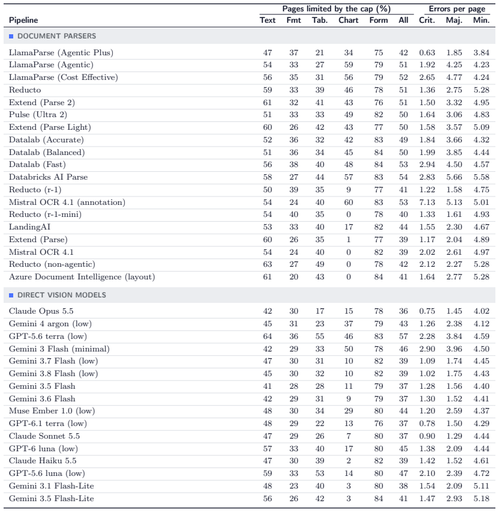
Table 18 Pages where the cap determines the final score, and mean penalized errors per scored page. All combines the five dimensions with a cap. Fmt scores Formatting on the Text core pages. Error counts are pooled across these five core collections. Visual grounding has no cap.
원문 · CC BY 4.0 · Pierre-Loïc Doulcet, Boyang Zhang, Sebastián G. Acosta, Sacha Bron, Daniel B. Ospina, Antonio Jimeno Yepes, Nutchapol Dendumrongsup, Simon Suo · ParseBench-2: Severity-Aware Evaluation of Document Parsing · 원문 그림 인용 · 원본 PDF 55쪽에서 그림 영역을 추출했습니다.정책 준수 평가
여섯 개 테스트 묶음 각각에서 ParseBench-2 지표를 벤치마크 지표 및 기준 지표와 비교했습니다. 다섯 개의 실제 페이지 묶음에서는 각 페이지 100개에 섭동을 적용해 총 16,059개의 채점 시나리오를 평가했습니다. 정책 준수 요약 PCS는 치명적·주요·경미 오류의 위반 비율에 0.5, 0.3, 0.2를 곱하고 benign 위반 비율을 더해 100에서 빼는 방식입니다. 이 값으로 ParseBench-2 지표는 여섯 묶음 모두에서 벤치마크 지표 중 가장 높은 PCS를 기록했습니다. Formatting 지표는 치명적 시나리오의 96%에서 목표 하락을 충족했고, ParseBench-1 Semantic Formatting은 5%에서 충족했습니다.
무해한 변형에 대한 감점은 어느 묶음에서도 3.4%를 넘지 않았습니다.
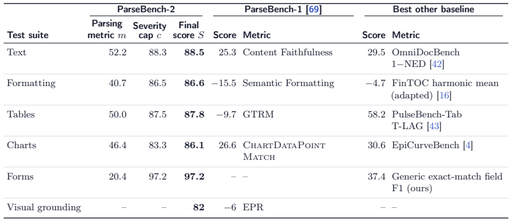
Table 1 Policy-compliance summary (PCS; higher is better) for ParseBench-2 and baseline metrics.
원문 · CC BY 4.0 · Pierre-Loïc Doulcet, Boyang Zhang, Sebastián G. Acosta, Sacha Bron, Daniel B. Ospina, Antonio Jimeno Yepes, Nutchapol Dendumrongsup, Simon Suo · ParseBench-2: Severity-Aware Evaluation of Document Parsing · 원문 그림 인용 · 원본 PDF 8쪽에서 그림 영역을 추출했습니다.LLM 판정과의 비교
대안으로 PAIR 프롬프트를 쓰는 LLM 판정도 같은 오류와 benign 변형에서 시험했습니다. 판정기는 정답에 가까운 출력을 대체로 선호했습니다. 그러나 두 출력이 모두 오류를 포함한 경우에는 심각도가 더 큰 오류를 가진 출력을 고르는 비율이 29%에 그쳤습니다. 저자들은 이 결과가 판정 방식을 심각도 정책에 맞추는 개선이 필요하다는 근거라고 봅니다.
논문 정보
- 저자
- Pierre-Loïc Doulcet, Boyang Zhang, Sebastián G. Acosta, Sacha Bron, Daniel B. Ospina, Antonio Jimeno Yepes, Nutchapol Dendumrongsup, Simon Suo
- 학회·저널
- arXiv · 프리프린트
- 최초 공개일
- 2026년 11월 12일
- 등록일
- 2026년 11월 16일
- 수정일
- 2026년 11월 12일
- 버전
- v1
- arXiv
- 2611.17400
- 분류
- cs.CV
- 원문 이용 조건
- CC BY 4.0
- 제공 범위
- 논문 정보, 해설, 허용된 원문 그림
AI 해설은 논문 원문과 별개의 설명이며 오류가 있을 수 있습니다. 원문과 그림은 각 출처의 이용 조건과 따로 표시된 권리를 따릅니다.
초록
Document-parsing metrics can give high scores to outputs that change important facts and penalize changes that preserve meaning. People can often judge these consequences more easily than they can design a metric to measure them. We introduce a method for developing parsing metrics from severity policies that specify how each error type should affect the score. We express these policies through test scenarios that specify how a metric should behave. We then optimize the metric implementations against these fixed expectations, using coding agents to refine comparison rules, error detectors and weights under human review. This makes stated human priorities an explicit objective of metric design. We apply this method in ParseBench-2, a comprehensive document-parsing benchmark that combines broad capability coverage with metrics calibrated to error severity. It covers 4,317 pages across six dimensions of parsing quality: text, formatting, tables, charts, visual grounding, and forms. We use detailed annotations and targeted difficult cases to check for changed facts, broken structural relationships, and missing content. We take the lower of a parsing score that measures content recovery and a severity cap that penalizes detected errors, so recovering most of a page cannot hide a serious error. Across six severity test suites, our metrics more closely match the expert judgments expressed by the scenario targets than existing metrics and penalize at most 3.4% of the tested benign variations. We conduct a comprehensive evaluation spanning frontier vision-language models, specialized document parsers and open-weight systems, comparing their overall rankings, performance across parsing capabilities and tradeoffs between accuracy and cost.
원문 인용
Pierre-Loïc Doulcet, Boyang Zhang, Sebastián G. Acosta, Sacha Bron, Daniel B. Ospina, Antonio Jimeno Yepes, Nutchapol Dendumrongsup, Simon Suo (2026). ParseBench-2: Severity-Aware Evaluation of Document Parsing. arXiv:2611.17400v1. https://arxiv.org/abs/2611.17400v1
BibTeX
@misc{doulcet2026parsebench,
  title = {{ParseBench-2: Severity-Aware Evaluation of Document Parsing}},
  author = {Pierre-Loïc Doulcet and Boyang Zhang and Sebastián G. Acosta and Sacha Bron and Daniel B. Ospina and Antonio Jimeno Yepes and Nutchapol Dendumrongsup and Simon Suo},
  year = {2026},
  eprint = {2611.17400},
  archivePrefix = {arXiv},
  url = {https://arxiv.org/abs/2611.17400v1}
}