논문 해설
Automatically Interpreting Millions of Features in Large Language Models
대규모 언어 모델의 수백만 개 특징을 자동으로 해석하기
- 연구 문제 수백만 개의 SAE 특징을 LLM으로 자동 해석하고, 시뮬레이션 채점보다 저렴한 방법으로 평가하는 문제를 다룹니다.
- 연구 방법 SAE 활성값을 수집하고, 설명기 LLM으로 특징 해석을 만든 뒤, 해석이 활성 맥락과 비활성 맥락을 구분하는 정도를 여러 채점 기법으로 평가합니다.
- 주요 결과 fuzzing이 인간 평가와 시뮬레이션 점수와 가장 높은 상관을 보이며, fuzzing과 detection은 시뮬레이션보다 크게 저렴하다고 보고합니다.
연구 문제: 수백만 개 SAE 특징의 자동 해석
대규모 언어 모델의 뉴런 활성값은 사람이 바로 이해할 수 있는 형태가 아닌 경우가 많습니다. 희소 오토인코더(SAE)는 이 활성값을 더 높은 차원의 잠재 공간으로 바꾸어 해석하기 쉽게 만들 수 있지만, 하나의 SAE가 수백만 개의 특징을 가질 수 있어 사람이 각 특징을 일일이 해석하기는 어렵습니다[passage:p003][passage:p004]. 이 논문은 SAE 특징마다 자연어 해석을 생성하고 평가하는 오픈소스 자동 파이프라인을 구축하며, 기존 시뮬레이션 채점보다 저렴한 다섯 가지 새로운 채점 기법을 도입합니다[passage:p001].
자동 해석 파이프라인의 세 단계
파이프라인은 활성값 수집, 해석 생성, 해석 채점의 세 단계로 구성됩니다. 먼저 SAE의 활성값을 RedPajama-v2에서 얻은 10M 토큰 샘플로 수집하며, 이 샘플은 Gemma 2 9b SAE의 활성 수집에 사용됩니다[passage:p007]. 이후 특징마다 관련 맥락을 골라 설명기 LLM인 Llama 3.1 70b Instruct에 40개의 활성 예시(각 32토큰)를 보여 주고 짧은 자연어 해석을 만들게 합니다[passage:p008][passage:p009]. 마지막으로 채점기 LLM이 이 해석만 가지고 활성 맥락과 비활성 맥락을 구분하도록 하여 해석의 품질을 평가합니다[passage:p010].
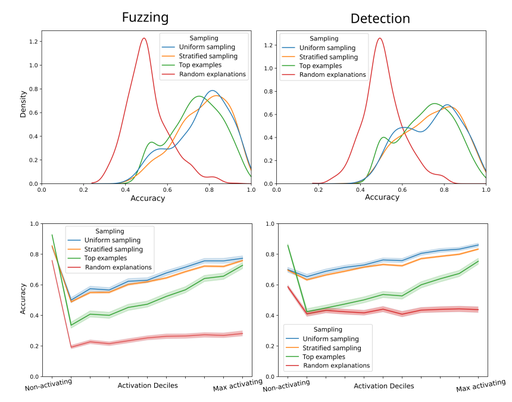
Figure 2 . Fuzzing and detection scores for different sampling techniques. Panels a) and b) show the distributions of fuzzing and detection scores, respectively, as a function of different example sampling methods for interpretation generation. Sampling only from the top activation gets on average lower accuracy in fuzzing and on detection when compared with uniform sampling and stratified sampling. The distributions from random sampling and sampling from quantiles are very similar. Panels c) and d) measure how the interpretations generalize across activation quantiles, showing that interpretations generated from the top quantiles are better at distinguishing non-activating examples, but have lower accuracy on other quantiles, especially on the lower activating deciles. This also happens for the other interpretations, but the accuracy does not drop as much in lower activating deciles. We also show the scores of random explanations.
원문 · CC BY 4.0 · Gonçalo Paulo, Alex Mallen, Caden Juang, Nora Belrose · Automatically Interpreting Millions of Features in Large Language Models · 원문 그림 인용 · 원본 PDF 7쪽에서 그림 영역을 추출했습니다.해석 채점 방법과 시뮬레이션 채점과의 차이
기존 방법인 시뮬레이션 채점은 설명기 모델이 해석을 바탕으로 맥락 안의 각 토큰 활성을 예측하게 하고, 예측과 실제 활성의 피어슨 상관을 점수로 씁니다[passage:p014]. 이 논문은 해석이 활성 맥락과 비활성 맥락을 구분하는 이진 분류기처럼 작동해야 한다는 관점을 취합니다[passage:p015]. 이에 따라 detection은 전체 예시가 특징을 활성화하는지 판별하고, fuzzing은 토큰 단위로 표시가 맞는지 판별하며, surprisal은 기본 언어 모델의 교차 엔트로피 감소로 정보 가치를 측정하고, embedding은 해석과 맥락의 유사도로 AUROC를 계산합니다[passage:p016][passage:p017][passage:p018][passage:p019].
개입 채점은 특징에 개입했을 때 출력 분포의 변화를 해석이 예측하는 정도를 측정하며, 개입 강도는 KL-divergence로 고정하여 비교합니다[passage:p020].
채점 방법 간 상관과 인간 평가 결과
인간 평가자와의 Spearman 상관에서는 fuzzing이 0.69로 가장 높고, simulation이 0.60, detection이 0.59로 보고됩니다. surprisal과 embedding은 각각 0.34와 0.32입니다[passage:p024]. 800개의 해석에 대한 상관 분석에서는 fuzzing이 simulation과 가장 높은 상관을 보이며, simulation은 detection, embedding, surprisal과는 상대적으로 낮은 상관을 보인다고 보고됩니다[passage:p023]. 계산 비용에서는 fuzzing과 detection이 AAO 방식의 시뮬레이션보다 최소 5배 저렴하며, TBT 방식의 시뮬레이션은 fuzzing과 detection보다 30배 이상 비싸다고 보고됩니다[passage:p022].
embedding 채점은 100개 맥락에 4000개 입력 토큰을 요구하며, 원문은 이를 약 $50/100k features로 추정합니다[passage:p023].

Table 1 . Estimated cost of the different scoring methods. Brackets represent tokens that can be cached, potentially saving costs, although we do not do these calculations here. The number of input and output tokens is computed considering 100 examples show, and using fewer examples would cost proportionally less.
원문 · CC BY 4.0 · Gonçalo Paulo, Alex Mallen, Caden Juang, Nora Belrose · Automatically Interpreting Millions of Features in Large Language Models · 원문 그림 인용 · 원본 PDF 6쪽에서 그림 영역을 추출했습니다.개입 점수와 fuzzing 점수의 관계
개입 점수는 맥락 기반 점수와 다른 관점에서 특징을 평가합니다. 원문은 fuzzing 점수와 개입 점수 사이에 약한 음의 상관이 있다고 보고하며, 이는 fuzzing 점수가 낮은 특징이 하류 효과로 더 잘 설명될 수 있음을 시사한다고 저자들은 해석합니다[passage:p026]. 이 관계는 Gemma 2 9B의 layer 32에서 측정된 결과이며, 해석 점수와 무작위 설명의 분포 차이는 이 채점 방법의 타당성을 뒷받침하는 근거로 제시됩니다[passage:p025][passage:p027].
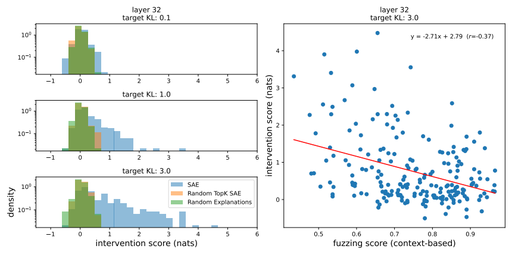
Figure 3 . Intervention scores. Here we present intervention scores (Sec 3.3.5) for SAE features in Gemma 2 9B at layer 32. Left: SAE features are more interpretable than random features, especially when intervening more strongly. Our explainer also produces interpretations that are scored higher than random interpretations. Right: Many features that would normally be uninterpreted when using context-based automatic interpretability are interpretable in terms of their effects on output.
원문 · CC BY 4.0 · Gonçalo Paulo, Alex Mallen, Caden Juang, Nora Belrose · Automatically Interpreting Millions of Features in Large Language Models · 원문 그림 인용 · 원본 PDF 8쪽에서 그림 영역을 추출했습니다.한계와 적용 범위
저자들은 일부 점수화 방법이 추가 개선을 필요로 하며, 특히 비활성 예시 선택을 더 다듬어야 한다고 밝힙니다[passage:p031]. 또한 현재 점수는 해석의 길이를 고려하지 않습니다[passage:p031]. 긴 맥락에서 활성화되는 특징은 32토큰 예시 기반 파이프라인으로 잘 포착되지 않을 수 있다고 원문이 설명합니다[passage:p009]. 여기서 얻은 결과는 해당 실험의 모델, 데이터셋, 채점기 설정에 한정하여 읽어야 합니다.
논문 정보
- 저자
- Gonçalo Paulo, Alex Mallen, Caden Juang, Nora Belrose
- 학회·저널
- arXiv · 프리프린트
- 최초 공개일
- 2024년 10월 17일
- 등록일
- 2026년 10월 29일
- 수정일
- 2025년 8월 6일
- 버전
- v3
- arXiv
- 2410.13928
- 분류
- cs.LG · cs.CL
- 원문 이용 조건
- CC BY 4.0
- 제공 범위
- 논문 정보, 해설, 허용된 원문 그림
AI 해설은 논문 원문과 별개의 설명이며 오류가 있을 수 있습니다. 원문과 그림은 각 출처의 이용 조건과 따로 표시된 권리를 따릅니다.
초록
While the activations of neurons in deep neural networks usually do not have a simple human-understandable interpretation, sparse autoencoders (SAEs) can be used to transform these activations into a higher-dimensional latent space which may be more easily interpretable. However, these SAEs can have millions of distinct latent features, making it infeasible for humans to manually interpret each one. In this work, we build an open-source automated pipeline to generate and evaluate natural language explanations for SAE features using LLMs. We test our framework on SAEs of varying sizes, activation functions, and losses, trained on two different open-weight LLMs. We introduce five new techniques to score the quality of explanations that are cheaper to run than the previous state of the art. One of these techniques, intervention scoring, evaluates the interpretability of the effects of intervening on a feature, which we find explains features that are not recalled by existing methods. We propose guidelines for generating better explanations that remain valid for a broader set of activating contexts, and discuss pitfalls with existing scoring techniques. We use our explanations to measure the semantic similarity of independently trained SAEs, and find that SAEs trained on nearby layers of the residual stream are highly similar. Our large-scale analysis confirms that SAE latents are indeed much more interpretable than neurons, even when neurons are sparsified using top-$k$ postprocessing. Our code is available at https://github.com/EleutherAI/sae-auto-interp, and our explanations are available at https://huggingface.co/datasets/EleutherAI/auto_interp_explanations.
원문 인용
Gonçalo Paulo, Alex Mallen, Caden Juang, Nora Belrose (2024). Automatically Interpreting Millions of Features in Large Language Models. arXiv:2410.13928v3. https://arxiv.org/abs/2410.13928v3
BibTeX
@misc{paulo2024automatically,
  title = {{Automatically Interpreting Millions of Features in Large Language Models}},
  author = {Gonçalo Paulo and Alex Mallen and Caden Juang and Nora Belrose},
  year = {2024},
  eprint = {2410.13928},
  archivePrefix = {arXiv},
  url = {https://arxiv.org/abs/2410.13928v3}
}