논문 해설
LIBRA: Programmatic Induction of Executable Tool Libraries
LIBRA: 실행 가능한 도구 라이브러리의 프로그램적 귀납
- 연구 문제 의미 유사도 기반 도구 검색은 요청에 직접 맞는 도구는 찾지만 여러 도구를 순서대로 써야 할 때 필요한 선행 도구를 놓칠 수 있습니다.
- 연구 방법 LIBRA는 LLM이 만든 도구 실행 계약을 샌드박스에서 실행하고, 반사실적 대조를 통과한 입력 출처·호환·상태 관계만 보존한 뒤 검색 시 한 홉 그래프 전파로 선행 도구 점수를 조정합니다.
- 주요 결과 일회성 검색에서 QTS 대비 Recall 7.9와 NDCG 3.7 퍼센트포인트, ToolReAGt 통합 검색에서 Recall 4.5와 NDCG 2.9 퍼센트포인트의 평균 향상을 보고합니다.
기존 도구 검색의 한계
대규모 도구 카탈로그에서 대형 언어 모델 에이전트는 사용자 요청과 가장 비슷한 도구를 골라야 합니다. 그러나 대부분의 검색기는 각 도구를 요청과의 유사도로 독립적으로 순위 매기므로, 여러 도구를 순서대로 써야 하는 작업에서 목표에 직접 맞는 도구만 찾고 인증, 식별자 조회, 상태 초기화, 형식 변환 같은 선행 도구를 놓칩니다. 이 논문은 의존 관계 주석, 도구 사용 궤적, 작업별 학습이 없는 새 실행 가능 카탈로그에서 이 문제를 다룹니다.
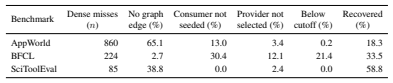
Table 3 : Recovery outcomes for query specific gold tool occurrences outside the top K under Dense retrieval. Each occurrence is assigned to exactly one outcome; percentages sum to 100 within each benchmark.
원문 · CC BY 4.0 · Zekai Li, Zhenke Liu, Yonghao Li, Junhan Liu, Xulong Xiao, Jiapeng Zhang · LIBRA: Programmatic Induction of Executable Tool Libraries · 원문 그림 인용 · 원본 PDF 7쪽에서 그림 영역을 추출했습니다.실행으로 검증하는 도구 라이브러리 구성
LIBRA는 먼저 각 도구의 공개 설명과 입출력 스키마만으로 LLM이 실행 계약을 만들고, 이를 격리된 샌드박스에서 실행합니다. 공급자 도구의 출력 값을 소비자 입력에 넣은 호출이 성공하고, 같은 소비자 호출에 독립적으로 만든 리터럴이나 생략을 넣은 대조군이 실패할 때만 입력 출처 관계를 보존합니다. 두 호출이 모두 성공하면 출력과 입력의 의미적 정렬을 추가로 확인해 호환 관계로 남깁니다. 환경 상태를 매개하는 의존은 같은 호출을 공급자 실행 전후에 한 번씩 수행해, 실행 전에는 실패하고 실행 후에는 성공할 때만 상태 의존으로 보존합니다.

Table 1 : Comparison of methods for learning tool dependencies. Prior methods either depend on existing tool use trajectories or training, or retain metadata inferred relations without runtime validation. LIBRA performs trajectory free, training free dependency induction and validates candidate tool compositions through execution in the target environment.
원문 · CC BY 4.0 · Zekai Li, Zhenke Liu, Yonghao Li, Junhan Liu, Xulong Xiao, Jiapeng Zhang · LIBRA: Programmatic Induction of Executable Tool Libraries · 원문 그림 인용 · 원본 PDF 2쪽에서 그림 영역을 추출했습니다.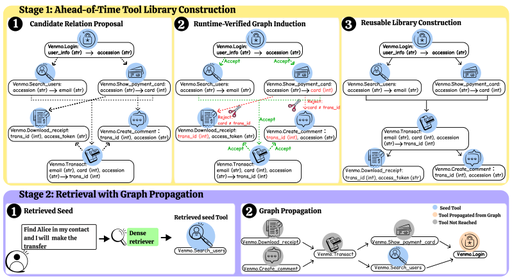
Figure 1 : Overview of LIBRA.Stage 1:Before user queries arrive, an LLM proposes an executable contract of each tool. LIBRA tests each candidate composition in the target runtime. Successful compositions are retained to construct the executable tool library, while unsuccessful ones are removed. For example, although card and trans_id share the same integer type, a payment card identifier cannot be used as a transaction identifier. Stage 2:Given the request “Find Alice in my contact and I will make the transfer,” dense retrieval returns Venmo.Search_users. LIBRA performs one-hop propagation and recovers its prerequisite toolVenmo.Login.
원문 · CC BY 4.0 · Zekai Li, Zhenke Liu, Yonghao Li, Junhan Liu, Xulong Xiao, Jiapeng Zhang · LIBRA: Programmatic Induction of Executable Tool Libraries · 원문 그림 인용 · 원본 PDF 3쪽에서 그림 영역을 추출했습니다.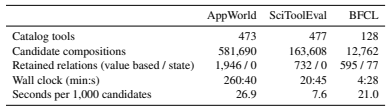
Table 5 : Library construction statistics. Candidate compositions are schema compatible combinations of provider exports and consumer inputs before runtime filtering. A single tool pair may contribute multiple candidate compositions. Relation counts report value based relations and state dependencies included in the benchmark specific retrieval graph. Normalized time is calculated from the recorded wall clock time and candi- date composition count.
원문 · CC BY 4.0 · Zekai Li, Zhenke Liu, Yonghao Li, Junhan Liu, Xulong Xiao, Jiapeng Zhang · LIBRA: Programmatic Induction of Executable Tool Libraries · 원문 그림 인용 · 원본 PDF 16쪽에서 그림 영역을 추출했습니다.검색 시 한 홉 그래프 전파
질의가 주어지면 기본 밀집 검색기가 각 도구에 정규화된 관련도 점수를 계산하고 상위 K_s개 도구를 시드 소비자로 고릅니다. 그 뒤 유지된 관계를 따라 각 시드 소비자의 입력마다 최대 두 공급자를 고르는데, 하나는 출력과 입력 필드 유사도가 가장 높은 공급자이고 다른 하나는 밀집 관련도가 가장 높은 공급자입니다. 한 공급자의 점수는 자신의 원래 점수와 연결된 시드 소비자 점수들의 평균을 비교하여 최댓값으로 갱신되며, 이 평균의 분모는 1과 연결된 소비자 수의 합입니다. 그래프 밖의 도구는 원래 밀집 점수를 유지하고, 조정된 점수의 상위 K_c개를 최종 후보로 씁니다.
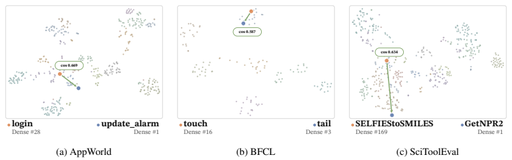
Figure 3 : We projected tool embeddings separately for each benchmark using t-SNE, with background colors indicating different clusters. In each example, Dense retrieval ranks the consumer (blue) within the topK but misses its provider (orange): (a) phone.update_alarm (#1) depends on phone.login (#28); (b) tail (#3) depends on touch (#16); and (c) GetNPR2 (#1) depends on SELFIEStoSMILES (#169). LIBRA follows the retained relation and recovers the provider. For SciToolEval and AppWorld, we observed runtime dependencies connecting tools across different clusters.
원문 · CC BY 4.0 · Zekai Li, Zhenke Liu, Yonghao Li, Junhan Liu, Xulong Xiao, Jiapeng Zhang · LIBRA: Programmatic Induction of Executable Tool Libraries · 원문 그림 인용 · 원본 PDF 7쪽에서 그림 영역을 추출했습니다.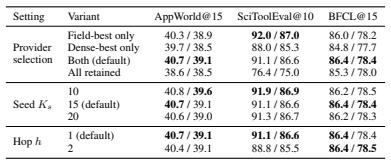
Table 6 : Sensitivity to retrieval-time settings. The in- duced library is fixed throughout. Values are R / NDCG (%).
원문 · CC BY 4.0 · Zekai Li, Zhenke Liu, Yonghao Li, Junhan Liu, Xulong Xiao, Jiapeng Zhang · LIBRA: Programmatic Induction of Executable Tool Libraries · 원문 그림 인용 · 원본 PDF 17쪽에서 그림 영역을 추출했습니다.일회성 검색과 에이전트 검색의 결과
일회성 검색에서 LIBRA는 같은 밀집 임베딩을 쓰는 QTS와 비교해 세 벤치마크 평균 Recall이 7.9 퍼센트포인트, NDCG가 3.7 퍼센트포인트 높습니다. AppWorld에서 가장 큰 차이가 나며, 그 과제에는 평균 8.18개의 도구가 필요합니다. ToolReAGt에 통합한 에이전트 검색에서는 세 벤치마크, 세 에이전트 LLM, 세 랜덤 시드에 걸쳐 평균 Recall과 NDCG가 각각 4.5와 2.9 퍼센트포인트 높습니다. 이 평균은 10회 반복 이후의 결과에 기반하며, 1회, 3회, 5회, 7회 반복 결과는 부록의 추가 그림에 있습니다.
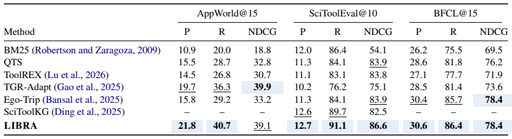
Table 2 : One-shot retrieval results without query time reranking. Dataset@K denotes the evaluation cutoff. Values are percentages. The best result in each column is highlighted, and the second best is underlined.
원문 · CC BY 4.0 · Zekai Li, Zhenke Liu, Yonghao Li, Junhan Liu, Xulong Xiao, Jiapeng Zhang · LIBRA: Programmatic Induction of Executable Tool Libraries · 원문 그림 인용 · 원본 PDF 5쪽에서 그림 영역을 추출했습니다.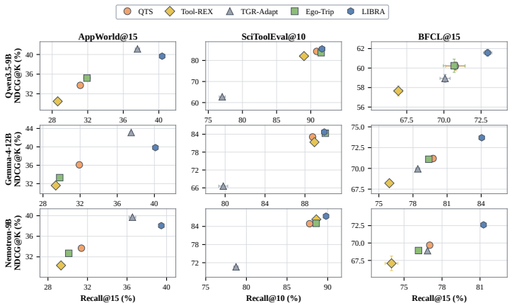
Figure 2 : Agentic retrieval after 10 iterations. Each panel reports Recall and NDCG for one agent LLM and benchmark. Points show the mean over three random seeds, and error bars show standard error. LIBRA attains the highest Recall in8of the9settings and the highest NDCG on SciToolEval and BFCL for all three agent LLMs.
원문 · CC BY 4.0 · Zekai Li, Zhenke Liu, Yonghao Li, Junhan Liu, Xulong Xiao, Jiapeng Zhang · LIBRA: Programmatic Induction of Executable Tool Libraries · 원문 그림 인용 · 원본 PDF 6쪽에서 그림 영역을 추출했습니다.검증 범위와 한계
반사실적 검증은 유지되는 관계의 정밀도를 통제하지만, 사전 구성 단계에서 질의별 환경을 관찰할 수 없어 일부 선행 도구의 관계가 애초에 제안되지 않을 수 있습니다. 이 한계는 AppWorld에서 크고 BFCL에서는 작다고 원문이 보고합니다. 또한 소비자가 시드로 검색되지 않으면 보존된 관계도 검색에 기여할 수 없습니다. 벤치마크는 격리 가능하고 재설정 가능한 런타임에서 실제로 실행되는 도구를 요구하며, 모의 응답만 제공하는 합성 도구 벤치마크에는 적용되지 않습니다.
논문 정보
- 저자
- Zekai Li, Zhenke Liu, Yonghao Li, Junhan Liu, Xulong Xiao, Jiapeng Zhang
- 학회·저널
- arXiv · 프리프린트
- 최초 공개일
- 2026년 11월 3일
- 등록일
- 2026년 11월 6일
- 수정일
- 2026년 11월 3일
- 버전
- v1
- arXiv
- 2611.05445
- 분류
- cs.SE · cs.AI · cs.IR
- 원문 이용 조건
- CC BY 4.0
- 제공 범위
- 논문 정보, 해설, 허용된 원문 그림
AI 해설은 논문 원문과 별개의 설명이며 오류가 있을 수 있습니다. 원문과 그림은 각 출처의 이용 조건과 따로 표시된 권리를 따릅니다.
초록
Large language model agents increasingly retrieve tools from large catalogs, yet most retrievers rank each tool independently by request similarity. For multi tool tasks, this recovers the goal matching tool while omitting prerequisite tools required by the workflow.We introduce LIBRA, a framework for Library Induction by Runtime Assembly that turns a flat tool catalog into an executable tool library. An LLM proposes per tool contracts of candidate invocations, reusable outputs and state changes, and success conditions; LIBRA then tests these compositions in a sandbox and retains the relations supported at runtime. Constructed before user queries, the library requires no dependency annotations, tool use trajectories, or task specific training, and supports both one-shot and agentic retrieval. On AppWorld, BFCL, and SciToolEval, LIBRA improves one-shot Recall and NDCG over the same dense retriever by 7.9 and 3.7 percentage points on average. Within ToolReAGt, it yields corresponding gains of 4.5 and 2.9 points after ten retrieval iterations.
원문 인용
Zekai Li, Zhenke Liu, Yonghao Li, Junhan Liu, Xulong Xiao, Jiapeng Zhang (2026). LIBRA: Programmatic Induction of Executable Tool Libraries. arXiv:2611.05445v1. https://arxiv.org/abs/2611.05445v1
BibTeX
@misc{li2026libra,
  title = {{LIBRA: Programmatic Induction of Executable Tool Libraries}},
  author = {Zekai Li and Zhenke Liu and Yonghao Li and Junhan Liu and Xulong Xiao and Jiapeng Zhang},
  year = {2026},
  eprint = {2611.05445},
  archivePrefix = {arXiv},
  url = {https://arxiv.org/abs/2611.05445v1}
}