논문 해설
Training AI Co-Scientists Using Rubric Rewards
루브릭 보상을 이용한 AI 공동 과학자 훈련
- 연구 문제 언어 모델은 모든 제약과 암묵적 요구를 만족하는 연구 계획을 만드는 데 어려움을 겪으며, 실험 기반 검증은 느리고 비용이 큽니다.
- 연구 방법 논문에서 연구 목표와 루브릭을 자동 추출하고, 동결된 초기 정책을 특권 정보 기반 자기 채점자로 사용하여 GRPO로 계획 생성 정책을 강화학습합니다.
- 주요 결과 ML 전문가 평가에서 fine-tuning 모델의 계획은 70.0%의 주석에서 선호되었고, 자동 평가에서는 Qwen-3-30B 초기 모델 대비 10-15% 향상이 보고되었습니다.
연구 문제와 기존 한계
언어 모델은 연구 목표와 제약이 주어졌을 때 모든 제약과 암묵적 요구사항을 만족하는 연구 계획을 만드는 데 어려움을 겪습니다. 실제 실험으로 계획을 검증하는 방식은 느리고 비용이 크며, 의료처럼 고충실도 시뮬레이터를 만들기 어려운 분야에서는 더 제한됩니다. 이 논문은 이 문제를 해결하기 위해 기존 연구 논문에서 연구 목표와 목표별 루브릭을 자동으로 추출하고, 이를 학습 신호로 사용하는 방법을 제안합니다.
논문 기반 학습 데이터와 자기 채점 보상
학습 데이터는 샘플 생성기가 논문에서 최대 세 개의 통찰을 추출하고, 각 통찰에 대해 연구 목표, 목표별 루브릭, 참조 해법을 만드는 과정으로 구성됩니다. 샘플 선택기는 루브릭을 10개로 줄이고 논문당 가장 높은 평균 점수의 샘플을 고릅니다. 학습 중 보상은 동결된 초기 정책이 채점자로 작동하여 계획을 평가하며, 루브릭 항목마다 일반 지침 위반 목록을 나열하게 합니다. 위반이 없는 항목의 비율이 보상으로 사용되고, 형식 위반은 별도의 페널티로 처리됩니다. 정책은 같은 입력에 대한 출력 집단 안에서 보상을 정규화하는 GRPO로 갱신됩니다.
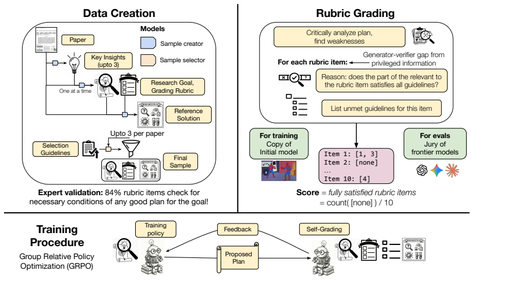
Figure 1 Summary of methodology. (Bottom)We train models to generate research plans for a given research goal. We obtain rewards for RL by using the initial model to grade generated plans with the help of rubrics.(Left)To collect training data, we use a sample creator model (Llama-4-Maverick) to extract up to three samples per research paper, each including a research goal, goal-specific grading rubric, and reference solution. For each of these components, we provide guidelines to a sample selector model (Claude-4-Sonnet) that picks one best sample per paper for our use. (Right)During grading, the goal-specific rubrics are used alongside a list of seven general guidelines that are checked for the part of the plan relevant to each rubric item. Rubric items that meet all guidelines are marked satisfied, and the fraction of satisfied rubric items is used as part of the training reward and evaluation scores.
원문 · CC BY 4.0 · Shashwat Goel, Rishi Hazra, Dulhan Jayalath, Timon Willi, Parag Jain, William F. Shen, Ilias Leontiadis, Francesco Barbieri, Yoram Bachrach, Jonas Geiping, Chenxi Whitehouse · Training AI Co-Scientists Using Rubric Rewards · 원문 그림 인용 · 원본 PDF 3쪽에서 그림 영역을 추출했습니다.인간 전문가 선호 평가
ML 테스트 샘플 100개에 대해 전문가 25명이 초기 Qwen-3-30B-A3B-Instruct 모델과 ML fine-tuning 모델의 계획을 비교했습니다. 각 샘플은 세 명의 전문가가 평가했습니다. fine-tuning 모델의 계획은 전체 주석의 70.0% ± 5.3%에서 선호되었습니다. 평균 점수는 초기 모델 7.31 ± 0.2, fine-tuning 모델 7.89 ± 0.2였습니다. 이 결과는 ML 도메인에 한정된 인간 평가이며, 의료와 ArXiv 결과는 프런티어 모델 심사단의 자동 평가에 의존합니다.
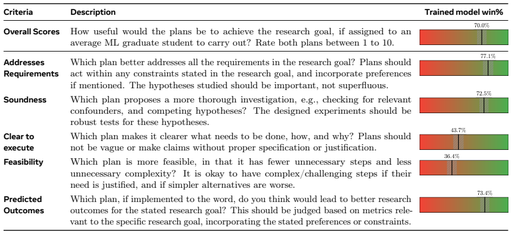
Table 1 Results from human expert annotations. Preference plots (right) show win-rates of research plans generated by the ML finetuned model over the initial Qwen-3-30B model across criteria, for a subset of 100 test set research goals inResearchPlanGenML. The shaded grey region shows the 95% confidence interval based on bootstrap sampling.
원문 · CC BY 4.0 · Shashwat Goel, Rishi Hazra, Dulhan Jayalath, Timon Willi, Parag Jain, William F. Shen, Ilias Leontiadis, Francesco Barbieri, Yoram Bachrach, Jonas Geiping, Chenxi Whitehouse · Training AI Co-Scientists Using Rubric Rewards · 원문 그림 인용 · 원본 PDF 7쪽에서 그림 영역을 추출했습니다.자동 평가와 도메인 일반화
자동 평가는 GPT-5-Thinking, Gemini-2.5-Pro, Claude-4-Sonnet 세 프런티어 모델의 평균 루브릭 채점으로 수행되었습니다. 미세조정된 Qwen-3-30B 모델은 초기 정책보다 상대적으로 10-15% 높은 점수를 보였고, 의료 도메인에서 학습한 모델은 ML과 ArXiv 연구 목표에서도 향상을 보였습니다. 다만 GPT-5-Thinking은 테스트한 모든 모델보다 높은 성능을 보였으며, 이 차이는 남아 있는 격차로 보고됩니다.
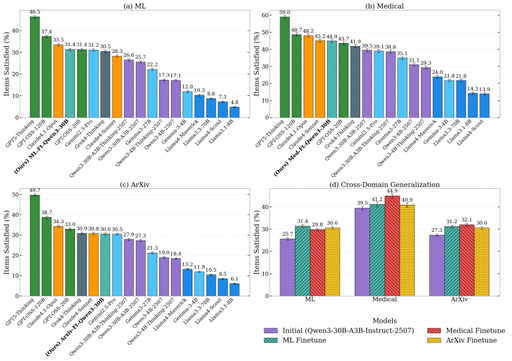
Figure 3 Research plan generation scores of models across research goals extracted from ML, medical, and arXiv papers.We report average scores on the full test sets across rubric grading by three frontier models, and use bootstrap sampling for error bars. In (a)-(c), we observe that our domain finetuned models always improve over the initial policy (Qwen-3- 30B-A3B-Instruct). We also find that GPT models consistently outperform the rest, while within model families, more recent and larger models perform better, as expected. In (d), we observe that our finetuning also leads to significant cross-domain generalization. For example, the medical finetune improves significantly on ML and arXiv research goals.
원문 · CC BY 4.0 · Shashwat Goel, Rishi Hazra, Dulhan Jayalath, Timon Willi, Parag Jain, William F. Shen, Ilias Leontiadis, Francesco Barbieri, Yoram Bachrach, Jonas Geiping, Chenxi Whitehouse · Training AI Co-Scientists Using Rubric Rewards · 원문 그림 인용 · 원본 PDF 8쪽에서 그림 영역을 추출했습니다.SFT, KL 페널티, 채점 모델 절제
Qwen-3-4B 기준의 절제 실험에서 참조 해법에 대한 SFT는 성능을 12.0에서 3.4로 낮췄고, 같은 설정의 RL은 21.7을 기록했습니다. 30B 채점 모델을 사용한 RL 설정에서는 KL 페널티를 제거했을 때 29.7, 포함했을 때 23.3이 보고되었습니다. 이 결과는 검증 세트에서 Claude-4-Sonnet 루브릭 판정으로 측정되었으며, 절제 결과는 각각의 비교 조건 안에서만 해석해야 합니다.
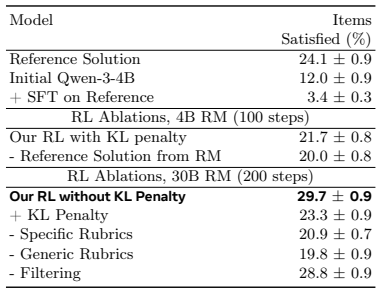
Table 2 Training ablations on a smaller Qwen-3-4B policy, leading up to our final methodology.Results are based on Claude-4-Sonnet rubric judgements on the validation set. We see that SFT worsens performance. For rubric RL, we see large improvements from disabling the KL penalty, and providing both the goal-specific rubrics andgeneral grading guidelines to the reward model (RM). We also see improvements from providing the grader a reference solution, and shifting from a 4B RM to a stronger 30B RM. In contrast, we see only a minor improvement from our filtering of training data.
원문 · CC BY 4.0 · Shashwat Goel, Rishi Hazra, Dulhan Jayalath, Timon Willi, Parag Jain, William F. Shen, Ilias Leontiadis, Francesco Barbieri, Yoram Bachrach, Jonas Geiping, Chenxi Whitehouse · Training AI Co-Scientists Using Rubric Rewards · 원문 그림 인용 · 원본 PDF 9쪽에서 그림 영역을 추출했습니다.한계와 적용 범위
인간 평가는 ML 도메인에서만 수행되었습니다. 의료와 ArXiv 결과는 프런티어 모델 심사단의 자동 평가에 기반하므로, 샘플 단위에서는 판정이 노이즈를 가질 수 있습니다. 자기 채점에 사용된 Qwen-3-30B 채점자는 비용 효율성 기준을 제대로 판정하지 못했고, 그 결과 fine-tuning 계획이 더 복잡해지는 경향이 보고되었습니다. 또한 더 강한 외부 채점자가 없는 상황에서 자기 채점에 의존하는 설계는 채점 모델 자체의 능력에 제약을 받습니다.
논문 정보
- 저자
- Shashwat Goel, Rishi Hazra, Dulhan Jayalath, Timon Willi, Parag Jain, William F. Shen, Ilias Leontiadis, Francesco Barbieri, Yoram Bachrach, Jonas Geiping, Chenxi Whitehouse
- 학회·저널
- arXiv · 프리프린트
- 최초 공개일
- 2025년 12월 29일
- 등록일
- 2026년 10월 30일
- 수정일
- 2025년 12월 29일
- 버전
- v1
- arXiv
- 2512.23707
- 분류
- cs.LG · cs.CL · cs.HC
- 원문 이용 조건
- CC BY 4.0
- 제공 범위
- 논문 정보, 해설, 허용된 원문 그림
AI 해설은 논문 원문과 별개의 설명이며 오류가 있을 수 있습니다. 원문과 그림은 각 출처의 이용 조건과 따로 표시된 권리를 따릅니다.
초록
AI co-scientists are emerging as a tool to assist human researchers in achieving their research goals. A crucial feature of these AI co-scientists is the ability to generate a research plan given a set of aims and constraints. The plan may be used by researchers for brainstorming, or may even be implemented after further refinement. However, language models currently struggle to generate research plans that follow all constraints and implicit requirements. In this work, we study how to leverage the vast corpus of existing research papers to train language models that generate better research plans. We build a scalable, diverse training corpus by automatically extracting research goals and goal-specific grading rubrics from papers across several domains. We then train models for research plan generation via reinforcement learning with self-grading. A frozen copy of the initial policy acts as the grader during training, with the rubrics creating a generator-verifier gap that enables improvements without external human supervision. To validate this approach, we conduct a study with human experts for machine learning research goals, spanning 225 hours. The experts prefer plans generated by our finetuned Qwen3-30B-A3B model over the initial model for 70% of research goals, and approve 84% of the automatically extracted goal-specific grading rubrics. To assess generality, we also extend our approach to research goals from medical papers, and new arXiv preprints, evaluating with a jury of frontier models. Our finetuning yields 12-22% relative improvements and significant cross-domain generalization, proving effective even in problem settings like medical research where execution feedback is infeasible. Together, these findings demonstrate the potential of a scalable, automated training recipe as a step towards improving general AI co-scientists.
원문 인용
Shashwat Goel, Rishi Hazra, Dulhan Jayalath, Timon Willi, Parag Jain, William F. Shen, Ilias Leontiadis, Francesco Barbieri, Yoram Bachrach, Jonas Geiping, Chenxi Whitehouse (2025). Training AI Co-Scientists Using Rubric Rewards. arXiv:2512.23707v1. https://arxiv.org/abs/2512.23707v1
BibTeX
@misc{goel2025training,
  title = {{Training AI Co-Scientists Using Rubric Rewards}},
  author = {Shashwat Goel and Rishi Hazra and Dulhan Jayalath and Timon Willi and Parag Jain and William F. Shen and Ilias Leontiadis and Francesco Barbieri and Yoram Bachrach and Jonas Geiping and Chenxi Whitehouse},
  year = {2025},
  eprint = {2512.23707},
  archivePrefix = {arXiv},
  url = {https://arxiv.org/abs/2512.23707v1}
}