논문 해설
A Survey on Physics Informed Reinforcement Learning: Review and Open Problems
물리 정보 기반 강화학습에 관한 서베이: 검토와 열린 문제
- 연구 문제 강화학습에 물리 사전정보를 통합하는 PIRL 연구들을 택소노미로 정리하고, 샘플 효율·고차원성·안전 탐색 등 열린 문제를 검토합니다.
- 연구 방법 강화학습 파이프라인을 골격으로 물리 정보의 형태와 반영 위치를 분류하고, 학습 구조와 대표 사례를 함께 정리합니다.
- 주요 결과 검토된 연구는 PPO를 가장 많이 사용하며 정책·제어기 설계에 집중되어 있습니다. 평가 환경이 연구마다 달라 공정한 비교가 어렵다는 점이 주요 과제로 제시됩니다.
물리 정보를 강화학습에 넣는 이유
강화학습은 환경과의 시행착오를 통해 정책을 익히지만, 실제 시스템에서는 시뮬레이터와 현실의 차이, 샘플 효율, 고차원 상태 공간, 안전 탐색 같은 문제가 남아 있습니다. 이 논문은 물리 사전정보(physics prior)를 강화학습의 상태, 행동, 보상, 정책 또는 가치 네트워크, 시뮬레이터에 통합하는 연구들을 PIRL(physics-informed reinforcement learning)로 묶어 검토합니다.
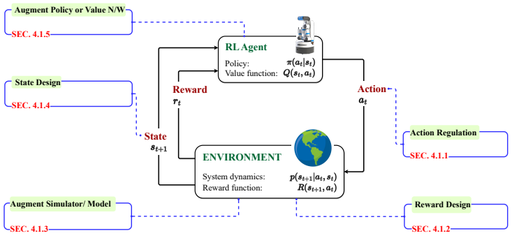
Figure 4 : Map of physics incorporation (PI) in the conventional Reinforcement Learning (RL) framework.
원문 · CC BY 4.0 · Chayan Banerjee, Kien Nguyen, Clinton Fookes, Maziar Raissi · A Survey on Physics Informed Reinforcement Learning: Review and Open Problems · 원문 그림 인용 · 원본 PDF 5쪽에서 그림 영역을 추출했습니다.논문이 제시한 범위는 로보틱스에 국한되지 않습니다. 교통 제어, 전력 및 전압 제어, 분자 구조 최적화, 안전 탐색, 로봇 조작 등 여러 영역의 PIRL 연구를 포함합니다. 저자들은 이 분야가 물리적 타당성, 정밀도, 데이터 효율, 실세계 적용성을 높일 잠재력이 있다고 보고, 연구 경향과 열린 문제를 함께 정리합니다.
물리 정보의 형태와 RL 구성 요소에 대한 분류
이 논문은 강화학습 파이프라인을 뼈대로 삼는 새로운 택소노미를 제안합니다. 첫 축은 물리 정보의 형태입니다. 편미분방정식과 상미분방정식, 경계 조건 같은 미분·대수 방정식(DAE), 제어 이론의 장벽 함수와 물리 제약(BPC), 물리 파라미터와 물리 변수(PPV), 실제 데이터와 저차원 표현(ODR), 물리 시뮬레이터와 모델(PS), 시스템 형태나 대칭 같은 물리적 성질(PPR)이 여기에 해당합니다.
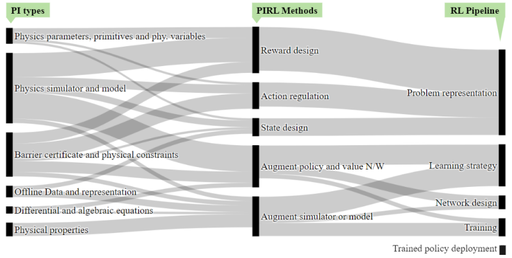
Figure 9 : Taxonomy, the diagram connects PI types with PIRL methods and then to the RL pipeline backbone. The connection thickness represents the quantity of work done which corresponds to those components/ categories.
원문 · CC BY 4.0 · Chayan Banerjee, Kien Nguyen, Clinton Fookes, Maziar Raissi · A Survey on Physics Informed Reinforcement Learning: Review and Open Problems · 원문 그림 인용 · 원본 PDF 9쪽에서 그림 영역을 추출했습니다.둘째 축은 PIRL 방법이 그 정보를 강화학습의 어느 부분에 반영하는지입니다. 상태 설계, 행동 조정, 보상 설계, 정책 또는 가치 네트워크의 증강, 시뮬레이터 또는 모델의 증강이 있습니다. 예를 들어 어떤 연구는 PINN으로 과도 전압 과정의 물리 제약을 학습하고, 그 제약을 RL 알고리즘의 손실 항으로 전달합니다. 논문은 학습 구조도 별도로 나누어 안전 필터, PI 보상, 잔차 학습, 물리 내장 네트워크, 미분 가능한 시뮬레이터, Sim-to-Real, 물리 변수, 계층 RL, 데이터 증강, PI 모델 식별의 열 가지 범주로 설명합니다.
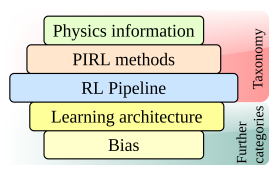
Figure 7 : PIRL taxonomy and further categories. Physics information (types), the RL methods that incorporate them and the underlying RL pipeline constitutes the PIRL- taxonomy, see Fig. 9. bias (sec. 3.4.1) and Learning architec- ture (sec. 3.4.2) are two additional categories which has been introduced to better explain the implementation of PIRL.
원문 · CC BY 4.0 · Chayan Banerjee, Kien Nguyen, Clinton Fookes, Maziar Raissi · A Survey on Physics Informed Reinforcement Learning: Review and Open Problems · 원문 그림 인용 · 원본 PDF 7쪽에서 그림 영역을 추출했습니다.RL 파이프라인과 대표적인 학습 구조
강화학습 문제는 보통 상태, 행동, 보상, 전이 확률로 정의되는 마르코프 결정 과정(MDP)으로 표현됩니다. 정책은 상태를 보고 행동을 고르는 규칙이며, 목표는 할인된 누적 보상의 기댓값을 최대화하는 것입니다. 모델 기반 RL은 환경 모델을 사용해 계획과 샘플 효율을 높이지만, 실제 환경의 정확한 모델을 얻기 어렵다는 제약이 있습니다.
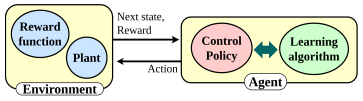
Figure 2 : Agent-environment framework, of RL paradigm. Here the reward generating function and the system/ plant is abstracted as the environment. And the control policy (e.g. a DNN) and the learning algorithm, forms the RL agent.
원문 · CC BY 4.0 · Chayan Banerjee, Kien Nguyen, Clinton Fookes, Maziar Raissi · A Survey on Physics Informed Reinforcement Learning: Review and Open Problems · 원문 그림 인용 · 원본 PDF 3쪽에서 그림 영역을 추출했습니다.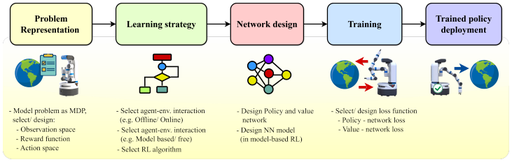
Figure 6 : Deep Reinforcement Learning Pipeline. Here the problem is first modeled as a MDP , clearly defining the state, action and reward spaces. Followed by selecting the RL algorithm as Learning strategy and then selecting/ designing the policy and/or value networks in network design stage. Finally the agent is trained using default/ custom loss function in training stage and finally deployed.
원문 · CC BY 4.0 · Chayan Banerjee, Kien Nguyen, Clinton Fookes, Maziar Raissi · A Survey on Physics Informed Reinforcement Learning: Review and Open Problems · 원문 그림 인용 · 원본 PDF 7쪽에서 그림 영역을 추출했습니다.안전이 중요한 제어에서는 신경 장벽 인증서(neural barrier certificate, NBC)가 쓰입니다. 원문 사례에서는 모델 프리 제어기와 장벽 인증 시스템을 결합하고, 초기 상태 집합과 위험 상태 집합에 대해 장벽 함수의 부호 조건을 만족하도록 학습합니다. 이때 필터링된 제어 행동은 운영 제약을 만족하도록 보정됩니다. 이처럼 안전 필터, 잔차 학습, 물리 내장 네트워크는 같은 목표를 서로 다른 위치에서 구현하는 설계 선택으로 읽어야 합니다.
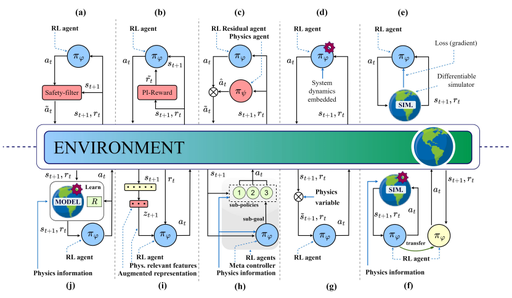
Figure 8 : Typical RL architectures with physics information incorporation (a) Safety filter (b) PI-reward (c) Residual agent (d) Physics embedded network (e) Differentiable simulator (f) Sim-to-Real (g) Physics variable (h) Hierarchical RL (i) Data augmentation (j) PI model identification. To keep illustrations simple, we have not included ancillary networks e.g. value function networks above.
원문 · CC BY 4.0 · Chayan Banerjee, Kien Nguyen, Clinton Fookes, Maziar Raissi · A Survey on Physics Informed Reinforcement Learning: Review and Open Problems · 원문 그림 인용 · 원본 PDF 8쪽에서 그림 영역을 추출했습니다.검토된 연구의 알고리즘과 적용 영역
논문이 정리한 표에서 PPO는 PIRL 연구에서 가장 많이 쓰인 알고리즘으로 보고됩니다. 그 뒤를 DDPG가 잇고, 최근 알고리즘 중에서는 SAC가 TD3보다 자주 선택됩니다. 이는 문헌 분포에 대한 통계이며, 어떤 알고리즘이 본질적으로 우월하다는 뜻은 아닙니다.
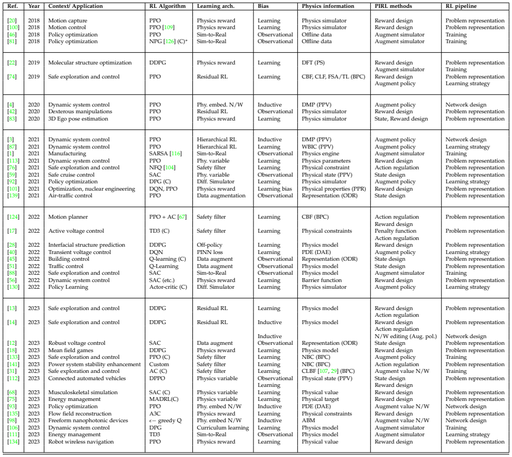
Table 2 : Summary of PIRL literature - Model Free.
원문 · CC BY 4.0 · Chayan Banerjee, Kien Nguyen, Clinton Fookes, Maziar Raissi · A Survey on Physics Informed Reinforcement Learning: Review and Open Problems · 원문 그림 인용 · 원본 PDF 13쪽에서 그림 영역을 추출했습니다.적용 영역을 보면 물리 정보를 활용하는 연구의 대다수는 정책 또는 제어기 설계에 속합니다. 저자들의 집계에 따르면 약 85%가 제어기나 정책 설계와 관련됩니다. 안전 제어와 탐색은 약 25%, 동적 시스템 제어는 약 23%로 나타납니다. 한편 벤치마크에서는 많은 연구가 OpenAI Gym, MuJoCo, Safety Gym 같은 표준 환경과 함께 사용자 정의 환경을 사용합니다. 따라서 수치를 비교할 때에는 각 연구의 환경과 설정을 함께 확인해야 합니다.
열린 문제와 연구 한계
저자들은 현재 PIRL에 포괄적인 벤치마킹 및 평가 환경이 부족하다고 지적합니다. 많은 연구가 특정 도메인에 맞춘 사용자 정의 환경에 의존하므로, 서로 다른 PIRL 알고리즘을 공정하게 비교하기 어렵습니다. 또한 물리 사전정보의 선택은 시스템에 대한 깊은 이해를 요구하며 도메인과 사례에 따라 크게 달라질 수 있습니다.
고차원 상태와 행동 공간에서 물리적으로 의미 있는 저차원 표현을 학습하는 문제, 근사 모델에 의존하는 안전 제어 문제, 여러 과제에 일반화되는 물리 기반 모델 학습 문제도 남아 있습니다. 이 한계들은 논문이 검토한 범위 안에서 저자들이 제시한 과제이며, 해결 방법이 이 논문에서 입증된 것은 아닙니다.
논문 정보
- 저자
- Chayan Banerjee, Kien Nguyen, Clinton Fookes, Maziar Raissi
- 학회·저널
- arXiv · 프리프린트
- 최초 공개일
- 2023년 9월 5일
- 등록일
- 2026년 11월 6일
- 수정일
- 2023년 9월 5일
- 버전
- v1
- arXiv
- 2309.01909
- DOI
- 10.1016/j.eswa.2025.128166
- 분류
- cs.LG · eess.SY
- 원문 이용 조건
- CC BY 4.0
- 제공 범위
- 논문 정보, 해설, 허용된 원문 그림
AI 해설은 논문 원문과 별개의 설명이며 오류가 있을 수 있습니다. 원문과 그림은 각 출처의 이용 조건과 따로 표시된 권리를 따릅니다.
초록
The inclusion of physical information in machine learning frameworks has revolutionized many application areas. This involves enhancing the learning process by incorporating physical constraints and adhering to physical laws. In this work we explore their utility for reinforcement learning applications. We present a thorough review of the literature on incorporating physics information, as known as physics priors, in reinforcement learning approaches, commonly referred to as physics-informed reinforcement learning (PIRL). We introduce a novel taxonomy with the reinforcement learning pipeline as the backbone to classify existing works, compare and contrast them, and derive crucial insights. Existing works are analyzed with regard to the representation/ form of the governing physics modeled for integration, their specific contribution to the typical reinforcement learning architecture, and their connection to the underlying reinforcement learning pipeline stages. We also identify core learning architectures and physics incorporation biases (i.e., observational, inductive and learning) of existing PIRL approaches and use them to further categorize the works for better understanding and adaptation. By providing a comprehensive perspective on the implementation of the physics-informed capability, the taxonomy presents a cohesive approach to PIRL. It identifies the areas where this approach has been applied, as well as the gaps and opportunities that exist. Additionally, the taxonomy sheds light on unresolved issues and challenges, which can guide future research. This nascent field holds great potential for enhancing reinforcement learning algorithms by increasing their physical plausibility, precision, data efficiency, and applicability in real-world scenarios.
원문 인용
Chayan Banerjee, Kien Nguyen, Clinton Fookes, Maziar Raissi (2023). A Survey on Physics Informed Reinforcement Learning: Review and Open Problems. arXiv:2309.01909v1. https://doi.org/10.1016/j.eswa.2025.128166
BibTeX
@article{banerjee2023survey,
  title = {{A Survey on Physics Informed Reinforcement Learning: Review and Open Problems}},
  author = {Chayan Banerjee and Kien Nguyen and Clinton Fookes and Maziar Raissi},
  year = {2023},
  eprint = {2309.01909},
  archivePrefix = {arXiv},
  doi = {10.1016/j.eswa.2025.128166},
  url = {https://arxiv.org/abs/2309.01909v1}
}