논문 해설
Real-World Light Field Image Super-Resolution via Degradation Modulation
열화 변조를 통한 실세계 라이트 필드 이미지 초해상도
- 연구 문제 실제 LF 영상은 기기와 촬영 조건에 따라 다양한 열화를 겪지만, 기존 DNN 기반 LF 초해상도 방법은 bicubic 열화에 맞춰 개발되어 실세계 영상에서 성능이 떨어집니다.
- 연구 방법 LF 촬영 과정에 기반한 열화 모델로 블러와 잡음을 조절해 학습 데이터를 만들고, 커널 사전 임베딩과 열화 변조 합성곱으로 열화 정보를 네트워크에 반영하며 Distg-Block으로 공간-각도 정보를 통합합니다.
- 주요 결과 합성 열화 설정에서 LF-DMnet은 bicubic 설정을 제외한 대부분의 조건에서 기존 방법보다 높은 PSNR과 SSIM을 보고합니다. 절제 실험에서는 DM-Conv와 각도 정보 제거 시 평균 PSNR이 각각 1.61 dB, 2.25 dB 낮아집니다.
실세계 LF 영상의 열화 문제
기존 DNN 기반 LF 영상 초해상도 방법들은 대부분 bicubic 다운샘플링이라는 단일하고 고정된 열화를 가정하고 개발되었습니다. 그래서 실제 Lytro나 Raytrix 카메라로 촬영된 LF 영상처럼 기기와 촬영 조건에 따라 열화가 다양한 입력에 적용하면 성능이 크게 떨어집니다. 이 논문은 이 일반화 문제를 다루기 위해 실제 LF 영상의 열화 과정을 근사하는 열화 모델과, 그 열화 정보를 네트워크 안에서 활용하는 LF-DMnet을 함께 제안합니다.
또 하나의 어려움은 열화 정보를 활용하면서 동시에 SAI 사이의 각도 정보를 살리는 것입니다. 단일 영상 실세계 SR 방법들은 뷰 사이의 상관관계를 무시하므로 LF 영상 전체에 대해서는 만족스럽지 않습니다. 저자들은 이 두 요구를 동시에 충족하는 것을 목표로 삼습니다.
LF 열화 모델의 구성
저자들은 카메라 촬영 과정을 점 확산 함수(PSF)와 센서 샘플링, 추가 잡음으로 나누어 단일 영상의 열화 모델을 유도합니다. 이를 4D LF로 확장하여 각 뷰 (u, v)의 저해상도 SAI가 고해상도 SAI에 블러 커널을 합성곱하고 α배 다운샘플링한 뒤 잡음을 더한 형태로 쓰입니다. 이때 블러 커널 k는 21×21 크기이며, 블러는 커널 폭 하나로 결정되는 등방성 가우시안 커널로 제한됩니다. 이방성 블러를 제외한 이유는 LF의 각 SAI에서 회전 각도와 움직임 궤적이 서로 다르게 나타나 LF 디블러링 문제에 속하기 때문이라고 설명합니다.
잡음은 채널에 독립적인 가산 백색 가우시안 잡음으로 두고, 잡음 수준을 조절 가능한 값으로 둡니다. 다운샘플링은 bicubic으로 고정됩니다. 커널 폭과 잡음 수준이 0이면 이 모델은 표준 bicubic 열화로 귀결됩니다. 따라서 학습 시 블러와 잡음을 바꾸어 열화 공간을 넓히는 것이 이 모델의 핵심입니다.
KPE, DM-Conv, Distg-Block으로 구성된 LF-DMnet
LF-DMnet은 입력 LR SAI 배열과 각 뷰의 커널 폭 및 잡음 수준을 함께 받는 비블라인드 네트워크입니다. 먼저 커널 사전 임베딩(KPE) 모듈이 입력 커널 폭으로 21×21 등방성 가우시안 커널을 재구성하고, 이를 441차원 벡터로 펼쳐 5개 FC 층의 MLP에 넣어 15차원 블러 표현을 얻습니다. 이 블러 표현에 잡음 수준을 이어 붙여 16차원 열화 표현을 만듭니다.
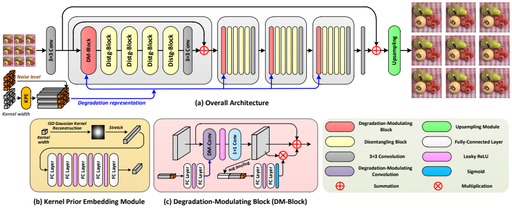
Fig. 3 : An overview of our LF-DMnet.
원문 · CC BY 4.0 · Yingqian Wang, Zhengyu Liang, Longguang Wang, Jungang Yang, Wei An, Yulan Guo · Real-World Light Field Image Super-Resolution via Degradation Modulation · 원문 그림 인용 · 원본 PDF 5쪽에서 그림 영역을 추출했습니다.다음으로 DM-Block은 열화 표현으로부터 두 개의 FC 층을 거쳐 3×3×64 크기의 합성곱 커널을 만들고, 이를 쓰는 깊이별 동적 합성곱(DM-Conv)으로 특징을 처리합니다. 별도의 두 FC 층과 Sigmoid 층은 열화 표현으로부터 채널별 변조 계수를 만들어 특징 채널을 재조정합니다. 열화 표현을 입력 특징에 그대로 이어 붙여 합성곱하는 대신 커널 자체를 열화에 따라 생성한 이유는, 저자들이 열화 표현과 영상 특징 사이에 도메인 차이가 있어 직접 합성곱하면 간섭이 생긴다고 설명하기 때문입니다.
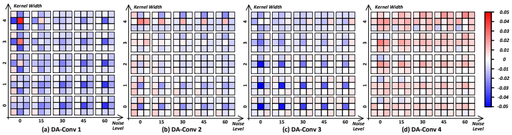
Fig. 8 : Kernel visualization of our degradation-modulating convolutions (DM-Convs) with different input blur and noise levels.
원문 · CC BY 4.0 · Yingqian Wang, Zhengyu Liang, Longguang Wang, Jungang Yang, Wei An, Yulan Guo · Real-World Light Field Image Super-Resolution via Degradation Modulation · 원문 그림 인용 · 원본 PDF 10쪽에서 그림 영역을 추출했습니다.마지막으로 Distg-Block은 원래 방식의 MacPI 기반 전용 합성곱 대신 특징을 공간, 각도, 수평 EPI, 수직 EPI 분기에서 재배열한 뒤 평범한 합성곱으로 처리합니다. 네트워크는 네 개의 잔차 그룹을 쌓고 각 그룹에 DM-Block 하나와 Distg-Block 네 개를 둡니다.
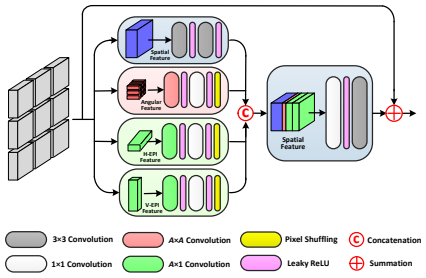
Fig. 4 : The architecture of our modified Distg-Block.
원문 · CC BY 4.0 · Yingqian Wang, Zhengyu Liang, Longguang Wang, Jungang Yang, Wei An, Yulan Guo · Real-World Light Field Image Super-Resolution via Degradation Modulation · 원문 그림 인용 · 원본 PDF 6쪽에서 그림 영역을 추출했습니다.학습 설정과 평가 데이터
학습과 검증에는 HCInew, HCIold, STFgantry 데이터셋을 사용하고, 실세계 일반화 테스트에는 EPFL, INRIA, STFlytro와 Raytrix 기반 데이터셋을 사용합니다. 9×9 각도 해상도의 LF는 중앙 5×5 SAI를 사용하고, 5×5 Raytrix LF는 그대로 사용합니다. 학습 중 커널 폭은 [0, 4] 범위, 잡음 수준은 [0, 75] 범위에서 무작위로 뽑습니다. 이 범위는 학습 시 열화를 샘플링하는 설정이며, 테스트 시 입력 커널 폭과 잡음 수준은 별도로 주어집니다.
평가 지표는 RGB 채널의 PSNR과 SSIM이며, 장면마다 A×A SAI의 평균을 낸 뒤 데이터셋 내 장면들의 평균으로 집계합니다. 이 논문은 4배 초해상도만 고려합니다.
합성 열화 설정에서의 비교 결과
합성 열화 실험은 커널 폭 0, 1.5, 3과 잡음 수준 0, 15, 50, 90 조합에서 HCInew, HCIold, STFgantry를 평가합니다. bicubic 설정(커널 폭 0, 잡음 0)에서는 DistgSSR과 LFT가 상위 PSNR과 SSIM을 보이지만, 블러나 잡음이 있을 때 성능이 크게 떨어집니다. 반면 SRMD와 DASR은 블러와 잡음이 있는 장면에서 더 잘 작동합니다. 이 비교에서 SRMD는 입력 정답 열화를 사용하는 비블라인드 방법입니다.
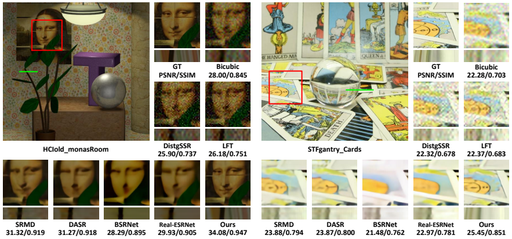
Fig. 5 : Visual results achieved by different methods on synthetically degraded LFs ( kernel width = 1.5, noise level = 15) for 4×SR. The super-resolved center view images and horizontal EPIs are shown. The PSNR and SSIM scores on the presented scenes are reported below the zoom-in regions.
원문 · CC BY 4.0 · Yingqian Wang, Zhengyu Liang, Longguang Wang, Jungang Yang, Wei An, Yulan Guo · Real-World Light Field Image Super-Resolution via Degradation Modulation · 원문 그림 인용 · 원본 PDF 8쪽에서 그림 영역을 추출했습니다.LF-DMnet은 bicubic 설정을 제외한 대부분의 설정에서 가장 높은 PSNR과 SSIM을 보고합니다. 다만 이 결과는 해당 합성 열화 설정에서 얻은 것이며, 실세계 LF에 대한 일반적 우위로 바로 옮길 수는 없습니다. 저자들은 단일 영상 SR 방법이 뷰 간 상관관계를 쓰지 못하기 때문에 우위가 있다고 해석합니다.
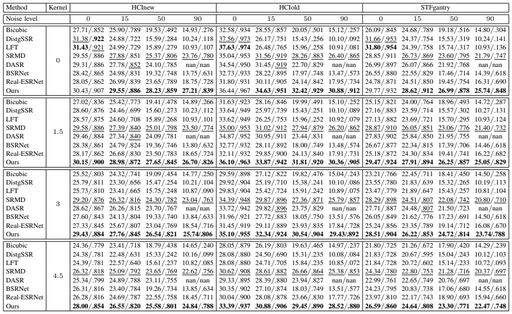
원문 그림 TABLE I: PSNR and SSIM results achieved by different methods on the HCInew [68], HCIold [69] and STFgantry [70] datasets under synthetic degradation (with different blur kernel widths and noise levels) for 4 × SR. Note that, the degradation degenerates to the bicubic downsampling degradation when kernel width and noise level equal to 0. Best results are in bold faces and the second best results are underlined .
원문 · CC BY 4.0 · Yingqian Wang, Zhengyu Liang, Longguang Wang, Jungang Yang, Wei An, Yulan Guo · Real-World Light Field Image Super-Resolution via Degradation Modulation · 원문 그림 인용 · 원본 PDF 7쪽에서 그림 영역을 추출했습니다.절제 실험으로 본 구성요소의 기여
DM-Conv의 효과는 Model 2와 비교하여 확인됩니다. Model 2는 DM-Conv를 깊이별 3×3 합성곱과 일반 3×3 합성곱으로 바꾸고 Distg-Block은 유지합니다. 이 변형은 평균 PSNR이 LF-DMnet보다 1.61 dB 낮습니다. 각도 정보의 효과는 Model 3과 비교하여 확인됩니다. Model 3은 Distg-Block의 각도 분기와 EPI 분기를 제거하여 단일 뷰 공간 정보만 사용하며, 모델 크기를 맞추기 위해 합성곱 층을 늘렸습니다. 이 경우 평균 PSNR이 2.25 dB 감소합니다.

원문 그림 TABLE III: PSNR values achieved by LF-DMnet and its variants for 4×SR. Here, we report the number of parameters (#Params.), FLOPs and running time of each model for efficiency evaluation.
원문 · CC BY 4.0 · Yingqian Wang, Zhengyu Liang, Longguang Wang, Jungang Yang, Wei An, Yulan Guo · Real-World Light Field Image Super-Resolution via Degradation Modulation · 원문 그림 인용 · 원본 PDF 10쪽에서 그림 영역을 추출했습니다.KPE와 DM-CA도 절제 대상입니다. KPE를 제거한 Model 4는 평균 PSNR이 0.22 dB 낮아지고 노이즈가 없는 장면에서 하락이 더 큽니다. DM-CA를 제거한 Model 5는 평균 PSNR이 0.20 dB 낮습니다. 이 수치는 각 구성요소를 유지했을 때의 이득이며, 모든 구성요소가 항상 이득을 준다는 의미는 아닙니다.
실세계 시각 결과와 한계
실제 Lytro와 Raytrix LF에는 정답 HR 영상이 없으므로 PSNR과 SSIM을 계산하지 않고 시각 결과와 EPI 패턴을 비교합니다. 이 비교에서 DistgSSR과 LFT는 입력 잡음을 증폭하거나 세부를 흐리게 만들고, SRMD와 단일 영상 방법은 잔여 잡음, 과도한 평활화 또는 각도 불일치를 보인다고 보고됩니다. 실제 장면에서 SRMD와 LF-DMnet에는 데이터셋별로 다른 커널 폭과 잡음 수준이 설정되었습니다.
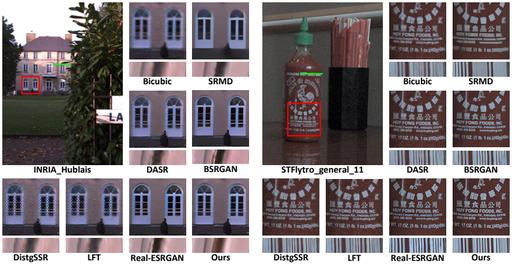
Fig. 6 : Visual results achieved by different methods on real LFs captured by Lytro Illum cameras for 4 ×SR. Scenes Hublais from the INRIA dataset [71] and general 11 from the STFlytro dataset [33] are used as example scenes for comparison. The super-resolved center view images and horizontal EPIs are shown. For SRMD and our method, the input blur kernel width and noise level are set to 2 and 30, respectively. Groundtruth HR images are unavailable in this case.
원문 · CC BY 4.0 · Yingqian Wang, Zhengyu Liang, Longguang Wang, Jungang Yang, Wei An, Yulan Guo · Real-World Light Field Image Super-Resolution via Degradation Modulation · 원문 그림 인용 · 원본 PDF 9쪽에서 그림 영역을 추출했습니다.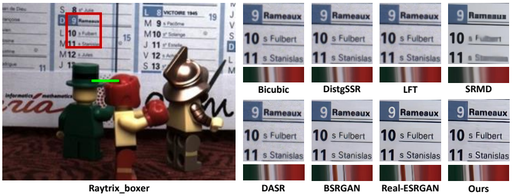
Fig. 7 : Visual results achieved by different methods on real LFs captured by a Raytrix camera for 4 ×SR. Scenes boxer from the dataset in [72] is used as an example scene for comparison. The super-resolved center view images and horizontal EPIs are shown. For SRMD and our method, the input blur kernel width and noise level are set to 4 and 60, respectively. Groundtruth HR images are unavailable in this case.
원문 · CC BY 4.0 · Yingqian Wang, Zhengyu Liang, Longguang Wang, Jungang Yang, Wei An, Yulan Guo · Real-World Light Field Image Super-Resolution via Degradation Modulation · 원문 그림 인용 · 원본 PDF 10쪽에서 그림 영역을 추출했습니다.한계로, LF-DMnet은 입력 열화에 민감하며 정확한 열화 추정이 필요합니다. 입력 커널 폭이나 잡음 수준이 실제 값과 어긋나면 아티팩트나 과도한 평활화가 생깁니다. 또한 이 방법은 비블라인드 설정이므로 새로운 LF 카메라를 쓸 때는 점 확산 함수와 잡음 수준을 먼저 측정해야 합니다.
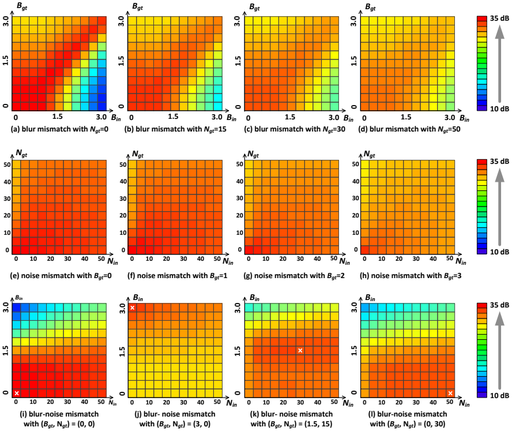
Fig. 9 : Visualization of the performance variation of our method with mismatched degradation. (a)-(d) show the PSNR values achieved with mismatched blur kernel widths under different noise levels. (e)-(h) show the PSNR values achieved with mismatched noise level under different blurs. (i)-(l) show the PSNR values achieved with simultaneously mismatched blurs and noise levels under four representative degradation settings (marked by white cross).
원문 · CC BY 4.0 · Yingqian Wang, Zhengyu Liang, Longguang Wang, Jungang Yang, Wei An, Yulan Guo · Real-World Light Field Image Super-Resolution via Degradation Modulation · 원문 그림 인용 · 원본 PDF 11쪽에서 그림 영역을 추출했습니다.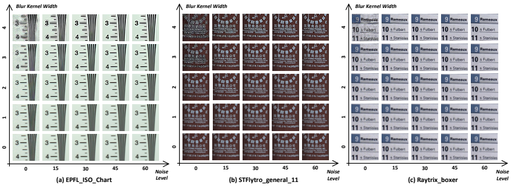
Fig. 10 : Visual results achieved by our method on real LF images with different blur kernel width and noise levels. Three scenes from the EPFL [32], STFlytro [33] and Raytrix [72] datasets are used as examples for illustration.
원문 · CC BY 4.0 · Yingqian Wang, Zhengyu Liang, Longguang Wang, Jungang Yang, Wei An, Yulan Guo · Real-World Light Field Image Super-Resolution via Degradation Modulation · 원문 그림 인용 · 원본 PDF 12쪽에서 그림 영역을 추출했습니다.논문 정보
- 저자
- Yingqian Wang, Zhengyu Liang, Longguang Wang, Jungang Yang, Wei An, Yulan Guo
- 학회·저널
- arXiv · 프리프린트
- 최초 공개일
- 2022년 6월 13일
- 등록일
- 2026년 11월 6일
- 수정일
- 2023년 11월 30일
- 버전
- v2
- arXiv
- 2206.06214
- 분류
- cs.CV · eess.IV
- 원문 이용 조건
- CC BY 4.0
- 제공 범위
- 논문 정보, 해설, 허용된 원문 그림
AI 해설은 논문 원문과 별개의 설명이며 오류가 있을 수 있습니다. 원문과 그림은 각 출처의 이용 조건과 따로 표시된 권리를 따릅니다.
초록
Recent years have witnessed the great advances of deep neural networks (DNNs) in light field (LF) image super-resolution (SR). However, existing DNN-based LF image SR methods are developed on a single fixed degradation (e.g., bicubic downsampling), and thus cannot be applied to super-resolve real LF images with diverse degradation. In this paper, we propose a simple yet effective method for real-world LF image SR. In our method, a practical LF degradation model is developed to formulate the degradation process of real LF images. Then, a convolutional neural network is designed to incorporate the degradation prior into the SR process. By training on LF images using our formulated degradation, our network can learn to modulate different degradation while incorporating both spatial and angular information in LF images. Extensive experiments on both synthetically degraded and real-world LF images demonstrate the effectiveness of our method. Compared with existing state-of-the-art single and LF image SR methods, our method achieves superior SR performance under a wide range of degradation, and generalizes better to real LF images. Codes and models are available at https://yingqianwang.github.io/LF-DMnet/.
원문 인용
Yingqian Wang, Zhengyu Liang, Longguang Wang, Jungang Yang, Wei An, Yulan Guo (2022). Real-World Light Field Image Super-Resolution via Degradation Modulation. arXiv:2206.06214v2. https://arxiv.org/abs/2206.06214v2
BibTeX
@misc{wang2022real,
  title = {{Real-World Light Field Image Super-Resolution via Degradation Modulation}},
  author = {Yingqian Wang and Zhengyu Liang and Longguang Wang and Jungang Yang and Wei An and Yulan Guo},
  year = {2022},
  eprint = {2206.06214},
  archivePrefix = {arXiv},
  url = {https://arxiv.org/abs/2206.06214v2}
}