논문 해설
Quantum algorithms applied to satellite mission planning for Earth observation
지구 관측을 위한 위성 임무 계획에 적용된 양자 알고리즘
- 연구 문제 지구 관측 위성의 촬영 요청 순서를 정하는 임무 계획에서, 양자 강화학습과 최적화 모델이 고전 그리디 기준선보다 고우선순위 요청 완료율을 높일 수 있는지 검증합니다.
- 연구 방법 정수 최적화 모델, PPO 기반 강화학습과 양자 회로 결합 모델, 하이브리드 AlphaZero를 비교합니다.
- 주요 결과 2위성 2000개 요청 데이터셋에서 하이브리드 AlphaZero는 π1 완료율 98.5%, 정수 최적화 모델은 98.1%를 보고하며, 그리디 기준선의 75.8%보다 높습니다.
위성 임무 계획 문제와 연구 질문
지구 관측 위성은 촬영 요청마다 정해진 DTO 창 안에서 획득 시간과 자세 회전 시간을 함께 고려해야 합니다. 위성은 궤도를 따라 한 번에 여러 요청을 처리할 수 없으므로, 어떤 요청을 어떤 순서로 완료할지가 계획의 핵심입니다. 원문은 이 문제를 고우선순위 요청의 완료 수를 최대화하는 문제로 정의하며, 실제 데이터셋은 수천 개 요청과 여러 위성을 포함합니다.
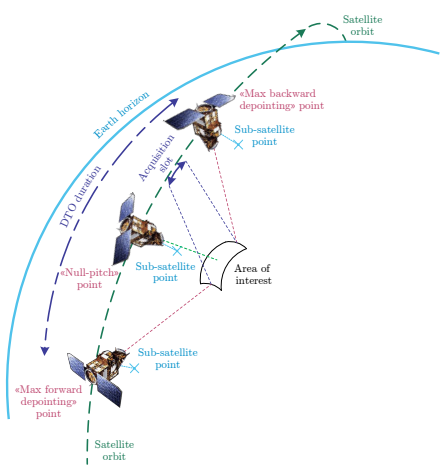
Fig. 1 . The trajectory of a satellite orbiting on the Earth’s terminator and across a DTO window. At the first and third positions on the orbital line, the satellite is at the ends of the request’s DTO window, as its depointing angle is maximized at 45 ◦. At its second position, it is at the apex point, directly above the request location.
원문 · CC BY 4.0 · Serge Rainjonneau, Igor Tokarev, Sergei Iudin, Saaketh Rayaprolu, Karan Pinto, Daria Lemtiuzhnikova, Miras Koblan, Egor Barashov, Mo Kordzanganeh, Markus Pflitsch, Alexey Melnikov · Quantum algorithms applied to satellite mission planning for Earth observation · 원문 그림 인용 · 원본 PDF 2쪽에서 그림 영역을 추출했습니다.이 논문이 던지는 질문은 양자 강화학습과 최적화 모델이 고전 그리디 기준선보다 고우선순위 요청의 완료율을 높일 수 있는지입니다. 주요 비교는 위성 2기와 2000개 요청으로 구성된 데이터셋에서 우선순위 1 요청(π1)의 완료율을 기준으로 합니다. 이 데이터셋에서 그리디 알고리즘의 π1 완료율은 75.8%로 보고됩니다.
그리디 기준선과 군집화 전처리
기준선은 K-means로 요청을 군집화한 뒤 각 군집에서 그리디 알고리즘을 실행하는 방식입니다. 그리디 알고리즘은 시각을 1초씩 증가시키며 열린 DTO 창에 들어가는 요청 중 가장 높은 우선순위를 골라 완료하고, 회전 시간과 획득 시간의 합만큼 시각을 진행합니다.
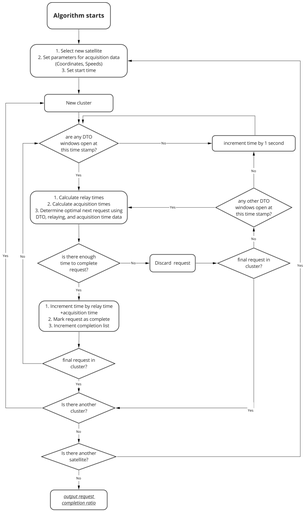
Fig. 9 . The flowchart used to implement the greedy algorithm in Sec. III-B. The time-incrementing block references the ”open DTO windows” query. Without accessible DTOs within a cluster, satellites remain idle under the greedy algorithm, with the simulation advancing until availability arises. Upon addressing all requests, satellites transition to the subsequent cluster and replicate the procedure. Note that the connection between one-second time increments and new clusters is implicit rather than explicit.
원문 · CC BY 4.0 · Serge Rainjonneau, Igor Tokarev, Sergei Iudin, Saaketh Rayaprolu, Karan Pinto, Daria Lemtiuzhnikova, Miras Koblan, Egor Barashov, Mo Kordzanganeh, Markus Pflitsch, Alexey Melnikov · Quantum algorithms applied to satellite mission planning for Earth observation · 원문 그림 인용 · 원본 PDF 13쪽에서 그림 영역을 추출했습니다.원문 표에서 그리디 알고리즘은 1위성 462개 요청에서 π1 99.2%, 2위성 2000개 요청에서 π1 75.8%를 보입니다. 같은 데이터셋에서 K-means와 결합한 결과는 63.6%로 보고됩니다. 논의 절은 그리디 완료율을 78.5%(K-means 결합 시 63.6%)로 적어 표 I 및 초록의 75.8%와 값이 다릅니다. 이 불일치는 본문에서 그대로 구분해 읽어야 합니다.
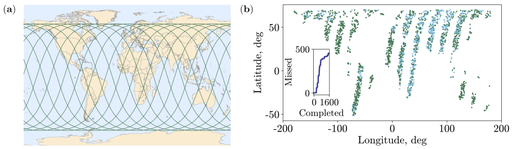
Fig. 3 . (a) Schematic view of 15 satellite orbits performed within approximately 24 hours. (b) The results of the greedy algorithm are shown on the map. The task contains 2000 requests that are planned for acquisition using 2 satellites. Green points correspond to completed requests, whereas blue points are missed requests. (Inset) Progression of completed compared to missed requests.
원문 · CC BY 4.0 · Serge Rainjonneau, Igor Tokarev, Sergei Iudin, Saaketh Rayaprolu, Karan Pinto, Daria Lemtiuzhnikova, Miras Koblan, Egor Barashov, Mo Kordzanganeh, Markus Pflitsch, Alexey Melnikov · Quantum algorithms applied to satellite mission planning for Earth observation · 원문 그림 인용 · 원본 PDF 4쪽에서 그림 영역을 추출했습니다.정수 최적화 모델과 QUBO 형식
정수 최적화 모델은 요청 f의 시작 슬롯 변수 x_fq, 시작 각도 변수 y_fα, 연속 요청 지시 변수 κ_f1f2를 이진 변수로 두고, 우선순위 가중치 J_f와 시간 페널티 γ_fα로 구성된 비용 함수를 최대화합니다. 제약은 요청이 한 번만 완료되고, 각 슬롯에 하나의 요청만 들어가며, 시작 각도가 하나로 정해지도록 설계됩니다. 최대화 대상은 가중 완료 항에서 페널티를 뺀 값입니다.
QUBO 형식에서는 제약을 선형 등식으로 바꾸고 제곱해 비용 함수에 페널티로 넣습니다. 부등식 제약은 slack 이진 변수를 추가해 등식으로 바꿉니다. 이 해법은 Gurobi로 풀려 π1 완료율 98.1%를 얻었다고 보고됩니다. 다만 D-Wave Leap Hybrid와 Gurobi는 1분 제한에서 요청 4개의 작은 클러스터도 풀기 어렵다고 보고되므로, 최적화 결과는 클러스터 분해를 전제로 합니다.
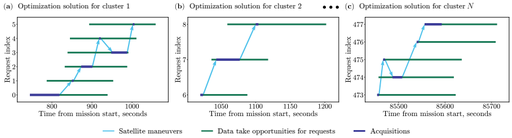
Fig. 4 . Chaining results of classical integer optimization algorithm within clusters of data points.
원문 · CC BY 4.0 · Serge Rainjonneau, Igor Tokarev, Sergei Iudin, Saaketh Rayaprolu, Karan Pinto, Daria Lemtiuzhnikova, Miras Koblan, Egor Barashov, Mo Kordzanganeh, Markus Pflitsch, Alexey Melnikov · Quantum algorithms applied to satellite mission planning for Earth observation · 원문 그림 인용 · 원본 PDF 5쪽에서 그림 영역을 추출했습니다.PPO와 하이브리드 양자 PPO
PPO 에이전트는 위성 관점 환경에서 가까운 100개 요청의 관측값을 받아 요청 하나를 선택합니다. 선택한 요청이 완료되면 보상 1을 받고, 그렇지 않으면 0을 받습니다. PPO의 클리핑 목적 함수는 이전 정책과 새 정책의 확률 비율을 1−ϵ과 1+ϵ 사이로 제한해 한 번의 갱신이 지나치게 커지지 않도록 합니다.
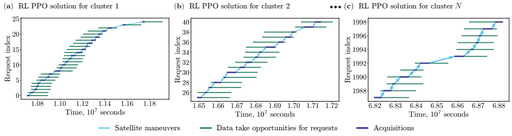
Fig. 6 . Visualization of the chaining process used to complete requests within each cluster of the PPO algorithm.
원문 · CC BY 4.0 · Serge Rainjonneau, Igor Tokarev, Sergei Iudin, Saaketh Rayaprolu, Karan Pinto, Daria Lemtiuzhnikova, Miras Koblan, Egor Barashov, Mo Kordzanganeh, Markus Pflitsch, Alexey Melnikov · Quantum algorithms applied to satellite mission planning for Earth observation · 원문 그림 인용 · 원본 PDF 9쪽에서 그림 영역을 추출했습니다.하이브리드 양자 PPO는 MLP 입력 뒤에 4큐빗 파라미터화된 양자 회로를 넣습니다. 원문은 이 구조에서 같은 복잡도의 고전 네트워크보다 빠르게 높은 보상에 도달한다고 보고합니다. 구체적으로 하이브리드 모델은 8k 환경 단계 안에서 높은 보상을 얻고, 고전 네트워크는 110k 환경 단계 이후에도 같은 수준에 이르지 못했습니다. 이 비교는 초기값을 달리한 5회 학습 중 최고 실행을 기준으로 합니다.
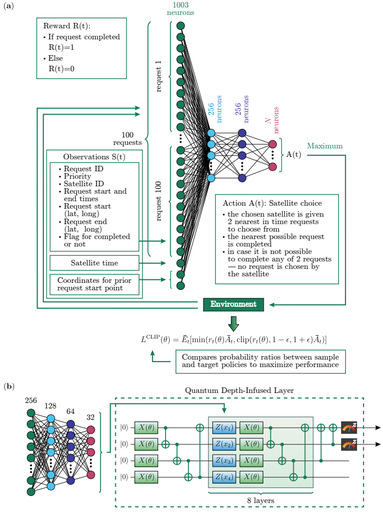
Fig. 5 . (a) The reinforcement learning PPO model used to solve the mission planning problem. The state of the model encompasses the data of 100 requests, which are fed into the MLP agent to output an action (one request that is selected to complete), which then feeds into the environment (clip equation), generates an appropriate reward, and updates the state. (b) Quantum-hybrid reinforcement learning model. A quantum circuit (left) is added to the beginning of the MLP Agent in the RL model (right) to incorporate quantum computation into the neural network.
원문 · CC BY 4.0 · Serge Rainjonneau, Igor Tokarev, Sergei Iudin, Saaketh Rayaprolu, Karan Pinto, Daria Lemtiuzhnikova, Miras Koblan, Egor Barashov, Mo Kordzanganeh, Markus Pflitsch, Alexey Melnikov · Quantum algorithms applied to satellite mission planning for Earth observation · 원문 그림 인용 · 원본 PDF 8쪽에서 그림 영역을 추출했습니다.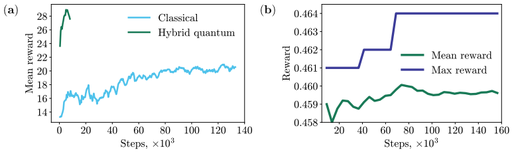
Fig. 8 . (a) The rewards the classical and hybrid PPO RL agents achieve. The hybrid model reaches a higher reward at a significantly improved learning speed. (b) The agent reaches a maximum normalized reward of 0.464 after 70,000 steps of the simulation. This is compared to a total possible reward of 0.471, translating to an accuracy of 98.5%.
원문 · CC BY 4.0 · Serge Rainjonneau, Igor Tokarev, Sergei Iudin, Saaketh Rayaprolu, Karan Pinto, Daria Lemtiuzhnikova, Miras Koblan, Egor Barashov, Mo Kordzanganeh, Markus Pflitsch, Alexey Melnikov · Quantum algorithms applied to satellite mission planning for Earth observation · 원문 그림 인용 · 원본 PDF 10쪽에서 그림 영역을 추출했습니다.하이브리드 AlphaZero와 최고 성능 결과
하이브리드 AlphaZero는 MCTS의 선택·확장·시뮬레이션·역전파 과정 안에서 파라미터화된 양자 회로를 정책 네트워크로 사용합니다. 상태 변수는 크기 256과 32 뉴런의 두 은닉층을 거친 뒤 가치 네트워크와 정책 네트워크로 병렬 전달됩니다. 외부 루프는 정책 손실, 가치 손실, 총 손실을 계산해 신경망 가중치를 갱신합니다.
이 모델은 2000개 요청과 위성 2기의 데이터셋에서 π1 완료율 98.5%를 달성했다고 보고됩니다. 같은 실행 조건에서 그리디 기준선의 π1 완료율은 75.8%이며, 정수 최적화 모델은 98.1%입니다. 원문은 최고 성능 실행을 제시하므로 이 결과는 다섯 번 학습 중 최선의 결과로 읽어야 합니다.
적용 범위와 한계
이 결과는 원문이 사용한 두 데이터셋과 특정 시뮬레이션 설정에서 얻은 것입니다. 단일 위성 462개 요청 결과와 2위성 2000개 요청 결과는 구분해서 읽어야 합니다. 한 위성 모델에서 최적화 방법은 100% 완료율을 보이지만, 이 값은 다른 조건을 대표하지 않습니다.
또한 양자 구성요소의 장점은 시뮬레이션 학습 곡선과 특정 모델 구조에서 관찰된 결과입니다. 원문은 양자 하드웨어의 실제 대규모 이득을 증명하지 않으며, 저자들은 해당 결과를 향후 양자 기반 솔루션의 가능성으로 해석합니다.
논문 정보
- 저자
- Serge Rainjonneau, Igor Tokarev, Sergei Iudin, Saaketh Rayaprolu, Karan Pinto, Daria Lemtiuzhnikova, Miras Koblan, Egor Barashov, Mo Kordzanganeh, Markus Pflitsch, Alexey Melnikov
- 학회·저널
- arXiv · 프리프린트
- 최초 공개일
- 2023년 2월 14일
- 등록일
- 2026년 11월 6일
- 수정일
- 2023년 8월 7일
- 버전
- v2
- arXiv
- 2302.07181
- DOI
- 10.1109/jstars.2023.3287154
- 분류
- quant-ph · cs.LG · cs.SE
- 원문 이용 조건
- CC BY 4.0
- 제공 범위
- 논문 정보, 해설, 허용된 원문 그림
AI 해설은 논문 원문과 별개의 설명이며 오류가 있을 수 있습니다. 원문과 그림은 각 출처의 이용 조건과 따로 표시된 권리를 따릅니다.
초록
Earth imaging satellites are a crucial part of our everyday lives that enable global tracking of industrial activities. Use cases span many applications, from weather forecasting to digital maps, carbon footprint tracking, and vegetation monitoring. However, there are limitations; satellites are difficult to manufacture, expensive to maintain, and tricky to launch into orbit. Therefore, satellites must be employed efficiently. This poses a challenge known as the satellite mission planning problem, which could be computationally prohibitive to solve on large scales. However, close-to-optimal algorithms, such as greedy reinforcement learning and optimization algorithms, can often provide satisfactory resolutions. This paper introduces a set of quantum algorithms to solve the mission planning problem and demonstrate an advantage over the classical algorithms implemented thus far. The problem is formulated as maximizing the number of high-priority tasks completed on real datasets containing thousands of tasks and multiple satellites. This work demonstrates that through solution-chaining and clustering, optimization and machine learning algorithms offer the greatest potential for optimal solutions. This paper notably illustrates that a hybridized quantum-enhanced reinforcement learning agent can achieve a completion percentage of 98.5% over high-priority tasks, significantly improving over the baseline greedy methods with a completion rate of 75.8%. The results presented in this work pave the way to quantum-enabled solutions in the space industry and, more generally, future mission planning problems across industries.
원문 인용
Serge Rainjonneau, Igor Tokarev, Sergei Iudin, Saaketh Rayaprolu, Karan Pinto, Daria Lemtiuzhnikova, Miras Koblan, Egor Barashov, Mo Kordzanganeh, Markus Pflitsch, Alexey Melnikov (2023). Quantum algorithms applied to satellite mission planning for Earth observation. arXiv:2302.07181v2. https://doi.org/10.1109/jstars.2023.3287154
BibTeX
@article{rainjonneau2023quantum,
  title = {{Quantum algorithms applied to satellite mission planning for Earth observation}},
  author = {Serge Rainjonneau and Igor Tokarev and Sergei Iudin and Saaketh Rayaprolu and Karan Pinto and Daria Lemtiuzhnikova and Miras Koblan and Egor Barashov and Mo Kordzanganeh and Markus Pflitsch and Alexey Melnikov},
  year = {2023},
  eprint = {2302.07181},
  archivePrefix = {arXiv},
  doi = {10.1109/jstars.2023.3287154},
  url = {https://arxiv.org/abs/2302.07181v2}
}