논문 해설
BARF: Bundle-Adjusting Neural Radiance Fields
BARF: 번들 조정 뉴럴 레이디언스 필드
- 연구 문제 불완전하거나 알 수 없는 카메라 포즈로 NeRF의 장면 표현과 카메라 등록을 동시에 학습하는 방법을 다룹니다.
- 연구 방법 위치 인코딩의 주파수 대역을 저주파에서 고주파로 점진적으로 활성화하는 coarse-to-fine 등록 전략을 NeRF에 적용합니다.
- 주요 결과 합성 객체 장면에서 BARF는 평균 회전 오차 0.193도로 포즈를 등록하면서 참조 NeRF에 가까운 시점 합성 품질을 보고합니다.
카메라 포즈 없이 NeRF를 학습하는 문제
NeRF는 장면의 3D 점 위치를 색과 부피 밀도로 매핑하는 신경망을 학습하고, 볼륨 렌더링으로 새로운 시점의 이미지를 합성합니다. 그러나 NeRF는 각 학습 이미지의 정확한 카메라 포즈가 주어져야 학습할 수 있으며, 이 포즈는 보통 외부의 보조 알고리즘으로 얻습니다.
가장 단순한 대안은 포즈 파라미터를 역전파로 NeRF와 함께 최적화하는 것입니다. 저자들은 이 방법이 초기화에 민감하여 장면 표현이 나쁜 해에 머물 수 있고, 그 결과 시점 합성 품질이 떨어질 수 있다고 설명합니다. 따라서 이 연구는 불완전하거나 알 수 없는 포즈에서 장면 표현 학습과 카메라 등록을 동시에 수행하는 문제를 다룹니다.
2D 정합에서 얻은 coarse-to-fine 아이디어
저자들은 고전적인 평면 이미지 정합을 먼저 살펴봅니다. 두 이미지의 광도 오차를 최소화하는 워프 파라미터를 Gauss-Newton이나 경사 기반 최적화로 찾을 때, 신호가 부드러울수록 픽셀 차이로부터 예측되는 업데이트가 일관적입니다. 그래서 고전 방법은 이미지를 흐리게 만들어 수렴 영역을 넓히는 coarse-to-fine 전략을 씁니다.
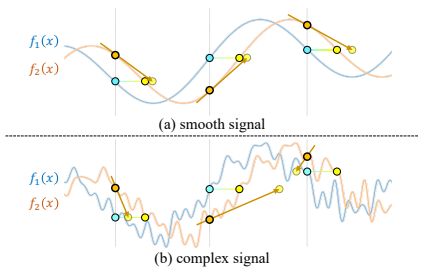
Figure 2 : Predicting alignment from signal differences. Consider two 1D signals wheref1(x) = f2(x +c) differs by an offsetc. When solving for alignment, smoother sig- nals can predict more coherent displacements than complex signals, which easily results in suboptimal alignment.
원문 · CC BY 4.0 · Chen-Hsuan Lin, Wei-Chiu Ma, Antonio Torralba, Simon Lucey · BARF: Bundle-Adjusting Neural Radiance Fields · 원문 그림 인용 · 원본 PDF 3쪽에서 그림 영역을 추출했습니다.같은 관점에서 좌표 기반 신경망 표현도 정합 목적 함수에 넣을 수 있습니다. 이 연결은 NeRF의 합성 기반 목적 함수에서도 성립합니다. 저자들은 그 목적 함수의 포즈 업데이트가 네트워크 f의 야코비안과 위치 인코딩의 주파수 구조에 의존한다는 점에서 평활도 제어가 중요하다고 해석합니다.
위치 인코딩 주파수 대역의 점진적 활성화
BARF의 핵심 변경은 위치 인코딩의 주파수 대역마다 가중치를 곱하는 것입니다. k번째 주파수 성분은 w_k(α) 가중치로 곱해지며, 가중치는 α가 k보다 작을 때 0, α−k가 0과 1 사이일 때 부드럽게 증가하는 코사인 형태, α−k가 1 이상일 때 1입니다. 따라서 α가 0이면 원시 3D 좌표만 사용하고, α가 L이면 원래 NeRF의 완전 위치 인코딩과 같아집니다.
이 가중치는 그래디언트에도 직접 작용합니다. 위치 인코딩의 야코비안이 w_k(α)를 곱하므로, 가중치가 0인 높은 주파수 성분은 그래디언트 기여가 0이 됩니다. 학습 초기에는 평활한 신호로 올바른 등록을 찾고, 이후 고주파 성분을 점차 켜서 고충실도 장면 표현을 학습하는 구조입니다.
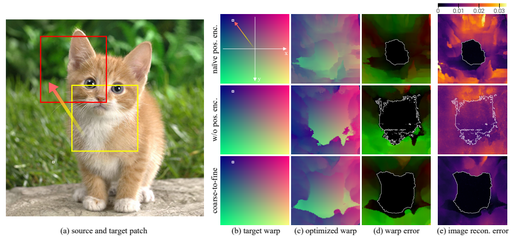
Figure 9 : Visualization of the basin of attraction. (a) We aim to align a center box (yellow) to a target patch (red) atevery possible location within the raw image. For each target patch, we jointly optimizef and the translational warp p to analyze the final warp error and the image reconstruction loss. (b) The target offsets forms a color-coded map, where green indicates horizontal offsets and red indicates vertical offsets. The above example corresponds to the highlighted pixel. (c) The optimized warp parameters and (d) the warp error for every target patch location, where the white contours highlight the offset error threshold of 0.5 pixels. BARF effectively widens the basin of attraction (range of successful alignment) with a smoother landscape compared to naïve positional encoding. (e) Without positional encoding,f has limited capacity of representing the image details, resulting in nonzero image errors despite the registration being successful as well.
원문 · CC BY 4.0 · Chen-Hsuan Lin, Wei-Chiu Ma, Antonio Torralba, Simon Lucey · BARF: Bundle-Adjusting Neural Radiance Fields · 원문 그림 인용 · 원본 PDF 10쪽에서 그림 영역을 추출했습니다.합성 객체 장면의 등록과 시점 합성
합성 객체 실험에서는 8개 장면에 대해 각 장면의 학습 이미지 100장과 정답 카메라 포즈를 사용하고, 포즈에 δp∼N(0, 0.15I) 노이즈를 더해 초기화합니다. BARF는 200K 반복 동안 α를 20K부터 100K까지 선형으로 조정하며 학습하고, 비교 대상은 완전 위치 인코딩을 쓴 NeRF입니다. 포즈 평가는 최적화된 카메라 위치를 Procrustes 분석으로 정답 위치에 정렬한 뒤 회전과 이동 오차를 계산하는 방식입니다.
보고된 결과에서 BARF의 평균 회전 오차는 0.193도이며, 이 값은 0.2도 미만입니다. 시점 합성 품질은 PSNR, SSIM, LPIPS로 측정되었고, 원문은 BARF가 정답 포즈로 학습한 참조 NeRF와 비슷한 수준을 보인다고 보고합니다. 완전 위치 인코딩 NeRF는 카메라 포즈를 잘못 등록해 평균 회전 오차가 6.167도로 보고되었습니다.
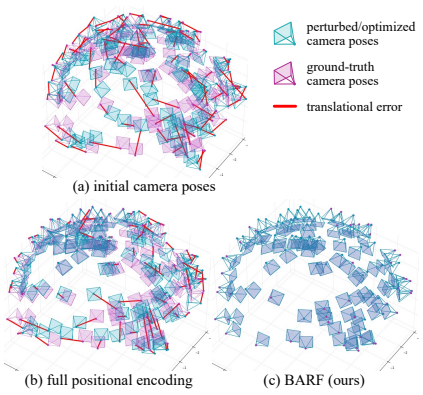
Figure 5 : Visual comparison of the initial and optimized camera poses (Procrustes aligned) for thechair scene. BARF successfully realigns all the camera frames while NeRF naïve positional encoding gets stuck at suboptimal solutions.
원문 · CC BY 4.0 · Chen-Hsuan Lin, Wei-Chiu Ma, Antonio Torralba, Simon Lucey · BARF: Bundle-Adjusting Neural Radiance Fields · 원문 그림 인용 · 원본 PDF 6쪽에서 그림 영역을 추출했습니다.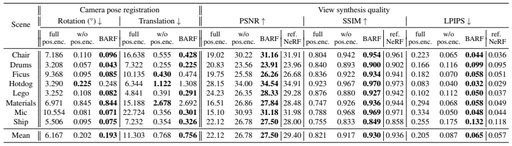
Table 2 : Quantitative results of NeRF on synthetic scenes. BARF successfully optimizes for camera registration (with less than 0.2° rotation error) while still consistently achieving high-quality view synthesis that is comparable to the reference NeRF models (trained under perfect camera poses). Translation errors are scaled by 100.
원문 · CC BY 4.0 · Chen-Hsuan Lin, Wei-Chiu Ma, Antonio Torralba, Simon Lucey · BARF: Bundle-Adjusting Neural Radiance Fields · 원문 그림 인용 · 원본 PDF 7쪽에서 그림 영역을 추출했습니다.LLFF 실세계 장면의 미지 포즈 학습
실세계 실험은 LLFF 데이터셋의 8개 전방향 장면에서 수행되었습니다. 모든 카메라 포즈는 항등 변환으로 초기화되며, 카메라 내부 파라미터는 데이터셋이 제공한 값을 알고 있다고 가정합니다. 학습은 200K 반복이며 BARF는 α를 20K부터 100K까지 조정합니다. 이 설정은 포즈가 알려지지 않은 상황을 모사하지만, 카메라 내부 파라미터는 알려진 상태라는 점이 함께 보존되어야 합니다.

Table 4 : Dataset statistics of the train/test splits for the real- world scene (LLFF) experiments, where we hold out the last 10% frames from each sequences.
원문 · CC BY 4.0 · Chen-Hsuan Lin, Wei-Chiu Ma, Antonio Torralba, Simon Lucey · BARF: Bundle-Adjusting Neural Radiance Fields · 원문 그림 인용 · 원본 PDF 10쪽에서 그림 영역을 추출했습니다.결과에서 BARF의 평균 회전 오차는 0.6도 미만이며, 원문은 이 값이 SfM으로 추정한 포즈와의 일치를 보여준다고 해석합니다. 다만 LLFF의 포즈 기준 자체가 SfM 추정값이므로, 이 평가는 기하학적 포즈 추정과의 일치 정도를 나타내는 것으로 읽어야 합니다. 완전 위치 인코딩 NeRF는 잘못된 위치로 발산하여 시점 합성 품질이 낮게 보고됩니다.
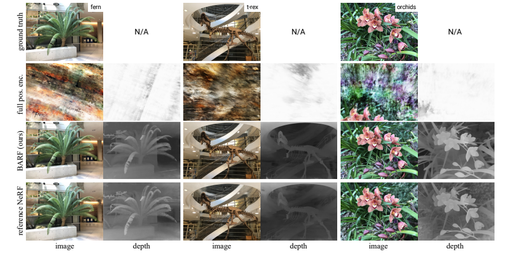
Figure 7 : Qualitative results of NeRF on real-world scenes from unknown camera poses. Compared to a reference NeRF model trained with camera poses provided from Sf M [44], BARF can effectively optimize for the poses jointly with the scene representation. NeRF models with full positional encoding diverge to incorrect localization and hence poor synthesis quality.
원문 · CC BY 4.0 · Chen-Hsuan Lin, Wei-Chiu Ma, Antonio Torralba, Simon Lucey · BARF: Bundle-Adjusting Neural Radiance Fields · 원문 그림 인용 · 원본 PDF 8쪽에서 그림 영역을 추출했습니다.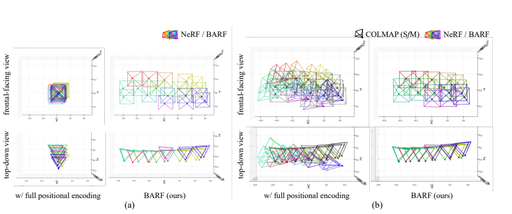
Figure 10 : Visualization of the optimized camera poses for the fern scene. The poses for both the baseline NeRF (with full positional encoding) and BARF are initialized to the identity transform for all frames. (a) The camera poses of the baseline NeRF get stuck in a suboptimal solution that does not accurately reflect the actual viewpoints, whereas BARF can effectively optimize for the underlying poses. (b) We compare the optimized poses to those computed from Sf M [44] (colored in black), where we align the pose trajectories using Procrustes analysis. The camera poses optimized by BARF highly agree with those from Sf M, whereas those from the baseline NeRF cannot be well-aligned with Procrustes analysis. Therefore, there is no systematic way of finding a reasonable set of corresponding held-out views with respect to the optimized coordinate system.
원문 · CC BY 4.0 · Chen-Hsuan Lin, Wei-Chiu Ma, Antonio Torralba, Simon Lucey · BARF: Bundle-Adjusting Neural Radiance Fields · 원문 그림 인용 · 원본 PDF 11쪽에서 그림 영역을 추출했습니다.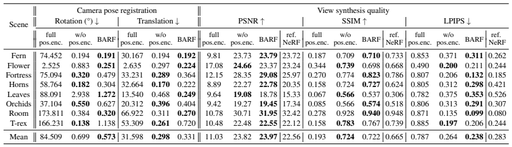
Table 5 : Full quantitative comparison of NeRF on the LLFF forward-facing scenes from unknown camera poses. BARF and our baseline without positional encoding are competitive in different metrics. An optimal coarse-to-fine schedule for BARF could be theoretically found per scene that are at least as good as the baseline methods; exhaustively or adaptively search for such optimal schedule is currently out of scope of this paper. Translation errors are scaled by 100.
원문 · CC BY 4.0 · Chen-Hsuan Lin, Wei-Chiu Ma, Antonio Torralba, Simon Lucey · BARF: Bundle-Adjusting Neural Radiance Fields · 원문 그림 인용 · 원본 PDF 11쪽에서 그림 영역을 추출했습니다.적용 범위와 남은 한계
저자들은 BARF가 원래 NeRF와 비슷한 한계를 가진다고 밝힙니다. 최적화와 렌더링이 느리고, 강체 가정을 사용하며, 밀집한 3D 샘플링에 민감합니다. 또한 coarse-to-fine 스케줄을 휴리스틱하게 정해야 합니다.
LLFF 부록의 깊이 공간 실험에서도 완전 위치 인코딩 NeRF는 여전히 모든 지표에서 낮게 나타나지만, 위치 인코딩을 쓰지 않은 방법이 일부 설정에서 BARF보다 나을 수 있습니다. 따라서 주파수 스케줄의 최적화나 최적 깊이 파라미터화는 이 논문의 범위 밖입니다.
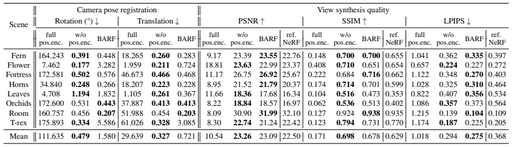
Table 6 : Quantitative results of NeRF on the LLFF forward-facing scenes fromunknown camera poses, sampling the 3D points in the regular depth space (instead of the inverse depth space). Translation errors are scaled by 100.
원문 · CC BY 4.0 · Chen-Hsuan Lin, Wei-Chiu Ma, Antonio Torralba, Simon Lucey · BARF: Bundle-Adjusting Neural Radiance Fields · 원문 그림 인용 · 원본 PDF 13쪽에서 그림 영역을 추출했습니다.논문 정보
- 저자
- Chen-Hsuan Lin, Wei-Chiu Ma, Antonio Torralba, Simon Lucey
- 학회·저널
- arXiv · 프리프린트
- 최초 공개일
- 2021년 4월 13일
- 등록일
- 2026년 11월 5일
- 수정일
- 2021년 8월 19일
- 버전
- v2
- arXiv
- 2104.06405
- 분류
- cs.CV · cs.GR · cs.LG · cs.RO
- 원문 이용 조건
- CC BY 4.0
- 제공 범위
- 논문 정보, 해설, 허용된 원문 그림
AI 해설은 논문 원문과 별개의 설명이며 오류가 있을 수 있습니다. 원문과 그림은 각 출처의 이용 조건과 따로 표시된 권리를 따릅니다.
초록
Neural Radiance Fields (NeRF) have recently gained a surge of interest within the computer vision community for its power to synthesize photorealistic novel views of real-world scenes. One limitation of NeRF, however, is its requirement of accurate camera poses to learn the scene representations. In this paper, we propose Bundle-Adjusting Neural Radiance Fields (BARF) for training NeRF from imperfect (or even unknown) camera poses -- the joint problem of learning neural 3D representations and registering camera frames. We establish a theoretical connection to classical image alignment and show that coarse-to-fine registration is also applicable to NeRF. Furthermore, we show that naïvely applying positional encoding in NeRF has a negative impact on registration with a synthesis-based objective. Experiments on synthetic and real-world data show that BARF can effectively optimize the neural scene representations and resolve large camera pose misalignment at the same time. This enables view synthesis and localization of video sequences from unknown camera poses, opening up new avenues for visual localization systems (e.g. SLAM) and potential applications for dense 3D mapping and reconstruction.
원문 인용
Chen-Hsuan Lin, Wei-Chiu Ma, Antonio Torralba, Simon Lucey (2021). BARF: Bundle-Adjusting Neural Radiance Fields. arXiv:2104.06405v2. https://arxiv.org/abs/2104.06405v2
BibTeX
@misc{lin2021barf,
  title = {{BARF: Bundle-Adjusting Neural Radiance Fields}},
  author = {Chen-Hsuan Lin and Wei-Chiu Ma and Antonio Torralba and Simon Lucey},
  year = {2021},
  eprint = {2104.06405},
  archivePrefix = {arXiv},
  url = {https://arxiv.org/abs/2104.06405v2}
}