논문 해설
ParticleFormer: A 3D Point Cloud World Model for Multi-Object, Multi-Material Robotic Manipulation
ParticleFormer: 다중 객체·다중 재질 로봇 조작을 위한 3D 포인트 클라우드 월드 모델
- 연구 문제 기존 그래프 기반 3D world model은 입자 인접 관계와 3D 재구성에 의존해 다중 재료·다중 객체 조작에서 정확도와 학습 비용 측면의 한계를 보입니다.
- 연구 방법 ParticleFormer는 입자 점군에 Transformer self-attention을 적용해 상호작용을 학습하고 Chamfer Distance와 Hausdorff 근사를 결합한 하이브리드 손실로 감독합니다.
- 주요 결과 시뮬레이션 다중 재료 과제의 MSE와 CD+HD에서 ParticleFormer가 GBND와 DINO-WM보다 낮은 오차를 보였고, 실제 과제의 MPC 평가에서도 낮은 최종 상태 불일치를 보고했습니다.
기존 3D 世界 모델의 한계
로봇 조작에서 world model은 로봇 행동이 주어졌을 때 환경이 다음 시점에 어떻게 변할지 예측하는 학습 모델입니다. 기존 3D 방법은 입자를 그래프로 연결하는 GBND 계열이 주로 쓰였고, 이 방식은 입자 인접 관계를 정하는 최대 거리나 최대 이웃 수 같은 하이퍼파라미터에 민감합니다. 또한 3D 입자 궤적을 얻기 위해 dynamic Gaussian Splatting 재구성이 필요해 실제 로봇 데이터로 학습하기 어렵습니다. 이 논문은 이러한 문제를 다중 재료·다중 객체 조작 환경에서 다룹니다.
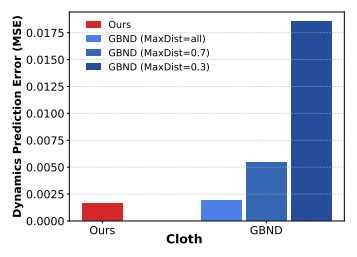
Figure 9 : Effect of MaxDist on GBND Dynamics Accuracy. Since information propagation in GBND relies on graph topology, its performance is highly sensitive to the maximum distance thresh- old for edge construction. In contrast, ParticleFormer avoids this sensitivity through attention- based interactions.
원문 · CC BY 4.0 · Suning Huang, Qianzhong Chen, Xiaohan Zhang, Jiankai Sun, Mac Schwager · ParticleFormer: A 3D Point Cloud World Model for Multi-Object, Multi-Material Robotic Manipulation · 원문 그림 인용 · 원본 PDF 16쪽에서 그림 영역을 추출했습니다.Transformer 기반 점군 동역학 모델
ParticleFormer는 객체와 엔드이펙터의 점군 위치, 입자별 재료 one-hot 인코딩, 운동 정보를 결합해 각 입자의 잠재 표현을 만듭니다. 이 표현은 L=3개의 multi-head self-attention 층으로 전이되어 입자 간 상호작용을 학습하며, 공유 디코더가 입자별 변위를 예측하고 현재 위치에 더해 다음 위치를 출력합니다. 저자들은 이러한 attention 방식이 미리 정한 그래프 인접 관계 없이 상호작용 구조를 학습하게 한다고 설명합니다.
하이브리드 점군 손실
학습 손실은 Chamfer Distance와 Hausdorff Distance의 미분 가능한 근사를 α로 결합한 형태입니다. Chamfer Distance는 예측 입자와 정답 입자 사이의 평균 최근접 거리로 지역 정렬을 감독하고, Hausdorff 항은 최악의 편차에 벌점을 주어 전역 구조를 돕습니다. 학습은 무작위로 고른 시작 시점에서 k=5 스텝 동안 모델의 자기 예측을 입력으로 되먹임하는 자기회귀 롤아웃으로 진행됩니다. 이 설계는 dense correspondence나 명시적 3D 재구성 없이 점군 센서 스트림에 직접 적용된다고 저자들이 밝힙니다.
다중 재료 과제에서의 동역학 예측 비교
Table 1의 시뮬레이션 다중 재료 과제에서 MSE는 낮을수록 좋고, CD+HD도 낮을수록 좋습니다. Cloth Gathering에서 ParticleFormer의 MSE는 0.0023이고 GBND는 0.0076입니다. Rope Sweeping의 CD+HD는 ParticleFormer 0.328, GBND 0.473, DINO-WM 0.798입니다. 같은 Cloth Gathering의 CD 지표에서는 Ours w/o Hybrid가 0.082로 ParticleFormer의 0.096보다 낮게 보고되어 있어, 전반적인 우위는 MSE와 CD+HD에서 두드러집니다. DINO-WM은 점 대 점 대응이 없어 점군 기반 지표만 적용되었고 3D 지표는 Depth Anything V2로 복원한 점군으로 계산되었습니다.
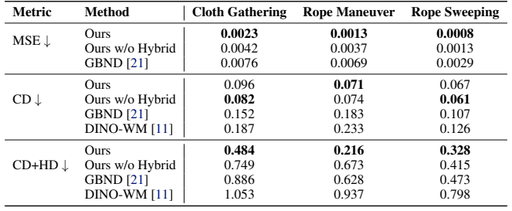
Table 1 : Quantitative Results for Dynamics Prediction. We report prediction errors across three multi-material simulation tasks (please refer to Appendix A for detailed task descriptions), where ground-truth object state information is available for computing evaluation metrics. Since DINO- WM does not provide point-to-point particle correspondences, we evaluate it using point cloud-based metrics only. Results for additional tasks are provided in Appendix B.
원문 · CC BY 4.0 · Suning Huang, Qianzhong Chen, Xiaohan Zhang, Jiankai Sun, Mac Schwager · ParticleFormer: A 3D Point Cloud World Model for Multi-Object, Multi-Material Robotic Manipulation · 원문 그림 인용 · 원본 PDF 7쪽에서 그림 영역을 추출했습니다.Hybrid 손실과 TopK 민감도
Ours w/o Hybrid는 Chamfer Distance 감독만 사용한 변형입니다. 이 변형은 CD 지표 일부에서 ParticleFormer보다 낮은 값을 보였기 때문에, hybrid 손실의 효과는 MSE와 CD+HD에서 보는 것이 적절합니다. 별도로 GBND에서 TopK를 5, 10, 15로 늘리면 예측 오차는 줄어들지만 GPU 메모리와 계산 비용이 증가한다고 원문에 보고되어 있습니다. 이는 GBND의 그래프 하이퍼파라미터 민감도를 보여 주는 분석이며, ParticleFormer의 결과와 분리해 해석해야 합니다.
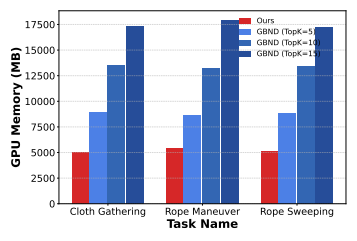
Figure 8 : Effect of TopK on GBND GPU Usage. As the maximum number of allowed adjacent nodes increases, GBND’s GPU memory usage grows significantly. This highlights the scalability bottleneck in GNN-based methods. In contrast, ParticleFormer avoids this issue by using soft attention without explicit neighbor selection.
원문 · CC BY 4.0 · Suning Huang, Qianzhong Chen, Xiaohan Zhang, Jiankai Sun, Mac Schwager · ParticleFormer: A 3D Point Cloud World Model for Multi-Object, Multi-Material Robotic Manipulation · 원문 그림 인용 · 원본 PDF 16쪽에서 그림 영역을 추출했습니다.MPPI 기반 모델 예측 제어 평가
학습된 world model은 MPPI 알고리즘과 결합되어 샘플된 행동 시퀀스를 롤아웃하고, 정규화된 CD+HD를 비용으로 사용해 목표 상태와의 차이가 가장 작은 행동을 선택합니다. 실제 로봇의 Box Pushing, Cloth Gathering, Rope Sweeping 과제에서 GBND와 Ours w/o Hybrid와 비교했으며, 최종 상태 불일치를 세 번의 rollout 시도에서 평가했습니다. 이 결과는 해당 실제 과제와 목표 설정에서 얻은 것이며 다른 로봇이나 환경으로의 일반화를 보여 주지는 않습니다.
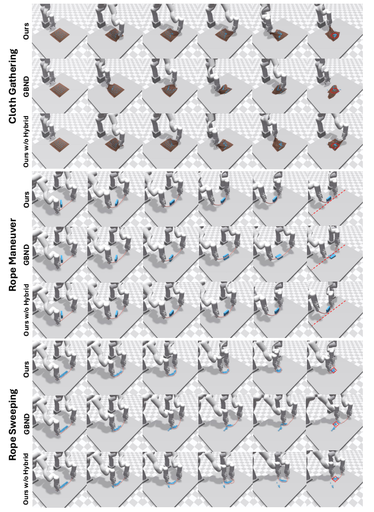
Figure 10 : MPC Rollout Results in Multi-Material Simulation Tasks. The robot is tasked with using the learned world model to perform closed-loop feedback control toward novel target states unseen during training. Target states are indicated by red dashed boxes or lines. Compared to baselines, ParticleFormer achieves more accurate planning and lower final-state mismatch.
원문 · CC BY 4.0 · Suning Huang, Qianzhong Chen, Xiaohan Zhang, Jiankai Sun, Mac Schwager · ParticleFormer: A 3D Point Cloud World Model for Multi-Object, Multi-Material Robotic Manipulation · 원문 그림 인용 · 원본 PDF 17쪽에서 그림 영역을 추출했습니다.적용 범위와 한계
저자들이 밝힌 주된 한계는 ParticleFormer가 현재 장면별로 학습되며 여러 환경과 로봇으로 일반화되었다고 보이지 않는다는 점입니다. 파이프라인은 외부 foundation model로 만든 객체 마스크에 의존하므로 분할 실패가 동역학 예측으로 전파될 수 있습니다. 향후 연구로는 장면에 독립적인 모델과 명시적 마스킹 없는 의미 코드 임베딩이 제시되어 있습니다.
논문 정보
- 저자
- Suning Huang, Qianzhong Chen, Xiaohan Zhang, Jiankai Sun, Mac Schwager
- 학회·저널
- arXiv · 프리프린트
- 최초 공개일
- 2025년 6월 29일
- 등록일
- 2026년 11월 4일
- 수정일
- 2025년 8월 25일
- 버전
- v4
- arXiv
- 2506.23126
- 분류
- cs.RO
- 원문 이용 조건
- CC BY 4.0
- 제공 범위
- 논문 정보, 해설, 허용된 원문 그림
AI 해설은 논문 원문과 별개의 설명이며 오류가 있을 수 있습니다. 원문과 그림은 각 출처의 이용 조건과 따로 표시된 권리를 따릅니다.
초록
3D world models (i.e., learning-based 3D dynamics models) offer a promising approach to generalizable robotic manipulation by capturing the underlying physics of environment evolution conditioned on robot actions. However, existing 3D world models are primarily limited to single-material dynamics using a particle-based Graph Neural Network model, and often require time-consuming 3D scene reconstruction to obtain 3D particle tracks for training. In this work, we present ParticleFormer, a Transformer-based point cloud world model trained with a hybrid point cloud reconstruction loss, supervising both global and local dynamics features in multi-material, multi-object robot interactions. ParticleFormer captures fine-grained multi-object interactions between rigid, deformable, and flexible materials, trained directly from real-world robot perception data without an elaborate scene reconstruction. We demonstrate the model's effectiveness both in 3D scene forecasting tasks, and in downstream manipulation tasks using a Model Predictive Control (MPC) policy. In addition, we extend existing dynamics learning benchmarks to include diverse multi-material, multi-object interaction scenarios. We validate our method on six simulation and three real-world experiments, where it consistently outperforms leading baselines by achieving superior dynamics prediction accuracy and less rollout error in downstream visuomotor tasks. Experimental videos are available at https://suninghuang19.github.io/particleformer_page/.
원문 인용
Suning Huang, Qianzhong Chen, Xiaohan Zhang, Jiankai Sun, Mac Schwager (2025). ParticleFormer: A 3D Point Cloud World Model for Multi-Object, Multi-Material Robotic Manipulation. arXiv:2506.23126v4. https://arxiv.org/abs/2506.23126v4
BibTeX
@misc{huang2025particleformer,
  title = {{ParticleFormer: A 3D Point Cloud World Model for Multi-Object, Multi-Material Robotic Manipulation}},
  author = {Suning Huang and Qianzhong Chen and Xiaohan Zhang and Jiankai Sun and Mac Schwager},
  year = {2025},
  eprint = {2506.23126},
  archivePrefix = {arXiv},
  url = {https://arxiv.org/abs/2506.23126v4}
}