논문 해설
Editing Conditional Radiance Fields
조건부 래디언스 필드 편집
- 연구 문제 NeRF는 장면마다 최적화되는 방사장으로 새로운 시점을 높은 품질로 합성하지만, 범주 수준의 조건부 방사장을 사용자가 2D 스크리블로 색상이나 형상을 편집하는 방법은 명확하지 않습니다.
- 연구 방법 공유 형상 분기를 가진 조건부 방사장을 학습한 뒤, 편집 시 색상은 F_rad와 색상 코드를, 형상은 F_fuse와 F_dens를 갱신하는 하이브리드 업데이트로 사용자 제약을 맞춥니다.
- 주요 결과 PhotoShape 색상 편집에서 제안 방법은 PSNR 35.25, LPIPS 0.027을 보였고, Aubry 형상 편집에서는 PSNR 24.57, LPIPS 0.081, 37.4초를 보고했습니다.
카테고리 수준 NeRF를 편집하기 어려운 이유
NeRF는 장면마다 최적화되는 신경 방사장으로, 새로운 시점의 뷰를 높은 품질로 합성할 수 있습니다. 이 논문은 이를 한 객체 범주 전체에 대해 학습한 조건부 방사장(conditional radiance field)을 사용자가 편집할 수 있게 만드는 문제를 다룹니다. 이 표현은 장면이 신경망의 가중치 안에 암묵적으로 담기므로, 명시적 메쉬나 텍스처처럼 특정 부분을 직접 고르기 어렵습니다.
저자들은 두 가지 난점을 제시합니다. 첫째, 사용자가 찍은 희소한 2D 스크리블을 3D 공간의 대응 영역 전체로 어떻게 전파할지가 불분명합니다. 둘째, 네트워크는 수백만 개의 파라미터를 가지므로 어떤 파라미터가 형상과 색상을 조절하는지, 그리고 희소한 국소 입력에 따라 무엇을 바꿔야 하는지가 분명하지 않습니다. 이 논문은 편집 대상을 색상 변경, 형상 수정(부분 제거와 추가), 색상·형상 전달의 세 가지로 한정합니다.
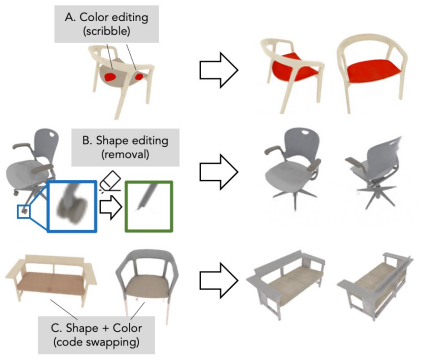
Figure 1 : Editing a conditional radiance field. Given a condi- tional radiance field trained over a class of objects, we demonstrate three editing applications: (A) color editing, (B) shape editing, and (C) color/shape transfer. A user provides coarse scribbles over a local region of interest or selects a target object instance. Local edits propagate to the desired region in 3D and are consistent across different rendered views.
원문 · CC BY 4.0 · Steven Liu, Xiuming Zhang, Zhoutong Zhang, Richard Zhang, Jun-Yan Zhu, Bryan Russell · Editing Conditional Radiance Fields · 원문 그림 인용 · 원본 PDF 1쪽에서 그림 영역을 추출했습니다.공유 형상 분기를 가진 조건부 방사장
제안 모델은 3차원 위치 x와 시점 방향 d, 그리고 인스턴스별 형상 코드 z(s)와 색상 코드 z(c)를 입력으로 받아 방사 색 c와 스칼라 밀도 σ를 출력합니다. 밀도는 시점 방향과 무관하고, 색은 위치와 시점 방향 모두에 의존하도록 설계되었습니다. 렌더링은 광선 위의 샘플 점들에 대해 알파 합성(alpha compositing) 연산으로 픽셀 색을 계산합니다.
네트워크는 범주 전체에 공유되는 형상 네트워크 F_share, 인스턴스별 형상 네트워크 F_inst, 두 결과를 합치는 융합 형상 네트워크 F_fuse로 구성됩니다. 밀도는 F_fuse의 출력을 선형층인 F_dens에 통과시켜 얻고, 색은 F_fuse의 출력과 색상 코드, 시점 방향 인코딩을 이어 붙인 뒤 두 층 MLP인 F_rad로 예측합니다. 저자들은 공유 형상 분기가 객체 인스턴스들 사이에서 공통 형상 특징을 담도록 유도한다고 설명합니다. 이 유도 효과는 저자들이 해석한 것이며, 이 논문은 이를 개별 가중치의 의미로 직접 증명하지 않습니다.
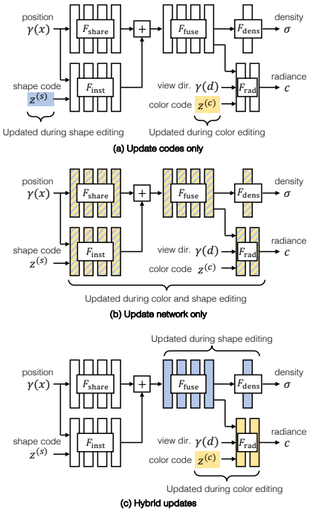
Figure 2 : Conditional radiance field network. Our network maps a 3D location x, viewing direction d, and instance-specific shape code z(s) and color code z(c) to radiance c and scalar density σ. The network is composed of modular parts for better shape and color disentanglement. We train our network over a collection of 3D objects (Section 3.1). As highlighted, only a subset of the network components need to be updated during editing (Section 3.2).
원문 · CC BY 4.0 · Steven Liu, Xiuming Zhang, Zhoutong Zhang, Richard Zhang, Jun-Yan Zhu, Bryan Russell · Editing Conditional Radiance Fields · 원문 그림 인용 · 원본 PDF 3쪽에서 그림 영역을 추출했습니다.하이브리드 네트워크 갱신과 편집 최적화 가속
편집은 인스턴스를 표현하는 네트워크와 코드 중 무엇을 갱신할지로 나뉩니다. 코드만 갱신하는 방법은 효율적이지만 편집 품질이 낮았고, 네트워크 전체를 갱신하는 방법은 느리며 편집하지 않은 영역까지 바꿀 수 있습니다. 제안 방법인 하이브리드 업데이트는 편집 종류에 따라 일부 층만 갱신합니다. 색상 편집에서는 F_rad와 z(c)만 갱신하고, 형상 편집에서는 F_fuse와 F_dens를 갱신합니다.
이 선택으로 최적화 시간이 줄어듭니다. 저자들은 색상 편집에서 최적화 시간이 전체 네트워크 최적화의 972초에서 260초로, 형상 편집에서는 1,081초에서 342초로 줄었다고 보고합니다. 편집 시에는 두 가지 가속을 추가로 씁니다. 하나는 사용자 제약 광선 일부를 샘플링하는 것으로, 색상 편집에서는 64개, 형상 편집에서는 8,192개 광선을 무작위로 씁니다. 다른 하나는 편집 중 변하지 않는 네트워크 출력을 캐싱하는 것입니다. 저자들은 특히 색상 편집에서 F_rad의 입력이 변하지 않으므로 이를 캐싱할 수 있다고 설명합니다.
색상과 형상 편집 손실
색상 편집에서는 사용자가 지정한 전경 광선의 목표 색과 배경 광선의 원래 색을 맞추는 재구성 손실 L_rec를 정의합니다. 여기에 원래 모델 가중치에서 벗어나는 정도를 벌하는 정규화 항 L_reg를 더해 L_color = L_rec + λ_reg·L_reg를 최적화하며, λ_reg는 10으로 설정합니다. 이 손실은 z(c)와 F_rad에 대해 최적화됩니다.
형상 부분 제거에서는 사용자가 칠한 영역을 전경으로, 나머지를 배경으로 삼아 편집 예제를 만듭니다. 이때 전경 광선의 밀도 벡터에 대한 엔트로피 기반 손실 L_dens = −Σ σ_r^T log(σ_r)를 사용하며, 밀도 벡터는 단위 길이로 정규화됩니다. 엔트로피 페널티는 광선의 밀도를 희소하게 만들어 제거된 영역의 밀도를 0으로 유도합니다. 형상 추가는 새 객체의 일부를 원래 장면에 붙인 합성 이미지에 맞추는 재구성 손실을 사용하며, 이 방법은 학습 반복이 많아 느린 것으로 보고됩니다.
색상 편집 결과
색상 편집은 PhotoShape 의자 데이터셋에서 평가되었습니다. 소스 학습 인스턴스를 같은 형상이지만 다른 색을 가진 목표 인스턴스와 맞추는 것이 목표입니다. 편집 후 40개 시점에서 렌더링하여 PSNR과 LPIPS로 비교합니다. 제안 방법은 PSNR 35.25, LPIPS 0.027을 보고했습니다. 다른 기준선은 단일 인스턴스 NeRF fine-tuning 29.53, 색상 코드만 fine-tuning 26.29, 모든 가중치 fine-tuning 31.00, Model Rewriting 18.42입니다.
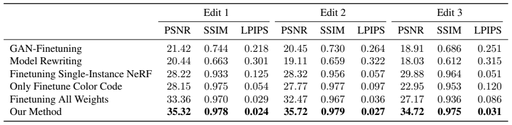
Table 7 : Color editing quantitative results. We evaluate color editing of a source object instance to match a target instance. Please refer to Figure 8 (this supplemental) for a visualization of each of the edits. Notice that our method outperforms the baselines for all color edits on all criteria.
원문 · CC BY 4.0 · Steven Liu, Xiuming Zhang, Zhoutong Zhang, Richard Zhang, Jun-Yan Zhu, Bryan Russell · Editing Conditional Radiance Fields · 원문 그림 인용 · 원본 PDF 15쪽에서 그림 영역을 추출했습니다.이 결과는 세 가지 색상 편집의 평균입니다. 색상 코드만 미세조정하면 편집을 맞추기 어렵고, 전체 네트워크를 바꾸면 밀도 출력을 통해 형상이 크게 바뀐다고 저자들은 설명합니다. GAN 기반 편집은 새 시점으로 일반화하지 못했고, 단일 인스턴스 NeRF는 범주 수준의 외형 사전 지식이 없어 다른 시점에서 아티팩트를 만들었습니다. 이 비교는 PhotoShape 색상 편집이라는 조건에 한정됩니다.
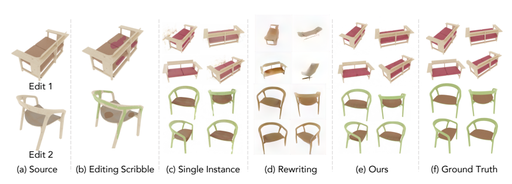
Figure 3 : Color editing qualitative results. We visualize color editing results where the goal is to match a source instance’s colors to a target. Our method accurately captures the colors of the target instance given scribbles over one view. Notice how (c) Editing a Single-Instance NeRF causes visual artifacts, and (d) Rewriting a GAN [8] fails to propagate the edit to unseen views and generates unrealistic outputs.
원문 · CC BY 4.0 · Steven Liu, Xiuming Zhang, Zhoutong Zhang, Richard Zhang, Jun-Yan Zhu, Bryan Russell · Editing Conditional Radiance Fields · 원문 그림 인용 · 원본 PDF 7쪽에서 그림 영역을 추출했습니다.형상 편집 결과와 절제 실험
형상 편집은 Aubry 의자 데이터셋에서 소스 인스턴스를 비슷한 형상의 목표 인스턴스로 바꾸는 실험입니다. 세 편집의 평균 결과에서 제안 방법은 PSNR 24.57, LPIPS 0.081, 시간 37.4초를 보고했습니다. 형상 코드만 미세조정한 방법은 PSNR 22.07, 밀도 네트워크만 미세조정한 방법은 21.84, 모든 가중치 fine-tuning은 20.31과 시간 66.4초였습니다. 제안 방법은 PSNR과 LPIPS에서 가장 높은 품질을 보였고, 비용은 전체 fine-tuning보다 낮았습니다.
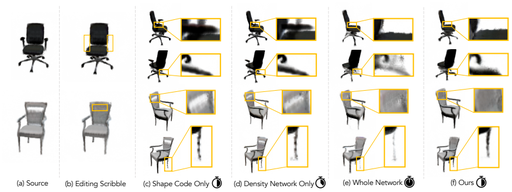
Figure 4 : Shape editing qualitative results. Our method successfully removes the arms and fills in the hole of a chair. Notice how only optimizing the shape code or branch are unable to fit both edits. Optimizing the whole network is slow and causes unwanted changes in the instance.
원문 · CC BY 4.0 · Steven Liu, Xiuming Zhang, Zhoutong Zhang, Richard Zhang, Jun-Yan Zhu, Bryan Russell · Editing Conditional Radiance Fields · 원문 그림 인용 · 원본 PDF 8쪽에서 그림 영역을 추출했습니다.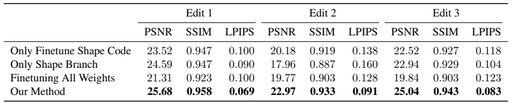
Table 8 : Shape editing quantitative results. We evaluate shape editing of a source object instance to match a target instance. Please refer to Figure 11 for a visualization of each of the edits. Notice that our method outperforms the baselines for all color edits on all criteria.
원문 · CC BY 4.0 · Steven Liu, Xiuming Zhang, Zhoutong Zhang, Richard Zhang, Jun-Yan Zhu, Bryan Russell · Editing Conditional Radiance Fields · 원문 그림 인용 · 원본 PDF 19쪽에서 그림 영역을 추출했습니다.뷰 재구성 절제 실험은 PhotoShapes와 Aubry 데이터셋에서 단일 NeRF, 학습된 잠재 코드 추가, 분리된 형상·색상 코드, 공유 형상 분기를 비교합니다. 공유 형상 분기를 포함한 모델이 PhotoShapes에서 PSNR 37.67, Aubry에서 21.78을 보고했으며, 개별 인스턴스 NeRF는 PhotoShapes에서 37.31, Aubry에서 24.15로 나타났습니다. 따라서 Aubry 데이터셋에서는 개별 인스턴스 NeRF가 더 높은 PSNR을 보였다는 점을 함께 읽어야 합니다.
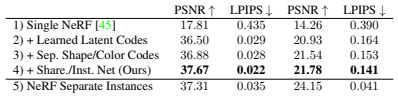
Table 1 : Ablation study. We evaluate our model and several abla- tions on view reconstruction. Notice how separating the shape and color codes and using the shared/instance network improves the view synthesis quality. Our model even outperforms single-instance NeRF models (each trained on one object).
원문 · CC BY 4.0 · Steven Liu, Xiuming Zhang, Zhoutong Zhang, Richard Zhang, Jun-Yan Zhu, Bryan Russell · Editing Conditional Radiance Fields · 원문 그림 인용 · 원본 PDF 6쪽에서 그림 영역을 추출했습니다.상호작용성과 적용 범위
저자들은 형상 편집이 사용자 피드백을 받는 데 1분 이상 걸려 상호작용성이 제한된다고 밝힙니다. 계산의 대부분은 편집 자체보다 뷰 렌더링에 쓰이며, NeRF 렌더링 속도 개선 연구가 이를 줄일 수 있다고 제안합니다. 또한 학습 범주의 인스턴스와 매우 다른 새 객체는 재구성하지 못한다고 보고합니다.
실제 사진 편집은 입력 이미지의 시점을 수동으로 고르고 학습된 방사장을 그 이미지에 미세조정하는 절차를 거칩니다. 이 논문은 이 절차가 입력이 학습 데이터와 비슷한 객체 클래스와 배경을 가진다고 가정한다고 밝힙니다. 따라서 실제 사진의 결과는 이 가정이 성립하는 조건에 한정하여 읽어야 합니다.
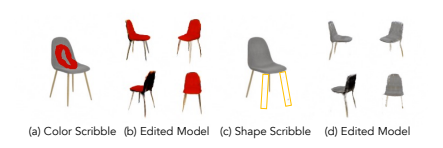
Figure 6 : Real image editing results. Our method first finetunes a conditional radiance field to match a real still image input. Editing the resulting radiance field successfully changes the chair seat color to red and removes two of the chair’s legs.
원문 · CC BY 4.0 · Steven Liu, Xiuming Zhang, Zhoutong Zhang, Richard Zhang, Jun-Yan Zhu, Bryan Russell · Editing Conditional Radiance Fields · 원문 그림 인용 · 원본 PDF 8쪽에서 그림 영역을 추출했습니다.논문 정보
- 저자
- Steven Liu, Xiuming Zhang, Zhoutong Zhang, Richard Zhang, Jun-Yan Zhu, Bryan Russell
- 학회·저널
- arXiv · 프리프린트
- 최초 공개일
- 2021년 5월 13일
- 등록일
- 2026년 11월 5일
- 수정일
- 2021년 6월 4일
- 버전
- v2
- arXiv
- 2105.06466
- 분류
- cs.CV · cs.GR · cs.LG
- 원문 이용 조건
- CC BY 4.0
- 제공 범위
- 논문 정보, 해설, 허용된 원문 그림
AI 해설은 논문 원문과 별개의 설명이며 오류가 있을 수 있습니다. 원문과 그림은 각 출처의 이용 조건과 따로 표시된 권리를 따릅니다.
초록
A neural radiance field (NeRF) is a scene model supporting high-quality view synthesis, optimized per scene. In this paper, we explore enabling user editing of a category-level NeRF - also known as a conditional radiance field - trained on a shape category. Specifically, we introduce a method for propagating coarse 2D user scribbles to the 3D space, to modify the color or shape of a local region. First, we propose a conditional radiance field that incorporates new modular network components, including a shape branch that is shared across object instances. Observing multiple instances of the same category, our model learns underlying part semantics without any supervision, thereby allowing the propagation of coarse 2D user scribbles to the entire 3D region (e.g., chair seat). Next, we propose a hybrid network update strategy that targets specific network components, which balances efficiency and accuracy. During user interaction, we formulate an optimization problem that both satisfies the user's constraints and preserves the original object structure. We demonstrate our approach on various editing tasks over three shape datasets and show that it outperforms prior neural editing approaches. Finally, we edit the appearance and shape of a real photograph and show that the edit propagates to extrapolated novel views.
원문 인용
Steven Liu, Xiuming Zhang, Zhoutong Zhang, Richard Zhang, Jun-Yan Zhu, Bryan Russell (2021). Editing Conditional Radiance Fields. arXiv:2105.06466v2. https://arxiv.org/abs/2105.06466v2
BibTeX
@misc{liu2021editing,
  title = {{Editing Conditional Radiance Fields}},
  author = {Steven Liu and Xiuming Zhang and Zhoutong Zhang and Richard Zhang and Jun-Yan Zhu and Bryan Russell},
  year = {2021},
  eprint = {2105.06466},
  archivePrefix = {arXiv},
  url = {https://arxiv.org/abs/2105.06466v2}
}