논문 해설
A Fine-Grained Hierarchy and Benchmark for State Tracking in Language Models
언어 모델의 상태 추적을 위한 세분화된 계층 구조와 벤치마크
- 연구 문제 언어 모델이 긴 문맥에서 상태를 추적하는 능력을 기존의 가장 어려운 S5 단어 문제만이 아니라 중간 난이도까지 포함한 계층으로 평가할 필요가 있습니다.
- 연구 방법 논문은 유한 모노이드의 Krohn–Rhodes 분해에 따라 상태 추적을 r-trivial, aperiodic, soluble, general finite의 네 수준으로 나누고, 이 계층에 여러 아키텍처를 배치하며 같은 기반에서 파생한 StateBench로 검증합니다.
- 주요 결과 직접 학습 실험에서 GDN은 r-trivial, aperiodic, soluble 데이터에서 분포 밖 길이로 완벽하게 일반화했고, Transformer는 r-trivial과 aperiodic 데이터에서 일반화가 완전하지 않았습니다. pre-training 모델은 general finite 데이터에서 우연 수준에 머물렀고, 프런티어 모델은 긴 입력의 soluble 및 general finite 문제에서 급격히 떨어졌습니다.
상태 추적 능력을 어떻게 세분화하여 평가할 것인가
언어 모델이 긴 문맥에서 변수나 개체의 상태를 추적하는 능력은 담화, 문서, 코드 이해에 필요합니다. 기존 연구는 상태 추적 문제를 유한 모노이드의 단어 문제로 모델링하고, 그중 가장 어려운 S5 단어 문제에 주로 집중해 왔습니다. 그러나 실제 과제에 더 가까울 수 있는 중간 난이도의 상태 추적은 상대적으로 적게 다뤄졌습니다. 이 논문은 r-trivial, aperiodic, soluble, general finite의 네 수준으로 이루어진 계층을 제안하여, 아키텍처별 차이를 더 세밀하게 살펴보려 합니다.
유한 모노이드 계층과 Krohn–Rhodes 분해
논문은 상태 갱신을 유한 모노이드의 단어 문제로 정의합니다. 모노이드의 Krohn–Rhodes 분해에서 나오는 기약 인자가 U1이면 r-trivial, U2이면 aperiodic, U2 또는 소수 위수의 순환군 Zp이면 soluble, 그 밖의 단순군이 포함되면 general finite에 대응합니다. 이 세 정의의 포함 관계는 Rtrv ⊊ Aprd ⊊ Sol ⊊ Fin으로 제시됩니다. 원문은 이 계층이 정규 언어, 스타프리 언어, 논리식, 회로 복잡도 클래스와도 대응한다고 설명합니다.
아키텍처별 표현력 분석
Softmax 어텐션(SMAT), 평균 하드 어텐션(AHAT), Gated DeltaNet(GDN)을 정밀도와 고윳값 설정에 따라 나눕니다. 고정 정밀도 SMAT은 r-trivial 단어 문제를 푸는 것으로 알려져 있고, 로그 정밀도에서는 TC0 관련 결과에 따라 Sol 안에 머문다고 정리됩니다. 저자들은 로그 정밀도 AHAT이 가해 모노이드의 단어 문제를 풀 수 있음을 보이고, 가정 TC0 ≠ NC1 아래에서 로그 정밀도 AHAT과 Fin의 교집합이 정확히 Sol과 같다고 기술합니다. GDN은 고윳값이 음수가 되는지에 따라 GDN+와 GDN±로 나뉘며, 고정 정밀도 GDN+는 aperiodic 모노이드를 모두 풀 수 있다고 주장합니다.
StateBench의 구성 방식
StateBench는 m개의 변수와 n개의 할당으로 이루어진 단어 문제 데이터입니다. 먼저 교환 할당을 포함하는 일반 유한 과제를 만들고, 같은 변수 수와 할당 위치를 유지한 채 교환을 자기 증가로 바꾸면 soluble 샘플, 값에 의한 재할당으로 바꾸면 aperiodic 샘플, 초기값 할당으로 바꾸면 r-trivial 샘플이 됩니다. 각 샘플에는 정답 최종 상태 하나와 오답 네 개가 붙어 생성형 평가와 객관식 평가에 모두 쓰일 수 있습니다. 텍스트 형식은 여섯 가지로 렌더링되어 서식 차이의 영향을 함께 볼 수 있게 합니다.
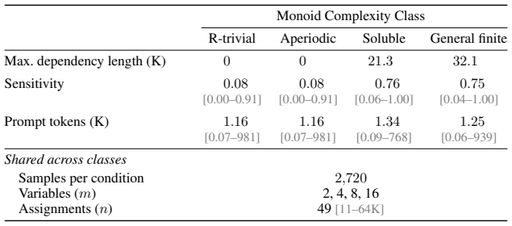
Table 1 : Descriptive statistics for StateBench. Cells give medians, with [min, max] ranges in grey below. Token counts and dependency lengths are in thousands.
원문 · CC BY 4.0 · Jackson Petty, William Merrill, Ashish Sabharwal · A Fine-Grained Hierarchy and Benchmark for State Tracking in Language Models · 원문 그림 인용 · 원본 PDF 22쪽에서 그림 영역을 추출했습니다.직접 학습 모델의 길이 일반화 결과
275M 파라미터 모델을 StateBench 접두부와 유효한 완성 시퀀스로 학습하고, 학습 길이를 넘어 최대 64,000 할당까지 평가했습니다. 이 설정에서 GDN 모델은 r-trivial, aperiodic, soluble 데이터에서 완벽하게 일반화했습니다. Transformer는 r-trivial과 aperiodic 데이터를 잘 학습하지만 학습 분포를 넘어서는 일반화가 완전하지 않았고, general finite 데이터는 분포 내에서도 완전히 학습하지 못했습니다. GDN±는 general finite에서 학습 길이의 약 10배까지 일반화했으나 GDN+는 학습 한계 직후 성능이 떨어졌습니다.
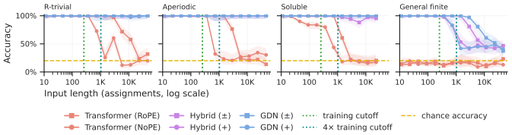
Figure 3 : Direct Training: GDNs generalize perfectly on r-trivial, aperiodic, and soluble data, and partially on general finite data; Transformers fail to generalize beyond their training distribution on r-trivial, aperiodic, and soluble data and fail to even learn in-distribution general finite data. Error bars show Wilson confidence intervals.
원문 · CC BY 4.0 · Jackson Petty, William Merrill, Ashish Sabharwal · A Fine-Grained Hierarchy and Benchmark for State Tracking in Language Models · 원문 그림 인용 · 원본 PDF 7쪽에서 그림 영역을 추출했습니다.pre-training 및 프런티어 모델의 성능 저하
Olmo-3 계열과 소형 pre-training 모델은 r-trivial 문제에서 대체로 잘 수행했으나 aperiodic 데이터에서는 기대보다 낮았고, general finite 데이터에서는 모든 길이에서 우연 수준에 머물렀습니다. 이 평가는 여섯 형식의 결과 중 최댓값을 보고한 것입니다. 프런티어 모델은 r-trivial과 aperiodic 문제에서는 강했지만, 입력이 10K에서 64K 토큰 사이에 도달하면 soluble 및 general finite 문제에서 우연 수준으로 떨어졌습니다. 형식에 따라 정확도가 크게 달라졌다는 점도 함께 보고되었습니다.
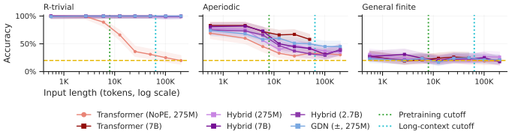
Figure 5 : Pretrained models underperform theoretical expectations and direct-training results, show- ing consistent performance degradation on aperiodic data and completely failing on general finite data. Error bars show Wilson confidence intervals.
원문 · CC BY 4.0 · Jackson Petty, William Merrill, Ashish Sabharwal · A Fine-Grained Hierarchy and Benchmark for State Tracking in Language Models · 원문 그림 인용 · 원본 PDF 9쪽에서 그림 영역을 추출했습니다.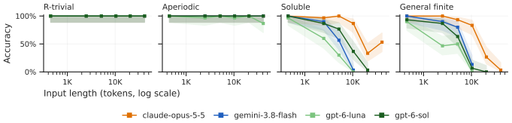
Figure 6 : Frontier LLMs struggle on long-horizon soluble and general finite state-tracking tasks. Error bars show Wilson confidence intervals.
원문 · CC BY 4.0 · Jackson Petty, William Merrill, Ashish Sabharwal · A Fine-Grained Hierarchy and Benchmark for State Tracking in Language Models · 원문 그림 인용 · 원본 PDF 9쪽에서 그림 영역을 추출했습니다.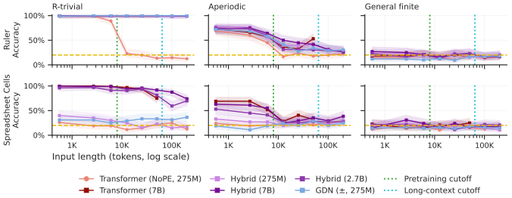
Figure 9 : Pretrained base models perform better on RULER-formatted StateBench sequences(top) than on the same sequences formatted as spreadsheet manipulations(bottom). Error bars show Wilson confidence intervals.
원문 · CC BY 4.0 · Jackson Petty, William Merrill, Ashish Sabharwal · A Fine-Grained Hierarchy and Benchmark for State Tracking in Language Models · 원문 그림 인용 · 원본 PDF 23쪽에서 그림 영역을 추출했습니다.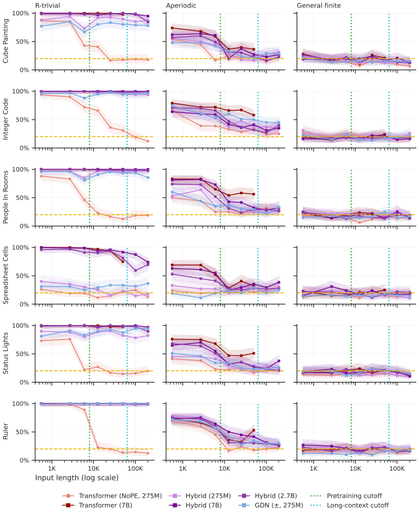
Figure 10 : Pretrained models evaluated on StateBench problems by complexity class and formatting. Error bars show Wilson confidence intervals.
원문 · CC BY 4.0 · Jackson Petty, William Merrill, Ashish Sabharwal · A Fine-Grained Hierarchy and Benchmark for State Tracking in Language Models · 원문 그림 인용 · 원본 PDF 24쪽에서 그림 영역을 추출했습니다.민감도와 주기성의 관계
민감도는 실행 중 변수 값을 바꾸면 최종 출력에 영향을 줄 수 있는 단계의 수로 측정되었습니다. 원문에 따르면 이론적으로 aperiodic 단어 문제의 민감도는 o(n)이고 그 밖의 경우는 Ω(n)입니다. StateBench에서 r-trivial과 aperiodic은 낮은 평균 민감도를, soluble과 general finite은 높은 민감도를 보였습니다. CruxEval 코드 샘플은 매우 높은 값과 매우 낮은 값에 봉우리가 있는 분포를 보여, 주기적 상태 추적이 자연 코드 이해에도 관련될 수 있음을 시사합니다.

Figure 4 : Sensitivity Analysis: Histograms of sample sensitivities in(left)the four complexity distributions in StateBench and(right)code samples from CruxEval.
원문 · CC BY 4.0 · Jackson Petty, William Merrill, Ashish Sabharwal · A Fine-Grained Hierarchy and Benchmark for State Tracking in Language Models · 원문 그림 인용 · 원본 PDF 8쪽에서 그림 영역을 추출했습니다.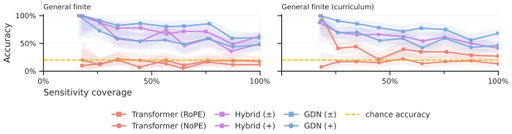
Figure 7 : Effect of Sensitivity: On general finite state tracking data, direct trained models perform worse on higher sensitivity data. Error bars show Wilson confidence intervals.
원문 · CC BY 4.0 · Jackson Petty, William Merrill, Ashish Sabharwal · A Fine-Grained Hierarchy and Benchmark for State Tracking in Language Models · 원문 그림 인용 · 원본 PDF 22쪽에서 그림 영역을 추출했습니다.한계와 남은 질문
논문은 GDN+가 계층 안에서 정확히 어디에 놓이는지 아직 알지 못한다고 밝힙니다. 또한 유한 모노이드를 넘어 변수 수가 무제한인 경우로 확장하는 것은 열린 문제로 남아 있습니다. 코드 데이터에서 주기성이 어디에 얼마나 나타나는지도 답하지 못한 질문입니다. 실험 결과는 StateBench라는 합성 데이터와 특정 모델 설정에서 얻은 것이므로, 자연 데이터 전반으로 바로 일반화하기는 어렵습니다.
논문 정보
- 저자
- Jackson Petty, William Merrill, Ashish Sabharwal
- 학회·저널
- arXiv · 프리프린트
- 최초 공개일
- 2026년 11월 2일
- 등록일
- 2026년 11월 4일
- 수정일
- 2026년 11월 2일
- 버전
- v1
- arXiv
- 2611.03094
- 분류
- cs.AI
- 원문 이용 조건
- CC BY 4.0
- 제공 범위
- 논문 정보, 해설, 허용된 원문 그림
AI 해설은 논문 원문과 별개의 설명이며 오류가 있을 수 있습니다. 원문과 그림은 각 출처의 이용 조건과 따로 표시된 권리를 따릅니다.
초록
Theoretical limitations of transformers on state tracking---the ability to track information about entities or variables over long contexts---have motivated new recurrent language modeling (LM) architectures such as Gated DeltaNet (GDN). These architectures have, in particular, been benchmarked against the $S_5$ word problem, a theoretically hard state-tracking task that captures abilities such as code evaluation under arbitrary variable assignment. It, however, remains open whether other, simpler forms of state tracking might both be more relevant in practice and already explain observed differences between these architectures. We propose evaluating state tracking using a hierarchy of word problems with four increasing levels of difficulty: r-trivial, corresponding to immutable assignment to variables in programming; aperiodic, where assignments are mutable; soluble, where assignments are self-referential; and general finite state tracking. Theoretically, we show that the class of problems transformers are thought to length-generalize on does not even contain all aperiodic state tracking. On the other hand, we prove that GDN with positive eigenvalues expresses all aperiodic problems, and the regular languages recognized by certain transformers are precisely all soluble ones, thus providing a fine-grained picture of state tracking capabilities of various architectures. Taking these ideas to practice, we construct StateBench, a 4-tier long-horizon state-tracking benchmark. Our systematic direct training experiments across architectures largely align with theoretical expectation, albeit with interesting observations at very large scale length-generalization. Additionally, we also evaluate pretrained models---both open hybrid and closed frontier ones---on StateBench, finding that none of them robustly solves even soluble state tracking, suggesting a direction for future improvement.
원문 인용
Jackson Petty, William Merrill, Ashish Sabharwal (2026). A Fine-Grained Hierarchy and Benchmark for State Tracking in Language Models. arXiv:2611.03094v1. https://arxiv.org/abs/2611.03094v1
BibTeX
@misc{petty2026fine,
  title = {{A Fine-Grained Hierarchy and Benchmark for State Tracking in Language Models}},
  author = {Jackson Petty and William Merrill and Ashish Sabharwal},
  year = {2026},
  eprint = {2611.03094},
  archivePrefix = {arXiv},
  url = {https://arxiv.org/abs/2611.03094v1}
}