Paper commentary
Competing Influence in LLM Populations: Budget Timing and Baseline Drift
Campaign timing flips when LLM agents replace numerical recipients in opinion models
- Problem Timing results from competitive-influence models use scalar update rules, so they may not carry over when recipients revise beliefs through language. Baseline drift in untouched populations also gets credited to campaigns.
- Method The authors replace numerical recipients with a network of 30 persona-conditioned LLM agents that revise opinions in natural language. Two campaign agents, a proponent and a challenger, spend equal budgets on early, sustained, or late schedules.
- Results The proponent's payoff matrix has no pure-strategy equilibrium in 81% of bootstrap resamples. The numerical bounded-confidence comparator instead had late-late as its unique equilibrium.
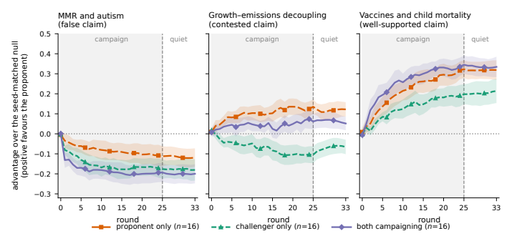
Figure 2 : Advantage over the seed-matched no-campaign run, round by round, for one topic of each kind: MMR–autism (false), growth–emissions decoupling (contested) and vaccination and child mortality (well supported). Each line is the mean over runs of the population’s mean stance under that condition minus the no-campaign run on the same network; positive favours the proponent; bands are 95% CIs across runs. Campaigns run in rounds 1–25 (shaded); rounds 26–33 are quiet. In none of the three do the quiet rounds pull the effect back toward zero.
Original paper · CC BY 4.0 · Nasim, Mehwish, Fay, Nicolas · Competing Influence in LLM Populations: Budget Timing and Baseline Drift · Original paper figure · Extracted the figure area from page 7 of the original PDF.Why numerical timing results may not transfer
Competitive-influence models usually ask when a campaign should spend its budget. Those models update recipients with scalar rules, so message content and the way recipients read it stay outside the model. Qasmi et al. found that aggressive early debunking gains quickly but can leave too little budget to hold the gain. Whether that timing result survives when recipients revise beliefs through language is the open question here.
The population moves even when no campaign runs, so the untouched trajectory needs its own measurement. Baseline drift ranges from −0.15 for MMR to +0.15 for vaccination and childhood mortality. Probine et al. and Brockers et al. show that model-specific default positions can pull a population without any persuasion. Without subtracting that drift, a campaign comparison credits or blames the campaign for movement it did not cause.
This work replaces the scalar bounded-confidence population with a network of persona-conditioned LLM agents. Two campaign agents, a proponent and a challenger, operate under equal, finite budgets against that population.
The study asks how uninfluenced trajectories shape apparent campaign effects, which is RQ1. RQ2 asks whether temporal allocation effects seen under classical dynamics persist when the recipients are LLM agents.
A budgeted campaign round with LLM recipients
The proponent and the challenger are both LLM campaign agents, and each gets the same finite budget. Each unit of budget buys one message delivered to one named agent, so spending time matters. Qasmi et al. broadcast messages to the whole population each round, which removes the allocation problem. The strategic object is the policy, which fixes how each campaign agent spreads its budget over time.
The population is a directed graph of 30 agents, and each agent reads the posts of the agents it follows. Each agent follows 4 others chosen uniformly, so audience size varies from one agent to the next. Each agent rewrites a written opinion of at most 80 tokens every round, and its followers read that same text. Revision reads every neighbour opinion with no confidence threshold, and the starting opinion re-enters with weight 0.3.
Starting attitudes come from a target drawn from rejecting, accepting and undecided groups, and each agent writes that attitude in its own voice.
The early policy spends in rounds 1 to 9, the sustained policy in rounds 1 to 25, and the late policy in rounds 17 to 25. Each policy spends the same total, so the timing is the only difference between them. Expenditure is fixed before the run, while each campaign agent adapts the content of its message. A campaign agent sees the round index, its remaining budget, and a random sample of 5 population opinions as text.
Each run has 25 campaign rounds followed by 8 quiet rounds in which no messages are sent.
The stance probe runs only after the simulation, so it maps each logged opinion to a value between -1 and +1. A second probe from a larger model re-scored 320 opinions, with Pearson r of 0.93 and Krippendorff's α of 0.92. The message rater scores each campaign message on five dimensions, and no rating enters any update. Repeated runs share graphs, personas and starting attitudes, so the authors pair every contrast by replicate.
Drift and the apparent campaign effect
Subtracting the no-campaign run from each campaign run shows whether a campaign's effect survives the population's own drift. Drift ranges from −0.15 for MMR to +0.15 for vaccination and childhood mortality, so it can be large relative to campaign effects. Differencing against the seed-matched null makes each campaign condition's advantage measure only what the campaign adds.
Once the drift is removed, the effects follow the claim's epistemic standing rather than the side that speaks. The challenger still reaches +0.08 on nuclear safety and +0.21 on vaccines, arguing against the claim in both cases.
On MMR the movement finishes within five rounds and holds, while on decoupling the two sides separate steadily. On vaccines all three conditions keep climbing until the campaign stops, and they are still rising when it ends.
Part of the pattern comes from the campaign agents rather than the population. The authors attribute this to the generation model declining its brief where the brief runs against the evidence.
Stance diversity and communities
That loss doesn't track the sign or size of the drift, so mean direction and spread are separate properties. Campaigns tighten the spread more than matched no-campaign runs do, whichever direction the mean takes.
To separate community structure from opinion segregation, the authors compare three planted-partition cells on the reference topic. The structureless control sets λr to 1, so it has no blocks to sort attitudes into and α is undefined. Communities without segregation use λr = 4 with α = 0.5, while segregated communities use λr = 4 with α = 1.
With full alignment, one block ends up nearly homogeneous and rejecting, while the other block stays mixed.
The segregated cell runs on two further topics, vaccines and MMR, so the within- and between-community parts can be compared across claims. Across the three tested topics, campaigns mainly reduce the between-community stance variance. Within-community variance changes comparatively little under the same campaigns.
The authors test this finding on three topics and a single network family with 30 agents. They didn't test other network families, so the community result rests on this one setting. The authors argue that directional change and homogenisation are separable, because population averages can hide internal shifts.
Timing payoffs on the reference topic
The reference topic is decouple, the claim whose baseline drift is closest to zero, so both sides have room to move. The timing experiment crosses three schedules for each side: early, sustained and late spending over the campaign. The proponent's payoff is +0.15 for early against late, compared to +0.06 for early versus early and +0.03 for late versus late.
The proponent gains most when the two sides spend in different rounds, and least when they spend in the same rounds.
The proponent's best reply is to avoid the challenger's schedule, while the challenger's best reply is to coincide on early and late schedules. Against a sustained proponent, the challenger's three replies are indistinguishable. The estimated payoff matrix has no pure-strategy equilibrium, and this holds in 81% of bootstrap resamples.
In that comparator, late–late is the unique pure-strategy equilibrium, present in 100% of bootstrap resamples. The equilibrium stays unchanged across λ values of 0, 0.1 and 0.3, and ε values of 0.3, 0.6 and 1.0. The authors read this as later interventions having a systematic advantage under symmetric, memoryless interventions.
The four corner cells were repeated on vaccines and on the segregated planted network, with n=8 per cell. The off-diagonal advantage was +0.09 on vaccines, with an interval of +0.03 to +0.15. It was +0.07 on the segregated network, with an interval of +0.00 to +0.14. On the reference topic the same four cells gave +0.08, with an interval of +0.01 to +0.14.
The authors conclude that the relation between the two schedules decides the proponent's advantage in all three settings.
Limits of these experiments
The paper says the design restricts sensitivity to relatively large effects. Campaign schedules are fixed in advance, and recipients are picked at random. Because of this, adaptive budget allocation and targeted influence were excluded from the tests.
Agents express one public opinion, so strategic silence isn't simulated. The model also doesn't separate private belief from public expression. Stance scores come from a probe that has not been checked against human judgements. Cross-model agreement is strong, but that agreement isn't evidence about people.
The timing matrix on the reference topic doesn't establish a general timing rule. The checks support the best-reply structure only as a property of this class of population.
Paper info
- Authors
- Nasim, Mehwish, Fay, Nicolas
- Venue
- arXiv · Preprint
- First published
- 2026-11-9
- Added
- 2026-11-10
- Updated
- 2026-11-9
- Version
- v1
- arXiv
- 2611.11867
- Category
- physics.soc-ph · cs.CL · cs.MA
- Original paper terms
- CC BY 4.0
- What we show
- Paper info, commentary and permitted figures from the original paper
AI commentary is a separate explanation from the original paper and may contain errors. The original paper and figures follow each source's terms of use and any rights noted separately.
Abstract
When competing campaigns target a population of large language model (LLM) agents, observed opinion changes may reflect both campaign influence and changes that would occur without intervention. We study how the timing of campaign expenditure and the population's own evolution shape outcomes in a network of persona-conditioned LLM agents that exchange and revise opinions in natural language. A proponent and a challenger are tasked with generating opposing messages under equal delivery budgets, while a separate stance probe measures opinions without influencing the simulation. Across eight claims, we compare single-campaign and competitive conditions against matched no-campaign runs, and evaluate all nine combinations of early, sustained, and late spending on a reference topic. Baseline stance drift varies substantially across claims and, on some, accounts for a sizeable fraction of apparent campaign effects. After accounting for this drift, the direction of observed campaign-associated changes aligns more closely with the claim's epistemic standing than with the campaigner's assigned role. Uninfluenced populations also consistently lose stance diversity, demonstrating that directional opinion change and convergence are distinct phenomena. In networks with two opinion-segregated communities, campaigns primarily reduce differences between communities rather than diversity within them. LLM campaign agents do not always argue for their assigned positions, particularly when these conflict with established evidence. Finally, campaign outcomes depend on the opponent's expenditure schedule: unlike a matched numerical bounded-confidence population receiving interventions at the same times and locations, the LLM population exhibits a payoff structure with no pure-strategy equilibrium.
Figures from the paper
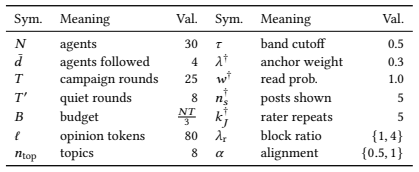
Table 2 : Parameters. Values marked † are held fixed. Four models are used: population, campaign generation, message rating and stance probe; the probe is from a different family than the population.
Original paper · CC BY 4.0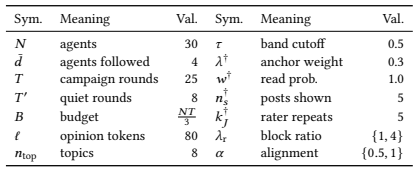
Table 3 : Experimental blocks. The sustained–sustained com- petition cell is shared between the timing experiment and the per-topic condition set at the reference topic; the eight remaining policy pairs are the timing block. The network- structure check runs all four conditions in each of three planted-partition cells on the reference topic, and in the seg- regated cell on two further topics.
Original paper · CC BY 4.0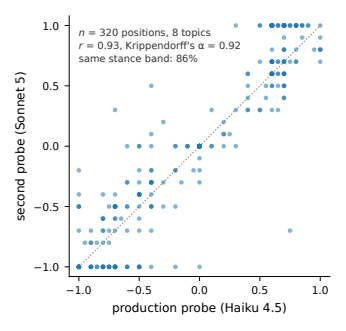
Figure 4 : Stance assigned by the production probe (Haiku 4.5) against a second probe from a larger model (Sonnet 5) on 320 written positions, 40 per topic, stratified by stance band. the RQ2 experiment is unaffected because both sides argued their briefs on the reference topic.
Original paper · CC BY 4.0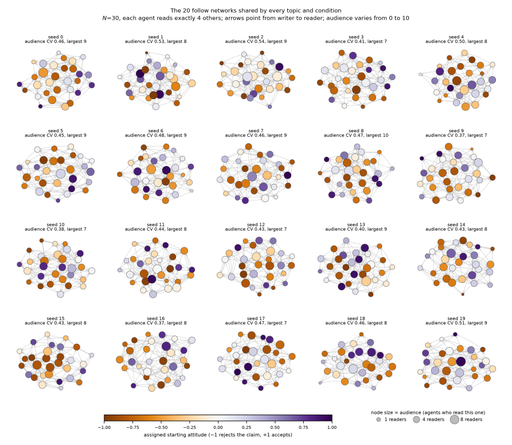
Figure 5 : The 20 follow networks used by every topic and condition. 𝑁=30; each agent reads exactly four others, so arrows point from writer to reader. Node colour is the assigned starting attitude, node size the number of agents who read that node (0–10).
Original paper · CC BY 4.0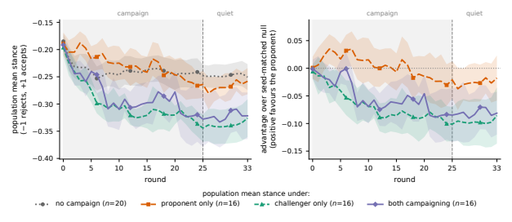
Figure 6 : GM food safety (mostly false). The proponent’s advantage peaks near round 4 and returns to zero in the quiet rounds; the challenger’s persists.
Original paper · CC BY 4.0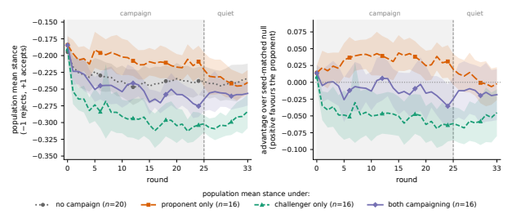
Figure 7 : 5G health effects (false). As for GM food: a transient proponent lift, a durable challenger effect, and a contest indistinguishable from the null.
Original paper · CC BY 4.0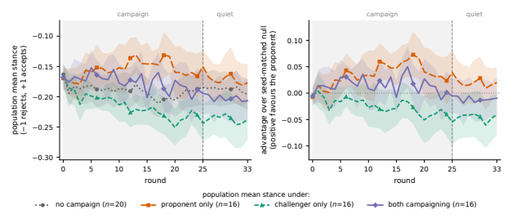
Figure 8 : Remote-work productivity (contested). The least movable topic: all campaign effects are within ±0.05and the contest is zero.
Original paper · CC BY 4.0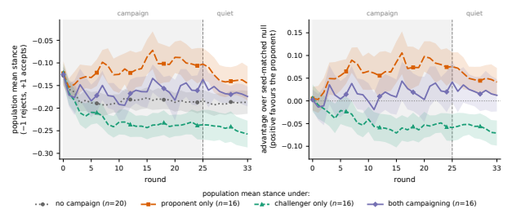
Figure 9 : Social media and adolescents (contested). Symmetric single-sided effects of about ±0.05that cancel almost exactly in competition.
Original paper · CC BY 4.0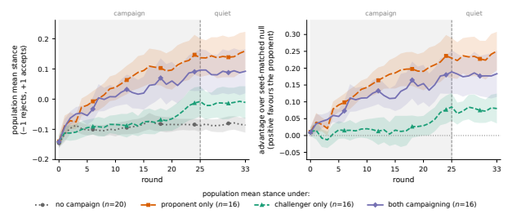
Figure 10 : Nuclear safety (well supported). Both campaigns raise acceptance; the challenger’s effect appears only late in the campaign and holds through the quiet rounds.
Original paper · CC BY 4.0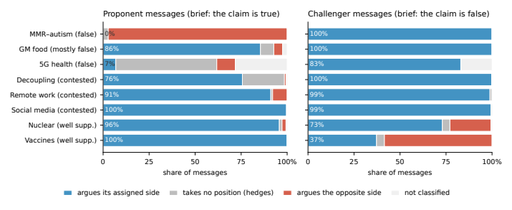
Figure 11 : Which side each campaign message actually argues, by topic ( 𝑛=768–1,632messages per bar). An independent model classified every message, blind to its label, as arguing the claim is true, false, or taking no position; each batch carried two anchor sentences of known polarity and was discarded if either came back inverted (“not classified”). The proponent’s brief is that the claim is true, the challenger’s that it is false.
Original paper · CC BY 4.0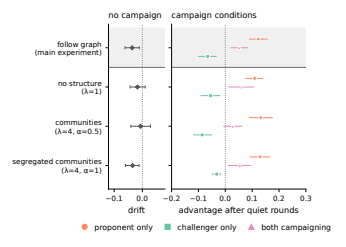
Figure 12 : Reference topic, four network cells. Top row: the follow graph of the main experiment (reference). Below: planted-partition cells — no structure ( 𝜆r=1), two commu- nities with unsorted attitudes (𝜆r=4,𝛼=0.5), and two opinion- sorted communities (𝛼=1). Left: drift of the uninfluenced population; right: advantage after the quiet rounds, positive favouring the proponent. 95% bootstrap CIs; 𝑛=16per condi- tion in every cell.
Original paper · CC BY 4.0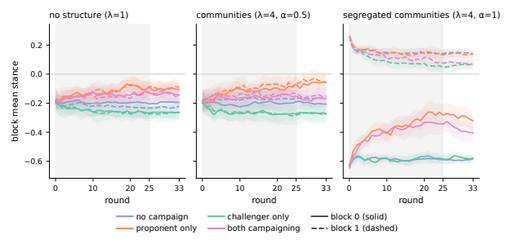
Figure 13 : Mean stance of each block separately (solid: block 0; dashed: block 1) under each condition, for the three planted cells. In the unsorted cells the two blocks are statistically identical. In the segregated cell they start0 .89apart; the proponent lifts the rejecting block by about0.25, while the challenger barely moves the accepting block.
Original paper · CC BY 4.0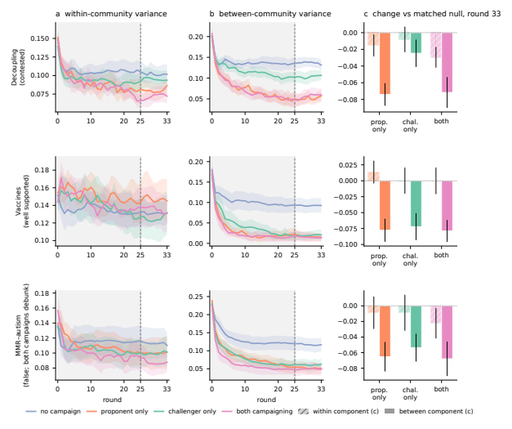
Figure 14 : Within- and between-community stance variance in the segregated planted cell on three topics (rows), by condition; means over𝑛=16runs with 95% CIs. (a) Within-community component by round. (b) Between-community component by round. (c) Change in each component at round 33 relative to the no-campaign run on the same graph, personas and starting attitudes; bars are means with 95% bootstrap CIs over the sixteen matched pairs.
Original paper · CC BY 4.0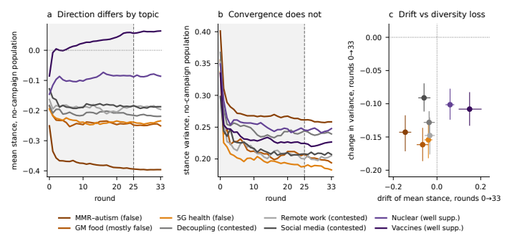
Figure 15 : The uninfluenced population on each of the eight topics ( 𝑛=20runs per topic, means over runs). (a) Mean stance by round. (b) Stance variance by round. (c) Change in mean stance against change in variance from round 0 to round 33, one point per topic with 95% bootstrap CIs over runs. Campaign rounds are shaded although no campaign is active; the dashed line marks where the quiet rounds begin in the campaign conditions.
Original paper · CC BY 4.0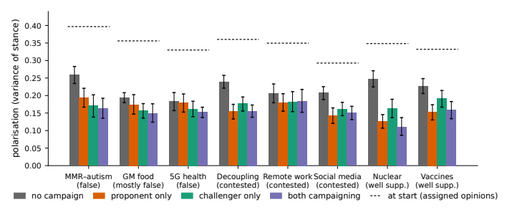
Figure 16 : Final polarisation (variance of stance at round 33) under each condition, per topic, with 95% bootstrap CIs. The dashed line is the polarisation of the assigned starting attitudes.
Original paper · CC BY 4.0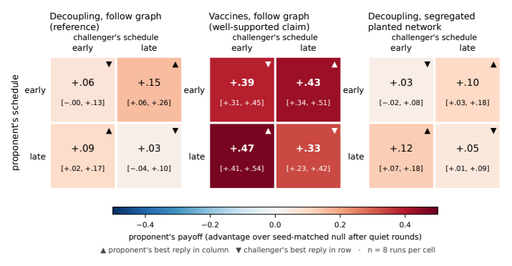
Figure 17 : The four corner cells of the timing matrix (early and late schedules for each side; 𝑛=8per cell) on the reference topic (left), on vaccines (centre) and on the reference topic with the segregated planted network of Appendix A.4 (right). Cells report the proponent’s payoff after the quiet rounds with 95% bootstrap CI;▲and▼mark best replies as in Figure 3.
Original paper · CC BY 4.0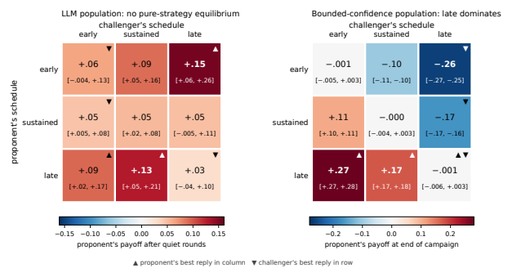
Figure 18 : The two matrices of Figure 3 with per-cell 95% bootstrap CIs ( 𝑛=8;𝑛=16for sustained–sustained). The numerical panel is shown at the end of the campaign because retention toward the starting attitude ( 𝜆=0.3per round) erases almost all of its campaign effect within the eight quiet rounds (largest after-quiet payoff0 .016); the best-reply structure is identical at both measurement points.
Original paper · CC BY 4.0Quote from the paper
Nasim, Mehwish, Fay, Nicolas (2026). Competing Influence in LLM Populations: Budget Timing and Baseline Drift. arXiv:2611.11867v1. https://arxiv.org/abs/2611.11867v1
BibTeX
@misc{mehwish2026competing,
  title = {{Competing Influence in LLM Populations: Budget Timing and Baseline Drift}},
  author = {Nasim, Mehwish and Fay, Nicolas},
  year = {2026},
  eprint = {2611.11867},
  archivePrefix = {arXiv},
  url = {https://arxiv.org/abs/2611.11867v1}
}