Paper commentary
When F1 Is Not Enough: Auditing Codebooks for LLM-Assisted Annotation
Codebook audits reveal whether LLM annotation errors come from the model or the codebook
- Problem A single F1 score cannot show why an LLM's labels disagree with reference labels. The error could come from the model, an incomplete codebook, or inconsistent reference labels, and each needs a different fix.
- Method The audit finds error sources and revises only repairable codebook entries.
- Results On the BFRS held-out data, F1 for the Other class rose from 0.429 to 0.535 after two codebook revisions.
Why aggregate F1 can't locate a disagreement
Researchers increasingly hand stance, framing, and political event coding to LLMs, and most methods work asks how to make those outputs more reliable. Those studies usually judge the outputs against human-coded reference labels with F1 or a related metric. A single F1 score doesn't say why a prediction and its reference label part ways. The disagreement could come from a model that fails to apply a clear rule, from a codebook that is incomplete or inconsistent, or from a reference label the codebook doesn't support.
The fix depends on which of these is true, so the score alone can send a team toward the wrong remedy.
The written codebook is more than a prompt, because it is the measurement instrument that turns a construct into coding rules. Human coders can lean on training, worked examples, discussion, and adjudication, so many of the conventions they apply never reach the page. A zero-shot LLM has only the text, so gaps in the text show up directly in its labels.
The credit-claiming codebook makes this concrete, since its original team reported a Krippendorff's α of 0.78 after several rounds of training and refinement. Independent coders who applied only the released codebook reached about 0.43.
Reference labels add a second source of doubt. Released reference sets can contain annotation errors, or follow conventions that the written rules don't record. High agreement among annotators doesn't establish that each label is supported by the codebook. Class-level precision, recall, and confusion matrices can show where disagreement clusters, but they can't show whether the codebook itself needs repair.
Treating the codebook and annotator as one system
The audit treats the codebook and the annotator as one system, so an error reflects both the written rules and the model applying them. Instead of rewriting entries whenever F1 is low, the audit first asks where the errors come from. Class-specific metrics and confusion matrices locate weak classes and systematic confusions. Structured document-level review then separates LLM errors, repairable codebook defects, reference-label issues, and substantive disagreements.
The audit runs in five steps: screen classes, localize errors, attribute error sources, revise repairable entries, and evaluate each version on held-out data. Only the first three steps use the development set, and their results decide which entries change. Held-out results assess generalization but don't feed back into the diagnostic or revision decisions.
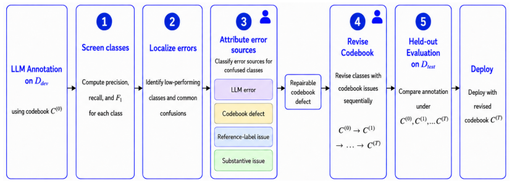
Figure 1 :Codebook audit pipeline.
Original paper · CC BY 4.0 · Yuehong Cassandra Tai, Qunhua Li · When F1 Is Not Enough: Auditing Codebooks for LLM-Assisted Annotation · Original paper figure · Extracted the figure area from page 7 of the original PDF.The authors write the codebook as C(0), with one entry c(0)k for each class k in Y. Each entry holds the written definition, inclusion criteria, exclusion criteria, and examples for its class. The development set Ddev feeds Steps 1 to 3, while the disjoint held-out set Dtest only evaluates the codebook versions. The annotator's prediction is a function f_θ of the document x_i, the codebook C, and the setting s.
Here f_θ denotes the model with its prompt, and s holds the decoding parameters and, when used, retrieval. Holding s fixed means that any change in performance comes from the codebook, not the pipeline.
With many classes, the prompt can include only the m codebook entries retrieved for each document. The annotator then conditions on the retrieved subset R_m(x_i, C) rather than the full codebook. For smaller codebooks, the full codebook goes into the prompt.
Step 1 runs the annotator on Ddev with the original codebook and computes precision, recall, and F1 for each class. A nonparametric document-level bootstrap quantifies the uncertainty in these class metrics. The level signal nominates the lowest-F1 class when the paired bootstrap interval for the F1 gap between the two lowest classes lies above zero.
The asymmetry signal uses A_k = P_k − R_k and nominates the class with the largest absolute value when its interval excludes zero.
Screening classes and reading the confusion matrix
The screen starts by running the annotator on the development set with the original codebook \(C^{(0)}\). Precision \(P_k\) divides the documents where the prediction and the reference both equal \(k\) by the documents predicted as \(k\), and recall \(R_k\) divides the same count by the documents whose reference label is \(k\). F1 is then \(F1_k = 2P_kR_k/(P_k + R_k)\), and a nonparametric document-level bootstrap gives its uncertainty.
Two signals then nominate classes for review. The level signal takes the lowest and second-lowest F1 classes, \(k(1)\) and \(k(2)\), and nominates \(k(1)\) when the paired bootstrap interval for \(F1_{k(2)} - F1_{k(1)}\) lies above zero. The asymmetry signal defines \(A_k = P_k - R_k\), picks \(k_A\) as the class with the largest \(|A_k|\), and nominates it when its interval excludes zero.
A positive \(A_k\) means low recall and under-prediction, while a negative value means low precision and over-prediction. Because both signals only set review priorities, the intervals don't test a substantive hypothesis.
For nominated classes, the confusion matrix \(M_{ab}\) counts documents whose reference label is \(a\) and whose prediction is \(b\). The off-diagonal cells then reveal three patterns: over-predicted classes, under-predicted classes, and pairs that confuse each other in both directions. Fallback categories get extra attention, because a class defined mostly by exclusion can drift in either direction when its conditions are vague.
Deciding which errors justify a revision
For each major pattern, the reviewer reads about five affected documents, and up to ten when the cause still looks mixed. Each case is read together with the document, the relevant codebook entries, the reference label, and the prediction. Model rationales, when present, add only context about how the model behaved.
The reviewer first asks whether the written codebook, read through its own definitions and guidance, clearly supports one label. If the rule supports the reference label and the model missed it, the case is an LLM error. If the rule supports the model's label, or similar documents receive inconsistent reference labels, the case is a reference-label issue.
If the entries are incomplete, ambiguous, or inconsistent in a way that clarifying the existing wording can fix, the case is a codebook defect. If fixing it would require a new substantive criterion the construct definition doesn't supply, the case is a substantive issue instead.
A pattern becomes a revision target only when the same explicit clause-level problem recurs in a majority of the reviewed cases. Patterns explained by model error, reference-label problems, substantive judgment, or mixed evidence stay documented but unrevised. Targets are revised one at a time, which gives a sequence \(C^{(0)} \to C^{(1)} \to \cdots \to C^{(T)}\) in which each version adds one change.
Every edit is logged with the original wording, the new wording, the rationale, the targeted error pattern, and the expected effect.
Alongside the revisions, the audit reruns annotation with anonymous labels such as L001 and computes \(\Delta\mathrm{name}_k = F1^{\text{text}}_k - F1^{\text{anon}}_k\). A positive value means the semantic class name helps, and a negative value means the anonymous label does better. The ablation signals name dependence, but it doesn't pick revision targets by itself.
Each version is scored on the held-out set under the same model, prompt, retrieval setup, decoding, and metrics. For the overall effect, the audit compares the final and original codebooks with \(\Delta F1_k = F1_k(C^{(T)}) - F1_k(C^{(0)})\). Uncertainty comes from a paired document-level bootstrap, so the same resampled documents are used for both versions.
Held-out scores are read after each planned update, but they never add a target, reorder targets, or change wording, so they test a plan fixed in advance.
BFRS: the Other fallback and one boundary
The BFRS codebook sorts political-violence news reports into twelve event types, one of which is the fallback category Other. Other makes up 6.5% of the BFRS corpus. The development set has 573 documents and the held-out set has 1,045, and the annotator is Llama-3.3-70B-Instruct with retrieval.
Only 42% of reference Other cases are predicted correctly. The misses scatter across neighboring classes, with Assassination at 30%, Terrorism at 12%, and Conventional Attack at 6%. Figure 2 shows the row-normalized confusion matrix in panel (a) and the decomposition of Other errors in panel (b), so the errors look spread out rather than concentrated in one confusion.
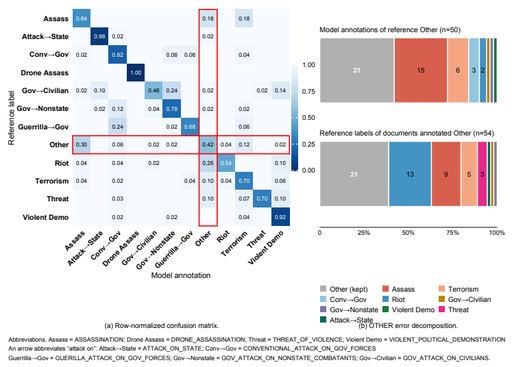
Figure 2 :BFRS diagnosis under the original codebook onD dev
Original paper · CC BY 4.0Review traces the Other errors to two codebook defects. The original Other entry is defined mostly by exclusion, which gives annotators few positive conditions for choosing the fallback. The second defect is the Other–Assassination boundary, because the Assassination clarification accepts a body with signs of violence even without evidence that the victim was targeted.
Gov Attack on Civilian has the lowest recall at 46%, but its errors trace to ambiguous reference labels rather than to its written entry. So the authors carry only Other and Assassination forward to revision.
The label-name ablation showed higher F1 with the semantic name than with an anonymous label, so the name was kept. The first revision, C(1), changes only Other, replacing the open fallback with two affirmative conditions and barring Other when a substantive class plausibly applies. The second, C(2), keeps that entry and requires the report to show deliberate targeting before a body found with signs of violence counts as Assassination.
On the development set, Other F1 rises from 0.40 under C(0) to 0.49 under C(1) and 0.57 under C(2), mostly through recall. That fits the earlier diagnosis that many Riot errors came from the same open fallback rule.
So clarifying the fallback class and one neighboring boundary improved the intended pattern on unseen documents, without touching every weak class.
Credit-claiming: a fallback class over-predicted
The credit-claiming codebook sorts statements about European Council summit outcomes into four classes. Descriptive is the fallback and covers 60.5% of the corpus. Under the original codebook, class F1 values sit between about 0.67 and 0.75, so no class is clearly the weakest.
Of 50 reference Descriptive cases in the development set, 41 are predicted correctly. However, 29 of the 70 documents predicted Descriptive carry a substantive attribution label, so the main error is substantive statements landing in the fallback. Figure 4 is not included here, and the numbers above come from the development sample of 172 documents.
Review traces this to conflicting guidance about future-oriented statements. Descriptive is defined as having no credit or blame, but one clarification counts statements that Europe must or should act as desired actions. Elsewhere the guidance accepts both prospective and retrospective attribution, so a future-oriented statement that credits an actor is pulled toward Descriptive by its modality and toward a credit class by its attribution.
The revision clarifies that future-oriented language doesn't by itself make a statement Descriptive. A must or should statement stays Descriptive only when it credits no specific actor. Statements that credit the speaker's own government go to Credit-claiming, and those crediting the EU, its institutions, or partner governments go to Credit-sharing.
The label-name ablation showed little change with anonymous labels, so the class names stayed as they were. No other clause-level problem met the bar, so C(1) is the only planned revision.
The authors read the Descriptive drop as the intended trade of recall for precision, and the revision improves the substantive-class errors even though Descriptive's own F1 doesn't rise.
Stability across samples and a second annotator
The authors checked stability by drawing 20 documents per class from the development data. They repeated this 20-per-class subsampling across 200 draws. Other was the lowest-F1 BFRS class in 96% of those draws. The Other–Assassination localization reappeared in 97% of draws. Descriptive's over-prediction in the credit-claiming case showed up in 100% of draws.
These figures describe these two applications, and they aren't a general sample-size rule.
The second annotator, Gemma-4-31B, ran on the same samples, prompts, and codebook versions as Llama-3.3-70B-Instruct. Gemma also flags Other as the weakest BFRS class. It places the main problem on the same Other–Assassination boundary. That pattern suggests that some clarifications transfer across annotators.
In the credit-claiming case, both models place their errors in the boundary region among Credit-sharing, Credit-claiming, and Descriptive. Llama nominates Descriptive, whereas Gemma nominates Credit-sharing. The Llama-derived Descriptive revision, C(1), moves Gemma's development classes in the same general direction. The authors tested a separate Gemma-derived Credit-sharing revision, C(2), outside the Llama sequence, which raises Gemma's Credit-sharing F1 by 0.044.
Figure 6 summarizes these held-out contrasts across the two annotators. Its notes use 1,045 held-out BFRS documents, 321 credit-claiming documents, and 5,000 bootstrap resamples.
Limitations: what the results don't establish
The study rests on two codebooks and one primary annotator, Llama-3.3-70B-Instruct. Gemma-4-31B is the only second annotator, so the cross-model picture rests on two systems. Held-out gains indicate that the revised wording helps the evaluated annotator match reference labels. They don't indicate that a revision is substantively correct or that it improves construct validity.
The authors didn't have human coders apply the original and revised codebooks, so reproducibility for people remains untested. Decisions about construct meaning stay with domain experts.
Error attribution depends on researcher judgment applied to a small purposive sample. The authors typically review 5 to 10 documents per pattern before deciding whether a revision is warranted. Their stability checks drew 20 documents per class, repeated across 200 draws. Larger samples would give more precise class-level estimates, and the authors prefer them for held-out evaluation.
These stability results describe these two applications and don't set a general sample-size rule.
Gov Attack on Civilian stayed a reference-label issue, so the paper offers no codebook fix for that class. Its sampled errors came from near-identical reports that received different reference labels. The Gemma-derived Credit-sharing revision sits outside the Llama revision sequence. Those effects are annotator-specific, so a revision has to be verified on the annotator that will actually be used.
Paper info
- Authors
- Yuehong Cassandra Tai, Qunhua Li
- Venue
- arXiv · Preprint
- First published
- 2026-11-6
- Added
- 2026-11-9
- Updated
- 2026-11-6
- Version
- v1
- arXiv
- 2611.08846
- Category
- cs.AI
- Original paper terms
- CC BY 4.0
- What we show
- Paper info, commentary and permitted figures from the original paper
AI commentary is a separate explanation from the original paper and may contain errors. The original paper and figures follow each source's terms of use and any rights noted separately.
Abstract
Large language models (LLMs) are increasingly used for text annotation in social science, but standard performance metrics do not explain why errors occur. Low F1 may reflect limitations of the annotation system, defects in the written codebook, or inconsistency in reference labels. We propose a pre-deployment codebook audit for LLM-assisted annotation. The audit uses class-specific metrics and confusion matrices to identify problematic classes and boundaries, structured document-level review to attribute error sources, and targeted codebook revision followed by held-out evaluation. We apply the audit to two published multi-class codebooks from distinct domains. In both applications, the audit identifies under-specified or conflicting coding rules, and targeted revisions reduce the diagnosed errors on held-out data. Analyses with two LLM annotators show that some problematic boundaries and codebook revisions transfer across models, whereas other revision effects are annotator-specific. The results show that LLM annotation errors can help identify weaknesses in the written measurement instrument, not only in the model. Codebook auditing complements prompting, retrieval, and fine-tuning by clarifying whether persistent errors call for model improvement, codebook revision, or renewed scrutiny of reference labels.
Quote from the paper
Yuehong Cassandra Tai, Qunhua Li (2026). When F1 Is Not Enough: Auditing Codebooks for LLM-Assisted Annotation. arXiv:2611.08846v1. https://arxiv.org/abs/2611.08846v1
BibTeX
@misc{tai2026when,
  title = {{When F1 Is Not Enough: Auditing Codebooks for LLM-Assisted Annotation}},
  author = {Yuehong Cassandra Tai and Qunhua Li},
  year = {2026},
  eprint = {2611.08846},
  archivePrefix = {arXiv},
  url = {https://arxiv.org/abs/2611.08846v1}
}