Paper commentary
Distilling Safety Filters for Filter-free Multi-agent RL
- Problem Filter-based training keeps robot teams collision-free, but the centralized quadratic program behind the filter grows with team size, and the filter also hides unsafe actions from learning, so removing it at deployment creates a train-deploy mismatch.
- Method Learns the policy only from executed safe actions with implicit Q-learning, distills the training filter into the actor at synthetic near-collision states, and deploys an attention-based actor on local observations with no filter.
- Results With local observation and no filter, the method recorded no collisions in 1,800 simulated test episodes across both dynamics models and three settings.
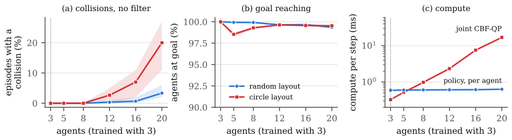
Figure 3 : Zero-shot scaling of the 3-agent DI policies (local sensing) to up to 20 agents with 2 obstacles, without the filter, in simulation. (a, b) Mean of 3 seeds×100 episodes; band: per-seed range. (c) Median per-step compute on one CPU thread: agent’s policy versus joint CBF-QP.
Original paper · CC BY 4.0 · Srikar Babu Gadipudi, Somayeh Sojoudi, Claire J. Tomlin · Distilling Safety Filters for Filter-free Multi-agent RL · Original paper figure · Extracted the figure area from page 9 of the original PDF.Why a training filter cannot simply be dropped
Robot teams that learn by trial and error collide during training, and a control barrier function filter can prevent those collisions by correcting each proposed action before it is executed.
Removing the filter after training creates a distribution mismatch, because the policy was learned under filtered transitions and is then run under unfiltered ones.
The filter also hides what the policy has to learn. The cost of unsafe actions never appears in the data, and states close to a collision are kept out of the training set. The problem is therefore to keep the filter's safety during training while producing a policy that behaves safely without it.
The centralized barrier filter
Each agent-obstacle constraint uses a barrier of the form \(h_{i,o}=\lVert p_i-c_o\rVert-(r_o+r+\rho)\), where \(c_o\) and \(r_o\) are the obstacle centre and radius. Wall and agent-agent barriers follow the same pattern, with a separate margin \(\rho_{\text{pair}}\) for pairs. The tightened safe set collects the states where every barrier is nonnegative, and a control barrier function condition keeps that set forward invariant along trajectories.
For single-integrator agents the condition becomes an affine constraint \(a_c(x)^{T}u\ge b_c(x)\) on the joint control, with \(a_c=\nabla h_c\) and \(b_c=-\alpha h_c\). Double-integrator agents use a high-order version of the same idea. The filter solves a quadratic program that keeps the joint action close to the raw proposal, and only its solution is executed.
Under single-integrator dynamics the constraints are hard, whereas under double-integrator dynamics the authors add a penalized slack so that the program stays feasible when an agent is already heading toward an obstacle.
Extracting the policy from executed safe actions
Because many raw actions produce one executed action and one transition, the critic cannot tell them apart, a effect the authors call action aliasing. An actor-critic method that maximizes over raw proposals can then favour proposals whose consequences the filter had already corrected. The authors therefore fit the critics only to executed safe actions, which are the only actions present in the replay buffer.
The centralized critics \(Q^i_{\phi_k}\) are regressed on \(r_i+\gamma V^i_\psi(o')\), and the value functions \(V^i_\psi\) are fit with an expectile loss \(\ell_\tau(z)=|\tau-\mathbf{1}[z<0]|z^2\). The value therefore never maximizes over actions that are absent from the buffer. Because IQL bootstraps from \(V_\psi(o')\) rather than from policy-sampled next actions, it avoids the need for a joint filter at every bootstrap step, which other offline methods would require.
The actor is extracted by advantage-weighted regression: \(\tanh\mu_\theta(o_i)\) is regressed onto \(u^{\text{safe}}_i/u_{\max}\) with weights \(W_i\propto\exp(\beta A_i)\), where \(A_i=Q^i_\phi(o,u^{\text{safe}})-V^i_\psi(o)\).
Supervising the actor at states the buffer lacks
The filter prevents collisions, so the replay buffer seldom holds the near-collision states that an unfiltered policy may reach. Off-support distillation draws states from a distribution \(D_q\) that mixes synthetic boundary states (40%), buffer states (30%) and perturbed buffer states (30%).
Each sampled state is labelled by the training filter, \(y(x)=\Pi_x(u^{\text{ref}}(x))\), where the reference controller is goal-directed and includes a tangential component against deadlock. The label is computed without executing any action, so the learner's own action is never applied in the environment, unlike in DAgger.
The OSFD loss averages, over the active agents, the squared difference between \(\tanh\mu_\theta(o_i)\) and \(y_i(x)/u_{\max}\). Agents held at their goals are excluded from the average.
A local-observation actor with a team-size-independent size
Agent i senses the agents whose centres, and the obstacles whose surfaces, lie within the sensing radius R of its position.
For each sensed entity k, the actor receives a token \(\tau_{ik}=(n_{ik},h_{ik},r_k,v_k-v_i,\chi_k)\), where \(n_{ik}\) is the normal of the filter barrier and \(h_{ik}\) its value, so the actor sees safety in the filter's coordinates.
The actor minimizes \(\beta_d L_{AWR}+wL_{OSFD}\), with gradients that never pass through the quadratic program. At deployment each agent executes \(u_i=u_{\max}\tanh\mu_\theta(o_i)\).
How the distillation loss limits barrier violations
For each constraint the authors define a CBF residual \(\nu_c(x)=[b_c(x)-a_c(x)^{T}\pi(x)]_+\), the label error \(e_\theta(x)=\lVert\pi(x)-y(x)\rVert\), and the label's own violation \(\epsilon_c(x)=[b_c(x)-a_c(x)^{T}y(x)]_+\). The residual is closed-form and needs no quadratic program. Proposition 1 states that \(\nu_c(x)\le\lVert a_c\rVert e_\theta(x)+\epsilon_c(x)\) for every labelled state.
Taking root-mean-square norms over \(D_q\) gives a bound by \(\lVert a_c\rVert u_{\max}\sqrt{nL_{OSFD}}\) plus the label-violation term, where \(\lVert a_c\rVert\) is 1 for obstacle and wall constraints and \(\sqrt{2}\) for pair constraints.
Theorem 2 concerns the unfiltered single-integrator loop with \(a=\alpha\Delta t\in(0,1)\). The barrier satisfies \(h_c(x_t)\ge(1-a)^t h_c(x_0)-\Delta t\sum_{k=0}^{t-1}(1-a)^k\nu_c(x_{t-1-k})\). Because each past residual enters with a factor \((1-a)^k\), residuals do not accumulate without limit. Bounded residuals keep the barrier above a bounded negative level for any horizon, and a residual below \(\alpha\rho_c\) prevents a collision during the first T steps.
Corollary 3 needs a coverage assumption: the deployed state distribution \(d_t\) satisfies \(d_t(E)\le C D_q(E)\) for every set E, where C is a concentrability coefficient that can be measured. Under this assumption and single-integrator dynamics, the probability that \(h_c(x_t)<-\rho_c\) is bounded by \(C\,E_{D_q}[\nu_c^2]/(\alpha\rho_c)^2\), and the training loss enters through the right-hand side of Proposition 1.
Checking the bound chain on 75 trained policies
The audit covers 75 policies: 21 single-integrator policies and 54 double-integrator policies from the ablation and hyperparameter tables and the two-obstacle setting. Each policy is run for 100 unfiltered episodes, with the label error, residual and barrier recorded at every step.
Filter-free collisions on the training scenes
Each cell of Table 1 reports collisions and goals over 3 seeds of 100 simulated episodes, with the filter removed at test time.
Zero-shot scaling to larger teams
The three-agent double-integrator policies are deployed without retraining on teams of up to 20 agents with 2 obstacles, and Figure 2 shows roll-outs on both layouts. In the circle stress test, collisions appear only beyond 12 agents, and mostly with obstacles.
Figure 3 plots collisions and goal reaching against team size and compares the per-step compute of the policy with that of the joint QP.
Which components carry safety and goal reaching
The variant with OSFD and SAC has 13.0% zero-shot collisions against 7.0% for the in-support IQL policy, so IQL gives about half of SAC's zero-shot collisions.
OSFD alone imitates the filtered reference and gives no reward signal, which is why the RL term matters for goal reaching.
The authors therefore read w as the setting that determines how far safety extends beyond the training distribution.
Hardware flights without a filter
Obstacles are declared with a larger radius than their physical size, and over the 18 flights an agent's disc entered a declared disc in four flights.
Limits of the evidence
The bound on barrier violation is proved for single-integrator dynamics and under the coverage assumption, and the double-integrator safety is supported only by simulation and the flight tests. The discretization term for double-integrator dynamics can use most of the safety margin at the control step used, so the safety in that case is measured empirically.
The simulation results use 3 seeds of 100 episodes per cell, and the audit rows marked with one seed rest on a single training run.
The coverage constant was measured on the training scenes, and the study does not report it for the deployed states of the hardware flights.
Paper info
- Authors
- Srikar Babu Gadipudi, Somayeh Sojoudi, Claire J. Tomlin
- Venue
- arXiv · Preprint
- First published
- 2026-11-14
- Added
- 2026-11-17
- Updated
- 2026-11-14
- Version
- v1
- arXiv
- 2611.19190
- Category
- cs.RO
- Original paper terms
- CC BY 4.0
- What we show
- Paper info, commentary and permitted figures from the original paper
AI commentary is a separate explanation from the original paper and may contain errors. The original paper and figures follow each source's terms of use and any rights noted separately.
Abstract
Reinforcement learning (RL) can teach robot teams to navigate shared spaces, but trial and error causes collisions that real robots cannot afford. Control barrier function (CBF) safety filters prevent these collisions by correcting unsafe actions, yet in a team the filter becomes a centralized optimization whose number of constraints grows quadratically with the team size. We propose an approach that builds the filter's safety into the RL policy and examine how such a system behaves during filter-free deployment. However, the filter that keeps training safe also hides what the policy must learn: it masks the cost of unsafe actions, which actor-critic methods then overvalue, and it keeps near-collision states out of the training data. Our approach therefore learns only from executed safe actions with implicit Q-learning and distills the filter into the policy at synthetic near-collision states. We prove that filter distillation loss bounds the policy's constraint violation and hence how far agents can cross their safety margin, so errors never accumulate. When distillation states cover deployed states, the loss also bounds the collision probability at every step. Without a filter and acting only on local observations, our policies have no collisions in 1,800 test episodes with multiple agents. A policy trained with three agents transfers zero-shot to teams of twenty at constant per-agent computation and stays collision-free with up to eight agents. We test our policies on Crazyflie quadrotors with up to five flying at the same time.
Quote from the paper
Srikar Babu Gadipudi, Somayeh Sojoudi, Claire J. Tomlin (2026). Distilling Safety Filters for Filter-free Multi-agent RL. arXiv:2611.19190v1. https://arxiv.org/abs/2611.19190v1
BibTeX
@misc{gadipudi2026distilling,
  title = {{Distilling Safety Filters for Filter-free Multi-agent RL}},
  author = {Srikar Babu Gadipudi and Somayeh Sojoudi and Claire J. Tomlin},
  year = {2026},
  eprint = {2611.19190},
  archivePrefix = {arXiv},
  url = {https://arxiv.org/abs/2611.19190v1}
}