Paper commentary
PianoBench: Evaluating Musical Perception and Reasoning in Language Models
Piano tutorial videos let language models learn to reason about music
- Problem Audio language models are trained mostly on track-level tags, which say little about local musical patterns like motifs and chord progressions. It is unclear whether a model can link a short musical pattern to a verbal description of it.
- Method PianoBench tests models on piano passages as audio or MIDI-text, built from tutorial videos.
- Results Interleaved mid-training raised Qwen 3.5 9B Base's zero-shot MIDI-text accuracy from 42.8% to 56.0% after instruction tuning. Open-weight audio models reach at most 52.8% on PianoBench, while GPT 6 Astra reaches 93.2% with MIDI-text.
Track-level labels leave local musical features untested
Audio Flamingo and Music Flamingo models score well on broad benchmarks of music understanding from audio. Much of their supervision, however, comes from track-level annotations such as captions and tags. Labels of that kind say little about localized material such as motifs and chord progressions. So it remains open whether a model can link a short musical pattern to a verbal description of it.
Piano tutorial videos place spoken words and music close together in time. A teacher introduces an idea, plays it at the keyboard, and then remarks on the passage just heard. Each explanation therefore sits beside the passage it describes, which is a tighter signal than tags provide.
To collect this supervision at scale, the authors crawl YouTube for instructional piano videos. They use an LLM to evaluate titles and descriptions, then apply source separation and transcription. The authors build PianoBench from the PianoTalk test split, which holds 250 human-verified multiple-choice questions.
The question splits into what a model perceives from sound and what it infers from explicit note events. PianoBench presents each musical passage either as audio or as a transcript. Because both forms exist for each passage, the comparison keeps the musical content fixed.
Turning tutorial videos into timed text and a benchmark
The core idea is to keep a teacher's commentary and the notes they play on one timeline, and to write both as text. An LLM first evaluates video titles and descriptions, and the crawl then expands to related videos and YouTube channels. Videos with fewer than 100 words of auto-generated captions are discarded before the audio is downloaded.
The piano classifier from Bradshaw & Colton (2025) keeps recordings with a mean score of at least 0.3. MVSEP1 separates the piano audio, and the transcription model from Bradshaw & Colton (2025) turns the full piano stem into MIDI. Parakeet-TDT-0.6B-v3 generates speech transcripts that supplement the auto-generated captions.
MIDI-text is the text form of the piano, and each MIDI segment is first tokenized with the Aria tokenizer. Each note is written as its pitch, velocity, onset, and duration, so the text is token efficient and information dense. A marker every 5 seconds resets the reference point for onsets, which keeps onset values bounded while preserving timing.
The text header states the time units and note fields, so a text-only model can read the encoding directly.
PianoBench draws its 250 human-verified multiple-choice questions from the PianoTalk test split, covering 162 videos. Each passage is presented as source-separated piano audio, as a Pianoteq rendering, as MIDI-text, or with no music. Candidate selection builds chunks from note and word timestamps, using a limit of 1 second between notes and 2 seconds between words.
Gemma 4 26B-A4B ranks the videos from these timelines before any question is written. GPT 5.6 Terra proposes ten candidate distractors, and Gemma 4 12B then scores them without hearing the music.
Each distractor's adversarial score is the mean probability that Gemma 4 12B selects it across three four-way choice sets. A human annotator with prior musical training listens to both the piano stem and the MIDI rendering before keeping a question. The annotator favors clear piano stems and reliable MIDI transcriptions, and prefers higher-scoring distractors.
The final music clips run 2 to 20 seconds, with a median of 11 seconds. Figure 4 shows how the human check keeps Q1 and rejects Q2 in the example.
Audio gains versus reasoning over note events
Open-weight audio-language models gain at most 6.0 percentage points from audio over their no-music control on PianoBench. Some open-weight models score lower with audio than without music, so the audio gain can be negative. Proprietary models do better, and Gemini 3.1 Pro scores 80.4% on the separated piano stem. That result sits 16.8 percentage points above Gemini 3.1 Pro's no-music accuracy of 63.6%.
Qwen 3.5 Omni Plus comes next, with a gain of 11.2 percentage points on the same piano stem condition. Audio Flamingo reaches 37.2% and Music Flamingo reaches 42.4% on the piano stem, but they have no no-music result to compare against.
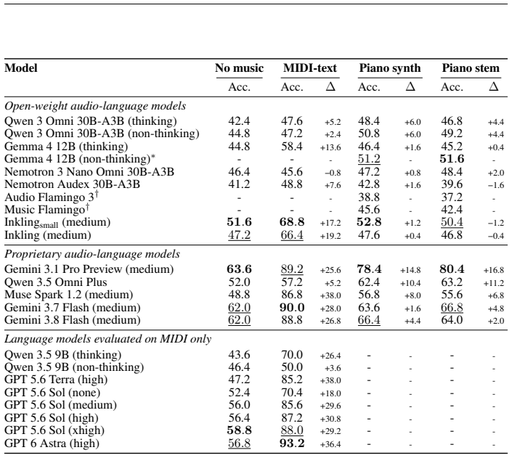
Table 1 : Zero-shot accuracy (%) on the 250 PianoBench MCQs. Models are evaluated with the ques- tion and choices alone (no music), MIDI-text, Pianoteq-synthesized audio, and the source-separated piano stem, where supported.∆denotes the percentage-point change from that model’s no-music accuracy.†: Audio Flamingo 3 and Music Flamingo had inconsistent instruction following on text- only inputs.∗: Gemma 4 12B continued to produce chain-of-thought on MIDI-text and no-music inputs despite thinking being disabled; we therefore omit these results.Boldis best per column / section, underline is second best.
Original paper · CC BY 4.0MIDI-text changes the picture for models that can reason at length, since frontier models reach far higher accuracy with it. GPT 6 Astra with high reasoning effort reaches 93.2% on MIDI-text, which is 36.4 percentage points above its no-music accuracy. The authors read this gap as models reasoning about patterns that remain difficult to perceive from audio.
Chain of thought also lifts the official Qwen 3.5 9B checkpoint from 50.0% to 70.0% on MIDI-text. Enabling thinking in Qwen 3 Omni and Gemma 4 12B doesn't improve audio accuracy, so reasoning alone doesn't fix perception.
No-music accuracy already ranges from 41.2% for Nemotron Audex to 63.6% for Gemini 3.1 Pro, far above the 25% chance level. The authors attribute part of this to cues that may have crept in during distractor selection. Because control accuracy varies across models, each model's gain is measured against its own no-music score rather than absolute accuracy.
This is why the audio and MIDI-text results are read as differences from each model's control.
Interleaving speech and MIDI-text during mid-training
The authors continue pretraining Qwen 3.5 9B Base on the PianoTalk training split under three data setups: speech only, separated, and interleaved. The interleaved setup places speech and MIDI-text chunks in temporal order inside one document, so commentary sits beside the notes it describes. The separated setup uses the same chunks but splits them into speech-only and MIDI-only documents.
Because both setups share identical chunks, any difference between them comes from the arrangement alone. The speech-only setup controls for gains that instructional speech alone might bring.
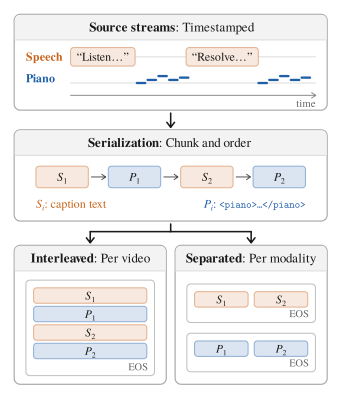
Figure 5 : Construction of mid-training docu- ments. Interleaved and separated training setups use the same speech and piano chunks, orga- nized either chronologically in one interleaved document or as separate speech-only and piano- only documents.
Original paper · CC BY 4.0 · Louis Bradshaw, Irmak Bukey, Daniel Chenyu Lin, John Thickstun, Chris Donahue · PianoBench: Evaluating Musical Perception and Reasoning in Language Models · Original paper figure · Extracted the figure area from page 9 of the original PDF.The authors then merge consecutive chunks of the same modality, which keeps single-modality passages continuous. This merging also yields finer interleaving where speech and piano overlap. Every checkpoint then receives the same instruction tuning on 40k Tulu 3 SFT examples and 10k MMLU auxiliary questions. No MIDI-text question answering and no chain-of-thought data enter this stage, so the comparison isolates the effect of mid-training.
Training uses AdamW for one epoch with a peak learning rate of 2e−5, a 5% warmup, and 4,096-token sequences.
Interleaved training reaches 56.0% on MIDI-text without chain of thought, a gain of 10.4 percentage points over no music. Separated training from the same chunks gives no gain over no music, at 0.0 percentage points. Speech-only training changes the no-music baseline by only 0.4 percentage points. The authors read this gap as evidence that keeping commentary beside the notes matters, since the chunks are identical.
The interleaved model ends 6.0 percentage points above the official instruct checkpoint at 50.0%, and their SFT-only baseline reaches 42.8%.
The official Qwen 3.5 9B checkpoint reaches 70.0% on MIDI-text when chain of thought is enabled, versus 50.0% without it. The authors therefore treat interleaved training and better chain-of-thought reasoning as promising parallel routes rather than competing ones. They didn't test whether interleaved mid-training combined with chain of thought gives further gains.
Limits of the evidence
The mid-training result rests on one base model, Qwen 3.5 9B Base, trained for one epoch on each document set. They didn't test other base models, so the gain from interleaving may not transfer to other architectures. Some PianoBench transcriptions are faulty, and the authors tagged them in the released dataset but kept them in the reported results.
Four of the 17 questions GPT 6 Astra answered incorrectly trace to transcription errors that human verification missed. The authors say one of those 17 questions had an incorrect human-selected reference answer, and they kept it in the accuracy.
The no-music control shows that models can pick answers above chance from question wording and choices alone. Accuracy without music ranges from 41.2% for Nemotron Audex to 63.6% for Gemini 3.1 Pro, against a 25% chance level. The authors suspect some of these cues came in during human distractor selection, and GPT 5.6 Terra generated the distractors.
Gemma 4 12B ranked the distractors without hearing the music, so its scores shape which choices remain. Most remaining errors involve higher-level ideas in note-dense passages, such as meter and dance-like accompaniment. The authors didn't test whether longer clips would change these errors.
PianoTalk covers 44 languages, but English makes up 68.48% of the captions. The dataset mostly features widely spoken Western languages, which may add geographic and cultural bias. The training mixtures behind the frontier audio gains aren't described in comparable detail. So the cause of Gemini 3.1 Pro's audio gain of +16.8 pp over its no-music control stays open.
Paper info
- Authors
- Louis Bradshaw, Irmak Bukey, Daniel Chenyu Lin, John Thickstun, Chris Donahue
- Venue
- arXiv · Preprint
- First published
- 2026-11-2
- Added
- 2026-11-5
- Updated
- 2026-11-2
- Version
- v1
- arXiv
- 2611.03839
- Category
- cs.SD · cs.AI · cs.LG
- Original paper terms
- CC BY 4.0
- What we show
- Paper info, commentary and permitted figures from the original paper
AI commentary is a separate explanation from the original paper and may contain errors. The original paper and figures follow each source's terms of use and any rights noted separately.
Abstract
Multimodal language models continue to improve on broad music understanding benchmarks, but which musical features can they perceive and reason about? We investigate this question by introducing PianoBench, a benchmark that tasks language models with reasoning about musical performances across congruent acoustic and symbolic input representations. PianoBench is derived from our new multimodal, training-scale dataset comprising more than 20,000 hours of interleaved transcripts of music and spoken musical commentary from instructional piano videos. Open-weight audio-language models achieve at most 52.8% accuracy on PianoBench, and at best only modestly outperform their accuracy on a no-audio control. In contrast, frontier models using chain of thought achieve up to 93.2% accuracy when provided transcripts of music as text, exposing a gap between perceiving musical features from audio and reasoning about musical events when they are given explicitly. We then test whether mid-training on interleaved musical instruction can improve question answering without chain of thought, raising Qwen 3.5 9B Base's zero-shot accuracy on PianoBench with music transcripts from 42.8% to 56.0% after instruction tuning. These experiments suggest that instructional videos may represent an overlooked source of multimodal supervision for music. Available: https://gclef-cmu.org/pianobench.
Quote from the paper
Louis Bradshaw, Irmak Bukey, Daniel Chenyu Lin, John Thickstun, Chris Donahue (2026). PianoBench: Evaluating Musical Perception and Reasoning in Language Models. arXiv:2611.03839v1. https://arxiv.org/abs/2611.03839v1
BibTeX
@misc{bradshaw2026pianobench,
  title = {{PianoBench: Evaluating Musical Perception and Reasoning in Language Models}},
  author = {Louis Bradshaw and Irmak Bukey and Daniel Chenyu Lin and John Thickstun and Chris Donahue},
  year = {2026},
  eprint = {2611.03839},
  archivePrefix = {arXiv},
  url = {https://arxiv.org/abs/2611.03839v1}
}