Paper commentary
Latent World Modeling for Point-Cloud Video Pretraining
- Problem Masked latent prediction on point-cloud videos can be solved by reading the answer off the target query, because the position of a masked target reveals where its geometry has moved.
- Method Queries each future target slot with last-seen anchor coordinates and its timestamp, and conditions the predictor on an annotation-free latent action whose prior sees only the context.
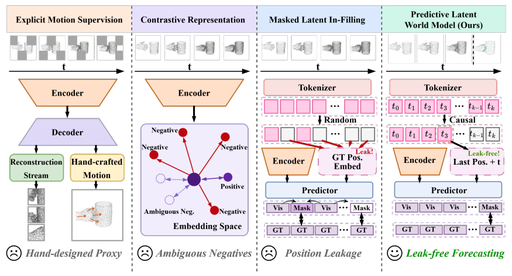
Figure 2 . Self-supervised objectives for point-cloud video representation learning, viewed through target-position information. Explicit motion supervision fits hand-designed proxies. Contrastive learning faces ambiguous negatives under temporal redundancy. Masked latent prediction samples targets at random and queries them with their true positions, inheriting the leakage shown in Figure 1(b). With last-seen anchors as queries, PointWM forecasts the features and geometry of future frames from earlier context.
Original paper · CC BY 4.0 · Zhuoyue Zhang, Jian Liu, Jihua Zhu, Ajmal Saeed Mian · Latent World Modeling for Point-Cloud Video Pretraining · Original paper figure · Extracted the figure area from page 2 of the original PDF.Why target positions leak future geometry
Masked objectives are a common way to learn from unlabeled point-cloud videos, and the study argues that their position queries let the pretext task be answered by reading the target off the query. The same leak reaches latent predictors that query masked tubes by their 4D centers, as PointTube-JEPA does.
Random spatio-temporal masking adds a second shortcut. Visible frames on both sides of a target let a latent predictor interpolate between them instead of forecasting. With the target positions withheld, a masked latent predictor still does only slightly better than copying the last frame, so its objective is close to completion.
The question the study asks is whether a predictor can be made to forecast, which requires modelling how the scene evolves, instead of reading back content it already sees.
Queries that withhold the target geometry
The encoder keeps the anchored point-tube design and changes only what the predictor is told about each target. Farthest-point sampling picks anchors in every frame, and ball queries gather the points around each anchor into a local tube. A P4DConv tokenizer maps each tube to a token and an anchor coordinate, with a temporal kernel of size three and stride one, so each token mixes the frame before, the frame itself and the frame after.
The token position combines the anchor coordinates with a normalized temporal index.
Each clip starts from a sampled anchor, six consecutive target anchors are predicted, and all spatial tokens of each target anchor are masked. The context keeps the anchors before the window minus a one-frame gap, so the last context token ends at the input frame just before the first target frame. At least 12 context anchors are retained.
A teacher copy of the tokenizer and encoder, held as an exponential moving average with momentum scheduled from 0.996 to 1.0, encodes the full clip without gradients, and its output is layer-normalized per token. The student encoder sees only the context tokens and produces the context latents that the predictor attends to.
The predictor takes the context tokens, the query positions and the latent action together. For each target slot it returns a latent prediction and a residual displacement that is added to the last-seen coordinate. The forecast is \[(\hat h_{t,j},\Delta\hat c_{t,j})=g_\phi(z_c,u_C,\tilde u_{t,j},a_t),\qquad \hat c_{t,j}=\tilde c_{t,j}+\Delta\hat c_{t,j}\], where a_t is the latent action after a linear projection and addition to the target query.
The anchor coordinate of each slot is taken from the last context anchor, so the query is built from the last-seen position joined with the target timestamp, and nothing is computed from the target frame.
What the latent action has to carry
The latent action answers a problem that withholding positions creates. A predictor that cannot see the target geometry still faces several possible futures after the same past, and a deterministic regression would settle on their average. A compact latent action gives the predictor a variable that can carry the part of the future the context leaves open, and the design tries to keep only that part.
The posterior comes from an inverse dynamics model that reads the change between consecutive pooled frame states. Each pooled state averages the layer-normalized student tokens of one frame, and the change is taken as follows. \[s_t=\frac{1}{M}\sum_{j=1}^{M}\mathrm{LN}(z^f_{t,j}),\qquad \delta_t=s_t-s_{t-1}\] The inverse dynamics model maps the change to a diagonal Gaussian posterior over an 8-dimensional action.
The prior is a second Gaussian that sees only the context. It takes the pooled state of the last context frame and the horizon k = t − t_c, and it never reads the target frames. The two are tied by KL terms with one-sided stop-gradients. The posterior term has a floor of λ_fb = 0.2 per dimension, so divergence below that floor is not penalized, and the prior term trains the prior to match the posterior.
The KL terms are weighted by β_q = 0.05 and β_p = 0.5.
During training the posterior sample is swapped for the prior mean on 30% of clips, so the predictor also learns to work from an action that the context alone provides.
How the losses shape the forecast
The feature loss pairs each target slot with the teacher feature of the same index, without re-matching, and uses a mean absolute error. \[\mathcal{L}_{\text{lat}}=\frac{1}{KM}\sum_{t\in\mathcal{T}}\sum_{j=1}^{M}\bigl\lVert \hat h_{t,j}-h_{t,j}\bigr\rVert_1\] Index pairing suits features, which vary smoothly between neighbouring anchors. It does not suit coordinates, where slot drift alone produces large errors.
Geometry is therefore supervised as a set with a symmetric Chamfer loss that does not depend on slot indices. \[\mathcal{L}_{\text{pos}}=\frac{1}{2K}\sum_{t\in\mathcal{T}}\Bigl[\frac{1}{M}\sum_{j=1}^{M}\min_{j'}\lVert\hat c_{t,j}-c_{t,j'}\rVert_2+\frac{1}{M}\sum_{j'=1}^{M}\min_{j}\lVert c_{t,j'}-\hat c_{t,j}\rVert_2\Bigr]\] Each predicted anchor is matched to its nearest true anchor and each true anchor to its nearest predicted anchor, so no persistent point identity is assumed.
The total pretraining loss adds the latent, Chamfer, KL and VICReg terms, with weight 5 on the Chamfer term and 0.1 on the VICReg term. Frame-pooled student features receive variance and covariance terms because a causal-only objective tends to collapse.
Pretraining uses 32-frame clips for 100 epochs with AdamW, batch size 64 and weight decay 0.05, and the tokenizer keeps 64 FPS anchors per frame from 2048 input points. Downstream models keep only the student tokenizer and encoder, and the predictor and EMA copies are discarded.
Forecasting probe on frozen models
Skill is measured against copy-last, which uses the last context state, and against the other reference predictors, with cosine similarity to the true target as the base quantity. Table 1 lists these scores for each frozen model, including the leakage diagnostic rows that query with true target anchors.
With the true target anchors supplied, Block reaches 0.81 skill and Leak reaches 0.85 over copy-last. The authors read the high scores under target positions as coming from the target geometry in the query, not from learned dynamics.
PointWM moves only from 0.52 with last-seen anchors to 0.54 with target positions, so its forecast does not depend on the query. With last-seen anchors PointWM reaches 0.52 skill and explains 58% of the feature change, against 0.42 skill and ∆R2 of 0.47 for Last. PointWM is ahead of Last by 0.10 in skill and by 0.11 in ∆R2, so removing the leakage alone does not account for the whole gain.
Predicting one anchor at a time, as an autoregressive rollout does, gives an average skill of 0.41, against 0.52 for predicting all horizons in parallel. The authors therefore forecast all horizons in parallel.
Downstream segmentation and recognition gains
On HOI4D offline action segmentation with the P4Transformer backbone, F1@50 rises from 58.2 under scratch training to 83.1 with PointWM pretraining, a gain of 24.9. Edit rises by 14.1 in the same comparison, and the PointWM row is the mean and standard deviation over three seeds.
With 10% of the training videos labeled, PointWM reaches F1@50 of 69.2, against 54.2 for Leak, a difference of 15.0. The authors read this as evidence that withholding target positions matters for offline segmentation as well.
On the PPTr backbone the same pretraining raises F1@50 by 14.5 and Edit by 7.9.
After fine-tuning from the HOI4D checkpoint, P4Transformer accuracy on MSR-Action3D rises from 90.94% to 95.06%, a gain of 4.12, and PST-Transformer accuracy rises from 93.73% to 96.18%, a gain of 2.45. Against the Leak variant on P4Transformer the gain is 2.69, with Leak at 92.37.
Strictly causal online segmentation
The online setting is strictly causal. Each 150-frame sequence is processed with a causal attention mask and a causal P4DConv kernel, and each frame label is decided from frames up to that frame, with no smoothing. Following the protocol used for PointNet4D, the pretrained tokenizer covers frames t−1 to t+1, so its three temporal slots are moved to offsets −2, −1 and 0 with the weights unchanged.
Each run is selected by unsmoothed causal validation F1@50 before a single test evaluation.
Under this protocol scratch training gives F1@50 of 46.3 and PointWM gives 75.4, a gain of 29.1, and accuracy is 14.3 above scratch. PointWM is 19.3 above Leak in F1@50, and Leak reaches 56.1.
Moving to the causal setting costs PointWM 7.7 F1@50 relative to its offline score, while scratch training loses 11.9, so the gap between them widens from 24.9 to 29.1. The authors read the widening gap as pretraining being most useful when the model has access only to the past.
Which components carry the gains
Table 5 adds the components one at a time, and each row is scored on forecast skill, the effective rank of frame-pooled features, Seg 10%, online F1@50 and MSR-Action3D accuracy. The authors note that this step mirrors the largest step in forecast skill.
Removing the block masks from the Last variant gives a purely causal objective, row (c). Its effective rank falls to 12.6 from 138.7, and its downstream metrics fall below those of Leak. Frame-level VICReg in row (d) prevents this collapse, with rank 178.2 and online F1@50 of 69.4, and the authors say it recovers Last's performance without completion.
The position head in row (e) and the latent action in row (f) each add about 3 online F1@50, from 69.4 to 72.5 and from 72.5 to 75.4. Together they account for 6.0 of the 6.8 by which PointWM exceeds Last in online F1@50. Applying VICReg per token in row (h) instead lowers online F1@50 by 5.3, although its effective rank is higher at 226.4.
Gaussian noise on the query leaves part of the leak. Online F1@50 is 69.6 at σ 0.02 and 73.0 at σ 0.20, against 75.4 for last-seen anchors. A time-only query reaches 71.1, above the leaky queries but below the last-seen anchors.
Table 6 compares latent-action designs at the same position head. A fixed N(0,I) prior gives skill of 0.40 at t+6, the same as the variant with no action, while the context-only prior of PointWM gives 0.45 against 0.61 for the oracle posterior.
Limits of the prior and the evidence
Slot pairing relies on approximate correspondence, because farthest-point sampling reruns in every frame, and fast motion may break that approximation.
Pretraining uses HOI4D only, which contains egocentric hand-object interactions, so transfer to larger and more varied point-cloud videos is untested. Several comparisons rest on three seeds, and some differences in effective rank and MSR-Action3D accuracy overlap within one standard deviation, so the authors treat them as descriptive trends.
The hyperparameter sweep does not establish an optimal setting.
Paper info
- Authors
- Zhuoyue Zhang, Jian Liu, Jihua Zhu, Ajmal Saeed Mian
- Venue
- arXiv · Preprint
- First published
- 2026-11-15
- Added
- 2026-11-17
- Updated
- 2026-11-15
- Version
- v1
- arXiv
- 2611.20090
- Category
- cs.CV
- Original paper terms
- CC BY 4.0
- What we show
- Paper info, commentary and permitted figures from the original paper
AI commentary is a separate explanation from the original paper and may contain errors. The original paper and figures follow each source's terms of use and any rights noted separately.
Abstract
Masked modeling is the dominant self-supervised paradigm for point-cloud videos. However, it leaks the information it is meant to predict, whether it reconstructs masked points as in MAE-style methods or predicts their latent features. Because point-cloud tokens are anchored at points sampled from each frame, querying a target at its own position reveals where its geometry has moved, in reconstruction and latent prediction alike. For latent predictors, random spatio-temporal masks introduce a further shortcut, as visible frames on both sides of each target allow interpolation rather than forecasting. The pretext task thus reduces to completion. Once the target positions are withheld, a masked latent predictor performs only slightly better than copying the last frame. To remove this leakage, we propose PointWM, a latent world model that turns completion into forecasting by predicting the features and geometry of future frames from strictly earlier context. Each target is queried only with its last-seen position and timestamp, while a latent action learned without annotations is meant to capture the part of the future that the past leaves undetermined. On HOI4D action segmentation with a P4Transformer backbone, PointWM improves F1@50 over training from scratch by 24.9 offline and 29.1 under strictly causal inference. These results show the promise of latent world models as a leakage-free pretraining paradigm for point-cloud videos.Our code is publicly available at https://github.com/InitalZ/PointWM.
Quote from the paper
Zhuoyue Zhang, Jian Liu, Jihua Zhu, Ajmal Saeed Mian (2026). Latent World Modeling for Point-Cloud Video Pretraining. arXiv:2611.20090v1. https://arxiv.org/abs/2611.20090v1
BibTeX
@misc{zhang2026latent,
  title = {{Latent World Modeling for Point-Cloud Video Pretraining}},
  author = {Zhuoyue Zhang and Jian Liu and Jihua Zhu and Ajmal Saeed Mian},
  year = {2026},
  eprint = {2611.20090},
  archivePrefix = {arXiv},
  url = {https://arxiv.org/abs/2611.20090v1}
}