Paper commentary
Detecting Is Not Choosing: What a World Model Needs to Keep a VLA Policy Safe
Learned critics detect danger but rank candidate robot actions near chance
- Problem Vision-language-action policies often break safety constraints even when they finish most tasks. Learned critics can flag dangerous states but rank candidate actions near chance within one state.
- Method The lookahead safety filter samples several candidate action chunks and executes the one with the fewest predicted violations. It uses the simulator as the world model.
- Results With the exact simulator, the filter raised the safety rate on LIBERO and LIBERO-Plus by 11.5 to 25.7 points over the policy alone.
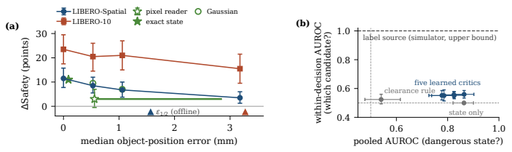
Figure 1 : (a) In-loop safety gain of the filter (π0.5) when the object positions it reads carry Gaussian error. Green (LIBERO-Spatial, one set of 200 pairs): the filter on the pixel reader, from its median error on non-target objects to that on task objects, on Gaussian error (circles) and on the exact state (star, drawn at 0.1 mm). Triangles: offlineϵ 1/2 (displacement constraint). (b) Detection against ranking for the critics on held-out layouts (289 contested decisions). Five see the candidate, while the state-only critic does not and sits at 0.5 by construction, and the clearance rule ranks by the gripper’s planned distance to non-target objects. Bars: 95% intervals.
Original paper · CC BY 4.0 · Thanish Bolla · Detecting Is Not Choosing: What a World Model Needs to Keep a VLA Policy Safe · Original paper figure · Extracted the figure area from page 3 of the original PDF.Why a good danger detector is not enough
Vision-language-action policies finish most benchmark tasks, but they often break safety constraints. On LIBERO-10, π0.5 succeeds in 88.0% of episodes, yet only 70.5% of them are free of violations. Because the policies are stochastic, the authors propose sampling several candidate action chunks at each decision and executing one predicted to be safe.
That remedy needs a world model, and the open question is what kind of model is needed and how accurate it must be. Implicit approaches learn a critic that scores candidates directly, while explicit approaches predict the future and then evaluate it.
The authors therefore test the models on that within-state ranking rather than on pooled separation.
How the lookahead filter works
The core idea is to use the simulator itself as the world model, because its state can be copied and restored exactly at each decision. At each decision the filter saves the simulator state, runs the nominal chunk for H steps and restores the state exactly. If no constraint is predicted to be violated, the robot executes the nominal chunk as it is.
Each chunk holds H=10 actions, of which the robot executes five before the policy is queried again. A violation is a non-target object other than the receptacle moving more than 5 mm, a contact force above 200 N, self-collision, or a carried object tilting more than 15 degrees (30 degrees on LIBERO-10).
It runs a fallback only if that fallback is predicted to cause fewer violations than the candidates.
To test learned models against this filter, the authors train six critics on simulator labels from 46,202 decisions, each with 16 candidates. Five critics see the candidate, and one sees only the state. The explicit models are a learned dynamics model, a DINOv2 latent world model in the style of DINO-WM, and Cosmos Policy's video predictions.
The simulator can also run from the output of a pixel reader or of FoundationPose instead of the true state. Detection is scored as pooled AUROC over decisions, while ranking is scored as within-decision AUROC over the 16 candidates of a contested decision.
Does the exact simulator make each policy safer?
With the exact simulator, the filter raised the safety rate in all eight policy-benchmark pairs. On LIBERO and LIBERO-Plus the gains were 11.5 to 25.7 points, and on RoboCasa they reached 30.8 points. The cost is success: for π0.5 on LIBERO-10 it fell from 88.0% to 83.0%.
The gain for π0.5 comes largely from the fallbacks rather than from ranking the candidates. Fallbacks ran in 74% of fixed LIBERO-Spatial episodes and in 42% of fixed LIBERO-10 episodes. Most fixed episodes also switched to another of the policy's candidates: 41 of 46 on LIBERO-Spatial and 48 of 50 on LIBERO-10. Only 5 and 2 fixed episodes were fixed by fallbacks alone.
Can learned models rank candidates at one state?
The state-only critic scores 0.864, as high as the best candidate-aware critic. So the pooled score measures how dangerous a state is, not which action at that state is safe.
Within one state, the five candidate-aware critics reach within-decision AUROC of 0.551 to 0.560, barely better than chance. Adding a ranking loss changed the within-decision AUROC by −0.007. A hand-written clearance rule ranks the candidates no better than the critics do. Figure 1b places pooled and within-decision AUROC side by side for these critics and the clearance rule on 289 contested decisions.
The learned dynamics model reaches within-decision AUROC 0.571 on 53 contested decisions, with seeds from 0.535 to 0.607. The DINOv2 latent world model sits near chance, at 0.46 and 0.45 on the two suites.
Chance at those decisions is 0.39, compared to that 0.56. So these models detect danger, but the authors judge that they don't rank well enough to replace the exact simulator.
How accurate must the state be?
The authors add Gaussian offsets to the positions of objects the robot doesn't touch, with σ of 0.45, 0.9 and 2.7 mm per axis. The resulting median errors are 0.53, 1.06 and 3.18 mm. Selection, however, falls from 1.00 to 0.61, with chance at 0.28. Selection falls halfway to chance at a half-gain error of 1.57 mm on LIBERO-Spatial and at 3.27 mm on LIBERO-10.
On LIBERO-10 the loss is 34%, and every level's interval overlaps the interval of the exact state. Part of the loss is blindness: large errors make the copy see objects past the 5 mm limit, so it can't flag new violations. When the error enters only the predicted dynamics, the loss is 39% on LIBERO-Spatial and 21% on LIBERO-10.
The pixel reader's median error on non-target objects is 0.56 mm, but its 90th percentile is 3.4 mm. On the same 200 pairs it kept 6.5 points less of the gain than Gaussian error with a median of 0.53 mm. Its error on task objects is larger, with median 2.85 mm and 90th percentile 19.5 mm, and at 25% of decisions it marks a constraint as already violated.
FoundationPose shows the same gap offline: it keeps 0.31 of the 26 rescues made with true poses, even though its median errors sit below the half-gain error.
The authors conclude that the median doesn't predict the cost, so the tail and the handled objects also need to be accurate.
Limitations
That version lowers LIBERO-10 success by 7.0 points, compared to 5.0 points for the full filter. The authors tested this only for π0.5, and they didn't run a geometric rule in the loop.
The critics were trained on one policy, and only 1,641 of 46,202 training decisions were contested. Retraining with all contested training decisions improved within-decision ranking slightly, and reweighting the existing ones did not measurably help.
All results are simulated, and the filter needs a state that can be restored exactly, which failed on two PhysX benchmarks, ManiSkill3 and SimplerEnv. The learned-model analysis rests on LIBERO alone, and the π0-FAST and SmolVLA runs cover only LIBERO. RoboCasa covers three tasks, and CoffeeSetupMug gives most of its gain.
The robot executes 0.25 s per decision, so the filter doesn't run in real time on this hardware.
Paper info
- Authors
- Thanish Bolla
- Venue
- arXiv · Preprint
- First published
- 2026-11-22
- Added
- 2026-11-24
- Updated
- 2026-11-22
- Version
- v1
- arXiv
- 2611.29553
- Category
- cs.RO · cs.AI · cs.LG
- Original paper terms
- CC BY 4.0
- What we show
- Paper info, commentary and permitted figures from the original paper
AI commentary is a separate explanation from the original paper and may contain errors. The original paper and figures follow each source's terms of use and any rights noted separately.
Abstract
Vision-language-action (VLA) policies complete most benchmark tasks but often violate safety constraints. Since they are stochastic, one remedy is to sample several candidate action chunks and execute one that a world model predicts is safe. We ask what such a model must do. In simulation, a lookahead safety filter with the simulator as an exact world model raises the safety rate of three VLA policies on LIBERO and of pi0.5 on LIBERO-Plus by 11.5 to 25.7 points. It also helps pi0.5 on three RoboCasa tasks. Learned critics trained on one policy's data detect dangerous states (pooled AUROC up to 0.864) but rank candidates at one state close to chance (within-decision AUROC 0.551-0.560), and the learned dynamics and video models we test do no better. When the simulator's state is perturbed, selection degrades long before detection. In the loop, a median position error of 3.18 mm removes 70% of the gain on LIBERO-Spatial, partly because the error also corrupts the displacement check. On LIBERO-10 the loss is smaller, and the intervals overlap. The median does not predict the cost: a pixel reader with a 0.56 mm median error keeps 6.5 points less of the gain than Gaussian error of a similar median. A world model for safety should thus be judged by within-state ranking, and its state must be accurate in the tail and on handled objects, not only in the median.
Quote from the paper
Thanish Bolla (2026). Detecting Is Not Choosing: What a World Model Needs to Keep a VLA Policy Safe. arXiv:2611.29553v1. https://arxiv.org/abs/2611.29553v1
BibTeX
@misc{bolla2026detecting,
  title = {{Detecting Is Not Choosing: What a World Model Needs to Keep a VLA Policy Safe}},
  author = {Thanish Bolla},
  year = {2026},
  eprint = {2611.29553},
  archivePrefix = {arXiv},
  url = {https://arxiv.org/abs/2611.29553v1}
}