Paper commentary
The Silent Cost of Conversation History in LLM Reasoning
Conversation history quietly lowers LLM accuracy
- Problem Earlier studies showed history can hurt short tasks but never tracked losses over long dialogues. Nobody measured how accuracy changes as a conversation grows.
- Method The authors replace the transcript with a solver-verified state summary, passing the exact task state from the previous turn plus the current user message.
- Results Under full history, accuracy fell from about 0.6 to 0.1 within twenty turns at matched difficulty, while the verified summary kept accuracy high.
Why a growing transcript can fail silently
Deployed assistants keep a transcript of every turn, so the model's own earlier replies and the evolving task state both sit in its context. The model then shows none of the usual symptoms of failure, so the error carries no visible mark. If the system never sees the gold answer, fluent and mutually consistent replies give no sign that the state has gone wrong.
The failure stays invisible unless some other signal flags it.
Multi-turn use is already known to be costly, since models commit to premature answers.
The paper asks whether retaining history costs accuracy, and whether that cost compounds as the conversation grows. None of the cited studies treats reasoning-quality metrics as a stream or reports a false-alarm rate.
Three context policies and the matched comparison
Each turn starts with a user message and ends with a primary reply, and a policy sets the context the model sees. Under dialogue history, the model sees every earlier user message and every earlier primary reply, as equation (1) writes it. The fresh prefix keeps the user messages but removes the assistant replies, so the model sees only what the user has said.
The verified state summary passes the exact task state from the previous turn, rendered by a solver, together with the current user message. Figure 1 shows the context policy as the first step, feeding the LLM before any scoring takes place.
Dialogue history and fresh prefix form a matched pair, so their gap estimates the net effect of keeping assistant replies. Context length and message positions also differ between the two arms, so the gap can't be pinned on the reply content alone. The verified state summary is a different kind of comparison, because it shortens the context and drops earlier replies.
The worked case uses turn 7, which reports that warehouse B received 40 crates of part X. Under dialogue history, the context is the full transcript of turns 1 to 8, including every earlier answer, right or wrong. Under the verified state summary, the context is only the solver's ledger line for warehouse B and part X, plus turn 8.
Each primary reply gets K-1 further samples from the same context. Each primary reply also gets L replies to frozen rewordings of the instruction.
Turning each reply into a monitored stream
Each primary reply comes with K−1 further samples from the same context, plus L replies to rewordings of the instruction. RQEval scores each reply on six dimensions in [0,1], and the paper uses those dimensions unchanged. CQ, RS and ES need the gold answer, while CS needs at least two answers. Only LS and SS can warn before the model is ready to answer, because they need only reasoning text.
LS splits a reply's reasoning into consecutive steps and subtracts the mean NLI contradiction probability from one. SS BERTScores the K sampled replies against each other, so near-duplicate phrasing raises it even when the shared answer is wrong.
A metric value is either observed or missing, and the monitor never imputes the missing ones. The window mean averages the last W valid values, so missing values neither enter nor advance the window. The paper sets W to 20 as the primary choice and also tests 10 and 30. The monitor computes the window mean only once the window holds W valid values.
Five detectors watch these window means: CUSUM, Page–Hinkley, EWMA, DDM and ADWIN. Study 1 estimates the null from permutation nulls, while Study 2 uses its stationary dialogues. An alarm before the change counts as a false alarm, and an alarm within 33 turns after it counts as a detection. Detection within 33 turns isn't yet a warning, so a signal must also alarm before the CQ alarm.
Retaining replies cost final success in Study 1
Study 1 asked whether keeping the model's own replies lowers final success when the user information stays identical. The design put 48 sharded math tasks with 4 to 9 shards, median 6, through two arms per model. Each reply had to end with FINAL_ANSWER or STATUS: NEED_MORE_INFORMATION, and only the primary reply entered later history. All 11,382 calls succeeded without truncation, and the run made 11,382 calls in total.
For GPT-4o-mini, final success fell from 0.896 under the fresh prefix to 0.688 under dialogue history. That paired difference of 0.208 had a Holm-adjusted p of 0.026, with a 95% CI of [0.063, 0.354]. The user information was the same in both arms, so the loss reflects carrying the model's own replies rather than missing information. The primary endpoint used exact McNemar tests with task-bootstrap intervals and Holm correction across models.
Mistral-7B fell from 0.354 under fresh prefix to 0.063 under dialogue history, a difference of 0.292. Its Holm-adjusted p was 0.004, the strongest effect in the study. Llama-4 Scout moved the same way, by 0.104, but its Holm-adjusted p was 0.125, so that effect isn't significant. Across models, only the fresh prefix succeeded on 34 model–task pairs, while only the history arm succeeded on 5.
Without those replies, the same model answered, which points to anchoring on its own earlier turns. Study 1 thus gives a paired, controlled estimate on short sharded tasks. They didn't test longer horizons here, which is the job of Study 2.
Quality metrics and readiness before the final answer
The pre-final warning candidates were therefore CS, LS and SS, which don't need the gold answer.
None of the three metrics showed a detectable association with final failure. CS gave a partial correlation of -0.047, LS of +0.017 and SS of -0.021. Every Holm-adjusted p-value was 1.0, so no metric passed the test. CS was measurable on only 29 source tasks, so the authors say small associations can't be excluded.
The paired readiness measure, CRL, was defined to track delay in becoming ready to answer, not accuracy. CRL discriminated its target modestly, with pooled model-stratified AUROC 0.627 and permutation p of 0.022.
Accuracy collapse and the verified state summary in Study 2
Difficulty follows a 12-level ladder calibrated per model, and five scenarios fix the regime sequence, two of them stationary. The verified state summary gives the model only the solver's current ledger line plus the current turn, so it never sees earlier replies.
In stationary easy dialogues, accuracy over turns 21–100 was 0.10–0.14 under dialogue history, compared to 0.82–0.86 under the verified summary. Table 5's state-summary column is pooled over all five scenarios, so it doesn't match the S0-E figures. Most of the decline falls in the first half, so the matched-level contrast of −0.118 (p < 0.001, n = 90 dialogues) understates the total loss.
The collapse also starts before any detector could form a baseline, so pre and post contrasts around scheduled changes mix the two.
Under the verified state summary, accuracy stayed high and followed the difficulty schedule. Per-dialogue accuracy over turns 1–100 was higher under the verified summary by 0.545 for Llama-3 70B and by 0.588 for Gemma 3 12B. Both gaps had Holm-adjusted p below 0.001, and over turns 21–100 the gaps were 0.575 and 0.630. GPT-4o-mini showed the same direction, with a mean gap of 0.521 under the verified summary.
GPT-4o-mini was observed before the protocol, so it sits outside the Holm family.
Figure 3 shows accuracy over 100 turns in 5-turn bins for both arms, across all dialogues and in each scenario. The recovery in the final easy regime of S3 appeared under the verified summary but never under dialogue history. The authors then asked whether a monitor could flag these changes early, which the next section takes up.
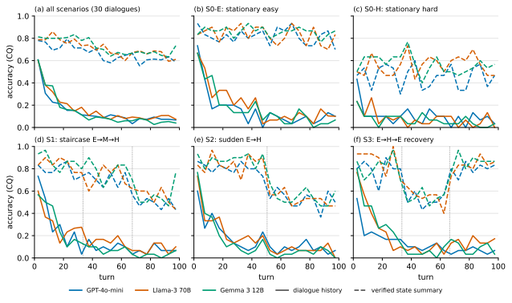
Figure 3 : Study 2 accuracy over 100 turns in 5-turn bins: (a) all 30 dialogues per model; (b)–(f) the five scenarios, six dialogues per model each. Solid: dialogue history; dashed: verified state summary; dotted vertical lines: scheduled difficulty changes.
Original paper · CC BY 4.0 · Ali Şenol · The Silent Cost of Conversation History in LLM Reasoning · Original paper figure · Extracted the figure area from page 14 of the original PDF.Quality metrics move the wrong way under long history
The quality metrics in Study 2 moved in the wrong direction as accuracy collapsed under dialogue history. For GPT-4o-mini, accuracy fell from 0.61 in turns 1 to 5 to 0.08 in turns 81 to 100. Stability rose from 0.94 to 0.98 over the same dialogues. Coherence moved only from 0.54 to 0.47, so the local reasoning looked almost unchanged. Consistency fell from 0.79 to 0.64, but it rose over turns 6 to 15 while accuracy halved.
That consistency decline came slowly and long after most of the accuracy was lost.
The authors also ran a post hoc replay of Study 1, streaming completed sessions and switching from fresh prefix to dialogue history. With window W = 20 in the sudden scenario, both metrics rose while accuracy fell. The median Cliff's δ between the last pre-change and last window was +0.46 for SS in GPT-4o-mini. It was +0.42 for SS in Llama-4 Scout and +0.31 for LS in GPT-4o-mini.
Responses become more alike and stay locally coherent as the model fails. A monitor that alarms only on decreases therefore can't see the failure. A two-sided monitor would flag a change whose sign says nothing about correctness. Figure 4a gives the 100-turn pattern as descriptive 5-turn means over 30 dialogues. CS is supported by 2976 of 3,000 turns in that figure, so its gaps are small.
Calibrated detectors on this data
Calibrated single-stream detectors were tested on the Study 1 replay and on the Study 2 dialogue arm. On the Study 1 replay, thresholds were set on 2,000 permutation nulls at family-wise α = 0.05. Checked against 2,000 disjoint nulls, the top detection rate across configurations reached 0.067. In that replay the stream items were sessions, and a detection meant any alarm after the switch.
In the Study 2 dialogue arm, the stationary dialogues meant to serve as nulls had already collapsed. The other metrics caught at most 0.11 of drifts within 33 turns. The decline starts at turn 1, so the streams that define normal behaviour already contain the degradation. Rules developed exploratorily on GPT-4o-mini failed the frozen validation when Llama-3 70B and Gemma 3 12B used them unchanged.
CUSUM on CQ caught 6/18 and 1/18 drift dialogues within 33 turns in those two models.
The frozen monitor uses a window of 20 values, so it can't alarm before turn 40, past the first scheduled change at turn 34. A post hoc CUSUM on raw values, standardised against turns 1–30, removed that floor.
On the control arms, LS alarmed before CQ in 3 of the 5 GPT-4o-mini dialogues where both alarmed.
Why one 100-turn stream is too short to reveal small drops
The authors bound the smallest drop a single stream can reveal, using a threshold on a window mean over n = mW pooled binary outcomes. Their Proposition 1 assumes independent Bernoulli outcomes with success probability p0 before a change and p1 = p0 − δ after it. Under the normal approximation, detection with power at least β is possible only if δ meets the bound in their equation (7).
The term σ_i squared equals p_i(1−p_i), and z_q is the q-quantile of the standard normal distribution. The proof sets the threshold k = p0 − z_{1−α}σ0/√n and requires (k − p1)√n ≥ z_β σ1.
With p0 = 0.8, W = 20, α = 0.05 and β = 0.8, the bound is about 0.24 for one dialogue. It falls to 0.10 for six dialogues and 0.05 for 18 dialogues pooled per turn. Monitors that look at many turns need a smaller per-look level, so the authors split α over the 67 looks from turn 34 to 100.
The task drifts in the data were 0.1 to 0.3, so one stream couldn't reveal them. Figure 5 plots this detection within 33 turns against the accuracy drop for each number of pooled dialogues.
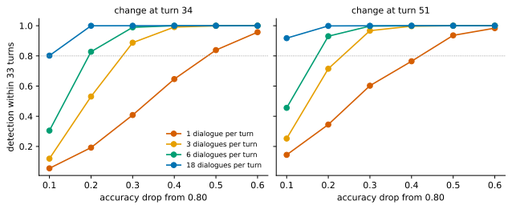
Figure 5 : Simulated detection within 33 turns versus the accuracy drop from 0.80 and the number of dialogues pooled per turn (W= 20, thresholds from 12 null streams, 5% false-alarm target). Left: change at turn 34; right: at turn 51. Dotted line: 80% detection.
Original paper · CC BY 4.0Those aggregates gave 0/2 and 1/2 alarms in the stationary Llama and Gemma aggregates. Two null aggregates per model can't verify a 5% false-alarm rate, so pooling sessions is promising but not settled. With no alarm in n null streams, the exact one-sided 95% upper bound is 1 minus 0.05 to the power 1/n, which is 0.78 for n = 2 and 0.22 for n = 12.
Where the findings stop
The tasks are narrow, since both studies use arithmetic and state-tracking problems with exact answers. Open-ended dialogue, where no exact answer exists, falls outside what these experiments can test. The models aren't the strongest available, and all of them were reached through one academic gateway. Study 1 and Study 2 use different model sets, so the two results can't be ranked against each other directly.
Testing frontier models would therefore need a harder ladder, not only more calls.
In Study 2 the repeat-based metrics CS, RS and SS were complete only for GPT-4o-mini. The verified state summary also changes history length, state load and accumulated errors at once. So the Study 2 result reads as a joint failure of state tracking, not proof that the assistant's replies alone cause the collapse. Study 1 covers 48 tasks, and CS was measurable on only 29 of them.
Token entropy, the signal behind ERGO, needs token probabilities, and the protocols didn't collect them. Semantic entropy could be computed from sampled answers, but the authors didn't compute it.
Counterfactual re-query signals were not tested as monitors here, so they remain an open route.
Paper info
- Authors
- Ali Şenol
- Venue
- arXiv · Preprint
- First published
- 2026-11-15
- Added
- 2026-11-17
- Updated
- 2026-11-15
- Version
- v1
- arXiv
- 2611.20071
- Category
- cs.CL · cs.AI
- Original paper terms
- CC BY 4.0
- What we show
- Paper info, commentary and permitted figures from the original paper
AI commentary is a separate explanation from the original paper and may contain errors. The original paper and figures follow each source's terms of use and any rights noted separately.
Abstract
Large language models (LLMs) in multi-turn information systems accumulate their own earlier replies and a growing task state. We asked whether this conversation history lowers accuracy, and whether process-level quality metrics warn before it does. Each analysis was fixed before its outcomes were computed. In Study 1, on 48 sharded math tasks, retaining its replies lowered final success by 0.21 for GPT-4o-mini and 0.29 for Mistral-7B (Holm-adjusted p = 0.026 and 0.004); Llama-4 Scout showed the same direction, not significant. Study 2 introduces CDR-Stream, 100-turn state-tracking dialogues with an exact answer per turn and per-model difficulty calibration. With the full history, accuracy fell from about 0.6 to 0.1 within twenty turns at matched difficulty, whereas a solver-verified state summary kept it 0.52-0.59 higher (Holm-adjusted p less than 0.001). Consistency and logical coherence fell far less than accuracy, and stability rose. None of these metrics, a paired readiness measure or calibrated single-stream drift detectors gave robust, model-general early warning, although in Study 2 the repeat-based metrics were complete only for GPT-4o-mini. In the monitors we tested, a single 100-turn stream had power only for very large drops. Systems built on LLMs should keep task state outside the transcript and monitor across sessions.
Quote from the paper
Ali Şenol (2026). The Silent Cost of Conversation History in LLM Reasoning. arXiv:2611.20071v1. https://arxiv.org/abs/2611.20071v1
BibTeX
@misc{enol2026silent,
  title = {{The Silent Cost of Conversation History in LLM Reasoning}},
  author = {Ali Şenol},
  year = {2026},
  eprint = {2611.20071},
  archivePrefix = {arXiv},
  url = {https://arxiv.org/abs/2611.20071v1}
}