Paper commentary
Linear Probes to Bayesian Manifolds: Geometry of Arithmetic in Large Language Models
Probes show structure, but not that models compute with it
- Problem Probe accuracy alone cannot show that a model computes with the structure it finds. Accuracy bundles four separate claims, so one number overstates what the model uses.
- Method The authors split the probe question into four claims and test each in a Bayesian pipeline. Stage 3 removes related concepts to test whether a shape is owned or inherited.
- Results Intervening on the shape keeps 61% of the probe's causal effect while using at most five dimensions.
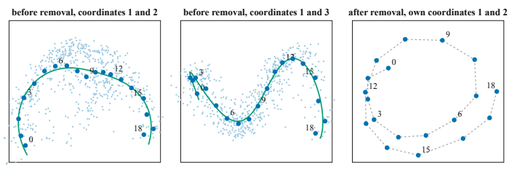
Figure 4 : The tens column sum of addition in GPT-J at layer 20 without preprocessing, the cell that passes all four criteria. Left and middle, the centroids of its 19 values (dots, every third labelled), a sample of 600 problems (light), and the fitted ribbon (curve), in the three leading principal coordinates of the ribbon inside the manifold basis, which hold 0.72 of the variance of the centroids. Right, the centroids after the subspaces of the two tens digits are removed, in their own two leading coordinates and joined in the order of the values, at 0.49 of the spread before removal. The values wind around twice with a growing radius, the ribbon that Stage 3 refits, which is why the evidence gap grows.
Original paper · CC BY 4.0 · Kumar, Anshul, Prasad, Neha, Kumar, Manoj, Póczos, Barnabás, Varshney, Deeksha · Linear Probes to Bayesian Manifolds: Geometry of Arithmetic in Large Language Models · Original paper figure · Extracted the figure area from page 25 of the original PDF.Why a high probe accuracy isn't enough
A high linear probe accuracy is often taken as evidence that a model computes with the structure the probe finds. Accuracy answers only one of four separate questions, so it cannot settle that claim on its own. The authors call these claims decodability, shape, ownership, and causal use.
The four claims can receive different answers, and superposition is one reason why.
The pipeline in Figure 1 turns these four questions into four stages, each issuing its own verdict on the same cell.
One cell, four questions, four verdicts
The pipeline runs four claims in order on a single cell, and a cell fixes the model, task, layer, concept and preprocessing setting. Because every stage works on the same data, the four verdicts can be compared directly rather than read from separate experiments. Each stage may decline to issue a verdict, so the output is one verdict per claim, and a cell can end with fewer than four answers.
The four claims are decodability, shape, ownership and causal use, and the pipeline tests each of them separately.
Stage 1 builds the probe from the centroids of the concept values, each weighted by the square root of Nv over N to limit the influence of rare values. The kept vectors form the basis B, and a cell is decodable when r is at least 1, which is a verdict about centroid variation rather than held-out accuracy. Linear discriminant analysis inside B then serves as a diagnostic, and it leaves B and the verdict unchanged.
Stage 2 projects each activation onto the probe subspace, so the shapes are fitted to the coordinates z_n of B. Stage 3 projects the span of the related concepts out of every activation, then refits the shapes with the same noise and periods. A shape is owned when the evidence gap change Delta is below 0 and inherited when it is at least 0.
Stage 4 ablates or patches the probe subspace B and the manifold basis Q geom, and compares each with random subspaces of equal rank. A cell passes all four criteria only when it is decodable, reaches Tier A and is owned, and is causally active, which holds for 46 of the 1,330 cells.
Models, tasks and the cell grid
The analysed grid covers three base models without instruction tuning, GPT-J 6B, Llama 3.1 8B and Pythia 6.9B. For GPT-J the layers are 4, 8, 14, 20 and 24 of 28, while Llama and Pythia use layers 4, 8, 16, 24 and 28 of 32. The paper argues that the answer is assembled at that token from information moved there, so the results describe that position only.
The two tasks are two-digit addition and multiplication, with operands from 0 to 99. Each verdict is conditional on one fixed prompt, such as 23 *17=, so the prompt is part of every result. They make no claim about problems answered incorrectly.
The concept set has 108 concepts in all, with 41 single concepts for addition and 47 for multiplication. Six core concepts per task are reported separately, and the remaining concepts are called extended concepts.
Three preprocessing settings are used, named off, answer and norm, and the off setting leaves the activations unchanged. The norm setting rescales every activation to unit length, so the shape doesn't depend on the varying norm of the residual stream. A value enters the analysis only with at least 30 correctly answered problems, and a cell needs at least two remaining values.
From centroids to a verified probe and a chosen shape
Stage 1 builds the probe from centroids rather than from a trained classifier, so a concept counts as decodable when its mean activation changes with its value. For each value, the pipeline stacks the centred centroids as rows, weights each row by the square root of the value's share of problems, and takes a singular value decomposition. The weighting limits the influence of values that have few problems, which keeps rare digits from dominating the directions.
The surviving vectors are orthonormal and form the probe subspace B, and a cell is decodable when at least one vector remains.
These checks are diagnostics, so they leave B and the verdict unchanged. Stage 2 then projects each activation onto B and fits named shapes to the coordinates z_n. The circle uses the features cos and sin of ω v with ω = 2π/T, so a period of T = 10 places the digits evenly around one turn. The open helix adds a linear feature to the circle, the torus multiplies two circles with two periods, and the ribbon lets the radius of a helix change linearly with the value.
Each shape is a linear image of its feature map plus Gaussian noise, with the noise variance σ_v set separately for each value. In Step 2c, the weights W are integrated out in closed form, which yields the marginal likelihood Z_k of each shape, its evidence. Because the evidence penalises unused flexibility, richer shapes need no separate penalty.
The cubic baseline K_0 carries a smooth trend with no periodic feature, and the evidence gap g = log Z_k̂ − log Z_0 is measured in nats.
The strictest grade, Tier A, adds two conditions and a permutation control on top of selection.
Ownership: refitting after removing related concepts
Stage 3 projects the span of the related concepts out of every activation, using an orthonormal basis built from the Stage 1 bases of those concepts. Keeping those other settings fixed means that any change in evidence comes from the removal and not from a new fit of the shape.
The verdict compares the evidence gap before removal, g, with the gap after removal, g perp, through Delta equals g minus g perp. The shape is owned when Delta is below zero, meaning the gap rises once the related concepts are removed. The shape is inherited when Delta is zero or positive, so a removal that leaves the coordinates unchanged counts as inherited.
The rule is strict at that boundary, which the authors chose so that a tie never yields an owned verdict. Appendix G decomposes Delta into the advantage of the selected shape on the removed component and an interaction term. The interaction term vanishes when the span of the related concepts lies inside the probe subspace.
The running example tests this rule, because the units digit of the answer depends only on the units partial product. An inherited verdict is therefore the expected outcome for that digit. Across the 1,330 ownership verdicts, 253 (19%) are owned and 1,077 (81%) are inherited. The verdict is relative to the listed related concepts, so it doesn't show that a shape is unique to the probed concept among all concepts.
The verdicts lie far from the boundary, so the rule is not sensitive to a small margin. The smallest absolute value of Delta is 1.51 nats over the 1,330 cells, while the median is about 3,024 nats. Among the core concepts, the removal keeps 0.85 of the coordinate variance on owned cells and 0.89 on inherited cells.
Intervening on the manifold basis
Stage 4 is the only stage that changes activations and then reads the output, so it tests causal use directly. It acts on the probe subspace B and on the manifold basis Q_geom, an orthonormal basis of the column space of B times the transpose of the posterior mean W-hat. Neither intervention moves an activation along the shape, which separates this stage from manifold steering.
Ablation replaces the part of the activation inside the subspace by its mean over correctly answered problems. Patching replaces that part with the same part taken from a donor problem whose concept value differs.
The random subspaces are drawn in the full activation space, so they control for disturbing any subspace of that rank.
Retention is the mean accuracy change under ablation of Q_geom divided by the change under ablation of B, over the same cells.
Decodability is nearly universal and heavily shared
Decodability is the first claim, and in this paper it is almost always met: without preprocessing, 1,445 of 1,620 candidate cells, or 89%, are decodable.
Being decodable doesn't mean a direction belongs to one concept, and the superposition rate tests that. The authors attribute part of this overlap to related concepts being functions of the same digits, so the shared directions reflect the arithmetic rather than a bug. Probe accuracy alone therefore can't show structure specific to one concept, because a probe for one concept can succeed by decoding a related one.
The residual stream also carries structure outside the probe subspace, which the authors check with the Marčenko–Pastur edge.
Ribbons and tori win the shape comparisons
Every one of the 338 strongly supported comparisons selects a ribbon or a torus, and the paper reports no other named shape among them. Table 1 splits the shape counts by model and task, which shows where the torus appears more often than in other rows.
The ribbon fits the two-digit range best, because its linear feature carries the trend across the operands and the sum. Among the core concepts, the ribbon also wins for the units digit of a in multiplication in every model. For residues modulo 10, the torus has the highest evidence in many cells, with exceptions the paper lists. A residue modulo 10 advances along no line, so the authors tie the torus result to that absence of a linear trend.
Concepts of mixed range are split between the ribbon and the torus.
With its two cross weights set to zero, the ribbon reduces to the open helix, and zeroing its linear weight as well gives the circle. The evidence therefore selects the ribbon's extra features only when those features are supported.
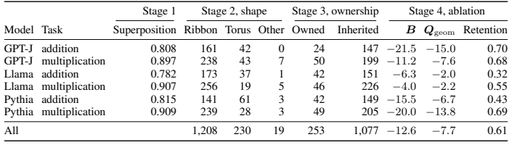
Table 1 : Results by model and task. Superposition is the mean rate over the cells of the row. Ribbon, torus, and other count the cells with a shape fit, 1,457 in all, pooled over the three settings, by the shape with the highest evidence, and other covers the baseline, the circle, and the open helix. Owned and inherited count the cells with an ownership verdict, 1,330 in all. Ablation gives the mean accuracy change in percentage points under ablation ofBand ofQ geom over the same 1,330 cells, and retention is their ratio.
Original paper · CC BY 4.0Among the core concepts, the median evidence gap is 10,866 nats for strongly supported comparisons. That gap is far larger than the 224 nats for Tier A family verdicts and the 509 nats for Tier B.
Most shapes are inherited, not owned
Ownership asks how often a shape belongs to the concept that carries it, and Stage 3 answers this by removing related concepts. Stage 3 uses related concepts listed before any experiment, and it projects their span out of every activation. The shape is owned when Delta is below zero and inherited when Delta is zero or above. A cell whose coordinates the removal leaves unchanged counts as inherited, because the rule is strict at the boundary.
The owned share stays between 14% and 22% in every model and task, and it is 18%, 20%, and 19% under the off, answer, and norm settings. The tens column sum of GPT-J addition gives the exception at layer 20 and passes all four criteria.
The verdicts sit far from the boundary, since the smallest absolute value of Delta is 1.51 nats over the 1,330 cells. Among the core concepts, the smallest value is 10.58 nats. Removal takes 0.85 of the coordinate variance on owned cells and 0.89 on inherited cells, so owned cells don't lose more variance. Their alignment stays at 0.97 and 1.03 of its value, so the verdict rests on the evidence gap rather than the size of the projection.
The manifold basis keeps 61% of the probe's effect
Ablating the manifold basis changes the output nearly as much as ablating the full probe subspace, and the numbers show how close the two effects are. Averaged over the 1,330 cells, ablating the probe subspace B lowers accuracy by 12.6 points, while ablating the manifold basis Q geom lowers it by 7.7 points. That gives a retention of 61%, which lies between 0.54 and 0.67 when the concepts are resampled.
The retention varies by model, reaching 0.69 in GPT-J, 0.60 in Pythia, and 0.42 in Llama. Across the settings it reaches 0.64, 0.61, and 0.57 in the order of Table 17. Ablating B alone lowers accuracy by 5.0 points in the same cells, against 15.4 points in GPT-J and 18.1 points in Pythia.
Of those 337 cells, 154 (46%) are causally active at 0.5 logits and 66 (20%) at 1.0, and all of them carry a negative excess. Under patching, Q geom keeps 60% of the effect of B. Causal activity is 41% among the 253 owned cells and 42% among the inherited cells, so an ownership verdict doesn't stand in for a causal one.
Only 46 of the 1,330 cells pass all four criteria, with 38 cells holding a strongly supported comparison and 8 holding a Tier A verdict that names only the family. The paper reads a probe verdict as overstating what the model computes with, which is why it proposes four verdicts per probe result.
Limits of the evidence
The results cover two-digit addition and multiplication at a single token position, in three models. Circuit-level analyses across operand positions and attention routes lie outside this scope, and the authors didn't test them. The three models are GPT-J 6B, Llama 3.1 8B, and Pythia 6.9B, so the results don't yet show how other tasks or positions behave.
The four verdicts share one cell, which fixes the model, task, layer, concept, and preprocessing setting. The authors analyse only problems that a model answers correctly, and they make no claim about incorrect answers. The 46 cells that pass all four criteria are conditional on the listed related concepts, which the authors read as a conservative count.
The random-subspace control compares each intervention with subspaces of equal rank drawn in the full activation space.
The superposition rate is high, so most concept pairs share subspaces, and probe accuracy alone can't isolate one concept. The authors suggest the manifold basis as a handle for model editing, but they report no editing experiment. Extending the pipeline to arithmetic beyond single-token answers is left as the next task.
Paper info
- Authors
- Kumar, Anshul, Prasad, Neha, Kumar, Manoj, Póczos, Barnabás, Varshney, Deeksha
- Venue
- arXiv · Preprint
- First published
- 2026-11-8
- Added
- 2026-11-11
- Updated
- 2026-11-8
- Version
- v1
- arXiv
- 2611.12998
- Category
- cs.LG · cs.CL
- Original paper terms
- CC BY 4.0
- What we show
- Paper info, commentary and permitted figures from the original paper
AI commentary is a separate explanation from the original paper and may contain errors. The original paper and figures follow each source's terms of use and any rights noted separately.
Abstract
Linear probes are a standard method to study geometric structures, such as helices and circles, from the activations of large language models (LLMs), and such structure is often taken as evidence that the model computes with it. Probe accuracy alone cannot establish this, because it conflates four separate claims. These are (1) that the concept is decodable from the activations, (2) that they form a specific shape, (3) that the shape belongs to the probed concept rather than to a related concept the model also represents, and (4) that the output of the model depends on the shape. We call these claims decodability, shape, ownership, and causal use, and we test them separately with a four-stage Bayesian pipeline. Stage 2 compares candidate shapes and selects the best one only when its evidence passes a predefined threshold. Stage 3 removes a set of related concepts, specified in advance, and tests whether the shape is owned or inherited. Stage 4 intervenes on the shape to test whether the output of the model depends on it. We apply the pipeline to two-digit addition and multiplication in GPT-J 6B, Llama 3.1 8B, and Pythia 6.9B. Nearly every concept is decodable, but the decoded directions overlap substantially across concepts. Every strongly supported comparison selects a ribbon, which is a helix whose radius changes with the value, or a torus. Of 1,330 cells with an ownership verdict, 19% of shapes are owned and 81% are inherited. Owned and inherited shapes move the output about equally often. Intervening on the shape retains approximately 61% of the effect of intervening on the full probe while using at most five dimensions, against a median of nine for the probe. Our results indicate that a probe verdict alone overstates what a model computes with, and we propose that probe results be reported as verdicts on all four claims rather than as a single accuracy.
Quote from the paper
Kumar, Anshul, Prasad, Neha, Kumar, Manoj, Póczos, Barnabás, Varshney, Deeksha (2026). Linear Probes to Bayesian Manifolds: Geometry of Arithmetic in Large Language Models. arXiv:2611.12998v1. https://arxiv.org/abs/2611.12998v1
BibTeX
@misc{anshul2026linear,
  title = {{Linear Probes to Bayesian Manifolds: Geometry of Arithmetic in Large Language Models}},
  author = {Kumar, Anshul and Prasad, Neha and Kumar, Manoj and Póczos, Barnabás and Varshney, Deeksha},
  year = {2026},
  eprint = {2611.12998},
  archivePrefix = {arXiv},
  url = {https://arxiv.org/abs/2611.12998v1}
}