Paper commentary
LongCap: Hour-Scale Timestamped Audio Captioning via Chunk-wise Processing
LongCap captions hour-long audio by processing it in chunks
- Problem Captioners that encode a whole recording first place each event far from its audio, and models trained on short clips degrade on long inputs. Accuracy suffers as recordings get longer.
- Method LongCap splits a recording into consecutive audio chunks and writes each chunk's events as soon as it ends. Timestamps are relative to each chunk, and earlier chunks and labels stay in context.
- Results LongCap-Diar extrapolates to 16 hours of concatenated audio despite training on recordings of at most 20 minutes. On LongCapBench-TAC-Long it beats the evaluated baselines on caption similarity and timeline error in segment-level comparisons.
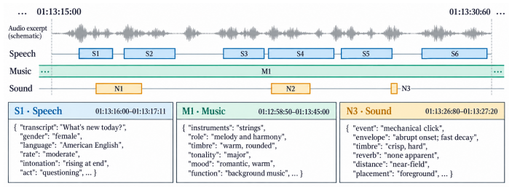
Figure 2 : TAC format. A schematic excerpt of long-form audio illustrates overlapping speech, music, and sound events with start/end timestamps and structured attribute dictionaries.
Original paper · CC BY 4.0 · Jinchuan Tian, Sen Chen, Wenbin Huang, Chao Weng, Zhengwei Huang, Jiatong Shi, Yichen Lu, Haoran Wang, Shinji Watanabe, Cong Zhou · LongCap: Hour-Scale Timestamped Audio Captioning via Chunk-wise Processing · Original paper figure · Extracted the figure area from page 2 of the original PDF.Why hour-long captioning breaks
The prevailing recipe encodes the whole recording into the context first and decodes the event list only afterwards, which is holistic processing. Every prediction then becomes a long-context retrieval, and the paper notes that accuracy is known to degrade in that setting. The token distance between an event's audio and its description grows as the recording gets longer.
Models trained on short recordings can degrade on longer inputs, which the authors tie to generation beyond training lengths. Speech recognition and language modeling both show this length bias, so a model that works on clips can fail on full recordings. LongCap avoids both problems by using chunk-wise processing with chunk-relative timestamps.
Its chunks are consecutive and non-overlapping, and each event is labeled in the chunk where it ends.
The authors first validate this design on speech recognition and diarization, where supervision is abundant, before extending it to TAC.
Structured captions and three scores
Every event caption is a set of key–value pairs drawn from a closed set of 62 keys designed with audio professionals. A key appears only when it applies to the event, otherwise it is absent from the caption. Because of this serialization, the TAC task stays an audio-to-text conversion that models the conditional distribution P(E|X). Fixed keys let each attribute be read and checked on its own, instead of parsing free-running natural language.
DER and tcpWER group utterances by speaker labels, but general audio events carry no such identity labels. LongCap therefore has a text LLM propose M=3 candidate groupings, and each metric keeps its best score across them. TER divides the sum of miss, false alarm and confusion durations by the reference activity duration, taking the minimum over groupings.
Miss time captures too few active predicted groups, false alarm time captures too many, and confusion time captures simultaneous activity in different groups.

Figure 3 : TAC scoring metrics. (a) TER measures timeline mismatch, (b) GER measures event granularity mismatch, and (c) tcpCapSim measures time-constrained caption similarity.
Original paper · CC BY 4.0GER counts overlap through one-to-one matching, so each event can match only one counterpart. A split or a merge keeps time covered, yet it lowers the matched overlap and raises the GER. A text LLM compares each shared attribute key's values and scores them in [0, 1], and a missing counterpart gives zero credit. Precision and recall are averaged, and the maximum over the groupings gives the final tcpCapSim.
The authors built LongCapBench with a two-stage workflow that starts from Qwen3.5-Omni-Plus drafts. Annotators correct event timestamps first, then verify each event's attributes, with specialist groups reviewing related attributes. Drafts changed a lot before curation, with about 65% and 53% of boundaries differing on TAC-short and TAC-long.
The authors kept Qwen3.5-Omni-Plus as a baseline even though it produced the initial drafts.
Chunk-wise decoding with relative timestamps
LongCap reads a recording as consecutive chunks and writes each chunk's events as soon as that chunk ends. Each chunk Xk starts at a start time and ends at an end time, and its label Yk holds every event that ends inside it. An event that spans several chunks is assigned only to the chunk where it ends, so no event is written twice. The model reads and writes one interleaved sequence of audio chunks and labels, keeping earlier chunks and labels in context.
Under this design, the probability of the full event list factorizes over chunks, with each factor conditioned on audio up to chunk k and on earlier labels. The authors call this causal assumption explicit: each Yk conditions on the audio up to chunk k, not on the full recording.
Chunk durations come from the discrete set {8, 16, 24, 32} s, and each chunk's duration is sampled randomly in training and inference. The authors compared a fixed 32 s chunk and a continuous uniform draw from U(8, 32) s against this set. Event timestamps are written relative to the start of their chunk, following Whisper's window-relative timing.
A recording-level timestamp is recovered by adding the chunk start to the relative prediction, so an event crossing the left boundary carries a negative start. Absolute timestamps became unreliable beyond the training duration range in these experiments, which is why relative timestamps were chosen.
Chunk-wise processing compares favorably with holistic processing because each description is emitted near the event's endpoint. Qwen3.5 natively supports a 256k-token context, and YaRN extends the window to 1M tokens. Length extrapolation depends on the base text model's long-context capacity, which the authors preserve by mixing long-form text into training.
Three training stages and dependency labels
Diarization and recognition supply timestamp supervision, while chunk captions of up to 30 seconds teach audio attribute prediction. The resulting checkpoint is named LongCap-Base, and all parameters stay unfrozen throughout training.
Fine-tuning LongCap-Base on these recording-level labels yields LongCap-SFT-1, which establishes basic TAC capabilities. LongCap-SFT-1 and Qwen3.5-Omni-Plus both show density degradation, with later events in a chunk holding fewer filled attributes. To counter this, the authors annotate another 10k hours of audio with LongCap-SFT-1, extracting each event's span by its predicted timestamps.
Fine-tuning LongCap-SFT-1 on these event-level annotations yields LongCap-SFT-2, which keeps attribute density more consistent across event positions.
The labels mostly come from short-window annotation, so cross-event links are not explicit in them. GLM-5.3-Flash analyzes each event sequence and assigns a semantically related earlier event as the ancestor, where appropriate. The current event's ID and its ancestor's ID go into the JSON training target, and following these links forms event chains.
Dependency modeling then matters for the results, since 122B-A10B raises long-form connectivity F1 from 4.2% to 14.8%.
Long-form recognition and diarization
The speech test asks whether chunk-wise processing still works when supervision is plentiful. LongCap-Diar-35B-A3B has the lowest macro-averaged DER, WER, cpWER and tcpWER across the five benchmark conditions. Its baselines are MOSS Transcribe Diarize, VibeVoice-ASR, Qwen3.8-Omni-Flash and Doubao ASR 2.0. The benchmark set covers AliMeeting, AISHELL-4, AMI-IHM, AMI-SDM, four CHiME-6 sessions and the LongCapBench-Diar subsets.
Window-level plots show where degradation starts, which a single macro average would hide. These numbers suggest the chunk-wise model outperforms the holistic baselines on these long recordings. With a 1M-token context window, LongCap-Diar extrapolates to 16 hours of concatenated audio.
The abstract says LongCap-Diar trains on recordings no longer than 40 minutes. The training section instead says the diarization model trains on recordings of at most 20 minutes. The 40-minute length belongs to the optional length-expansion data, which LongCap-SFT-2 annotates. The 16-hour extrapolation therefore reaches far beyond the 20-minute training span, with stable WER.
The timestamp comparison uses reduced-data 2B or 35B-A3B models, so its scores can't be read against the main results. Relative timestamps slightly worsen WER, but absolute timestamps fail completely on DER beyond the 20-minute training span. The trade is a small WER cost for stability on recordings longer than training.
Timestamped captioning on short and long audio
On LongCapBench-TAC-Short, both LongCap variants beat the evaluated baselines on caption similarity and stay competitive on timeline accuracy. Qwen3.5-Omni-Plus keeps the lower granularity error in that short setting. The short-form split holds 1,500 recordings totalling 18.50 hours, with a mean length of 0.74 minutes. On LongCapBench-TAC-Long, the segment-level comparison favors LongCap on caption similarity and timeline error.
LongCap doesn't lose coverage at full length, but the long split shrinks to four recordings with a mean of 105.70 minutes. Full recordings reach 117.1 minutes, with higher timeline error in some later windows. Coverage shrinks from four recordings to one at the longest durations, and the final partial window shows substantial music granularity errors.
Scaling from 0.8B and 2B to 9B and 35B-A3B lowers short-form TER and raises tcpCapSim from 61.65 and 62.58% to 64.42 and 64.59%. GER varies little across those sizes, so the size gain shows up mainly in timeline and caption similarity. The 122B-A10B model adds little on captioning, so the authors name 9B and 35B-A3B as the practical sizes.
Density degradation appears when later events in a chunk carry fewer filled attributes. Both Qwen3.5-Omni-Plus and LongCap-SFT-1 show this pattern, which Figure 8c plots by position within the chunk. LongCap-SFT-2 re-annotates each event's audio span with Qwen3.5-Omni-Plus, giving event-level labels instead of clip-level ones. That re-annotation spreads attribute density more evenly across event positions, and the model keeps this detail in full-recording outputs.
Event dependencies and long-form expansion
Dependency recovery is scored by comparing predicted ancestor links against silver annotations from DeepSeek-V4-Pro and Gemini-3.1-Pro. Link support (LS) checks reference support for each individual link, while connectivity F1 checks recovery of direct and transitive reference connections. The ancestor links come from GLM-5.3-Flash, which assigns each event a semantically related earlier event where appropriate.
The authors add these links to the JSON training target, so the model sees both the current event ID and its labeled ancestor. On long recordings, the 122B-A10B model reaches 14.8% connectivity F1, compared to 4.2% for 35B-A3B. Both models show substantial gaps on long recordings, so dependency recovery separates them more than captioning does.
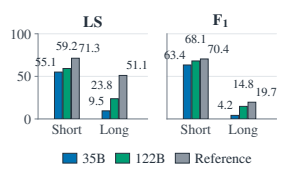
Figure 9 : LS andF 1 (%) for 35B- A3B, 122B-A10B, and GLM-5.3-Flash on reference events.
Original paper · CC BY 4.0Captioning gains beyond 35B-A3B are limited, so the authors read dependency recovery as a separate scaling need. Long-form expansion lowers full-recording TER from 44.84% to 41.09% at 35B-A3B. At 122B-A10B, the same expansion lowers TER from 42.35% to 39.64%. These TER gains are larger than the short-form gains, which the authors link to supervision extended to longer recordings.
Limitations of the LongCap results
The design comparisons rest on reduced data, so their scores aren't directly comparable to the main results. The timestamp and chunk-policy ablations use 2B or 35B-A3B models trained on reduced data. The long-text condition in Figure 6 also changes the training mixture and the token budget, so its lower WER can't be credited to long-form text alone.
Because of this, the authors can't report reliable full-recording results for those sizes, so the long-audio scaling picture starts at 9B. Full-recording coverage also falls from four recordings to one, as the TAC-long subset is small. Only four TAC-long recordings exist in LongCapBench, totaling 7.05 hours. The ethics statement says the four recordings have research-use permission, which doesn't by itself allow redistributing their audio.
The TER, GER and tcpCapSim scores depend on a text LLM that proposes the event groupings. Each metric keeps its best score over three LLM-proposed groupings, so the reported numbers reflect that selection. tcpCapSim also uses a text LLM to judge semantic agreement of shared attribute values on a scale from 0 to 1. The dependency scores rely on silver ancestor labels from DeepSeek-V4-Pro and Gemini-3.1-Pro, not human annotation.
The ancestor links were also produced by GLM-5.3-Flash, which adds one more model layer to the dependency labels.
Paper info
- Authors
- Jinchuan Tian, Sen Chen, Wenbin Huang, Chao Weng, Zhengwei Huang, Jiatong Shi, Yichen Lu, Haoran Wang, Shinji Watanabe, Cong Zhou
- Venue
- arXiv · Preprint
- First published
- 2026-11-8
- Added
- 2026-11-10
- Updated
- 2026-11-8
- Version
- v1
- arXiv
- 2611.11125
- Category
- cs.CL · cs.SD
- Original paper terms
- CC BY 4.0
- What we show
- Paper info, commentary and permitted figures from the original paper
AI commentary is a separate explanation from the original paper and may contain errors. The original paper and figures follow each source's terms of use and any rights noted separately.
Abstract
Describing hours of audio requires accurate event timing and sustained descriptive detail throughout the recording. We present LongCap, a framework for timestamped audio captioning (TAC), with the human-annotated LongCapBench and three diarization-inspired metrics: Timeline Error Rate (TER), Granularity Error Rate (GER), and Caption Similarity (tcpCapSim). LongCap interleaves audio chunks with structured event captions, using relative timestamps and retained context to support length extrapolation within a 1M-token inference context window. Event-level reannotation restores caption detail, while systematic studies examine model scaling, dependency supervision, and self-distillation. LongCap-Diar achieves strong benchmark results and extrapolates to 16 hours of concatenated audio despite training on recordings no longer than 40 minutes. Our TAC models are competitive with Qwen3.5-Omni-Plus on short clips, outperform evaluated baselines in caption similarity and timeline accuracy in segment-level comparisons on LongCapBench-TAC-Long, and caption full recordings approaching two hours. On LongCapBench-TAC, 9B and 35B-A3B offer favorable size-performance tradeoffs, while 122B-A10B substantially improves event-dependency recovery. These findings support long-horizon general audio understanding and provide a foundation for always-on voice agents.
Quote from the paper
Jinchuan Tian, Sen Chen, Wenbin Huang, Chao Weng, Zhengwei Huang, Jiatong Shi, Yichen Lu, Haoran Wang, Shinji Watanabe, Cong Zhou (2026). LongCap: Hour-Scale Timestamped Audio Captioning via Chunk-wise Processing. arXiv:2611.11125v1. https://arxiv.org/abs/2611.11125v1
BibTeX
@misc{tian2026longcap,
  title = {{LongCap: Hour-Scale Timestamped Audio Captioning via Chunk-wise Processing}},
  author = {Jinchuan Tian and Sen Chen and Wenbin Huang and Chao Weng and Zhengwei Huang and Jiatong Shi and Yichen Lu and Haoran Wang and Shinji Watanabe and Cong Zhou},
  year = {2026},
  eprint = {2611.11125},
  archivePrefix = {arXiv},
  url = {https://arxiv.org/abs/2611.11125v1}
}