Paper commentary
Same Contacts, Different Rooms:Meeting Format Shapes LLM Group Influence Beyond Pairwise Contact Counts
Meeting format changes LLM group support even when contact counts match
- Problem Contact networks discard meeting format, so they cannot tell apart packings of the same contacts.
- Method The authors hold pairwise contact counts fixed and only reorganise meetings.
- Results Merging triads into five-person meetings moves group support more than reshuffling meetings, 4.36 versus 2.59 pp.
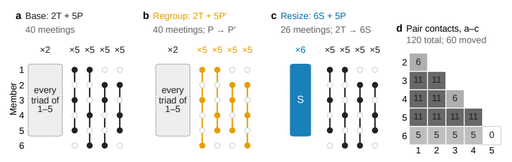
Figure1 :Contact-matchedschedulesforsixmembers(rows).Filleddotsmarkthemembersofonetriad;“×k”isitsnumberof copies.(a)Base:twocopiesofeverytriadamongmembers1–5(2T)plusfivecopiesofeachoffourfurthertriadsP.(b)Regroup replaces P with four other triads P′ (orange). (c) Resize replaces 2T with six five-person meetings S of members 1–5. (d) All threeschedulessharethispair-contactmatrix(120dyadiccontacts);eachinterventionremovesandadds60.Meetingcountsare 40, 40 and 26; members 1–5 attend 22 meetings in base and regroup and 16 in resize, and member 6 attends 10 in all three.
Original paper · CC BY 4.0 · Zhexi Gu, Shusheng Cao, Runping Zhu · Same Contacts, Different Rooms:Meeting Format Shapes LLM Group Influence Beyond Pairwise Contact Counts · Original paper figure · Extracted the figure area from page 2 of the original PDF.Why contact counts may not be enough
Simulations of LLM agent collectives usually record who interacted with whom as a pairwise contact network, with an edge weight for how often two agents met. That network discards the format of each interaction, meaning how large each meeting was and who else was in the room. Some group models, however, reduce exactly to weighted pairwise networks, so the reduction question stays open.
For LLM agents, the open question is whether a change in outcome comes from the pattern of pairwise contacts or from how the meetings were organised.
The authors test this with an intervention that holds every pairwise contact count fixed while the meeting format changes. Each schedule moves the same 60 dyadic exposures, so any difference in group support is caused by meeting format. A static contact network can't represent regrouping at all, because base and regroup share the same network.
Pairwise rules applied meeting by meeting can represent it, and the authors ask which such rules predict the format effects.
The authors' predictors use a meeting-wise Size rule, which applies Eq. 1 to predicted probabilities computed from each meeting's logits. The static network instead averages logits per member first and applies the sigmoid once, as Eq. 3 states. The meeting-wise rule explains up to 76% of the regroup effect, a share the network cannot reach.
Holding contacts fixed while changing meetings
The core idea is to keep every pairwise contact count fixed and change only how those contacts are packed into meetings. If group support still moves, the cause must be the meeting format rather than who met whom or how often. Each schedule moves the same 60 dyadic exposures, so the comparison stays controlled.
Six members with fixed initial stances meet under one of three schedules, all producing the same pair-contact matrix. Resize replaces the two copies of each triad with six five-person meetings of members 1 to 5. Resize has 26 meetings where base has 40, so the contrast holds pair-contact budget fixed rather than meeting count.
In each meeting, every attendee reads the arguments of the others and answers a binary support or oppose question. The logit difference between the two option tokens passes through a sigmoid to give a probability of support. Group support averages each member's per-meeting probabilities over that member's meetings, then averages over members.
Incidence weighting is the alternative, averaging over all member–meeting events instead.
Magnitude is the root mean square of the change, and direction is the majority-directed shift. The shift uses a sign of +1 when at least three of members 1 to 5 start in support, and −1 otherwise. Intervals come from a topic-cluster bootstrap with 14 topics and 20,000 draws, which the authors use to report uncertainty.
Transferring pairwise weights without group data
The pairwise predictors start from each member's logit with no peers present, plus one term per attendee. Each peer term is the change in that logit when only that peer is present, multiplied by a weight that depends on the rule. Sum uses a weight of 1, Mean uses 1/n, and Size weights use a fitted weight w_n for a meeting with n peers. Stance weights use separate weights for opponents and allies when the meeting has opponents.
The Size and Stance weights come from a separate micro-experiment, not from the group study. In it, a focal member faces 0 to 6 opponents and 0 to 3 allies across 64 items from 19 topics. The target topic is excluded from the fit, which leaves 58 to 64 training items. No parameter is fitted on group outcomes, so every group-level prediction is out of sample.
The meeting-wise prediction applies the sigmoid to each meeting's logit and averages those probabilities over the member's meetings. The static network prediction instead averages the logits first and applies the sigmoid once. With Size weights on triads, the network weight depends only on contact counts and meeting sizes. Comparing Size meeting-wise with Size on the network isolates placement, while comparing Size with Mean, or Stance with Size, isolates weight form.
Predictions are scored with the contrast R2, which compares the squared prediction error with the mean squared observed effect in each topic. An R2 of 0 means the predictor forecasts no change, so a rule earns credit only by explaining part of the effect's second moment. The paper's resize results then show which rules carry this signal, with Granite4.2-3B reaching R2 = 0.49 under Stance weights.
Resizing moves support more than regrouping
Resizing changes group support more than regrouping does, and the gap holds across all six models. Both schedules move the same 60 dyadic exposures, so the difference comes from meeting format rather than from contact counts.
Resize also has a direction that regroup lacks, measured against the initial majority of members 1 to 5. Resize pulls support toward that majority by 1.72 pp [1.41, 2.02] pooled, and every model's interval sits above zero. Regroup's majority-directed shift is at most 0.03 pp in every model, so it reshuffles outcomes without a systematic direction.
The authors read this as larger meetings acting as majority amplifiers, which matches majority-following in LLM groups.
The direction depends on the core's composition. With one or two supporters, resizing lowers support in 8 of 12 model-composition cells. Incidence weighting gives 2.53 pp [2.26, 2.79] with 84 of 84 cells, so the result doesn't depend on the weighting choice.
Which pairwise rules predict the format effects
The clearest gains come on regrouping, which the static network can't see. Because the static network predicts a regroup effect of exactly zero, its contrast R2 is zero by construction.
On resize, the picture is weaker, and the best rule reaches R2 = 0.49 for Granite4.2-3B with Stance weights. Size weights give 0.48 [0.37, 0.57] for Granite4.2-3B, and Mean reaches 0.34 for LFM2.5-1.2B. For Phi4-mini and Qwen3.5-4B, no low-parameter rule beats predicting no change, with R2 at most 0.01. The transferred Size weights show why: per-peer weights fall from 0.50 to 0.77 for two peers to 0.29 to 0.49 for four.
The best weight form is model-specific, as Appendix Table 5 shows. The meeting-wise Size rule also reproduces the majority amplification, predicting 2.26 of the observed 2.85pp for Granite4.2-3B.
Same weights, different placement
Holding the Size weights fixed and changing only where they are aggregated splits the six models into two groups. Meeting-wise computation raises R2 by 0.58 for LFM2.5-1.2B and 0.51 for Granite4.2-3B, improving all 14 topics in both. For regroup effects, the gain equals the meeting-wise R2 itself, because the network predicts zero. The regroup R2 values are 0.76 for LFM2.5-1.2B, 0.62 for Granite4.2-3B and 0.30 for Gemma4-E2B.
The network averages logits before the sigmoid, while the meeting-wise rule averages sigmoids after it. Their difference is the Jensen gap of the sigmoid over a member's meetings. The sigmoid is neither convex nor concave, so this gap can take either sign for a given member. Taylor's theorem bounds the gap by the dispersion of the meeting-conditional logits, which is the bound in Eq.
5. A contact network is therefore an accurate summary only when a rule's logits vary little across the meetings a member attends.
Every pair meets three times in both arms, so the placement difference equals the negative triad-side gap. Granite4.2-3B, LFM2.5-1.2B and Gemma4-E2B have mean logit variances of 7 to 14 across meetings.
Equal effective edge weights don't imply equal predictions, because the nonlinear readout separates the two notions.
When a contact network is enough
The aggregation gap is the difference between meeting-wise and network predictions of the same rule, and it is the Jensen gap of the sigmoid over each member's meetings. Taylor's theorem bounds that gap by the dispersion of the meeting-conditional logits, with the constant square root of 3 over 36 applied to the variance. Because the logits are a fitted pairwise rule's output, the spread across each member's meetings can be computed once the rule is fitted.
In the auxiliary five-person design, the gap tracks logit dispersion with a log-log r of 0.97. The mean logit variances explain the split between models: Granite4.2-3B, LFM2.5-1.2B and Gemma4-E2B have values of 7 to 14 across meetings. A small spread, as for MiniCPM5-2B, Phi4-mini and Qwen3.5-4B, means a contact network loses little, so contact counts are a safe summary there.
A large spread, as for Granite4.2-3B and LFM2.5-1.2B, calls for meeting-wise computation, which gains up to 0.58 R2.
Stance weights add a state-dependent term, and they help where a model's response depends on the stance mix of the room. That applies to MiniCPM5-2B on both effects and to Granite4.2-3B on regrouping. This parallels network results in which temporal and aggregated hypergraph dynamics diverge under nonlinear updates. The predictor set is therefore a template for checking the reduction that a simulation relies on.
Limitations of the evidence
The paper doesn't run a sequential simulation. Every result is a one-step readout from a fixed initial state. The authors name running the contact-matched schedules as sequential meetings with state updates as the natural next step.
The schedules equate pair contacts but don't equate meeting count or tokens. Resize holds 26 meetings where base and regroup hold 40, so format and meeting count change together. The contrast is therefore a format effect at a fixed pair-contact budget, not at a fixed meeting count or token cost.
The authors didn't test larger models. The six further topics and five additional models give robustness checks, with resize above regroup in 35 of 36 cells and 30 of 30 cells. The full-answer likelihood readout covers only two topics, with resize above regroup in 12 of 12 cells.
The arguments are human-written, but every agent is an LLM. So the findings describe LLM collectives rather than human groups. The ethical statement adds that the claims shouldn't be read as estimates of human group behaviour. It also asks that persuasion-oriented uses of meeting design get the same scrutiny as other influence techniques.
Paper info
- Authors
- Zhexi Gu, Shusheng Cao, Runping Zhu
- Venue
- arXiv · Preprint
- First published
- 2026-11-7
- Added
- 2026-11-10
- Updated
- 2026-11-7
- Version
- v1
- arXiv
- 2611.10641
- Category
- physics.soc-ph · cs.CL
- Original paper terms
- CC BY 4.0
- What we show
- Paper info, commentary and permitted figures from the original paper
AI commentary is a separate explanation from the original paper and may contain errors. The original paper and figures follow each source's terms of use and any rights noted separately.
Abstract
Simulations of LLM agent collectives usually summarise interaction as a pairwise contact network. We test that summary with a contact-matched intervention: the members, their initial stances and every pairwise contact count stay fixed while the meetings are reorganised, and each member gives a one-step support readout after reading the arguments of everyone present. Across six open-weight LLMs and 14 debate topics, merging triads into five-person meetings (resize) moves group support more than reshuffling who meets in triads (regroup), although both move the same 60 dyadic exposures. The root-mean-square change is 4.36 versus 2.59 percentage points (pp), larger for resize in all six models and in 81 of 84 model-topic cells. Resizing also has a consistent direction: it amplifies the initial majority of the merged members by 1.72 pp, in every model, whereas regrouping has no direction (<= 0.03 pp). A contact network cannot represent regrouping at all, yet pairwise rules applied meeting by meeting explain up to 76% of its effect, and with identical weights they raise resize R^2 by 0.51-0.58 for two models. We show that the gap between the two placements is an exact Jensen gap of the sigmoid readout, bounded by how much a member's predicted logits vary across meetings; this dispersion tracks the gap with log-log r=0.97 and tells a modeller when contact counts are a safe summary. Meeting format is a first-class variable for LLM social simulation.
Figures from the paper
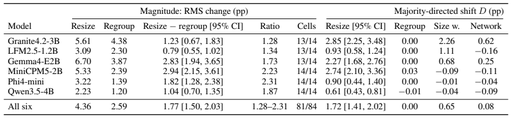
Table 1 : Meeting-format effects on one-step support with pair contacts fixed (14 topics, 1,920 configurations each, person weighting). Cells: model–topic cells in which resize has the larger RMS. The last two columns give the majority-directed shift that the meeting-wise Size-weight rule and the static network rule predict for resize. All-six row: equal-weight model average with jointly resampled topics; Ratio there gives the range across models.
Original paper · CC BY 4.0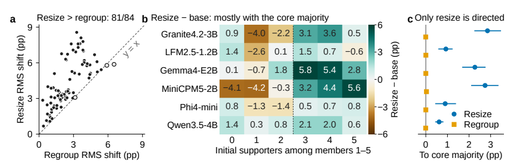
Figure2 :Meetingformatchangesone-stepgroupsupportatfixedpaircontacts.(a)RMSchangepermodel–topiccell(n= 84; 1,920configurationspercell);filledpoints:resizelarger,openpoints:regrouplarger.(b)Signedresizeeffect(pp),averagedover topics, by the number of initial supporters among members 1–5; the dashed line marks where the core majority switches from oppose to support. (c) Majority-directed shiftDwith 95% topic-cluster intervals, rows as in (b). Regroup estimates are at most 0.03ppineverymodel(itssignedeffectsbycorecompositionallliewithin±0.11pp),soonlyresizehasasystematicdirection.
Original paper · CC BY 4.0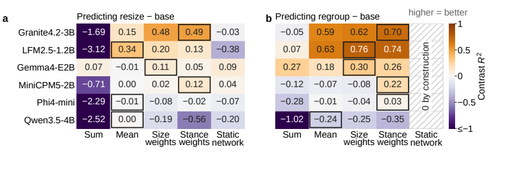
Figure 3 : ContrastR2 of five pairwise predictors for (a) resize and (b) regroup effects (14 topics per model).R2 = 0equals predicting no change; colours are clipped at−1. Boxes mark each model’s best predictor. Sum, Mean, Size and Stance are meeting-wise (Eq. 2); Static network applies Size weights to the aggregated contact network (Eq. 3) and predicts exactly zero regroup effect.
Original paper · CC BY 4.0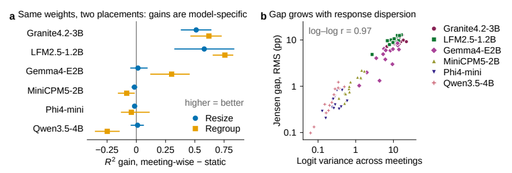
Figure 4 : Aggregation placement and its mechanism. (a) PairedR2 gain of meeting-wise Size weights over the same weights on the static contact network, for resize and regroup effects (95% topic-cluster intervals, 14 topics). (b) Auxiliary five-person design (three five-person meetings versus all ten triads; every pair meets three times in both): RMS Jensen gap of the Size rule against the mean variance of each member’s predicted logits across its meetings (one point per model–topic,n= 84).
Original paper · CC BY 4.0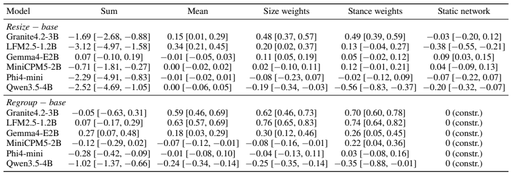
Table 4 : ContrastR2 [95% CI] for every predictor, model and intervention (values shown in Figure 3). “0 (constr.)”: identically zero because base and regroup share the contact network.
Original paper · CC BY 4.0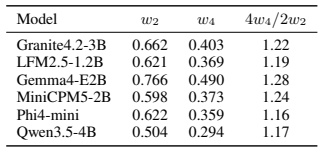
Table 6 : Transferred Size weights (mean over the 14 leave- topic-out fits). The last column is the total influence of four peers relative to two.
Original paper · CC BY 4.0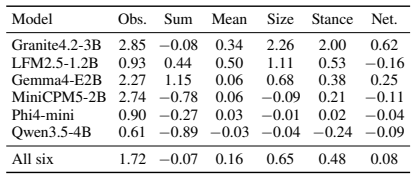
Table 7 : Majority-directed resize shiftD(pp): observed and predicted by each rule.
Original paper · CC BY 4.0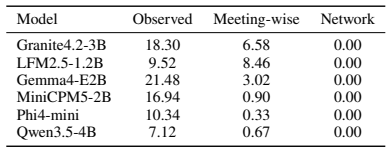
Table8 :Auxiliarydesignwith1/nweights,main-studytop- ics (1,344 conditions per model): RMS of the five-versus- triads difference (pp). The network column gives the maxi- mum absolute value, which is zero to machine precision.
Original paper · CC BY 4.0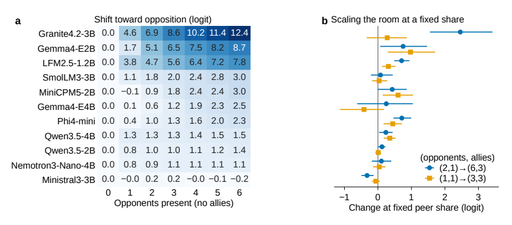
Figure 5 : Micro-experiment (64 items, 19 topics, 11 models). (a) Mean change in opposition-directed logit withkopponents andnoallies.(b)Changewhenpeersarescaledatfixedopponent:allyratios(95%topic-clusterintervals);rowsfollowtheorder in (a).
Original paper · CC BY 4.0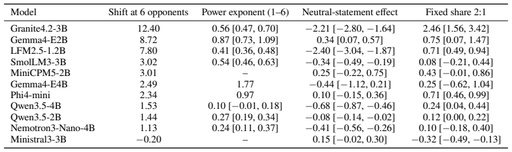
Table9 :Micro-experimentsummaries(logits,[95%CI]).Powerexponent:fittedexponentoftheno-allycountcurve;“–”orno interval where it is undefined. Neutral-statement effect: change in a single opponent’s influence when three neutral statements are added.
Original paper · CC BY 4.0Quote from the paper
Zhexi Gu, Shusheng Cao, Runping Zhu (2026). Same Contacts, Different Rooms:Meeting Format Shapes LLM Group Influence Beyond Pairwise Contact Counts. arXiv:2611.10641v1. https://arxiv.org/abs/2611.10641v1
BibTeX
@misc{gu2026same,
  title = {{Same Contacts, Different Rooms:Meeting Format Shapes LLM Group Influence Beyond Pairwise Contact Counts}},
  author = {Zhexi Gu and Shusheng Cao and Runping Zhu},
  year = {2026},
  eprint = {2611.10641},
  archivePrefix = {arXiv},
  url = {https://arxiv.org/abs/2611.10641v1}
}