Paper commentary
Equivariant Descriptor Fields: SE(3)-Equivariant Energy-Based Models for End-to-End Visual Robotic Manipulation Learning
Equivariant descriptor fields let robots learn manipulation end-to-end from few demonstrations
- Problem End-to-end learning for robot manipulation needs many demonstrations. NDFs are sample efficient but need pre-training, segmented point clouds and fixed placement targets, so they cannot be trained end-to-end.
- Method EDFs swap NDFs' rotation-invariant type-0 descriptors for type-1 or higher descriptors that turn with the rotation. They learn the pose energy end-to-end as an energy-based model over SE(3) poses.
- Results EDFs scored 0.97 total on unseen mug instances, compared to 0.36 for SE(3)-TNs. Training used only ten upright-pose demonstrations.
Where NDF-style pipelines get stuck
Learning manipulation from scratch often means learning from mistakes, which makes real-world use highly impractical. Pipelines for pose estimation, segmentation or pre-trained object representations are therefore commonly added to improve data efficiency.
Transporter Networks reach high sample efficiency end-to-end by exploiting SE(2) equivariance, the planar roto-translation symmetry. Their efficiency is limited to planar tasks because they lack full SE(3) equivariance. NDFs reach few-shot level sample efficiency on highly spatial tasks by exploiting SE(3) equivariance. However, unlike Transporter Networks, NDFs can't be trained end-to-end from demonstrations.
NDFs need pre-training on auxiliary self-supervised learning tasks, so they can't be fine-tuned on the demonstrated task. NDFs also need well-segmented point cloud inputs and a fixed placement target. These limits make NDFs hard to apply when no public pre-training dataset exists for the target category. They also struggle when well-segmented object point clouds can't be expected, or when the placement target isn't fixed.
Key idea: orientation-aware descriptors and an energy model
EDFs change NDFs by making the descriptors sensitive to orientation, which is the core of the design. NDFs use only type-0 descriptors, which are invariant to rotation, so they carry no orientation by themselves. EDFs add type-1 or higher descriptors, which turn with the rotation, so one query point can fix an orientation. EDFs require only one point for the same job, which the authors tie to their orientational sensitivity.
The authors also drop the direct minimization of the NDF energy, because minimizing it while training the descriptors would collapse them. Naively minimizing the energy would make all the descriptors collapse to zero or some other constant. So the authors treat the energy as an energy-based model over SE(3) poses and train the descriptors through its likelihood.
The energy-based model is written as the exponential of the negative energy, normalized by an integral over SE(3).
The target symmetry is bi-equivariance, which asks that a placement pose follow changes in the target and compensate for changes in the grasp. Uni-equivariant methods such as NDFs account for changes in only one object, so they fit poorly when both postures may change. Equivariance also has to stay local, so the model reacts to the target object rather than the background.
Transporter Networks get this locality from convolutions, while the centroid subtraction used by NDFs is nonlocal. Because of this nonlocal step, NDFs can't be used without object segmentation pipelines.
How the energy is computed and sampled
The key EDF is a direct sum of N SE(3)-equivariant vector fields, each of a type l_n, so the whole field rotates through a block-diagonal matrix. Each block is a real Wigner D-matrix of degree l_n, and type-0 blocks stay fixed under rotation while type-1 blocks rotate with R. Because NDFs use only type-0 descriptors, they need at least three non-collinear query points to represent an orientation, whereas EDFs need only one point.
The query density is modeled as a weighted sum of Dirac delta functions placed at N_q query points. The query point functions and weight field are SE(3)-equivariant, so the density moves with the grasp point cloud Y. Proposition 4 says a non-constant query density must depend on the grasp, so fixed query point constants are ruled out.
The energy integrates the density-weighted squared difference between the transformed key EDF and the rotated query EDF over space. For the implementation, this integral becomes a sum over query points, each term weighted by its own query weight. Lower energy means the query and key descriptors are better aligned, as Figure 3 shows for both type-0 and type-1 descriptors.
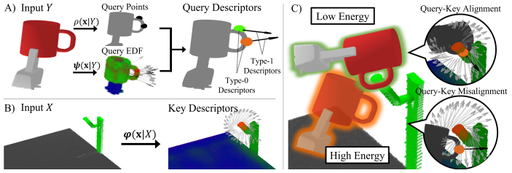
Figure 3 : A) Query points and query EDF are generated from the point cloud of the grasp. Query EDF values at the query points are used as the query descriptors. We visualized three type- 0 de- scriptors in colors (RGB) and type- 1 descriptors as arrows. We only visualized type- 1 descriptors in important locations. We did not visualize higher-type descriptors. B) The key descriptors are generated from the point cloud of the scene. C) The query descriptors are transformed and matched to the key descriptors to produce the energy of the pose. For simplicity, we only visualized the query descriptor for a single query point. Note that the query and key descriptors are better aligned in the low energy case than in the high energy case for both the type-0 and type-1 descriptors (The orange query points are near the orange region, and the black arrow is well aligned to the gray arrows).
Original paper · CC BY 4.0 · Hyunwoo Ryu, Hong-in Lee, Jeong-Hoon Lee, Jongeun Choi · Equivariant Descriptor Fields: SE(3)-Equivariant Energy-Based Models for End-to-End Visual Robotic Manipulation Learning · Original paper figure · Extracted the figure area from page 5 of the original PDF.Sampling first runs Metropolis-Hastings with an IGSO(3) distribution for orientation proposals and a Gaussian for translations. Its samples then seed Langevin dynamics on SE(3), with Lie derivatives in quaternion-translation form to avoid singularity issues. Only the last TFN layer is recalculated at each MCMC step, because the SE(3)-Transformer outputs depend only on the point cloud and can be reused.
Training estimates the gradient of the log-likelihood, which lowers the energy at the target pose and raises it at negative samples. Naive maximization is unstable, because query points at contact sites get pushed away when the query and key EDFs start far apart. The authors therefore use a surrogate query model with Gaussian noise on the query logits and a switch based on whether a scene point lies within distance r.
They maximize a variational lower bound during early training and return to maximum likelihood once the query model is trained.
Whether the comparisons support the idea
The authors train on ten upright-pose demonstrations generated by probabilistic oracles. They test unseen instances, unseen lying poses, unseen distracting objects, and arbitrary poses with distractors. The hanger and tray poses are randomized, unlike the fixed targets in NDF experiments. Each setting reports pick, place and total success rates for the mug, bowl and bottle.
SE(3)-TNs were the baseline, and they failed on the mug-hanging task when trained on multimodal demonstrations. The authors therefore trained SE(3)-TNs on unimodal, low-variance mug demonstrations. On unseen mug poses, EDFs scored 1.00 total, compared to 0.00 for SE(3)-TNs. The authors attribute this gap to equivariance, since SE(3)-TNs are only SE(2)-equivariant.
On unseen mug instances, EDFs scored 0.97 total, compared to 0.36 for SE(3)-TNs. For the distracting objects, the authors presume the point cloud inputs give EDFs better geometric information than the orthographic RGB-D inputs of SE(3)-TNs.
The ablation keeps the EDF pipeline but uses only type-0 descriptors, as NDFs do. Its query point count was raised so its inference time matches or slightly exceeds that of EDFs. In the unseen instances, poses and distracting objects setting, it scored 0.65 total on the mug, compared to 0.95 for EDFs. The authors read the gap as the orientational insensitivity of type-0 descriptors, which leaves orientation to the query points.
Inference times on the mug task were 14.3 s for the ablation and 13.4 s for EDFs.
The comparisons support the claim that EDFs generalize better than SE(3)-TNs in these out-of-distribution settings. The type-0 ablation supports the claim that higher-type descriptors help orientation when query points are limited. The authors didn't test NDFs directly, because NDFs need fixed placement targets and object segmentation. The ablation is an NDF-like model they built, so it doesn't stand in for NDFs themselves.
Limitations of EDFs and what the authors leave open
EDFs stop short of solving every spatial manipulation problem, and the authors name several limits in their conclusion. NDFs were not compared directly, since they require fixed placement targets and object segmentation pipelines. NDFs also cannot be trained end-to-end from demonstrations, which is the gap EDFs target. The neural networks of NDFs need pre-training on auxiliary self-supervised learning tasks, and they can't be fine-tuned for the demonstrated tasks.
The authors instead compared EDFs against an NDF-like ablation that uses only type-0 descriptors.
The authors say faster sampling is needed before EDFs can serve real-time manipulation. Their mug timing of 13.4 s was measured on an Intel i9-12900k CPU with an Nvidia RTX3090 GPU. Cooperative learning and amortized sampling are named as ways to accelerate the MCMC sampling. The paper doesn't benchmark either speedup, so their effect on EDFs remains untested.
EDFs are not intended for tasks with significant occlusions to the target object. The authors also list 3D reconstruction methods as future work. EDFs cannot solve problems at the trajectory level, a limit they share with NDFs. The authors leave open the equivariance condition needed for full trajectory-level manipulation tasks. Their summary claims rest on the experiments with unseen instances, poses, and distracting objects.
Paper info
- Authors
- Hyunwoo Ryu, Hong-in Lee, Jeong-Hoon Lee, Jongeun Choi
- Venue
- arXiv · Preprint
- First published
- 2022-6-16
- Added
- 2026-11-4
- Updated
- 2023-2-27
- Version
- v3
- arXiv
- 2206.08321
- Category
- cs.RO · cs.AI
- Original paper terms
- CC BY 4.0
- What we show
- Paper info, commentary and permitted figures from the original paper
AI commentary is a separate explanation from the original paper and may contain errors. The original paper and figures follow each source's terms of use and any rights noted separately.
Abstract
End-to-end learning for visual robotic manipulation is known to suffer from sample inefficiency, requiring large numbers of demonstrations. The spatial roto-translation equivariance, or the SE(3)-equivariance can be exploited to improve the sample efficiency for learning robotic manipulation. In this paper, we present SE(3)-equivariant models for visual robotic manipulation from point clouds that can be trained fully end-to-end. By utilizing the representation theory of the Lie group, we construct novel SE(3)-equivariant energy-based models that allow highly sample efficient end-to-end learning. We show that our models can learn from scratch without prior knowledge and yet are highly sample efficient (5~10 demonstrations are enough). Furthermore, we show that our models can generalize to tasks with (i) previously unseen target object poses, (ii) previously unseen target object instances of the category, and (iii) previously unseen visual distractors. We experiment with 6-DoF robotic manipulation tasks to validate our models' sample efficiency and generalizability. Codes are available at: https://github.com/tomato1mule/edf
Quote from the paper
Hyunwoo Ryu, Hong-in Lee, Jeong-Hoon Lee, Jongeun Choi (2022). Equivariant Descriptor Fields: SE(3)-Equivariant Energy-Based Models for End-to-End Visual Robotic Manipulation Learning. arXiv:2206.08321v3. https://arxiv.org/abs/2206.08321v3
BibTeX
@misc{ryu2022equivariant,
  title = {{Equivariant Descriptor Fields: SE(3)-Equivariant Energy-Based Models for End-to-End Visual Robotic Manipulation Learning}},
  author = {Hyunwoo Ryu and Hong-in Lee and Jeong-Hoon Lee and Jongeun Choi},
  year = {2022},
  eprint = {2206.08321},
  archivePrefix = {arXiv},
  url = {https://arxiv.org/abs/2206.08321v3}
}