Paper commentary
Better Answers, Weaker Evidence Control: Evidence Bypass in On-Policy Distillation
Distillation can make students ignore edited evidence while answering more accurately
- Problem On-policy distillation raises answer accuracy on the original document, but the student keeps its old answer when the document changes. Standard training never checks whether the student follows the evidence, so this goes unnoticed.
- Method Evidence-Paired OPD trains on pairs of matched documents that support different answers to the same question. It adds a margin that ranks each document's supported answer above its paired alternative, instead of the usual single-document training.
- Results On QASPER with a Qwen3-4B student, counterfactual accuracy rises from 39.2% under standard OPD to 42.7% under EP-OPD. This recovers 66% of the counterfactual loss while keeping most of the original-document gain.
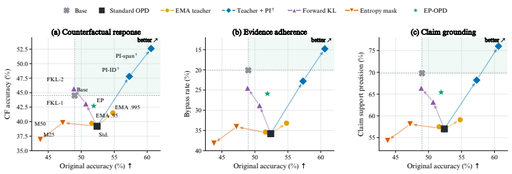
Figure 3 : One-axis OPD interventions trace different accuracy–evidence frontiers. Panels pair original accuracy with CFAcc, reversed bypass, or CSP (top-right is better). Arrows change one factor from standard OPD; dashed guides mark Base. PI (†) is an oracle and EP-OPD a symmetric-context reference.
Original paper · CC BY 4.0 · Ruoran Xu, Yilun Zhao, Ziyu Chen, Xiaoqiang kang, Arman Cohan · Better Answers, Weaker Evidence Control: Evidence Bypass in On-Policy Distillation · Original paper figure · Extracted the figure area from page 7 of the original PDF.Accuracy gains that hide weaker evidence use
On-policy distillation (OPD) has the student generate its own trajectories while the teacher supervises each prefix the student visits. In document-grounded tasks, those trajectories bring the student's existing answer preferences into contact with evidence-conditioned teacher supervision. That contact is where a problem can appear: the student may become more accurate on the document it sees while leaning harder on its old answer.
To test this, the authors change one answer-critical fact and update its dependent mentions, so the edited document supports a different answer. They keep the question fixed and generate a fresh response to each document version. On QASPER with a Qwen3-4B student, standard OPD raised original-document accuracy from 49.0% to 52.4%. Counterfactual accuracy fell from 44.5% to 39.2%, and bypass, the share of originally correct answers that the student keeps after the edit, rose from 20.1% to 35.8%.
The paired interaction is −8.7 percentage points, so the change on the edited document is separate from the gain on the original. So the student got better on the document it sees and worse at following the edit.
Bypass is measured only over examples the model already answers correctly on the original document. Counterfactual accuracy and bypass are complementary, because avoiding the original answer doesn't by itself produce the answer the edited document supports. The paper also reports the same direction on PeerQA, where standard OPD raised original accuracy by 2.1 percentage points and lowered counterfactual accuracy by 2.6 points.
Across both datasets, the matched evaluations show a consistent shift toward keeping the original answer after an answer-changing edit.
Matched documents and the three answer metrics
The matched documents start from QASPER and PeerQA, which the authors evaluate as two scientific document QA datasets. Splits are disjoint by source paper, so a paper never sits in more than one split. Unanswerable examples instead contribute to abstention evaluation.
They update dependent mentions consistently and leave the question, section order, and unrelated context untouched. Each edit turns the original document and its answer into a counterfactual document with a different answer. A fresh response is generated for each document version, and each held-out pair is validated so the edited document uniquely supports its new answer.
The same example also yields a meaning-preserving paraphrase, an evidence-deleted version, and a length-matched irrelevant insertion. These versions measure response to semantic preservation, evidence availability, and distraction. Original accuracy scores the original document, and counterfactual accuracy (CFAcc) scores the edited one. Bypass is computed only over examples the model answered correctly on the original document, so it compares conditional rates across models.
Bypass is the fraction of those examples where the same model keeps the original answer on the counterfactual document, which CFAcc alone would not reveal.
Claim support precision (CSP) is the fraction of answer-relevant claims that a blinded evaluator labels as supported. Each matched question pair serves as the comparison unit, and source papers define the resampling clusters.
What standard OPD does to evidence response
Standard OPD on QASPER with the Qwen3-4B student raises original-document accuracy from 49.0% to 52.4%. Over the same matched answer-changing documents, counterfactual accuracy falls from 44.5% to 39.2%. Conditional bypass rises from 20.1% to 35.8%, so the original answer persists more often after the supplied evidence changes. The paired interaction is −8.7 percentage points, with a 95% interval of [−12.4, −5.1].
That number is the gap between how much training moved correctness on counterfactual documents and how much it moved correctness on original ones. Because the paper's paired estimand compares these two changes, a training run can gain accuracy on the observed document and still lose ground on the edited one. On PeerQA with the 4B student, original accuracy rises by 2.1 points and counterfactual accuracy falls by 2.6 points.
That yields a paired interaction of −4.7 points, the same direction as on QASPER. Among the baseline rows, standard OPD gives the largest original gain and the largest bypass increase.
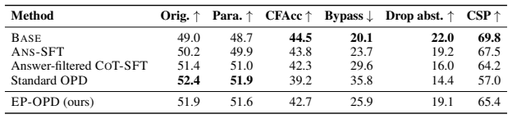
Table 1 : QASPER with Qwen3-4B-Base (%). ↑/↓: higher/lower is better. Among the baseline training conditions, standard OPD attains the highest original and paraphrase accuracy while every evidence-sensitive outcome moves away from the base model. EP-OPD (last row; Section 6) partially recovers these outcomes at a 0.5 pp original-accuracy cost.
Original paper · CC BY 4.0Paraphrases keep most of the gain, since paraphrase accuracy rises from 48.7% to 51.9%. Evidence deletion works differently, because correct abstention falls from 22.0% to 14.4%. Claim-level errors also rise, from 30.2% to 43.0% automatically and from 28.5% to 38.3% on the blinded expert subset. Claim support precision drops by 12.8 points, which ties the answer change to weaker support for the claims in the response.
The authors read this as a shift tied to answer-critical evidence rather than general sensitivity to perturbation.
The extra bypass from OPD grows across the frozen-base prior quartiles, from about 5 points in the weakest to 20 points in the strongest. Table 8 shows the same pattern, with standard OPD adding +5 at the lowest quartile and +20 at the highest. The base model already gives greater original-answer persistence in the stronger-prior quartiles, so the largest shift falls where that preference is strongest.
Which OPD design choices move evidence response
The factorized study changes one OPD design dimension at a time around standard OPD, keeping the rest of the training setup shared. Teacher target is either a fixed reference or an EMA teacher with µ ∈ {0.995, 0.95}. The EMA teacher with µ = 0.995 reaches 54.8% original accuracy, 41.5% CFAcc, 33.2% bypass and 59.1% CSP. The faster µ = 0.95 teacher produces a smaller shift than the slow µ = 0.995 teacher.
Moving from T = 1 to T = 2 raises CFAcc from 43.1% to 45.7%. Bypass falls from 28.8% to 24.5% over the same move, while original accuracy drops from 50.7% to 48.9%. Evidence response therefore improves at the cost of accuracy on the original document.
Teacher privileged information moves the evidence-sensitive measures more than any other factor. Gold evidence IDs, given only to the teacher, raise CFAcc to 47.8% and lower bypass to 22.8%. Gold evidence IDs also raise CSP to 68.2%. The exact answer-critical span pushes CFAcc to 52.6%, bypass to 14.8% and CSP to 76.0%. This is an oracle setup, because the span goes only to the teacher, and the student never sees it in rollouts or evaluation.
Such oracle rows give the teacher information that symmetric-context methods lack, so they estimate the value of resolving the teacher's evidence-location uncertainty.
Among the four dimensions, supplying the exact answer-critical span to the teacher gives the largest joint movement. That result motivates the next step, where each question is paired with documents supporting different answers.
Pairing documents with an answer margin
Standard OPD sees one document per question, and that can't separate a document-sensitive student from one that answers from the question alone. Proposition 1 makes this concrete: a question-only policy can match an evidence-responsive one on the observed support. The authors therefore pair each question with documents that support different answers, so one answer preference can't satisfy both targets.
EP-OPD gives each validated document its own student rollout and teacher supervision, and both members share a mini-batch. The paired term asks each document to score its supported answer above its partner's answer by at least a margin m. In the paper's notation, the paired term sums hinge losses over b in {0, 1}, with [z]+ equal to max{z, 0}.
The score s_θ is the length-normalized log probability of a canonical answer, conditioned on that document.
The full objective averages the two standard OPD losses and adds λ times the paired term. The OPD term carries teacher behavior along student-generated trajectories, while the margin ties each answer to its own document. The paper's Algorithm 1 scores the margin by teacher forcing over the short canonical answer strings, not over the full rollout.
If the pair loss reaches zero, each document's supported answer beats its partner by at least m under that same document. Corollary 3 gives a paired response of at least 2m, and a question-only policy has paired response of zero. Because that zero response rules out question-only solutions for m > 0, the paired loss rejects shortcut policies on the pair.
These guarantees concern the two canonical answers in the margin, and the main evaluation extends them to free generation on fresh pairs.
Does pairing keep the accuracy gain
Paraphrase accuracy is 51.6%, and counterfactual accuracy rises to 42.7%. Counterfactual accuracy increases by 3.5 points over standard OPD, recovering 66% of its counterfactual-accuracy loss. Bypass falls from 35.8% to 25.9%, and CSP rises to 65.4%. Correct abstention after evidence deletion also improves, to 19.1%. The authors connect this to paired training improving adaptation to changed evidence while keeping most of the original gain.
The paper checks whether this pattern holds across datasets and student sizes. Across QASPER and PeerQA with 1.7B and 4B students, EP-OPD recovers 54–66% of standard OPD's counterfactual loss. It also keeps 80–85% of the original-document accuracy gain in those four settings. Per setting, the recoveries are 59% for QASPER with 1.7B, 66% for QASPER with 4B, 62% for PeerQA with 1.7B and 54% for PeerQA with 4B.
Standard OPD's changes from the frozen base are +3.4 original and −5.3 counterfactual points for QASPER with the 4B student. For PeerQA with the 4B student, they are +2.1 and −2.6 points.
EP-OPD also lowers bypass in every prior-strength quartile relative to standard OPD. In the weakest quartile, bypass falls from 17% to 14%, and in the strongest it falls from 49% to 35%. The authors' component ablation separates the two parts of the objective. Swapping the answer cross-entropy term for the paired margin raises CFAcc by 1.8 points and CSP by 5.7 points.
Paired ANS-SFT has the lowest bypass at 25.3%, but it trails EP-OPD on original accuracy, CFAcc and CSP.
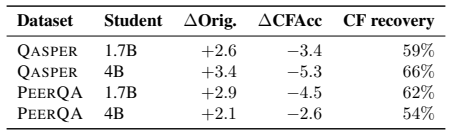
Table 3 : Cross-dataset and scale replication. Entries are percentage-point changes of standard OPD relative to the frozen base, except the final column, which is the fraction of OPD’s CFAcc loss recovered by EP-OPD.
Original paper · CC BY 4.0Limits of the evidence results
The diagnostics here measure behavioral evidence responsiveness, so they don't verify internal reasoning directly. The paper treats its claim-support labels as an assessment of source support, not of whether claims describe the model's internal reasoning.
Bypass is computed only over examples a model answers correctly on the original document. The phenomenon analysis uses one Qwen3-4B base student and a frozen Qwen3-30B-A3B-Instruct-2507 teacher. Each principal configuration runs with three seeds, and the 1.7B student appears only in the cross-dataset and scale replication.
Counterfactual compliance doesn't guarantee factuality when the supplied evidence is itself false or adversarial. The authors say the method may improve evidence following, but they don't treat counterfactual compliance as a universal trustworthiness criterion. The teacher-side privileged-information rows are oracle interventions that use information unavailable to the symmetric-context methods.
They estimate what resolving the teacher's evidence-location uncertainty is worth, rather than describing a deployable method.
Privileged information never appears in the student rollouts or at evaluation, so the student sees only the question and document. The paper's own tests cover QASPER and PeerQA with two student sizes, and the PeerQA comparison uses the 4B student only in the main analysis. Across the four settings, paired training keeps 80 to 85 percent of the original gain, which the authors report but don't extend to other models.
Paper info
- Authors
- Ruoran Xu, Yilun Zhao, Ziyu Chen, Xiaoqiang kang, Arman Cohan
- Venue
- arXiv · Preprint
- First published
- 2026-11-1
- Added
- 2026-11-4
- Updated
- 2026-11-1
- Version
- v1
- arXiv
- 2611.01967
- Category
- cs.CL · cs.AI
- Original paper terms
- CC BY 4.0
- What we show
- Paper info, commentary and permitted figures from the original paper
AI commentary is a separate explanation from the original paper and may contain errors. The original paper and figures follow each source's terms of use and any rights noted separately.
Abstract
On-policy distillation (OPD) can improve answer accuracy while weakening responsiveness to supporting evidence. We investigate this separation in scientific-document question answering through matched document interventions that change the supported answer while preserving the question and unrelated context. We identify evidence bypass: a student retains an originally correct answer after the document changes to support a different one. On QASPER with a Qwen3-4B student, standard OPD raises original-document accuracy by 3.4 percentage points, lowers counterfactual accuracy by 5.3 points, and increases bypass by 15.7 points; the same directional pattern appears on PeerQA. Controlled perturbations localize the shift to answer-critical evidence, and bypass grows with the student's pre-distillation closed-book preference for the original answer. A factorized study of teacher targets, privileged information, divergence, and supervision density finds that explicitly supplying the teacher with annotated answer-critical spans yields the largest joint improvement in evidence response and claim support. These findings motivate Evidence-Paired OPD (EP-OPD), which combines on-policy supervision on matched documents supporting different answers to the same question with an answer-level margin that favors each document's supported answer over its paired alternative. Across both datasets and two student sizes, EP-OPD recovers 54-66% of standard OPD's counterfactual-accuracy loss while preserving 80-85% of its original-document accuracy gain. Our results establish evidence responsiveness as a distinct training and evaluation target alongside answer accuracy. Our code is publicly available at: https://github.com/RuoranXu/EP-OPD.
Quote from the paper
Ruoran Xu, Yilun Zhao, Ziyu Chen, Xiaoqiang kang, Arman Cohan (2026). Better Answers, Weaker Evidence Control: Evidence Bypass in On-Policy Distillation. arXiv:2611.01967v1. https://arxiv.org/abs/2611.01967v1
BibTeX
@misc{xu2026better,
  title = {{Better Answers, Weaker Evidence Control: Evidence Bypass in On-Policy Distillation}},
  author = {Ruoran Xu and Yilun Zhao and Ziyu Chen and Xiaoqiang kang and Arman Cohan},
  year = {2026},
  eprint = {2611.01967},
  archivePrefix = {arXiv},
  url = {https://arxiv.org/abs/2611.01967v1}
}