Paper commentary
Optimal Rates for Adaptive Private $k$-PCA
AdaDPO updates the full subspace jointly to make private PCA optimal
- Problem Deflation-based private PCA finds one direction at a time, which adds an extra factor of k to the error. Earlier adaptive methods also needed sample sizes that grew exponentially with the eigengap.
- Method AdaDPO is a private variant of Oja's algorithm. It updates the full d×k basis in one step, using one scale and one clipping center for all k columns.
- Results On simulated spiked covariance data, AdaDPO shows lower subspace error than k-DP-PCA, k-DP-Ojas, DP-Gauss and the noisy power method.
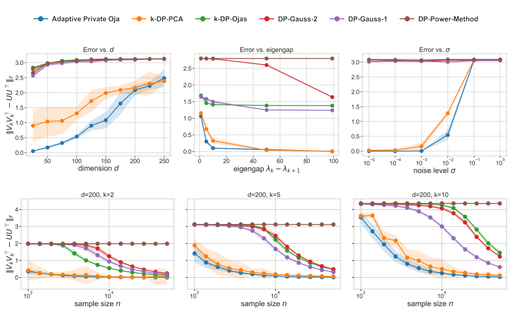
Figure 1 :Comparison ofAdaDPOwith baselines on the spiked covariance model. We plot the mean over 10 trials, with shaded regions representing 95% confidence intervals. We setε = 1, δ = 0.01. For the top row figures we set k= 5.
Original paper · CC BY 4.0 · Johanna Düngler, Amartya Sanyal · Optimal Rates for Adaptive Private $k$-PCA · Original paper figure · Extracted the figure area from page 8 of the original PDF.Where deflation-based private PCA gets stuck
Private PCA has mostly been studied on fixed datasets, where methods rely on deterministic norm bounds. When these methods are applied to stochastic PCA, the bounds must be enforced through clipping. The known optimal rate is of order sqrt(dk/n) + dk/(εn), so the gap sits in the d and k dependence of the privacy term.
Liu et al. [2022] gave the first adaptive private method for stochastic PCA, restricted to k = 1. Their key idea was to estimate the fluctuation scale privately and clip around a private center instead of zero. Because the noise scales with the randomness in the data, the privacy cost follows what the data actually show. Düngler and Sanyal [2025] extended this adaptive principle to k > 1, but their method is deflation-based.
Each eigenvector also needs its own parameter tuning, which makes the method harder to tune and less suited to block linear-algebra implementations.
Cai et al. [2024] reach optimal rates for Gaussian data under a flat-tail condition on Σ, namely λ_{k+1} = ... = λ_d. Because Σ is unknown, that condition cannot be privately certified from the input in general. So their privacy guarantee rests on an unverified distributional assumption about the data-generating process. Our method, AdaDPO, avoids deflation by estimating the target k-dimensional subspace jointly.
It uses one scale parameter and one clipping center for all k columns, instead of k separate range estimators.
Keeping the block update joint
AdaDPO is a private variant of Oja's algorithm that updates the full d×k basis in one step. The non-private template is Q_t = QR(Q_{t-1} + η_t A_t Q_{t-1}), which updates a k-dimensional subspace from a matrix product. Deflation-based methods such as k-DP-PCA reduce k-PCA to k private one-dimensional problems, whereas AdaDPO estimates the target subspace jointly.
Its privacy mechanism uses one scale parameter and one clipping center for all k columns, instead of k separate range estimators.
The obstacle is symmetry: the Oja theorem assumes symmetric matrices, and adding noise directly in d×k space breaks that property. The authors estimate the range and add Gaussian noise at the scale of A_t Q_{t-1}, because clipping the full A_t would be much more conservative. The resulting noise is generally not of the form G_t Q_{t-1} for a symmetric G_t, so the effective matrices are no longer symmetric.
Deflation avoids this obstruction, but it needs fresh batches of data for each direction, which costs a factor in k. The fix is to note that for fixed Q, any symmetric matrix acting on Q lies in the linear space S_Q, where Q^T Y is symmetric. Placing the privacy noise inside S_Q restores a symmetric representation, since every element of S_Q can be written as G_Q Q.
The privacy guarantee of AdaDPO does not depend on the data distribution. The global Assumption A is used only for the utility analysis, not for privacy. The experiments on spiked covariance data compare AdaDPO with k-DP-PCA, k-DP-Ojas, DP-Gauss and the noisy power method, which are all adapted by clipping. The authors note that the noisy power method was analyzed under single-entry changes, which is why its adjacency condition needs extra work.
Why the tangent component matters
The component of the update that moves the subspace is the tangent part, ΠQ A Q, once the iterate is already close to the target. The part of the update lying inside span(Q) only changes the coordinates of the basis Q, not the subspace it spans. These factors are larger than the single factor sqrt(λ1λ_{k+1})/(λk − λ_{k+1}) available in the flat-tail Gaussian family.
The second phase runs on fresh samples with projected updates Y_i = Π_{t-1} A_i Q_{t-1}, which removes the component that only rotates the basis. Within each step, PrivRange estimates the range, a truncated mean is formed, Gaussian noise is added and the basis is orthonormalized. Algorithm 3 sets the privacy noise multiplier from the truncation threshold r_t, the batch size B and the privacy budget.
The authors measure the tangent fluctuation with v_Q, the variance of Z_Q(A) = Π_Q(A − Σ)Q, and with the one-column scale g_Q. For Gaussian covariance data, the fourth-moment identity bounds v_Q and g_Q in a local basin around V_k V_k^T. In the flat-tail spiked model, tr_{>k}(Σ) = (d−k)λ_{k+1}, so v_Q ≈ sqrt(dλ1λ_{k+1}) and g_Q ≈ sqrt(λ1λ_{k+1}).
Substituting these scales gives the spectral factor sqrt(λ1λ_{k+1})/(λk − λ_{k+1}), rather than λ1/(λk − λ_{k+1}). The authors state that this matches the flat-tail spiked-covariance lower bound up to logarithmic factors when the linear Bernstein term is lower order and K = O(1).
The tangent update keeps the signal-noise interaction that moves the subspace and drops the fluctuations inside the signal subspace. In Figure 2, the warm-started TAdaDPO run reaches lower error than continuing with AdaDPO alone.
What the simulations show
The authors simulate a spiked covariance model with d = 200 and k in {2, 5, 10}, using ε = 1 and δ = 0.01. Each curve is a mean over 10 trials, and the shaded regions are 95% confidence intervals. The baselines are k-DP-PCA, k-DP-Ojas, the DP-Gauss adaptations, and the noisy power method, all adapted by clipping. Clipping is needed because these deterministic methods were designed for bounded data, not for independent matrices Ai with no norm bound.
AdaDPO attains lower subspace error than the deflation methods, the DP-Gauss adaptations and the noisy power method. The plots show that AdaDPO consistently attains lower subspace error across the varied ambient dimension, eigengap and noise level. When the sample size varies in Figure 1b, the gap persists across ranks and dimensions. The authors read this as the benefit of the predicted block k-dependence of AdaDPO.
The two-stage run warm-starts with AdaDPO and then runs TAdaDPO on fresh samples. Once the warm start is accurate enough, this run reaches lower error than AdaDPO alone. This comparison appears only in Figure 2 and its caption, and the excerpt gives no numeric values for it. So the simulations support the joint-update and tangent-refinement claims only in a qualitative sense.
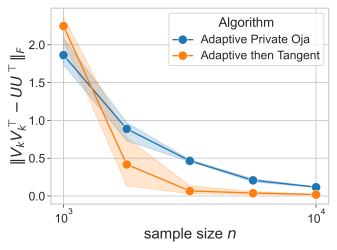
Figure 2 :Comparison of AdaDPO with a two-stage variant that warm-starts withAdaDPO and then runs TAdaDPO.
Original paper · CC BY 4.0Limitations and what remains untested
AdaDPO's utility analysis rests on Assumption A, which asks for independent symmetric matrices with bounded fluctuations and a Gaussian-like tail on bilinear forms. The privacy guarantees, by contrast, don't depend on that model, because the authors emphasize they are distribution-free. Assumption A is used only for utility, so the privacy claim stands even if the distributional model fails.
The sharper TAdaDPO bound depends on the local Assumption B, which applies only after the warm-up phase has reached a neighborhood of the target subspace. That neighborhood is set by the condition that the subspace error stays within the constant c0 of the true top-k eigenspace. Assumption B also requires the tail scale gQ to satisfy a bound with constants g0 and g1, as well as the bounded projected fluctuation M⊥.
The Theorem 3 guarantee needs the starting point Q0 to satisfy the c0/2 error bound with probability at least 1 − ζ/8.
The main open point concerns the flat-tail condition λk+1 = · · · = λd, which Cai et al. [2024] needed for their optimal rates. The authors say that Assumption B can be verified directly in structured settings such as the flat-tail spiked covariance model. Their experiments cover only simulated spiked covariance data, with ε = 1 and δ = 0.01.
They didn't test real datasets or other privacy levels in the reported experiments.
Paper info
- Authors
- Johanna Düngler, Amartya Sanyal
- Venue
- arXiv · Preprint
- First published
- 2026-11-9
- Added
- 2026-11-10
- Updated
- 2026-11-9
- Version
- v1
- arXiv
- 2611.12419
- Category
- cs.LG · stat.ML
- Original paper terms
- CC BY 4.0
- What we show
- Paper info, commentary and permitted figures from the original paper
AI commentary is a separate explanation from the original paper and may contain errors. The original paper and figures follow each source's terms of use and any rights noted separately.
Abstract
Given $n$ i.i.d. random matrices $A_i \in \mathbb{R}^{d \times d}$ with common expectation $Σ$, the goal of \emph{Differentially Private Stochastic PCA} is to identify a $k$-dimensional subspace capturing the leading variance directions of $Σ$, while preserving differential privacy~(DP) for each individual sample $A_i$. \citet{dungler2025iterative} introduced \kdppca, the first algorithm to simultaneously (1) achieve sample complexity $n=\widetilde O(d)$ for sub-Gaussian data, (2) adapt its privacy noise to the intrinsic randomness of the data, and (3) extend seamlessly to any target dimension $k\le d$. However, its sample complexity has a suboptimal dependence on $k$. We propose the first algorithm that achieves optimal sample complexity in both $d$ and $k$, while retaining properties (2) and (3) of \kdppca. Additionally, prior utility guarantees require a minimum sample size with exponential dependence on the eigengap. Our method removes this dependence. It also improves the dependence on spectral parameters, matching known lower bounds for the spiked covariance model. Unlike deflation-based approaches like \kdppca, our algorithm updates the full $d\times k$ subspace jointly rather than one eigenvector at a time. This non-deflation structure simplifies the algorithm, reduces the number of hyper-parameters, and improves computational efficiency, particularly when using block linear algebra libraries.
Quote from the paper
Johanna Düngler, Amartya Sanyal (2026). Optimal Rates for Adaptive Private $k$-PCA. arXiv:2611.12419v1. https://arxiv.org/abs/2611.12419v1
BibTeX
@misc{dngler2026optimal,
  title = {{Optimal Rates for Adaptive Private $k$-PCA}},
  author = {Johanna Düngler and Amartya Sanyal},
  year = {2026},
  eprint = {2611.12419},
  archivePrefix = {arXiv},
  url = {https://arxiv.org/abs/2611.12419v1}
}