Paper commentary
On the limitations of molecular representations
Molecular fingerprints give identical vectors to many structurally distinct molecules
- Problem Fixed-length fingerprints are short and discrete, so structurally distinct molecules can get identical representations. The literature had not measured how often this happens across fingerprint types in a real virtual-screening library.
- Method The authors hash fingerprints of 10.3 billion Enamine REAL molecules into 1,024 files, then sort each file and count identical runs.
- Results FCFP4 was the most degenerate fingerprint, with 40.5% of achiral molecules sharing a fingerprint with another molecule. ECFP4 was least degenerate at 13.2%.
Why fingerprints collide at library scale
Fingerprints squeeze a molecule into a fixed-length bit vector by encoding its substructures as integers and hashing them into indexes. Because the vector is short and discrete, structurally distinct molecules can map to identical representations, a property the authors call degeneracy. The authors treat this collision as the central failure they study, and they quantify it across the full Enamine REAL space.
Active learning and deep docking studies compute billions of fingerprints, so a collision rate that looks small per molecule can still affect very many molecules. The authors therefore set out to examine fingerprint degeneracy across fingerprint types in a real virtual-screening library, which the earlier literature had not done systematically.
The stakes rise when fingerprints feed clustering, because clustering assigns structurally related molecules to groups before dataset splitting. Butina clustering can break up close analogues across clusters, so a train and test split built on those clusters leaks structure from train into test. The authors used ECFP4 for this clustering test because it is the field default for clustering applications.
Counting collisions across 10.3 billion molecules
The authors started from the Q4 2025 Enamine REAL database of 10.8 billion molecules, and 10.3 billion molecules remained after pre-processing. They stripped all CXSMILES annotations and deduplicated the SMILES strings within each file, which removed approximately 532 million molecules. Enhanced stereochemistry was the reason for this step, because RDKit fingerprinting methods can't use it.
Without this step, repeated SMILES strings would trivially inflate the degeneracy rate. Each molecule was fingerprinted twice, once with the chirality flag on and once with it off.
All fingerprints were generated with RDKit at a hashed length of 1024 bits, with radius 2 for ECFP and FCFP. Atom pair and topological torsion fingerprints used default parameters. Instead of comparing pairs, the authors hashed every fingerprint into one of 1,024 possible files. The hash function was chosen to distribute fingerprints approximately uniformly, so each file held roughly 10M fingerprints.
Because the hash is deterministic, all copies of an identical fingerprint are guaranteed to land in the same file. This placement means that a degenerate group never has to be compared across files. Each file was then sorted, adjacent runs of identical fingerprints were counted, and these counts were summed across files. The result is the total degeneracy rate for each fingerprint type.
With this procedure, FCFP4 had the highest degeneracy rate, with 40.5% of achiral and 32.7% of chiral molecules degenerate.
How often collisions happen and what causes them
FCFP4 was the most degenerate fingerprint on the Enamine REAL space, with 40.5% of achiral molecules and 32.7% of chiral molecules degenerate. Topological torsion followed with 15.4% achiral and 4.3% chiral, then atom pair with 12.3% achiral and 5.6% chiral. ECFP4 was the least degenerate, at 13.2% achiral and 2.2% chiral, so enabling the chirality flag lowered the rate for every fingerprint.
Even the lowest rate, 2.2% for chiral ECFP4, means 225 million molecules have at least one structurally distinct partner with an identical fingerprint. Degenerate groups mix two kinds of collision: stereoisomers that neither setting can separate, and structurally distinct molecules.
Group sizes shrink as they become more common, so large groups are rare but exist. The maximum group size for FCFP4 is 3,974 for achiral molecules and 2,196 for chiral molecules. Enamine REAL screens with ECFPs and FCFPs often ran with chirality disabled, and one study screened 37 billion molecules with achiral FCFPs.
The failure modes are ordinary medicinal chemistry edits, such as carbon chain elongation, ring expansion and substituent relocation. Some collisions hit ECFP4, atom pair and topological torsion together, so simply ensembling fingerprints doesn't remove the problem. The authors built constructions that apply these edits to arbitrary molecules, which shows fingerprints ignore changes that medicinal chemists routinely make.
The collisions also hide activity differences that matter for drug design. In the ChEMBL examples, simple linker-length changes gave a 180-fold change in potency. Across approximately 40,000 ECFP4-degenerate groups measured in one assay, about half differed by at least two-fold. More than 5,000 of those groups displayed greater than a ten-fold change.
Graph distance as a fingerprint-free yardstick
Grading fingerprints with fingerprints would be circular, so the authors needed a reference that doesn't depend on any fingerprint. They used the weighted maximum common edge subgraph distance, dMCESw, which counts the bond weight removed from both molecules to reach a shared subgraph. Single bonds weigh 1, aromatic bonds 1.5, double bonds 2 and triple bonds 3.
The authors argue that raw dMCESw ignores molecular size, since a few bond edits matter less when the molecules share many bonds. They divide by the sum of both molecules' bond weights, which bounds the result between 0 and 1. The normalized distance is dMCESwnorm(G1,G2) = dMCESw(G1,G2) divided by the sum of b1(e) over E1 plus the sum of b2(e) over E2.
Normalizing this way gives the metric a worst case of deleting all bonds, so the value reads as a fraction of the total bond weight.
The distances come from Kretschmer et al, who computed exact values only below a cutoff of 10. Pairs with distances of 10 or more are only lower bounds, so the authors kept only exact values. Only pairs with exact values below 10 entered the correlation analysis, drawn from 63,437 molecules. The authors then correlated dMCESwnorm with Tanimoto and cosine similarities, where atom pair fingerprints reached -0.82 and MolE cosine reached 0.1.
Which representations track graph distance
Fingerprints and learned embeddings were ranked against the normalized weighted MCES distance, dMCESwnorm, using Spearman rank correlation. Atom pair fingerprints were strongest, with a Spearman correlation of -0.82 against dMCESwnorm. Topological torsion fingerprints came next at -0.73, and ECFP4 followed at -0.63, so the fingerprints track graph topology in that order.
Since similarity should fall as distance grows, a more negative correlation means the representation agrees better with the graph yardstick. The representations compared in this experiment are listed in Table 1, which covers the nine embedding models and four fingerprints.
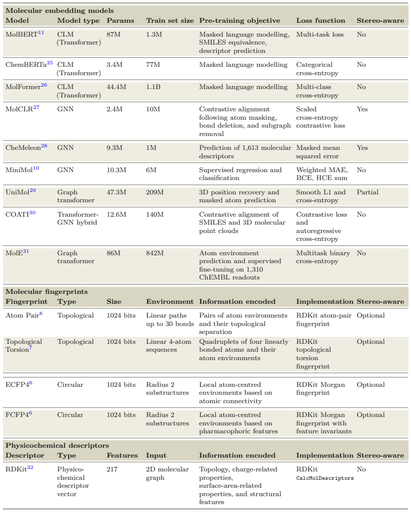
Table 1 | Molecular representations used in this study
Original paper · CC BY 4.0 · Acer Blake, Fergus Imrie, Charlotte M. Deane · On the limitations of molecular representations · Original paper figure · Extracted the figure area from page 3 of the original PDF.Among the learned models, MolFormer came closest to graph topology, at -0.72. Five of the nine learned representations reached correlations greater than -0.5, which the authors read as weak alignment with global graph topology. MolE cosine similarity reached a Spearman correlation of 0.1, so it was effectively uncorrelated with dMCESwnorm.
Marginal plots also show that fingerprint and learned-embedding similarity distributions differ in shape.
Pair-level examples show what these correlations mean in practice. CheMeleon gave a cosine similarity of 0.994 to a pair with dMCESw of at least 51. The same model gave only 0.494 to a near-identical pair with distance 4. The authors read this as evidence that learned models don't capture graph shape robustly.
How ECFP4 clustering leaks structure
Butina clustering greedily builds clusters around the molecule with the most unassigned neighbours under a distance threshold. The authors applied this to ECFP4 Tanimoto similarities, since that pairing is a widespread practice for clustering. They clustered about 20 thousand molecules from the MCES dataset across Tanimoto thresholds from 0.4 to 0.8.
The MCES dataset is chemically diverse, so the test covers a broad range of molecules.
At 0.4, the authors used the threshold as their example because it is a common cutoff for molecular novelty and for Butina clustering. The resulting network had 2,298 clusters and 614 edges, so structurally similar pairs sat in different clusters. An edge joins two clusters when a cross-cluster pair has dMCESwnorm of at most 0.05 and dMCESw below 10.
Each node is a non-singleton cluster, and a perfect clustering would show a disconnected network with no edges.
Tanimoto similarity can't reveal these pairs on its own, because ECFP4 correlates only moderately with global graph structure. One clearly similar pair has a Tanimoto similarity of 0.276, well below the 0.4 threshold. Such structure-similar pairs also have similar physicochemical properties, with modest average differences in weight, logP, TPSA, and hydrogen bond donors and acceptors.
Lower thresholds cut the number of cross-cluster pairs, but they inflate cluster sizes and heterogeneity. The authors link this to known cluster quality limits of the Butina algorithm, which partly explain why Butina splits overestimate virtual screening performance. They expect UMAP, DataSAIL, BitBIRCH and Lo-Hi splits, which also cluster fingerprints, to fail in the same way.
Shape and ADMET similarity
For shape, the authors sampled 30,000 molecules from ZINC and built pairwise similarity matrices for 12 molecular representations. They selected up to 100 pairs from each of 10 equal-width similarity bins, giving a maximum of 1,000 pairs per representation. Each molecule was given up to 10 RDKit conformers, and each pair was scored by its maximum shape and colour similarity across conformer combinations.
The authors computed Spearman correlations between each representation's similarities and these shape and colour scores, excluding pairs without valid scores.
Apart from COATI on shape score, fingerprints correlated more strongly with shape and colour than every embedding. COATI reached a Spearman correlation of 0.80 with shape score, while atom pair fingerprints reached 0.79. That gap is small, and COATI's colour correlation was weaker than that of all fingerprints. COATI's contrastive objective aligns SMILES strings with 3D point clouds, yet this didn't translate into a clear advantage on shape.
Most of the correlation comes from broad trends, where shape and colour scores rise across wide similarity ranges. Within narrow similarity bands, none of the representations correlated strongly with shape or colour. So current representations are unlikely to rank close analogues by 3D similarity, as recent work also suggests.
For ADMET similarity, the authors used the Biogen dataset, where all assays were run within the same lab. They dropped MiniMol and MolE because those models were trained on structures similar to the Biogen molecules. That left 11 representations, including the RDKit physicochemical descriptor vector (PDV) with 217 features. Each representation was judged by the median endpoint difference between molecules in its top closest pairs.
All representations showed a decrease in endpoint difference as the number of closest pairs decreased.
For all four endpoints, the PDV gave the lowest endpoint difference for the top 1,000 pairs. Learned embeddings were therefore no better than standard descriptors at placing similar endpoints close together. Jaccard similarity matrices also showed low agreement between representations on the most similar molecules. The authors measured property landscape roughness with ROGI-XD and ran 5-fold cross-validation without hyperparameter tuning.
The PDV gave the smoothest landscape for 3 of 4 endpoints, and this tracked with lower median RMSE across models on those endpoints.
Limitations of the findings
The leakage result has a clear boundary, because ECFP4 Tanimoto similarity correlates only moderately with global graph structure. That moderate correlation means Tanimoto similarity can't diagnose the split-leakage problem itself. For example, one pair in Fig.5n has a similarity of 0.276, yet it is clearly highly structurally similar. The Butina results also depend on the threshold, since lower thresholds reduce the number of close pairs but greatly increase cluster sizes and heterogeneity.
The degeneracy estimates have a scope limit, because count-based fingerprints were not tested in this study. The authors cite prior work showing that degeneracy rates would be lower with count-based fingerprints. That same work shows that degenerate representations can still be built for count-based fingerprints by combinatorial enumeration.
The graph analysis keeps only exact MCES values below 10, so pairs at or above 10 are lower bounds only.
The ChEMBL degeneracy analysis didn't de-duplicate degenerate groups, so the counts can include several assays on the same molecules. Clustering used only 19,994 molecules, because atom-type filtering and the 900 Da cutoff narrowed the MCES set. The authors note that dMCESw doesn't account for molecular size, which is why they normalized it to dMCESwnorm.
Normalization bounds the distance between 0 and 1, so the normalized metric is a design choice rather than a neutral measure.
Paper info
- Authors
- Acer Blake, Fergus Imrie, Charlotte M. Deane
- Venue
- arXiv · Preprint
- First published
- 2026-11-5
- Added
- 2026-11-7
- Updated
- 2026-11-5
- Version
- v1
- arXiv
- 2611.08420
- Category
- cs.LG
- Original paper terms
- CC BY 4.0
- What we show
- Paper info, commentary and permitted figures from the original paper
AI commentary is a separate explanation from the original paper and may contain errors. The original paper and figures follow each source's terms of use and any rights noted separately.
Abstract
Molecular representations such as fingerprints and learned embeddings play a central role in cheminformatics and small-molecule machine learning. They serve as the primary input for a diverse array of tasks, including clustering, dataset splitting, and virtual screening, yet their evaluation is often limited to downstream model performance on narrow benchmark tasks. We carried out a systematic investigation of the quality of molecular representations, finding that none of the state-of-the-art molecular embedding models capture graph structure, 3D shape, or ADMET endpoint similarity better than fingerprints or physicochemical descriptors. However, classical fingerprints also revealed their own material limitations. For example, we show that depending on the representation, between 225M and $\sim$4B molecules have non-unique representations in the 10.8B Enamine REAL database, with implications for virtual screening. Our findings provide an insight into the current limitations of molecular representations, outlining future research directions for the development of more robust encodings of small molecules.
Quote from the paper
Acer Blake, Fergus Imrie, Charlotte M. Deane (2026). On the limitations of molecular representations. arXiv:2611.08420v1. https://arxiv.org/abs/2611.08420v1
BibTeX
@misc{blake2026limitations,
  title = {{On the limitations of molecular representations}},
  author = {Acer Blake and Fergus Imrie and Charlotte M. Deane},
  year = {2026},
  eprint = {2611.08420},
  archivePrefix = {arXiv},
  url = {https://arxiv.org/abs/2611.08420v1}
}