Paper commentary
Surrogate-Assisted Compact-Model Extraction for SKY130 CMOS at 77 K
- Problem Cryogenic circuit design needs BSIM4 cards that match measured 77 K curves, but each fitting trial costs a simulator run and several parameter vectors can give nearly the same curves.
- Method A geometry-conditioned neural forward surrogate of NGSpice is trained on a Latin-hypercube simulator bank, then used inside a bounded trust-region least-squares search. NGSpice re-simulates the leading candidates, and the lowest-RRMS card is selected.
- Results Mean device RRMS falls from 0.275 for re-simulated released cards to 0.228 with seven parameters (17% lower) and to 0.204 with 43 parameters (26% lower), in-sample on 18 geometries.
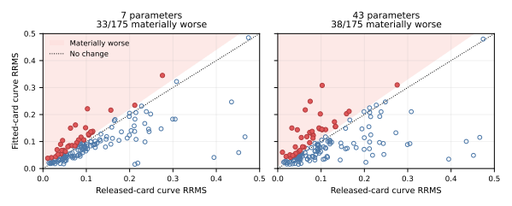
Figure 4 : Per-curve RRMS, released card vs. fitted card. Each panel shows the 156 of 175 scored curves with released and fitted RRMS at most 0.5; the counts in the panel titles include all 175. Red markers and shading mark curves whose fitted RRMS exceeds the released-card RRMS by more than 0.01 and by more than 10%. The flag uses a fixed threshold; no significance test is applied. One flagged seven-parameter curve lies outside the plotted range; all 38 flagged 43-parameter curves are shown.
Original paper · CC BY 4.0 · Aaron Wang, Olivia Gzamouranis, Vaibhav Lohia, Hershel Fei Xun Weiner, Olivia Seidel, Richard Cavanaugh, Giuseppe Di Guglielmo, Nhan Tran, Davide Braga · Surrogate-Assisted Compact-Model Extraction for SKY130 CMOS at 77 K · Original paper figure · Extracted the figure area from page 4 of the original PDF.Why released 77 K cards need refitting
A BSIM4 card expresses drain current through equations in the simulator, so changing parameter values alone leaves the simulator interface intact.
The starting point is a set of 77 K SKY130 cards released by Beall et al., which were produced by a staged extraction of seven temperature-sensitive multipliers and give 18 BSIM4 models for the measured geometries. The study refines those cards in two search spaces, one with the same seven parameters and one with 43 parameters chosen by NGSpice sensitivity.
The measured set holds 198 curves, five output and six transfer characteristics for each of the 18 devices. A fixed inclusion rule removes 23 near-off output curves, which leaves 175 curves for scoring.
How the surrogate-assisted search runs
The forward surrogate approximates the map from a BSIM4 parameter vector and device geometry to simulated currents. Its job is to score nearby candidates cheaply during local refinement. Every reported current still comes from NGSpice, because the surrogate only proposes endpoints that are then re-simulated.
Each parameter set uses one geometry-conditioned multilayer perceptron. Its inputs are the parameter vector, polarity, length and width, and its outputs are all output and transfer currents at once, so a candidate is compared across every operating region in one evaluation.
Several low-error bank samples start bounded trust-region least squares, and the starts are separated in parameter space so the result does not hinge on one basin. Jacobians come from two-point finite differences of the frozen surrogate, so the search moves between sampled cards without NGSpice derivatives or a simulator call per perturbation.
Afterwards, for each device, the leading refined endpoints, their bank starts and the released anchor are re-simulated in NGSpice. The candidate with the lowest RRMS under the same scorer as the baseline is selected.
What the seven and 43 parameter spaces contain
The expanded search starts from 115 candidate continuous BSIM4 DC-current parameters. Each one is perturbed in NGSpice, and those whose normalized response passes a fixed threshold are kept. The screening yields a common layout of 43 parameters, and each device has 38 to 40 non-degenerate dimensions within that layout.
Where the mean RRMS drops
The released cards, re-simulated with NGSpice, have a mean device RRMS of 0.275. The seven-parameter cards reach 0.228, a 17% reduction, and the 43-parameter cards reach 0.204, a 26% reduction.
On the high-bias subset the ranking flips: the seven-parameter cards average 0.074 and the 43-parameter cards 0.076.
Most of the gain is already present in the simulator bank. The best stored-bank means are 0.2297 for seven parameters and 0.2068 for 43 parameters, against final means of 0.2284 and 0.2038. Surrogate-guided refinement lowers the mean RRMS by a further 0.0012 with seven parameters and 0.0030 with 43 parameters, beyond the best bank card.
Surrogate error at the selected cards
At the selected cards, the mean absolute difference between surrogate-predicted and NGSpice-computed device RRMS is 0.0030 for the 43-parameter surrogate and 0.00035 for the seven-parameter surrogate. The 43-parameter surrogate is therefore the less accurate of the two, yet its confirmed cards have the lower extraction error.
A low-VDS mismatch in one output sweep
All three cards predict more current than measured below VDS of about 0.5 V. The fitted cards therefore improve saturation but leave the low-VDS mismatch largely in place.
Curves that get worse
Figure 4 plots released-card against fitted-card RRMS for each curve and marks the flagged curves in red, so the regressions can be read off curve by curve.
The overlays for all 198 measured curves, including the excluded ones, are given in the appendix, which shows the local changes behind these counts.
Limitations
No geometry is held out. The same 18 geometries serve for sensitivity screening, surrogate training and the reported scores, so the results describe in-sample extraction only. Prediction for other channel dimensions or temperatures was not tested.
The fitted parameter values are non-unique results of a fit to current agreement, so they are not direct measurements of device physics. Because every curve has equal weight, a circuit that works over a narrower bias range may prefer a different card, and this weighting can change which card ranks first.
Paper info
- Authors
- Aaron Wang, Olivia Gzamouranis, Vaibhav Lohia, Hershel Fei Xun Weiner, Olivia Seidel, Richard Cavanaugh, Giuseppe Di Guglielmo, Nhan Tran, Davide Braga
- Venue
- arXiv · Preprint
- First published
- 2026-11-16
- Added
- 2026-11-18
- Updated
- 2026-11-16
- Version
- v1
- arXiv
- 2611.21594
- Category
- physics.ins-det · cs.ET · cs.LG · physics.app-ph
- Original paper terms
- CC BY 4.0
- What we show
- Paper info, commentary and permitted figures from the original paper
AI commentary is a separate explanation from the original paper and may contain errors. The original paper and figures follow each source's terms of use and any rights noted separately.
Abstract
Cryogenic circuit design requires compact transistor models that reproduce measured low-temperature behavior and run in standard circuit simulators. We fit BSIM4 parameters to measured I-V curves of SkyWater 130 nm (SKY130) transistors at 77 K using a neural surrogate of NGSpice. The surrogate maps compact-model parameters and device geometry to the complete set of output and transfer characteristics. Extraction is a bounded least-squares search: a bank of NGSpice simulations supplies initial candidates, finite differences of the surrogate supply the local Jacobian, and NGSpice re-simulates the resulting cards before selection. On 18 measured geometries, we compare a search over seven card parameters with a search over 43 parameters selected by NGSpice sensitivity. Relative to NGSpice re-simulations of the previously released cards, the two searches reduce the in-sample mean relative root-mean-square error (RRMS) by 17% and 26%, respectively. The 43-parameter search has the lower overall error, but the seven-parameter search has the lower mean on high-bias curves, and some individual curves have higher error than with the released cards under both searches.
Quote from the paper
Aaron Wang, Olivia Gzamouranis, Vaibhav Lohia, Hershel Fei Xun Weiner, Olivia Seidel, Richard Cavanaugh, Giuseppe Di Guglielmo, Nhan Tran, Davide Braga (2026). Surrogate-Assisted Compact-Model Extraction for SKY130 CMOS at 77 K. arXiv:2611.21594v1. https://arxiv.org/abs/2611.21594v1
BibTeX
@misc{wang2026surrogate,
  title = {{Surrogate-Assisted Compact-Model Extraction for SKY130 CMOS at 77 K}},
  author = {Aaron Wang and Olivia Gzamouranis and Vaibhav Lohia and Hershel Fei Xun Weiner and Olivia Seidel and Richard Cavanaugh and Giuseppe Di Guglielmo and Nhan Tran and Davide Braga},
  year = {2026},
  eprint = {2611.21594},
  archivePrefix = {arXiv},
  url = {https://arxiv.org/abs/2611.21594v1}
}