Paper commentary
Almost Controlled: The FDR of Benjamini-Hochberg on Weighted Conformal p-Values
Benjamini-Hochberg can exceed its false discovery target on weighted conformal p-values
- Problem Benjamini-Hochberg is safe for unweighted conformal p-values, but weights break positive dependence, so it was unknown whether it controls the false discovery rate in finite samples.
- Method The authors certify two counterexamples in exact rational arithmetic, then bound how far the FDR can exceed q.
- Results The FDR exceeds its target, reaching 1.069q at n=20 and 1.136q at n=80 in a tuned global-null construction.
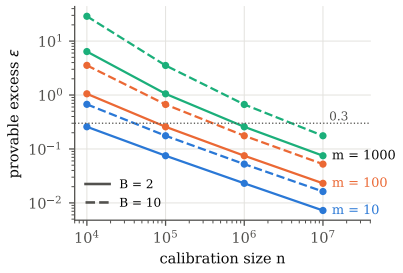
Figure 3 : Provable excessε(Theorem 6, integral formJ) againstn,q= 0.1, form= 10,100,1000and weight ratiosB= 2(solid) andB= 10(dashed). BH at the levelq ′ solvingq ′(1 +ε(q′)) =qcontrols the FDR atq.
Original paper · CC BY 4.0 · Ryan Lim · Almost Controlled: The FDR of Benjamini-Hochberg on Weighted Conformal p-Values · Original paper figure · Extracted the figure area from page 10 of the original PDF.Why plain BH on weighted p-values is an open question
Conformal p-values ask where a test point's score falls among a held-out calibration set, and that comparison is valid in finite samples when the data are exchangeable. Covariate shift breaks exchangeability, because the test units come from a covariate distribution Q that differs from the calibration distribution P. They serve two tasks, selection of test units whose unobserved outcome clears a threshold, and outlier detection of test units that don't come from the calibration distribution.
Either way, the usual tool for controlling the false discovery rate is the Benjamini–Hochberg procedure.
For unweighted conformal p-values, BH is safe, because the p-values are positively dependent. Weights break that argument, since the positive dependence property no longer holds for weighted conformal p-values. They proposed weighted conformalized selection, which has exact finite-sample control, but left open whether plain BH controls the FDR.
Their own experiments found BH empirically controlling the FDR, which made the open question concrete.
Later work has not settled the question, and the cited papers neither prove nor disprove finite-sample control. Lee & Ren show that e-BH on weighted conformal e-values controls the FDR, but they note this is no longer the same as applying BH to weighted conformal p-values. Lee et al. compare with BH on weighted conformal p-values and describe it as not necessarily FDR-controlling.
The paper's setting starts from n calibration points drawn i.i.d. from P and m test units drawn from Q, with weight ratio bounded by B. The weighted conformal p-value of Jin & Candès is written with a tie-breaking uniform variable, and an oracle p-value replaces the threshold by the true score.
Two counterexamples where BH fails
The paper answers the question negatively with two configurations that satisfy Jin & Candès's assumptions and give an FDR above q. One configuration is a global null in which every test unit is null. Both FDR values are certified in exact rational arithmetic, so the comparison with q involves no floating-point error. The certificates rely on the formulas in Appendix F, which the authors say must be trusted to be implemented correctly.
Re-tuned for each n, the same construction gives 1.069q, 1.103q and 1.136q at n=20, 40 and 80. The weight ratio B stays roughly 1.5n to 1.7n across these sizes, so the excess appears at several sample sizes in this family. This is a family of tuned instances, not one lucky configuration, and the paper treats it as a measure of how large the excess can be.
The global-null case uses n=5, m=2 and q=4/5, with FDR/q about 1.00026. Lemma 87 gives FDR minus q as Var b(D) minus Var a(D), where a(D) and b(D) are the conditional probabilities of the very small and moderate p-value bands. So BH exceeds q when the calibration draw moves the moderate p-value probability more than the very small one. A second program, written separately, reproduces the same fraction from the per-cell laws, which supports the certificate.
How large the excess can get
The excess is governed by n, m, q and B, and the paper gives an upper bound that holds at every n when B is at most n. For non-null test units, FDR/q−1 is at most κ + 1.612 times the square root of (1+κ)Bm/(nq), plus O(Bm/(nq)), where κ = B/n. The bound depends only on n, m, q and B, so a practitioner can evaluate it without knowing the distributions.
The order √(Bm/(nq)) is reached when several non-null test units share a common threshold.
The authors build a Poisson-limit model with decoy test units that share a threshold, and there the excess is c(q) times the square root of κm/q to first order. Here c(q) = (1−q)e^(−1−2q)/(2√(2π)), so the excess is set by the number of decoys. At q = 0.1 the limit of C_m over √(m/q) is 0.0541 in the appendix's iterated limit, with a = b = 1.
The coefficient of √(B/n) grows like √m, so configurations with more decoys reach the larger excess.
As m goes to infinity, the constant per unit of qmB/n is at least 12(1−q). Whether the upper bound is also linear in m rests on numerical evidence and a sketch, not on a proof.
Fixes a practitioner can use
The paper turns its upper bound into a practical tool: a lowered BH level with proved finite-sample FDR control. That level depends only on n, m, q and B, so a practitioner can compute it before seeing the outcomes. The authors also give a rule of thumb that is much less conservative than the lowered level. It is about ten times less conservative and covered every worst case the authors found.
It carries no guarantee, so it doesn't replace the lowered level when finite-sample control matters.
The paper also gives a computable envelope for the FDR, which a practitioner can evaluate from the data. Its inputs are covariates, reported p-values and recorded tie-breakers, so it applies in both selection and outlier detection. It bounds an expectation, not the realised FDP, so it isn't a high-probability guarantee.
The excess is not always small in practice, and the outlier example shows it. With a switching outlier block, the FDR reaches 1.110q at q=0.1, m=32 and κ≈0.033. The authors' asymptotic outlier result says nothing at such practical B/n, so it doesn't rule this excess out.
Limits of the evidence
The paper separates what it proves from what it only supports numerically or in a model, and the authors flag that split themselves. The linear-in-m behaviour of the upper bound for the global null is supported by numerical evidence and a sketch, but it isn't proved. The rule of thumb for the BH level covered every worst case the authors found, but it carries no guarantee.
The lowered level has proved finite-sample control, while the rule of thumb is about ten times less conservative.
The outlier-detection asymptotic says nothing at practical B/n, where a switching outlier block does produce an excess in numerical runs. Several lower bounds hold only in a Poisson-limit model, and the authors say so wherever that is the case. Some statements rest on numerical evidence rather than proof, and the Poisson-limit results don't cover a general distribution.
The n^{-1/2} decay of the excess is proved only for some fixed distributions, not for all of them. The authors report the decay of order n^{-1/2} as a feature of certain fixed distributions, so the general rate is left open. The upper bound of order √(Bm/(nq)) is proved for every configuration with B≤n, which is a guarantee rather than an estimate.
Paper info
- Authors
- Ryan Lim
- Venue
- arXiv · Preprint
- First published
- 2026-11-16
- Added
- 2026-11-18
- Updated
- 2026-11-16
- Version
- v1
- arXiv
- 2611.21509
- Category
- stat.ME · cs.LG · math.ST · stat.ML
- Original paper terms
- CC BY 4.0
- What we show
- Paper info, commentary and permitted figures from the original paper
AI commentary is a separate explanation from the original paper and may contain errors. The original paper and figures follow each source's terms of use and any rights noted separately.
Abstract
Weighted conformal p-values generalize conformal inference to cases with covariate shift. One way to use them is to pass them to the Benjamini-Hochberg (BH) procedure, either to decide which test units to select or to detect outliers. But weighted conformal p-values may not be positively dependent, so we want to know: does BH still control the false discovery rate (FDR) in finite samples? Based on experiments, it appears to, but we prove it doesn't. We give two counterexamples, certified in exact rational arithmetic, where the FDR exceeds its target level $q$. We also identify how large the difference between the FDR and $q$ can be. With $n$ calibration points, $m$ test units and weight ratio $B$, the relative excess $\mathrm{FDR}/q-1$ is bounded by a function of $n$, $m$, $B$ and $q$ that is of order $\sqrt{Bm/(nq)}$ when $Bm/(nq)$ is small. The bound holds for every configuration with $B\le n$ and every $n$. This order can be reached when multiple non-null test units share a common threshold: in a Poisson-limit model, that configuration's excess is $c(q)\sqrt{Bm/(nq)}$ to first order as $B/n\to0$ and then $m\to\infty$. For some fixed distributions with this structure, the excess decreases only like $n^{-1/2}$ as $n$ grows. If every test unit is null, the excess is $O(B/n)$ at fixed $m$, and in certain configurations it grows linearly with $m$. To assist practitioners in judging how large the FDR can be, we turn that bound, which depends only on $n$, $m$, $q$ and $B$, into a lowered BH level with proved finite-sample control, and give a much less conservative rule of thumb that covers every worst case we were able to find but provides no guarantee.
Figures from the paper
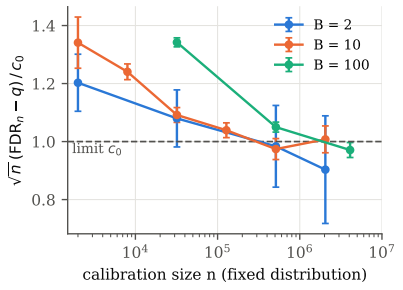
Figure 2 : Theorem 12 at finiten:√n(FDRn−q)divided by the predicted limitc0, for one fixed distribution perB(theparameters ofExample 10). Rao–Blackwellised simulationof thecalibration datawithE[FDP|D] computed exactly; bars are one standard error.
Original paper · CC BY 4.0Quote from the paper
Ryan Lim (2026). Almost Controlled: The FDR of Benjamini-Hochberg on Weighted Conformal p-Values. arXiv:2611.21509v1. https://arxiv.org/abs/2611.21509v1
BibTeX
@misc{lim2026almost,
  title = {{Almost Controlled: The FDR of Benjamini-Hochberg on Weighted Conformal p-Values}},
  author = {Ryan Lim},
  year = {2026},
  eprint = {2611.21509},
  archivePrefix = {arXiv},
  url = {https://arxiv.org/abs/2611.21509v1}
}