Paper commentary
The Answer Is Not the State: Trajectory-Level Corrigibility in Diffusion Language Models
Diffusion language models keep decisions tied to their rationale, not the answer
- Problem Diffusion language models look open to revision, so reopening the answer seems enough for new evidence to change it. But the rationale already written often still rebuilds the old decision.
- Method The authors reopen the written rationale together with the answer, instead of the answer alone. Then the model refills both regions from the current canvas.
- Results On a 150-question multiple-choice holdout, reopening both regions beats answer-only reopening by 49.6 points.
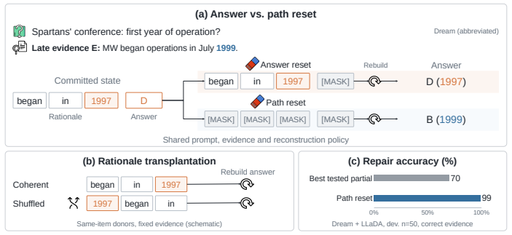
Figure 1 :Visible rationale is causal trajectory state.(a) In a Dream example, answer reset reconstructs the prior decision despite late correct evidence, whereas path reset changes it. (b) A separate same-item transplantation compares coherent donor rationale with a shuffle of the same tokens under fixed recipient evidence. (c) The best tested partial reset remains below the full-path endpoint. Case text is abbreviated and token strips are schematic.
Original paper · CC BY 4.0 · Liao, Junchi, Li, Wentao · The Answer Is Not the State: Trajectory-Level Corrigibility in Diffusion Language Models · Original paper figure · Extracted the figure area from page 2 of the original PDF.Why an open answer is not enough
A diffusion language model, or dLLM, proposes token values on a shared masked canvas, and a commitment policy chooses which positions become visible. That freedom makes an unfinished response look open, so a late retrieval result seems able to change it. Under monotone decoding, though, every committed position stays visible to all later denoising steps.
The authors' timing runs on Dream and LLaDA show that keeping the answer masked does not guarantee later evidence can redirect the decision.
The authors call a trajectory corrigible when the evidence currently present can still control the decision after such commitments have formed. That definition sets up the question the rest of the paper answers: which retained visible content blocks new evidence from redirecting the decision.
The key idea: retained rationale is the state
The core idea is that the committed rationale, not the answer slot alone, carries the decision state that resists new evidence. Here state means the visible rationale tokens on the canvas, not hidden activations. The authors expect these tokens to keep conditioning later predictions after the answer is masked, because they remain on the canvas.
To test this, they compare answer reset, which masks only the decision positions, with path reset, which masks the rationale and decision together on the current canvas. Path reset doesn't restart from the initial canvas, and it leaves the evidence and prompt untouched. Because the prompt, evidence, intervention time and reconstruction rule stay fixed, any difference between the two resets is attributed to the retained rationale.
Figure 1 shows a Dream example where answer reset rebuilds the earlier decision despite correct late evidence, while path reset changes it. On controlled arithmetic, the same pattern appears: at late evidence arrival, path reset raises the accuracy-identity effect by 31 points relative to answer reset.
How the canvas, evidence and resets are set up
The generated positions split into an evidence region E, a free-rationale region R and a decision region D. At each step the model proposes token distributions, and the commitment policy picks a subset of masked endogenous positions to fill. Endogenous commitments, meaning the R and D positions that already hold a token, grow monotonically under the base sampler.
Evidence is kept out of the commitment process: before arrival time τ its slot holds a shared pre-arrival state, and afterward it holds the tokenized evidence. Correct, corrupt and absent evidence share the same slot and arrival event, so evidence identity is the only change. Trajectories that differ only in evidence identity are identical before τ.
A reset scope chooses which positions return to the mask: nothing, the decision alone, or the rationale and decision together. The reset happens at step γ, and within each experiment answer reset and path reset use the same reconstruction rule. The controlled and multiple-choice experiments refill the rationale before the decision, while the free-form experiment selects globally by confidence.
Each trajectory yields a decision accuracy Z and a wrong-target match F, and the correct-specific effect compares the path-over-answer gain under correct evidence with the same gain under absent evidence. The subtraction removes gains from extra regeneration that absent evidence would also produce.
Arrival-time pairs use two arrivals of the same evidence, and path reset erases the difference because both arrivals reach the same post-reset state. Under a shared deterministic decoder, that equality implies identical terminal canvases, whereas answer reset keeps the rationale formed under each arrival.
Open answers don't settle evidence use
The arrival sweep moves evidence arrival across steps 2, 4, 8, 12, 16 and 20 under the base confidence policy. The authors check whether decisions still open at arrival respond to evidence, and whether the answer being open is enough.
In Dream the open-decision fraction falls from 78% to 16% across arrival steps, and the correct-evidence gain shrinks from +36 points to zero. Dream therefore shows an arrival-time curve in which evidence sensitivity fades as commitments accumulate. LLaDA starts mostly closed, with 22% of decisions open at step 2, and it shows no positive correct-evidence curve.
Figure 2 places the two models side by side on open fraction, correct-over-absent gain and corrupt attraction.
Every one of the 395 model-item-arrival units that had already committed before arrival stays invariant across correct, corrupt and absent evidence. So openness is necessary for revision under monotone sampling, but it doesn't tell which commitments block the evidence.
Path reset gives identical decisions and complete rationales in all 300 pairs of early and late arrivals, while answer reset leaves 26.7% early-late decision disagreement.
Path reset hands control to current evidence
On the 150-question multiple-choice holdout, the authors compare no reset, answer reset and path reset in Dream, LLaDA and iLLaDA. Correct evidence comes from the annotated supporting sentences, and corrupt evidence comes from a controlled answer-entity substitution. Matched absent evidence serves as the reference that separates evidence use from extra regeneration.
Subtracting the change under absent evidence, the path-over-answer benefit is +49.6 points, with interval [44.0,54.9]. Because answer reset keeps the rationale and path reset removes it, this gap isolates what the retained rationale does.
Relative to answer reset, the accuracy-identity and following-identity effects are +69.6 and +71.6 points. Figure 3 shows the pooled pattern: after path reset, correct and corrupt evidence move the decision in opposite directions, and absent evidence doesn't improve.
Each checkpoint shows the same split, with a correct-specific effect of +41.3 points in Dream, +51.3 in LLaDA and +56.0 in iLLaDA. The authors read this as path reset producing a larger correct-corrupt separation than answer reset in every checkpoint.
Free-form answers depend on the checkpoint
The free-form holdout removes answer choices and proposed answers, and the model writes a 16-position answer region scored as text. Gold and controlled false targets run 2-8 tokens under all three tokenizers, and the 100-question set is source-disjoint from earlier cohorts.
Path-over-answer correct exact match is +46 points in LLaDA, +63 in iLLaDA and +1 in Dream. The pooled correct-specific effect is +36.7 points, but Dream's interval runs from −3 to 5, so it shows almost no separation. All 3,600 outputs remain in their original cells, so no output moved to another cell.
Correct-evidence exact match is 64%, 57% and 70% for Dream, LLaDA and iLLaDA, compared to 66%, 54% and 67% under path reset. So LLaDA and iLLaDA can use the evidence when they start over, while answer-only reopening stays far lower. Dream shows little separation in either setting.
Donor rationale steers the rebuilt decision
Rationale transplantation keeps the recipient prompt, evidence, intervention time and decoding fixed and swaps only the donor's rationale. The recipient decision is masked before reconstruction.
The comparison set includes a self donor, an opposite-evidence donor, an absent-evidence donor, a shuffled opposite donor and a fully masked rationale. The shuffled donor keeps the same committed positions and token multiset, so it isolates the arrangement of tokens.
After sign alignment toward the donor's answer, the donor-identity contrast is +17.8 points for accuracy and +18.9 points for wrong-proposal following.
Compared with the shuffled-token control, the coherent opposite donor adds +28.3 points of donor-consistent accuracy and +27.7 points of following. The authors read this as donor identity and structured token arrangement both controlling the rebuild within the same item.
Attribution improves ranking, not compact repair
The authors rank committed rationale positions in two directions, and the two scores answer different questions. The decision-masking score asks how removing the decision changes the likelihood of each observed rationale token. The direct leave-one-out score asks how removing one rationale token changes the probability of the current decision label.
Yet neither its fixed-budget sets nor its mass-80 set beats count-matched random subsets.
The two rankings barely overlap, with mean Spearman correlation 0.115 and 30.0% top-quarter overlap. Figure 4 sets these rankings against the partial resets, the random subsets and full path reset.
Under correct evidence, direct top-75 scores 70% and direct mass-80 scores 65%. Both fall short of the 99% that path reset scores, and answer reset alone scores 46%. The same partial resets also carry control to corrupt evidence, raising following from 30% to 75% at top-50 and to 74% at mass-80. So better ranking improves which positions to reopen, but no tested compact set matches full path reset.
Limits of the evidence
At temperature one, Dream and LLaDA keep the evidence-control signature, with pooled effects of +13.8, +17.8 and +20.2 points across five fixed seeds. The effects also persist at reset steps 22, 24, 26 and 28 and under a proportional 64-step schedule. This robustness check covers only Dream and LLaDA, not iLLaDA.
The free-form effect is model-dependent: it is strong in LLaDA and iLLaDA and negligible in Dream. The partial-reset analysis uses a 50-item development set with two models, so its repair results rest on that set. Better ranking does not give a compact repair in the sets the authors tested.
The authors note that reopening trajectory state can transfer control to an untrusted corruption as well as to correct evidence. Any deployed revision mechanism therefore needs an independent evidence-trust and provenance policy.
Paper info
- Authors
- Liao, Junchi, Li, Wentao
- Venue
- arXiv · Preprint
- First published
- 2026-11-23
- Added
- 2026-11-24
- Updated
- 2026-11-23
- Version
- v1
- arXiv
- 2611.29937
- Category
- cs.CL
- Original paper terms
- CC BY 4.0
- What we show
- Paper info, commentary and permitted figures from the original paper
AI commentary is a separate explanation from the original paper and may contain errors. The original paper and figures follow each source's terms of use and any rights noted separately.
Abstract
Diffusion language models generate tokens at many positions on a shared canvas, making unfinished responses appear revisable. We find a counterexample: after the final answer is reopened, previously generated rationale can reconstruct the old decision despite newly available evidence. We isolate this effect by comparing reopening the answer alone with reopening both rationale and answer, and by exchanging rationales between paired trajectories. On a 150-question source-disjoint benchmark, reopening both regions makes decisions follow the evidence currently present--whether correct or deliberately corrupted--across Dream, LLaDA, and iLLaDA. On a new 100-question free-form short-answer evaluation, the same effect remains strong in LLaDA and iLLaDA but is negligible in Dream. Coherent transplanted rationales steer rebuilt decisions, while token-level attribution improves which positions to reopen without producing a compact repair. Corrigibility therefore depends on retained rationale state, not answer openness alone.
Quote from the paper
Liao, Junchi, Li, Wentao (2026). The Answer Is Not the State: Trajectory-Level Corrigibility in Diffusion Language Models. arXiv:2611.29937v1. https://arxiv.org/abs/2611.29937v1
BibTeX
@misc{junchi2026answer,
  title = {{The Answer Is Not the State: Trajectory-Level Corrigibility in Diffusion Language Models}},
  author = {Liao, Junchi and Li, Wentao},
  year = {2026},
  eprint = {2611.29937},
  archivePrefix = {arXiv},
  url = {https://arxiv.org/abs/2611.29937v1}
}