Paper commentary
Higher-Scoring Coding Models Did Not Get More Work Done
- Problem Benchmark score gains are read as evidence that a coding model helps developers get more work done, but it is unclear whether they show up in merged code.
- Method The study treats the 19-day U.S. export-control suspension of Fable 5 as a natural experiment and fits a difference-in-differences model on GitHub pull requests. Five model upgrades serve as a second, observational check.
- Results Access to Fable 5 changed the 7-day merge rate by +1.4 percentage points (95% CI −1.4 to +4.3) in the suspension analysis.
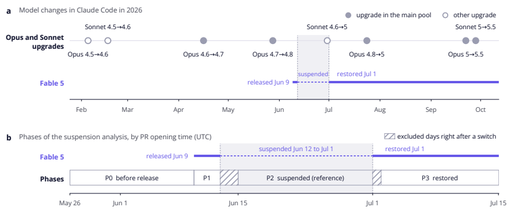
Figure 1 .Study design. (a) Model changes in Claude Code in 2026. Dots mark the eight upgrades within the Opus and Sonnet families, and filled dots are the five upgrades in the main analysis. The purple line shows Fable 5, solid when it could be used and dashed when it was suspended. (b) The suspension in a, enlarged, with the four phases of the suspension analysis by PR creation time (UTC). P2 is the reference phase. In both panels, the grey band marks the suspension, from June 12 to July 1. Hatched days, right after Fable 5 was suspended or restored, are excluded.
Original paper · CC BY 4.0 · Hua, Yining · Higher-Scoring Coding Models Did Not Get More Work Done · Original paper figure · Extracted the figure area from page 3 of the original PDF.Why benchmark gains may not reach finished work
Model companies present benchmark score gains on coding tasks such as SWE-Bench Pro as evidence that a model helps developers get more work done. The tasks behind these scores are usually drawn from issues already fixed in public repositories and judged only by existing tests, while ordinary engineering involves vague requests and code that must match a project's conventions.
A change only counts once a maintainer accepts it, and benchmark tests are not the standard maintainers use for merging. Because no one has shown how well such scores predict real work, an 11-point gain on SWE-Bench Pro does not reveal what it means for finished output.
Measuring the productivity effect of a model is hard because developers who adopt a new model may differ from those who do not. Repository mix adds another problem, because most of an agent's pull requests can come from a few repositories whose merge habits differ.
Using a suspension as a natural experiment
An export-control directive removed Fable 5 for 19 days, which pushed its users onto lower-tier models, and some of them returned once access was restored. Figure 1 places the suspension on the 2026 timeline of Claude Code model changes and marks the days excluded around each switch.
Each Fable 5 user's pull requests are sorted by creation time into four phases: P0 before release, P1 while Fable 5 was available, P2 during the suspension and P3 after restoration. P2 is the reference phase, and developers who never used Fable 5 form the control group.
The suspension analysis fits a PR-level linear model in which the outcome is 1 when a PR is merged within 7 days and 0 otherwise. The model is \(Y_{it}=\alpha_i+\gamma_t+\beta_0 P0_{it}+\beta_1 P1_{it}+\beta_3 P3_{it}+\varepsilon_{it}\), where \(Y_{it}\) is the PR that developer i opened on day t. The developer effect \(\alpha_i\) absorbs differences between developers that stay constant over time, and the calendar-day effect \(\gamma_t\) absorbs shocks shared by all developers on the same day.
The main estimate is the reversal contrast \((\beta_1+\beta_3)/2\), which averages the two phases with Fable 5 relative to the suspension, while \(\beta_0\) is a placebo for the period before release.
The upgrade analysis is a separate design that compares each developer with that developer's own earlier PRs across a switch, fitting \(Y_{ip}=\alpha_i+\delta\cdot New_{ip}+\varepsilon_{ip}\) for each upgrade. Developers chose their own models, so this design measures an association rather than the effect of a forced change. Five of the eight 2026 upgrades form the main pool, and their estimates are combined by inverse-variance weighting.
Identifying Claude Code pull requests by model
The pull requests were collected through the GitHub Search API, and Claude Code writes a co-author line naming the model into commits, which identifies the model behind each PR. A PR was kept only if its description names exactly one Claude model, its author is a user account rather than a bot, and it was created inside the study windows.
Collection covered PRs created between November 20, 2025 and October 5, 2026, and the main collection ran on November 2, 2026. The newest PR was four weeks old at collection, so each PR had more than 7 days to be merged. The suspension analysis covers 297 treated developers and 8,908 control developers, while the upgrade analysis covers 1,208 developers and 15,442 PRs.
Secondary outcomes are merges within one hour, closure without merge, comments per PR and reverts within 30 days, and a PR counts as a check failure when at least one check failed or timed out.
Effect of losing and regaining Fable 5
Fable 5 users stopped using the model almost at once: 82.3% of their PRs named Fable 5 during P1, while during the suspension only 0.9% did. During the suspension, 74.6% of their PRs named Opus 4.8, and in P3 26.9% named Fable 5 again. The share of PRs opened in the authors' own repositories stayed between 69% and 72% from P1 to P3.
The reversal contrast for the 7-day merge rate was +1.4 percentage points, with a 95% interval of −1.4 to +4.3. That interval includes zero, so the change is not statistically significant, and its upper bound puts any access effect at no more than +4.3 percentage points. The placebo comparison of P0 with the suspension gave −2.6 percentage points (−6.2 to +1.1).
Figure 2 shows the phase-by-phase coefficients, and most of them have intervals that include zero, the exception being the restored week of July 2 to 8, at +3.6 (+0.2 to +7.1).
Using all PRs with equal weight per developer gave +3.6 percentage points (+0.1 to +7.1), and this was the only setting that reached statistical significance. For PRs that named Fable 5, the change was +2.7 percentage points (−2.6 to +8.0), which is not statistically significant.
Switching to newer models
Pooled over the five upgrades, the 7-day merge rate of developers who switched changed by −0.9 percentage points (95% CI −1.9 to +0.2). Figure 3 lays the SWE-Bench Pro gains beside the merge-rate changes for each upgrade.
Weekly merged PRs changed by +2.4% (−4.9% to +10.2%) for developers who switched, compared with developers who did not, across six upgrades. The change is measured as a difference in log(1 + merged PRs), and the switching group also opened 2.7% more PRs (−6.7% to +13.0%).
Neither change is statistically significant, and check outcomes were estimated only in the upgrade analysis.
What a merge records in this sample
Because the author usually performs the merge, a merge here records that the developer judged the work finished, and it does not certify review of code quality. If differences between models appear mainly when someone else reviews the work, the estimates here would understate them.
Why the benchmark gap may not carry over
The authors hypothesize that the tasks developers give agents already fall within what the older model can do, so the new model's extra ability goes unused. This would also explain why almost all PRs were merged before the upgrades.
Fable 5 led Opus 4.8 by 6.4 points on SWE-bench Verified, and the authors suspect that benchmarks do not represent real work well. SWE-Bench Pro counts a task as solved when the code passes the tests from the original fix, and those tests may be of poor quality and cover only a small part of an engineer's work. On Terminal-Bench 2.1, Fable 5 led by only 1.6 points, and the authors link much of that small gap to fallbacks, in which one in five Fable 5 runs returned to Opus 4.8 after a safety refusal.
Terminal-Bench also selects hard tasks by design, so a higher score there does not say much about everyday work.
A study of Italy's ChatGPT ban found little change in the output of experienced developers, which points in the same direction as these results, though it studied removing ChatGPT rather than switching models.
Limitations
The suspension lasted 19 days, so its analysis has wide intervals, while the five upgrades give narrower intervals that agree with it. The upgrade analysis is observational because developers picked their own models.
The merge rate does not directly measure code quality, and measuring time saved would require a randomized trial, which has its own problems. Multiple comparisons were not adjusted, and the sensitivity analyses are read for size and direction rather than for significance. Check failures were not estimated for the suspension analysis, because it has no comparison group for that outcome.
Paper info
- Authors
- Hua, Yining
- Venue
- arXiv · Preprint
- First published
- 2026-11-17
- Added
- 2026-11-20
- Updated
- 2026-11-17
- Version
- v1
- arXiv
- 2611.23216
- Category
- cs.SE · cs.AI · cs.LG
- Original paper terms
- CC BY 4.0
- What we show
- Paper info, commentary and permitted figures from the original paper
AI commentary is a separate explanation from the original paper and may contain errors. The original paper and figures follow each source's terms of use and any rights noted separately.
Abstract
New coding models advertise themselves on score improvements of coding benchmarks. Yet no study has tested if a model that scores higher on these benchmarks gets more real work done. On June 12, 2026, a U.S. export control directive banned access to Claude Fable 5 for 19 days, which forced users to switch to other models. During this time, most former Fable 5 users switched to Opus 4.8 (11 points lower on SWE-Bench Pro compared to Fable 5). We treat this suspension as a natural experiment, where the people and projects stayed the same and only the model changed, so we could isolate the effect of Fable 5 on user productivity. We tracked GitHub pull requests of 297 Fable 5 users before, during, and after the suspension. We used 8,908 developers who stayed on Opus 4.8 all the time as the control group. We also repeated the comparison across five model upgrades before and after the suspension in 2026 (1,208 developers, 15,442 pull requests). Fitting a difference-in-differences model with developer and date fixed effects, we found that having access to Fable 5 increased the 7-day merge rate of pull requests by only 1.4 percentage points [-1.4; +4.3], which was not statistically significant. Similarly, no significant increases of merge rates were found with the upgrades (weighted mean: -0.9 percentage points [-1.9; +0.2]); all five estimates were negative (95% intervals included 0, did not differ from each other). We also did not observe a significant increase in the number of pull requests merged per week (+2.4% [-4.9%; +10.2%]).
Quote from the paper
Hua, Yining (2026). Higher-Scoring Coding Models Did Not Get More Work Done. arXiv:2611.23216v1. https://arxiv.org/abs/2611.23216v1
BibTeX
@misc{yining2026higher,
  title = {{Higher-Scoring Coding Models Did Not Get More Work Done}},
  author = {Hua, Yining},
  year = {2026},
  eprint = {2611.23216},
  archivePrefix = {arXiv},
  url = {https://arxiv.org/abs/2611.23216v1}
}