Paper commentary
SLICES: A Benchmark and Evaluation Framework for Self-Supervised Learning on Sparse ICU Time Series
SLICES benchmark shows which self-supervised objectives work best on ICU time series
- Problem Published self-supervised learning results for ICU time series are hard to compare, because data processing, encoders and adaptation protocols all vary together between studies. Differences in one result can come from any of these choices.
- Method SLICES fixes the ICU inputs, a Transformer encoder, patient-level splits and evaluation, so only the self-supervised objective changes. It provides reference implementations of masked autoencoding (MAE), JEPA and contrastive learning.
- Results MAE leads mean AUPRC in all nine frozen classification comparisons, including under converged probes. It also leads in seven of nine fine-tuning comparisons, so the ranking depends on the adaptation protocol.
Why ICU SSL comparisons break down
The hard part is the measurement process itself, which complicates the choice of learning signal.
Prior clinical SSL studies use reconstruction, forecasting, contrastive learning, or combined pretext tasks. Their differences are hard to attribute because cohorts, representations, encoders, augmentations, and evaluation also vary between studies. The review's heterogeneity covers features, temporal representation, SSL objectives, and adaptation.
Fine-tuning tests whether a pretrained initialization remains useful after label-driven adaptation. Either protocol alone can hide a ranking that depends on the protocol. So the authors evaluate both protocols on the same encoders, which keeps the comparison paired.
One fixed ICU interface
The authors hold the data, encoder and evaluation fixed, so the SSL objective is the only part that changes. SLICES fixes a 24-hour value–observation-mask input, a Transformer encoder, patient-level splits and four endpoints. Stays come from MIMIC-IV and eICU-CRD, with 74,829 and 132,686 processed stays. Their union, Combined, gives 207,515 stays, and Combined is pooled rather than a separate cohort.
Each stay becomes normalized values and an observation mask, both 24 by 84. The 84 variables are shared across the three regimes, so the input schema doesn't change with the database. Only 10.7% to 15.3% of the tensor cells are observed, so most of each grid is empty.
The mask keeps whether a value was observed, while missing cells are zero filled after normalization. Patients are split 70/15/15 for each seed, and every stay from one patient stays in one partition. Normalization statistics come from the training partition only, so test information stays out of the inputs. Each hour becomes one token, where 84 values and 84 indicators are concatenated and projected from 168 to 64 dimensions.
The same small Transformer, with 159,808 parameters, transfers for every SSL method.
MAE, JEPA and contrastive learning differ only in their masks and auxiliary modules, while the shared encoder stays fixed. MAE reconstructs observed normalized values at masked hours, and missing cells don't enter the loss. Trainable pretraining parameters are 269,460 for MAE, 189,440 for JEPA, and 193,408 for contrastive learning. Three classification endpoints are scored with AUPRC, because prevalence is low and changes by endpoint, from 1.6% to 20.3%.
The fourth endpoint is remaining ICU length of stay, scored by absolute error in days.
Three objectives, one encoder
Each objective asks the same 159,808-parameter encoder to learn from identical hourly tokens, but each through a different signal. MAE masks random non-empty hours, encodes the visible tokens, and passes them to a two-layer Transformer decoder. That decoder reconstructs observed normalized values at the masked hours, so missing cells never enter the loss.
Because the mask keeps missing cells from being read as observed zeros, the reconstruction target stays honest about what was measured.
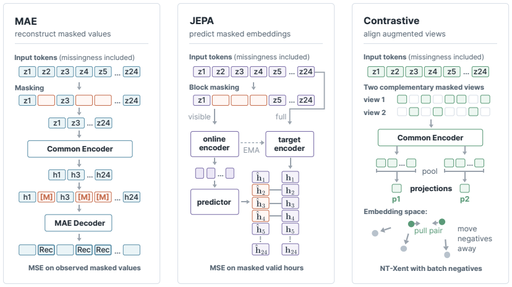
Figure 2 : Core objective geometries. MAE reconstructs observed values at masked hours. JEPA’s online
Original paper · CC BY 4.0 · Hannes Ill, Dimitrios Proios, Leo Anthony Celi, Peter J. Schüffler · SLICES: A Benchmark and Evaluation Framework for Self-Supervised Learning on Sparse ICU Time Series · Original paper figure · Extracted the figure area from page 5 of the original PDF.JEPA takes a different route and predicts embeddings instead of raw values. Its masks cover up to three contiguous blocks, and its online encoder receives only the visible valid hours. The predictor estimates layer-normalized targets from a stop-gradient exponential-moving-average target encoder that sees the full unmasked valid sequence.
The loss applies only to masked valid hours, so the target encoder never receives gradients directly.
Contrastive learning builds two complementary masked views and encodes each one separately. Its loss pulls the projected views of one stay together, which asks for agreement across views rather than rebuilding inputs. Two encoder passes per step give contrastive learning 193,408 trainable pretraining parameters.
The authors keep the objectives separate because reconstruction, latent prediction and view agreement are distinct learning signals. Only the common encoder transfers downstream, so the decoder, predictor and projection head get discarded. MAE has 269,460 trainable pretraining parameters, while JEPA has 189,440 plus a non-trainable 159,808-parameter target copy.
These counts compare complete implementations, so they don't isolate the effect of any single loss function.
Frozen probes, fine-tuning and the converged probe
Every SSL run starts from the encoder saved after the final pretraining epoch, and both protocols begin from that same checkpoint. The final epoch is chosen without looking at labels, so every objective gets the same 100-epoch data-pass rule.
The capped probe stops before convergence, and its LOS training loss doesn't match the reported absolute-error metric. The classification refit uses L2 logistic regression fitted to convergence, while LOS uses a Huber probe that approximates absolute error and a ridge probe. The authors recommend the converged probe for new objectives, but it isn't yet a framework protocol.
Under the refit, the converged probe scored higher than the capped probe in 132 of 135 runs, by .017 AUPRC on average. For the other endpoints the gain was .004–.012 per objective, and 93–96% of those capped probes reached the epoch cap.
Under fine-tuning, the SSL ranking is less uniform, and MAE leads seven cells while trailing contrastive learning on MIMIC-IV 24-hour mortality. Seeds are matched, and each core cell reports five runs with mean and sample standard deviation, without confirmatory significance claims.
Full-label classification results
Fine-tuning gives a less uniform picture: MAE leads seven of nine cells, and many paired differences cross zero. The supervised Transformer has the highest fine-tuned mean on all three AKI cells, so pretraining doesn't dominate every endpoint.
Baselines lead six of the twelve full-label cells, which means a new objective has to beat both the SSL methods and these comparators. Fine-tuned MAE leads hospital mortality in all three regimes, with .531, .495 and .579, compared to at most .527, .484 and .577 for the strongest comparator. That lead is narrow, so it reads as a small advantage rather than a clear win.
Length of stay under loss matching
The capped LOS probes were trained with squared error but selected and evaluated on absolute error, which is a mismatch. Absolute error therefore favors the training-median constant, while a squared-error model estimates the conditional mean. Under this metric the constant is a strong reference point for every objective.
With an absolute-error loss, all three SSL objectives beat the training-median constant in 5/5 seeds per regime, by 7 to 12%. Objective differences are small, so MAE is lowest on eICU-CRD and Combined. On MIMIC-IV the three objectives are within .023 days, and MAE is last in 5/5 seeds there.
The capped-probe ordering, where contrastive learning was lowest and frozen MAE sat above the constant, doesn't survive loss matching. The contrastive heads came from the first few epochs, which the authors offer as the reason for that early ordering. They didn't rerun fine-tuning with an absolute-error loss.
Label efficiency, checkpoints and missingness
Fine-tuned MAE beats the supervised Transformer at every hospital mortality fraction in every regime, so pretraining keeps paying off when labels are scarce. The gap is .033 at 1% labels on Combined, with a paired SD of .012. For MIMIC-IV 24-hour mortality, the differences above 5% labels change sign, and at 5% only 31 to 43 training positives remain per seed.
Reduced-label GRU-D and XGBoost runs aren't compared, so the baselines drop out of this label-efficiency picture.
The same selection also worsens JEPA's LOS by .26 days, while MAE and contrastive learning move by at most .001. Both leaders stay unchanged under this rule, so the final-epoch policy doesn't decide the ranking. Also, a random encoder trails SSL probes in 118 of 120 seed-level comparisons, which the authors report as a post hoc diagnostic.
A linear control on MIMIC-IV hospital mortality reaches .301 AUPRC from masks alone. Adding the values raises the same linear control to .404 AUPRC, so the input carries more than the mask does. The mask gap signals that measurement timing carries outcome information at 11.7% prevalence.
Limits of the evidence
The results don't show how rankings carry over to a new hospital, because no model is tested on a database or hospital it wasn't trained on.
Five matched seeds are few, and they reuse overlapping source populations. The seeds describe split and optimization variation, so the comparisons stay descriptive and don't establish population uncertainty or statistical equivalence. Every downstream SSL run starts from the encoder saved after the final pretraining epoch, which avoids label-dependent checkpoint choice.
Every objective uses one small Transformer, so rankings may change with other encoders or input representations. Observation-triplet, quantized, event-token, or patch representations would also change the masking unit. They didn't test waveforms, notes, images, or full medication histories, which are out of scope.
Paper info
- Authors
- Hannes Ill, Dimitrios Proios, Leo Anthony Celi, Peter J. Schüffler
- Venue
- arXiv · Preprint
- First published
- 2026-11-13
- Added
- 2026-11-17
- Updated
- 2026-11-13
- Version
- v1
- arXiv
- 2611.18868
- Category
- cs.LG
- Original paper terms
- CC BY 4.0
- What we show
- Paper info, commentary and permitted figures from the original paper
AI commentary is a separate explanation from the original paper and may contain errors. The original paper and figures follow each source's terms of use and any rights noted separately.
Abstract
Self-supervised learning (SSL) results for intensive care unit (ICU) time series are hard to compare when data processing, encoders, and adaptation vary together. We present SLICES, a benchmark and evaluation framework for comparing and extending SSL methods under a shared clinical setup. It fixes 24-hour value and observation-mask inputs, a Transformer encoder, patient-level splits, four endpoints, two adaptation protocols, and five matched seeds across MIMIC-IV, eICU-CRD, and their pooled union. Masked autoencoding (MAE), joint-embedding prediction (JEPA), and contrastive learning provide reference implementations. Among these objectives, MAE leads mean AUPRC in all nine frozen classification comparisons, also under converged probes, and in seven of nine fine-tuning comparisons. Fine-tuned MAE leads hospital mortality at full labels and scores higher than a supervised Transformer of the same architecture at every label fraction, and SSL fine-tuning gives the lowest length-of-stay error. Supervised baselines remain strong elsewhere: GRU-D leads 24-hour mortality and XGBoost leads acute kidney injury in all three regimes. Rankings depend on the adaptation protocol, the comparator set, and whether the probe loss matches the metric. A two-seed MIMIC-IV rerun with the maintained code stays within two across-seed SDs of the reference in all 48 downstream runs. The code repository supports new objectives, shared downstream evaluation, and regeneration of the reference results, so new SSL methods can be compared with these references under the same conditions. Generalization to unseen hospitals is not tested here and is the natural next extension.
Quote from the paper
Hannes Ill, Dimitrios Proios, Leo Anthony Celi, Peter J. Schüffler (2026). SLICES: A Benchmark and Evaluation Framework for Self-Supervised Learning on Sparse ICU Time Series. arXiv:2611.18868v1. https://arxiv.org/abs/2611.18868v1
BibTeX
@misc{ill2026slices,
  title = {{SLICES: A Benchmark and Evaluation Framework for Self-Supervised Learning on Sparse ICU Time Series}},
  author = {Hannes Ill and Dimitrios Proios and Leo Anthony Celi and Peter J. Schüffler},
  year = {2026},
  eprint = {2611.18868},
  archivePrefix = {arXiv},
  url = {https://arxiv.org/abs/2611.18868v1}
}