Paper commentary
How to Explain your Unexplainable Video Anomaly Detector
Explain The Unexplainable audits video anomaly detectors by regenerating features under masked semantic graphs
- Problem Saliency maps and VLM captions don't show what a video anomaly detector's score relies on. Captions come from branches the anomaly score never reads, so they can't reveal the real dependence.
- Method ETU regenerates each video's features under masked dependency graphs of agents, actions and outcomes. Unlike saliency maps, it measures how the frozen detector's score changes when the outcome chain is removed.
- Results On UCF-Crime with CLIP features, removing the outcome chain cut frame-AUC by 4.23 to 6.78 points, versus at most 1.13 for random deletion.
Why saliency maps and captions fall short
Weakly-supervised detectors learn from video-level labels alone, and they output a score from high-dimensional encoder features. Saliency maps answer where the model is looking, but on latent features like I3D or CLIP they capture spatial correlation. That spatial view says little about the score's dependence on content, which is the quantity an audit needs.
So the detector may rely on spurious correlations in feature space instead of the actual events.
Vision-language explainers offer captions instead, and their captions come from parallel branches that the anomaly score never reads. Figure 1 shows this gap for Holmes-VAU: a counterfactual prompt changes the caption, but the anomaly scores stay nearly identical. The counterfactual explanation even mentions the person the prompt told it to ignore, yet the score doesn't follow it.
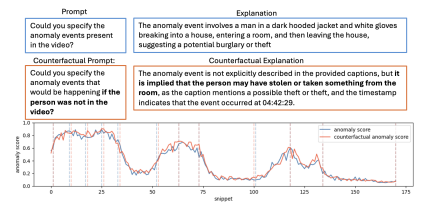
Figure 1 .A VLM explainer’s caption changes under a counter- factual prompt but its score does not.Counterfactual prompting of Holmes-V AU [67] on the “robbery” video provided in the official repository. The anomaly scores obtained with the two prompts are nearly identical, so the score does not follow the explanation the model gives, while the counterfactual explanation mentions the very person the prompt instructed to ignore.
Original paper · CC BY 4.0Neither saliency maps nor captions answer how much a frozen detector's score depends on the semantics a graph names. ETU tries to answer this by intervening directly in the latent feature space of the detector. It maps video features to a dependency graph of agents, actions and outcomes, then regenerates features under masked variants of that graph.
The key idea: regenerate features under masked graphs
A frozen detector scores both the full-graph reconstruction and the masked one, and the score change is the audit's reading. Because every detector receives the same regenerated features, one set of interventions can be compared across independently trained detectors. The graph is built offline by a VLM teacher, Qwen3-VL, which emits Ar →A a →A o chains from each video.
The VLM is used only to build the training graphs, so no VLM runs at test time.
The audit has a failure mode of its own, because a generator trained to make masked reconstructions diverge can create the contrast it measures. ETU keeps the generator on reconstruction alone, so it never learns the contrast it is asked to measure. The authors also test a generator that does carry a divergence objective, to see how its deltas behave.
The GFD generator conditions on the graph latent zgraph and on three deterministic masked variants of it. The variant zrel removes the core anomaly chains, zirr prunes irrelevant background events, and zsem replaces the scene semantics. A near-zero delta means the detector is invariant to that mask, because the delta is invariant to monotone rescaling of the scores.
How GEM builds the graph latent and GFD regenerates features from it
Figure 2 lays out the pipeline: GEM maps video features to a graph latent, GFD regenerates the features from it, and each frozen detector scores the result. The input is per-video features from a frozen I3D or CLIP encoder, and a Qwen3-VL teacher supplies the graph used for training. Each semantic type gets M = 25 node slots, and each slot is quantised against a codebook of N = 32 prototypes.
Video features pass through type-specific cross-attention blocks, and a Gumbel-Softmax estimator selects one prototype per slot, so every node is a discrete choice. Hungarian matching aligns each latent node with a VLM-derived atom through a reconstruction loss on the text embedding, and a codebook loss keeps the prototypes from collapsing.
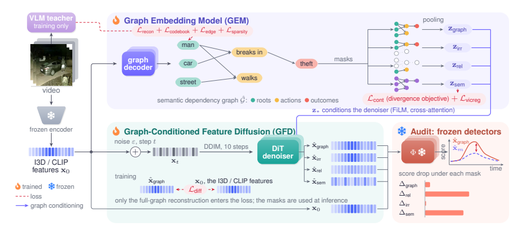
Figure 2 .Explain The Unexplainable (ETU) hands one set of masked reconstructions per video unchanged to every frozen detector. The Graph Embedding Model (GEM) maps continuous video features to a semantic dependency graph and a latent embedding zgraph; deterministic masks yield the counterfactual embeddings zrel,z irr,z sem, on which the Graph-Conditioned Feature Diffusion (GFD) denoises the video features. GFD is trained only to reconstruct the encoder features under the complete graph; the masked embeddings are used at inference. The change in a frozen detector’s score between the full-graph and a masked reconstruction is the audit’s reading of its dependence on the masked semantics. Node labels are illustrative.
Original paper · CC BY 4.0 · D'Amicantonio, Giacomom, Bondarev, Egor · How to Explain your Unexplainable Video Anomaly Detector · Original paper figure · Extracted the figure area from page 4 of the original PDF.Edges are predicted in two steps, with each root attending over the action nodes first. Each action node then receives information from its root parents, and a pairwise MLP scores every action-outcome edge. Online Hard Example Mining keeps all positive edges and the three hardest negatives per positive, so the sparse graph doesn't drown in easy negatives.
A degree hinge with a threshold of 1 prunes redundant correlations, and the positive term of the action-outcome loss is up-weighted by 5. Pooling weights each node by a gate computed from its out-degree, and the pooled vector is concatenated with a structural prior before projection to zgraph.
The graph latent is shaped by a contrastive loss over three counterfactual latents: zirr, zrel and zsem. The irrelevant-mask term pulls zirr onto zgraph, while the semantic and relevant hinges push those latents until their cosine is at most zero. A VICReg term prevents embedding collapse, and it also keeps zirr invariant to the irrelevant mask.
Because the relevant term also pulls zrel onto zgraph on normal videos, the loss uses the video-level label, so a near-zero irrelevant delta is a training result.
GFD is a 4-block Diffusion Transformer that conditions on the graph latent through FiLM and through cross-attention on four latent tokens. Training optimizes a noise-prediction loss and a feature loss on Tweedie's estimate under the full graph only, so the masked latents never enter the loss. At inference, features are diffused forward to t=300 of T=1000 and denoised by 10 deterministic DDIM steps under each latent.
The delta is the change in the detector's benchmark score between the full-graph reconstruction and the masked one, so a positive value means the mask lowered performance.
Whether the response survives the obvious alternatives
The first alternative to rule out is the cost of regeneration itself. On UCF-Crime with CLIP features, regenerating under the complete graph changes frame-AUC by between −0.10 and 0.30 points across the six detectors. Regenerating without any conditioning moves the AUC by at most 0.15, and the authors read this as evidence that the deltas come from the conditioning.
Substituting the scene semantics gives the largest drop for most detectors.
The second alternative is perturbation size, so the authors draw a random set of nodes of the same count for each video. The random deletion changes the detectors between −1.45 and 1.13 points, compared to 4.23 to 6.78 for the outcome chain.
The random draw moves the reconstruction farther than the relevant mask in median cosine, yet it costs the detectors much less. On average the relevant mask costs 5.76 AUC points and the random draw −0.17. The relevant-mask and semantic-mask deltas also grow with the noise level at which regeneration starts, as the authors expect from a conditioning effect.
Which ingredient makes the audit targeted
The count-matched test in Table 3 compares three regimes of the same intervention, and the question is which one holds the divergence objective. The random deletion still displaces the features about as much, so displacement alone doesn't explain the gap. Without the objective in GEM, the two deletions get the same small effect on all six detectors.

Table 3 .The count-matched random deletion under the three regimes.For each test video, a random draw of as many nodes as the relevant mask removes; the cost of the relevant mask, the cost of the random draw and their difference with its 95% confidence interval, in frame-AUC points at t=300 on the UCF-Crime/CLIP test videos. The divergence objective is used in GEM only by ETU, in both GEM and GFD by the divergence-trained generator (against its own full-graph reconstruction), and nowhere by the divergence-free ETU. The differences of ETU, positive on all six detectors with intervals that exclude zero, are in bold.
Original paper · CC BY 4.0Adding the divergence objective to the generator changes the picture, because the relevant mask no longer separates cleanly from random deletion. Of the six detectors, one shows a positive difference, three show none, and two show a negative one. One random node that the generator never saw in training takes between 1.75 and 14.92 AUC points away.
On anomalous videos, the relevant-mask reconstruction has a median cosine of 0.051 to the full-graph one, and the random draw moves farther at −0.217. After a random-node variant joins its training, a single random node shifts AUC by no more than 0.09 points.
Figure 3 shows the same outcome-chain removal on one video, where DSANet's score drops on every segment. DSANet starts at a clean AUC of 89.44 and UR-DMU at 85.05, so the audit separates detectors whose benchmark scores are close. The authors credit the divergence objective in GEM with turning a masked graph into a targeted intervention on the input features.
Limits of the teacher, the labels and the scope
The graphs come from a VLM teacher, so the audit inherits that teacher's parse of each video. The authors parsed the UCF-Crime videos with Qwen3-VL, InternVideo3 and Gemma-4, using the same prompts. Two teachers agree more on the atoms of one video than two videos of the same anomaly class do, on 73.4–81.4% of the videos. The authors therefore read the outcome chain as a property of the teacher's parse, which GEM reproduces, and not a structure of the scene.
The parsed graphs also leave most of the available slots empty. All N=32 prototypes of each type are still in use, so the codebook is not the limit.
The GEM loss uses the video-level labels of the training videos, which the authors state directly. A near-zero irrelevant-mask delta is therefore a result of training, and it doesn't describe the detector. So ETU doesn't measure a dependence on background content, even though the irrelevant mask costs almost nothing.
The divergence ablations run only on UCF-Crime with CLIP features, with three seeds per configuration. They didn't repeat these ablations on the I3D tracks or on XD-Violence. Off the outcome chain, a single-node mask changes frame-AUC by at most 1.80 points.
Paper info
- Authors
- D'Amicantonio, Giacomom, Bondarev, Egor
- Venue
- arXiv · Preprint
- First published
- 2026-11-16
- Added
- 2026-11-17
- Updated
- 2026-11-16
- Version
- v1
- arXiv
- 2611.21131
- Category
- cs.CV
- Original paper terms
- CC BY 4.0
- What we show
- Paper info, commentary and permitted figures from the original paper
AI commentary is a separate explanation from the original paper and may contain errors. The original paper and figures follow each source's terms of use and any rights noted separately.
Abstract
Weakly-supervised Video Anomaly Detection (VAD) models assign anomaly scores from high-dimensional features, and their predictions remain unexplained. Saliency maps show where a model looks but not what it relies on, and the descriptions produced by Vision-Language Models (VLMs) are generated by branches that the anomaly score never reads. To address this faithfulness gap, we propose \textbf{Explain The Unexplainable (ETU)}, a classifier-agnostic framework that audits frozen VAD models through counterfactual interventions in their feature space. ETU maps video features to a discrete dependency graph of agents, actions and outcomes ($A_r \to A_a \to A_o$), regenerates the features by graph-conditioned diffusion with selected nodes of the graph masked, and measures the change in the score of a frozen detector; one set of interventions is applied unchanged to every detector. The generator is trained only to reconstruct the input features, so it cannot learn the contrast it is asked to measure, and we validate the audit with experiments that test every alternative explanation of its results, from the cost of regeneration to random deletions of matched size. On UCF-Crime features obtained from a CLIP encoder, we show that substituting the scene semantics results in the largest drop for most detectors, and that removing the outcome chain of the graph ($\Delta_{rel}$) changes the anomaly score of all six audited detectors far more than removing the same number of random nodes, even though the random deletion perturbs the features about as much. We show that this targeted behavior comes from the divergence objective of the graph embedding. Without it, the two interventions become indistinguishable, and with a divergence objective in the generator as well, the score change of the detector follows the displacement of the reconstruction rather than the semantics that were removed.
Quote from the paper
D'Amicantonio, Giacomom, Bondarev, Egor (2026). How to Explain your Unexplainable Video Anomaly Detector. arXiv:2611.21131v1. https://arxiv.org/abs/2611.21131v1
BibTeX
@misc{giacomom2026explain,
  title = {{How to Explain your Unexplainable Video Anomaly Detector}},
  author = {D'Amicantonio, Giacomom and Bondarev, Egor},
  year = {2026},
  eprint = {2611.21131},
  archivePrefix = {arXiv},
  url = {https://arxiv.org/abs/2611.21131v1}
}