Paper commentary
Bounded-Order Non-Identifiability in Latent Structure Block Models: The Fiber in Closed Form
- Problem A bounded-order motif census leaves a one-dimensional fiber of latent configurations unresolved, and the signal that separates them is tiny.
- Method The study derives the census fiber in closed form for the symmetric latent structure block model with a shared radial law, then tests spectral and model-based estimators on simulated graphs.
- Results Spectral pipelines slid more than a third of the fiber's length in an intermediate regime, while RayEM stayed within 1% of the arc at every cell tested.
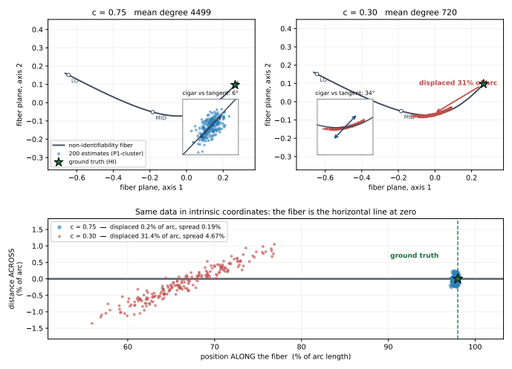
Figure 1 : P1-cluster at configuration HI (w min = 0.0375),n= 32,000. Top: the fiber and estimates in the fiber’s best-fit plane at two densities. Bottom: the same estimates in intrinsic coordinates (position along the fiber versus signed distance across it). At mean degree 720 every estimate lies close to the curve yet is displaced 31% of the arc along it.
Original paper · CC BY 4.0 · Dharmawan, Sie Hendrata, Chin, Peter · Bounded-Order Non-Identifiability in Latent Structure Block Models: The Fiber in Closed Form · Original paper figure · Extracted the figure area from page 8 of the original PDF.Why truncating a graphon costs something
A graphon is pinned down by the densities of every finite graph, and motif-based methods rely on that fact while keeping only a handful of small patterns. The theory that justifies this truncation says little about what a given truncation gives up. This study measures that loss exactly for one family, the latent structure block model, which is a random dot product graph whose latent positions lie on K rays through the origin.
The census, the full graph law and the spectral summaries then differ in how much of the ray structure each can recover.
How the ray model and its census are set up
Each node receives a community with a fixed weight, and the community sets the slope of the ray the node lies on. A node's radius is drawn from a radial law on (0, C), and in the symmetric family studied here all communities share that one law. Two nodes are joined independently with probability \(W(u,v)=x_{1,u}x_{1,v}(1+s_{c_u}s_{c_v})\), which is the product of their radii times one plus the product of their slopes.
The moments \(m_j=\mathbb{E}[s^{2j}]\) of the squared slope are the quantities the census responds to.
A homomorphism density of a graph F factors into a product of powers of the radial moments \(\rho_d\), times a sum over the even subgraphs S of F, each weighted by a product of slope moments. \[ t(F;\Theta)=\prod_{v\in V(F)}\rho_{\deg_F v}\sum_{S\in\mathcal{E}(F)}\prod_{v\in V(F)}m_{\deg_S(v)/2} \] Because the radii factor out, forests depend on the radial law alone, while cycles pick up slope moments as well.
Where the census stops seeing the slopes
The census of order 2K−2 fixes m_1 up to m_{K−2} and nothing further. Through any admissible configuration there is therefore a one-dimensional fiber of configurations that share the census, and its shape is given in closed form as an arc. The endpoints of that arc are classical quadrature rules.
The slope index of a graph F is the largest slope moment appearing in its expansion, and it never exceeds half the maximum degree of F. The bound is \(h(F)\le\lfloor\Delta(F)/2\rfloor\), and because every coefficient in the expansion is nonnegative, no terms cancel when two configurations are compared. The friendship graph \(F_{K-1}\) on 2K−1 vertices attains this bound and is the unique edge-minimal separator of the family.
The threshold grows with K, so no fixed motif order serves the whole family.
How small the separating signal is
Every motif's dependence on m_j passes through terms no higher than \(m_1^{2j}\), and \(F_{K-1}\) reaches that bound.
The cost does not change with edge density.
Lower-order statistics see less still. Trees carry no information about the slopes, and the message-passing graph neural networks bounded by the 1-WL test inherit that blindness. The information remains in the graph itself, since the law of the graph identifies the configuration.
Spectral summaries on the fiber
A spectral pipeline embeds the adjacency matrix, reduces each node to a direction such as a ratio of eigenvector entries, clusters the nodes, and reads the parameters off the clusters. Adjacency spectral embedding is consistent for latent positions up to an orthogonal transformation, so the loss enters in the summary taken afterward. The authors attribute the amplification to a flat direction of the population objective, which turns a second-order bias into an O(1) displacement along the fiber.
Replicate spread is 5–14 times smaller than the displacement. Across the 17 of 18 groups where no cell's nominal 95% region contains the truth, the intervals are silent about the error.
Two of the three published pipelines slide by up to 58% of the arc.
Model-based fits and practical checks
Model-based fits keep the embedding's noise geometry instead of reducing each node to a direction, and they stay accurate at every cell tested. RayEM and the Bayesian LSBM stay within 1% and 2.3% of the arc, respectively, at every cell tested. Both need K and the ray family, and their behavior when these are wrong has not been tested.
Even with the true replicate covariance, the best nominal 95% region contains the truth in 5.1% of cases. The error is bias in every direction, so bootstrap, jackknife, sandwich and profile methods, which estimate variance, cannot cover it. Subsampling a single graph flags low density rather than displacement, and Richardson correction overshoots where the bias is small.
Limitations
The theory covers only the symmetric family with a shared radial law. The spectral experiments use K=4, n up to 32,000, one fiber and simulated graphs. The census cost n* is extrapolated rather than measured directly.
Relaxing the symmetry changes the closed form, and which of the two grows faster is unproved.
K is not selected by the study, and the census cannot separate K from K−1 at the open end of the fiber. Higher-order entrywise bias correction was not tested.
Paper info
- Authors
- Dharmawan, Sie Hendrata, Chin, Peter
- Venue
- arXiv · Preprint
- First published
- 2026-11-17
- Added
- 2026-11-20
- Updated
- 2026-11-17
- Version
- v1
- arXiv
- 2611.23547
- Category
- stat.ML · cs.LG · math.ST
- Original paper terms
- CC BY 4.0
- What we show
- Paper info, commentary and permitted figures from the original paper
AI commentary is a separate explanation from the original paper and may contain errors. The original paper and figures follow each source's terms of use and any rights noted separately.
Abstract
A graphon is determined by all of its homomorphism densities, but motif-based methods use finitely many. We compute exactly what that truncation costs in a natural family: latent structure block models whose positions lie on $K$ rays, equivalently degree-corrected block models of rank two. For a given radial law, the configurations that agree on every graph with fewer than $2K-1$ vertices form a one-dimensional fiber, which we give in closed form with explicit endpoints; the friendship graph $F_{K-1}$ is its unique edge-minimal separator, so no fixed motif order serves every $K$. The separating signal is suppressed by a factor of at most $m_1^{2(K-1)}$, where $m_1$ is the mean squared slope, about $10^{-4}$ at $K=4$: detecting it from motif counts would take about $10^{15}$ nodes in a single graph, at any edge density. The information is nonetheless in the graph; the fiber belongs to the statistic, not the model. Common spectral pipelines, which count no motifs, still slide along the fiber by more than a third of its length at ordinary densities, with confidence regions that almost never contain the truth, while model-based fits of the same embedding do not. We give practitioners four checks: whether a fit is at risk, what to run instead, why a confidence interval will not warn, and how wide the remaining ambiguity is.
Quote from the paper
Dharmawan, Sie Hendrata, Chin, Peter (2026). Bounded-Order Non-Identifiability in Latent Structure Block Models: The Fiber in Closed Form. arXiv:2611.23547v1. https://arxiv.org/abs/2611.23547v1
BibTeX
@misc{hendrata2026bounded,
  title = {{Bounded-Order Non-Identifiability in Latent Structure Block Models: The Fiber in Closed Form}},
  author = {Dharmawan, Sie Hendrata and Chin, Peter},
  year = {2026},
  eprint = {2611.23547},
  archivePrefix = {arXiv},
  url = {https://arxiv.org/abs/2611.23547v1}
}