Paper commentary
One Scale, Four Texts: Gaps, Overlaps and Silent Repairs in Published Grading Schemes
A grading text can leave eyes uncovered even when every reading is allowed
- Problem Published grading texts leave some eyes without a category under any reading. Readers fill these holes silently, but software must return a definite answer, so the text as written returns nothing.
- Method The authors split each text into Boolean rules over threshold tests, with every open point as a named parameter. They keep a defect only if it survives every reading.
- Results On DDR, England and ICO 2017 disagree on referral for 26.8% of the eyes both decide.
Why silent repairs break a grading text once software or a model runs it
A human grader fills the holes in a grading scheme without noticing, and the habits that do the filling are rarely written down. A reader takes the worst category when two apply and picks the nearest sensible one when none does. Those habits work for a person, but they don't transfer to a program that must return a definite answer. A gap leaves an eye with no category under any admissible reading, so the text applied as written returns nothing.
Repairs stop being invisible once that is done, because a defect can be tested against every choice. The paper uses the English NHS Diabetic Eye Screening definitions of December 2025, the ICO tabulation of 2017, the 2003 ICDR scale and the Italian guideline of 2015.
Pooling labels across texts needs to know whether they define the same categories, and this is the practical stake. Several texts claim to state the same scale, so pooling their labels presumes they define the same categories. The authors don't claim anything about medicine or patients, only about what the texts license. Each category is linked to a verbatim quote, so a reader can check a rule against its wording without clinical judgement.
The paper's four contributions cover the supervaluational treatment, the gaps and overlaps that survive every reading, the photograph study, and the language-model test.
That question matters because a model is one of the executors that the repairs stop working for. The paper treats a silent repair as the step where a text's defect disappears from view.
Readings instead of one interpretation
The paper separates a text's content from a reader's choices by turning each text into Boolean rules over threshold tests. Every open point in a text becomes a named parameter, so each alternative reading is explicit rather than silently chosen. England has 12 readings, ICO 2017 has 24, ICDR 2003 has 16, and Italy has 48. The readings differ on things like the maculopathy exemption, the meaning of "isolated", and whether a printed threshold is exact or open.
The authors add a parameter wherever the wording allows more than one rule, such as a vague term or an unstated precedence. They don't add any reading that needs clinical knowledge the text omits, so the set describes the text rather than good practice.
The set of readings can't be shown complete, so the authors check how each kind of defect responds to a missed reading. A defect under some reading survives any reading added later, since the added reading can't remove it. A defect under every reading can be removed by one admissible reading that avoids it.
An action is determinate when it is defined and the same under every reading of its text. Two texts structurally disagree at an eye when both actions are determinate and differ, so no admissible reading of either text removes the clash. Two texts invert on a pair of eyes only when all four actions are determinate and the texts rank the pair in opposite orders.
That is a gap that survives supervaluation, and it is the English witness in Figure 2.
How the enumeration runs and how its results are checked
The enumeration splits the eye's variables into two halves that never share a constraint. The lesion variables form one half, while the exudate and non-image variables form the other. The full space holds 1,425,807,360 profiles, each one an eye described by 24 ordinal variables. Sixteen constraints remove impossible profiles before any reading is applied.
Every profile is evaluated under every reading of every text, and the first witness of each claim is kept.
For each claim, a Z3 query returns the witness that lies closest to a baseline eye with no findings. Supervaluation, pair and inversion queries use an optimiser, while per-reading queries run on a plain solver.
The enumerator and Z3 disagree on 0 claims. HermiT is posed 29 satisfiability questions, and it agreed with the SMT encoding on all 29. Four of those 29 questions are negative controls that must come out unsatisfiable. A provenance check tests each quote for a match in its source, ignoring whitespace and line-break hyphenation.
A sabotage suite of ten cases edits a fresh copy of the project and expects each gate to fail with its message. The sabotage runs symlink the data and the virtual environment, so the real files never change. The relevance pruning behind the HermiT checks is sound because the baseline satisfies every constraint.
Gaps and overlaps that no reading removes
Three of the four texts leave some eyes uncovered under every admissible reading, and the question is which eyes those are. The English witness is therefore a gap that survives every one of the 12 readings, since the cotton wool spot clause and maculopathy rules can't supply a grade.
The Italian table has no row for vitreous haemorrhage, so that eye fits none of its 48 readings. Other Italian gaps depend on the reading, such as two to seven haemorrhages without microaneurysms when isolated means one and multiple means eight or more. The 2003 text has gaps only under some of its readings, so it doesn't yield an eye uncovered under every reading.
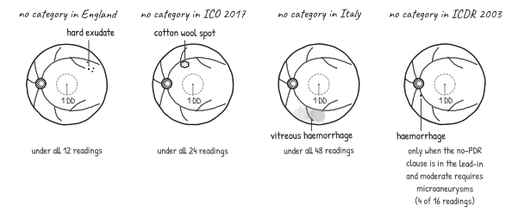
Figure 2 :A minimal gap in each text: an eye that no category of the text covers. England: hard exudate outside the macula, no R grade, under every reading. ICO 2017: cotton wool spot, no DR grade, under every reading. Italy: vitreous haemorrhage, no table row applies, under every reading. ICDR 2003: haemorrhage, no DR grade, only when the no-PDR clause is in the lead-in and moderate requires microaneurysms (4 of 16 readings; no eye has a gap under every reading).
Original paper · CC BY 4.0An Italian overlap appears for a single microaneurysm away from the fovea, which fits both the mild row and the moderate row under every reading. The mild row gives rescreen at 12 months and the moderate row gives recall at 6 to 12 months, so the eye gets two actions. The English maculopathy overlap rests on a precedence the text doesn't state, so the referral action depends on a choice the wording leaves open.
The 2017 tabulation adds a macular gap that the 2003 text lacks, because exudates without thickening fall between the two oedema grades under every ICO reading. The 2003 text has no macular gap under any reading, so this defect belongs to the 2017 wording and not to the scale itself.
Where two texts rank the same eyes in opposite orders
An order inversion is a stronger defect than a gap, because two texts disagree about which eye needs more urgent action. An inversion needs all four actions to be determinate, so every reading of both texts must give a definite action for both eyes. Such an inversion rules out every monotone crosswalk, which can only move thresholds and never reverse order.
A disagreement without inversion, by contrast, is still compatible with a monotone crosswalk.
The check runs over the 79,211,520 profiles that carry no non-image findings. On these profiles every pair of action texts disagrees about referral somewhere. England inverts against Italy using two eyes: eye x with eight or more microaneurysms and more than 20 microaneurysms or haemorrhages in one quadrant, and eye y with a venous loop alone.
England assigns x recall and y rescreen, while Italy assigns x recall and y refer, so the two orderings cross. Figure 1 draws these four actions, and ICO 2017 assigns x recall and y no grade under all of its readings.
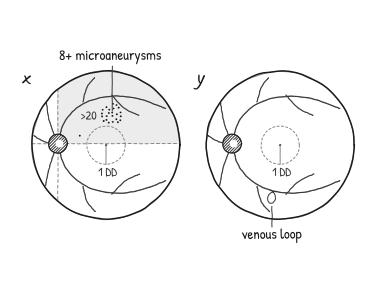
Figure 1 :An order inversion between England and Italy on image findings alone. Each line joins the actions one eye receives from the three texts, each determinate under every reading; the lines cross between England and Italy. 𝑥: 8+ microaneurysms, more than 20 microaneurysms/haemorrhages in 1 quadrant. 𝑦: a venous loop. No other findings.
Original paper · CC BY 4.0 · Elisa Rovai, Fabio Rovai · One Scale, Four Texts: Gaps, Overlaps and Silent Repairs in Published Grading Schemes · Original paper figure · Extracted the figure area from page 5 of the original PDF.England also inverts against ICO 2017, with a second pair of eyes. ICO 2017 and Italy never invert on image findings, so their difference is a disagreement of thresholds rather than of order.
Once acuity, thickening or grader uncertainty enter the comparison, all three pairs invert. So no model that sees only photographs can reproduce any of these texts exactly. The next section asks how often real annotated photographs fall into these defects.
Do annotated photographs fall into these defects?
The authors test the defects on 927 annotated photographs drawn from three public datasets: IDRiD, DDR and DIARETDB1. IDRiD gives 81 segmentation photographs with pixel masks, but it marks the fovea and disc only in part. DDR contributes 757 images, and DIARETDB1 contributes 89 images whose findings the authors take from the strict-majority consensus of its experts.
Because those datasets don't mark the fovea and disc fully, the authors trained a U-Net with a ResNet-34 encoder to predict heatmaps for the disc centre and fovea. The detector passed its acceptance gate on the 103 localisation test images, with a median fovea error of 0.045 DD. Its 95th percentile fovea error was 0.214 DD, against a limit of 1/3, so the detector met every condition the gate set.
Under the closed completion, England and ICO both decide referral on 570 DDR eyes, and they disagree on 153 of them, or 26.8%. England and Italy disagree on 63 of 403 eyes, while ICO and Italy disagree on seven of 279. Leaving thickening free drops the ICO gap under every reading to 0.0% on IDRiD, 24.7% on DDR and 5.6% on DIARETDB1. On the 147 DDR eyes where England and ICO both decide with thickening free, the two texts always agree.
The classifier comparison uses 310 images that all three texts label, and the authors train one ResNet-18 per text. ICO and Italy disagree on only seven images, below the registered minimum of 10, so the authors couldn't test those two pairs. The four testable pairs, all involving England, support the hypothesis, so the registered verdict is partially supported.
Do language models repair defects silently
The study gives each model 140 items covering 31 defects and 28 control classes across the four texts. A single category on a gap or overlap item counts as a silent repair, since the licensed answer there is none or several. Only the opening sentence changes between the two instructions: LITERAL asks for exact application, while SCREENER casts the model as a grader.
The primary test is an exact McNemar test of repair between conditions, applied at the level of each defect.
Qwen3.8-Flash-Next with reasoning off answered all 45 control items correctly under both instructions. Yet it repaired 12 of its 13 gap items under LITERAL and 11 under SCREENER. The instruction made no difference to repair, with p = 1 over 13 defects. Claude Sonnet 5.5 with thinking repaired 2 gap items under LITERAL and 5 under SCREENER.
Within Qwen3.8-Flash-Next, reasoning lowered repair on 40 paired repair-eligible items under both instructions. Under SCREENER it fell in 17 pairs and rose in 3, with p = 0.0026, so the registered hypothesis held at item level. Under LITERAL it fell in 23 pairs and rose in 1, with p = 3.0×10 −6. Claude Haiku 4.5 ran 280 calls with thinking, and thinking lowered its gap and overlap repair.
Even with thinking, Claude Haiku 4.5 repaired most gap items, so deliberation alone didn't make it a literal reader.
A canary test showed that minimal calls used 388 to 451 input tokens. Planting the marker phrases in the system prompt added 9,966 to 36,565 tokens, which confirmed isolation for all three models. The comparison across models doesn't separate the effect of thinking from the model itself, because Claude Sonnet 5.5 and Claude Opus 5.5 can't switch thinking off.
What the results do not cover
The disagreement frequencies describe hospital images that were chosen for annotation, not a screening population. In DDR, 75.3% of images have microaneurysms, 79.4% have haemorrhages and 64.2% have hard exudates, so the sample is enriched for disease. The study didn't sample a screening population, so its percentages can't be read as screening rates.
The English referral results rest on this closed completion, because a colour photograph can't confirm that the retina is not thickened.
The reading set can't be shown complete, so a defect under every reading holds only for the readings the authors admit. Added readings can't remove a defect that holds under some reading. No dataset annotates vitreous haemorrhage, so the Italian gap cannot be tested on photographs.
Paper info
- Authors
- Elisa Rovai, Fabio Rovai
- Venue
- arXiv · Preprint
- First published
- 2026-11-4
- Added
- 2026-11-6
- Updated
- 2026-11-4
- Version
- v1
- arXiv
- 2611.06569
- Category
- cs.AI
- Original paper terms
- CC BY 4.0
- What we show
- Paper info, commentary and permitted figures from the original paper
AI commentary is a separate explanation from the original paper and may contain errors. The original paper and figures follow each source's terms of use and any rights noted separately.
Abstract
Category systems often reach their users as text, and readers apply them with tacit repairs. We ask what such a text determines once the repairs are removed, using diabetic retinopathy grading, where one international scale circulates in several documents. We transcribe four texts (the English screening definitions of 2025, the international scale as tabulated in 2017 and as published in 2003, and an Italian guideline of 2015) into one rule language over 24 finding variables, and make every point a text leaves open a named precisification. Exhaustive enumeration of 1,425,807,360 finding profiles, re-derived by an SMT solver and spot-checked by an OWL reasoner, shows that every text that assigns actions leaves some eyes without a category under every reading; that the 2017 tabulation has a proliferative class that is empty when read literally and a macular gap that the 2003 text lacks, so that no function maps the 2003 grades onto the 2017 grades; and that on image findings alone the English and Italian texts order some pairs of eyes in opposite ways. On 927 annotated photographs from three public datasets, with retinal thickening assumed absent, the English text and the 2017 tabulation disagree on referral for 26.8% of the eyes of one dataset (DDR) on which both decide, and in a pre-registered experiment classifiers trained on each text's labels side with their own text. Thickening cannot be seen on a colour photograph; left free, every disagreement involving England becomes undecidable, so it rests on what the camera cannot show. In a second pre-registered study, language models that answered without deliberating repaired most gap and overlap items even when told to read literally, while Claude Sonnet 5.5 and Claude Opus 5.5 reported the defects far more often; within two models, deliberation reduced silent repair without removing it.
Quote from the paper
Elisa Rovai, Fabio Rovai (2026). One Scale, Four Texts: Gaps, Overlaps and Silent Repairs in Published Grading Schemes. arXiv:2611.06569v1. https://arxiv.org/abs/2611.06569v1
BibTeX
@misc{rovai2026scale,
  title = {{One Scale, Four Texts: Gaps, Overlaps and Silent Repairs in Published Grading Schemes}},
  author = {Elisa Rovai and Fabio Rovai},
  year = {2026},
  eprint = {2611.06569},
  archivePrefix = {arXiv},
  url = {https://arxiv.org/abs/2611.06569v1}
}