Paper commentary
The Flip Test: Video World Models Fail to Learn the World State
Video world models miss decisive state changes that flip the future
- Problem Video world models must flip predictions when a small state change flips the outcome.
- Method FlipTest checks this with counterfactual frame pairs that sit on opposite sides of a physical boundary. Its three levels run from simple pairs to control groups and dense sweeps that locate where predictions switch.
- Results The best of 11 video models scores 18.3%, below 25% random guessing.
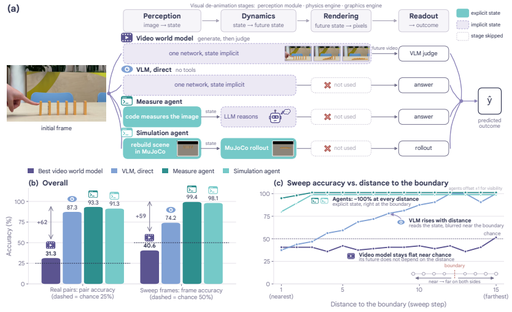
Figure 7 | Making the state explicit closes the gap.(a) Predictors mapped onto the three stages of Visual De-animation (Wu et al., 2017a), with every pipeline terminating in a binary outcome label scored against ground truth. (b) Pair accuracy on the 150 real pairs and frame accuracy on the 480 sweep frames, comparing the best video world model, the direct VLM, the Measure agent, and the Simulation agent against chance (dashed lines: 25% for pairs, 50% for frames). (c) Sweep accuracy as a function of distance from the boundary, pooled over four tasks, four scenes, and both boundary sides (32 frames per step; invalid agent runs count as wrong).
Original paper · CC BY 4.0 · Mi Luo, Lijun Yu, Adams Wei Yu, Ang Cao, Baochen Sun, Ming-Hsuan Yang, Nan Hua, Yuan Hao, Alex Dimakis, Ya Xu, Ed H. Chi, Xuezhi Wang, Yinxiao Liu · The Flip Test: Video World Models Fail to Learn the World State · Original paper figure · Extracted the figure area from page 11 of the original PDF.Why single-video scores miss the failure
Video world models generate the future of a scene from its first frame, and most benchmarks score each rollout on its own. Those benchmarks ask whether one video looks physically plausible, using bespoke, event-specific metrics that are hard to scale. An isolated plausibility score never sees that contradiction, since it never compares the two outputs.
The problem matters because a world model is useful only when its forecast depends on the present state. A small change in initial conditions should yield a fundamentally different future, so the forecast has to follow that change.
Comparing predictions across such tipping points reduces evaluation to a clean, binary outcome label. If the prediction doesn't flip along with the true outcome, the model has missed the state that decides it. A single pair isn't enough on its own, because a stochastic or hypersensitive model could flip by chance or react to any pixel change.
That is why FlipTest extends the pairwise test into a multi-level hierarchy that checks whether predictions flip if and only if the true outcome changes.
How FlipTest builds its three tests
The key idea is to perturb the present just enough to flip the true outcome, then check that the prediction flips as well. The outcome is governed by a margin \( m(s) \), such as a support overhang, a clearance, a net torque or a collision offset. The outcome is \( y(s)=\mathbb{I}[m(s)>0] \), where the indicator \( \mathbb{I}[\cdot] \) returns 1 when the condition is true and 0 when it isn't.
A pair places two states on opposite sides of the threshold, so that \( m(s^-)<0<m(s^+) \). Their images look nearly the same, yet their true futures differ, so a model that reads the state must answer differently for each frame. Figure 1 shows the idea with a book stack, where a small change to the first frame decides whether the stack collapses.
Within each pair the scene, objects and camera stay fixed, and only the outcome-controlling variable changes.
Ten simulated tasks in MuJoCo have 15 pairs each, and fifteen real tasks have 10 pairs each. Of the 300 real frames, 59 come from captured footage and 241 are counterfactual edits or staged stills. In total the benchmark spans 1,680 initial frames across the 10 simulated and 15 real-world tasks.
Only the step from \( -\delta \) to \( +\delta \) crosses the boundary, so the two outer steps should leave the prediction unchanged. Level 3 samples 30 states per scene across four simulated tasks with four scenes each, for 480 frames, concentrated near \( m=0 \).
Each model gets the clean first frame and a neutral prompt that describes the setup and the possible outcomes. Two VLM judges, Gemini 3.6 Flash and Gemini 3.8 Flash, read the depicted event from each video or flag it as unclear. A pair counts as correct only when both judges agree on the true outcome for both frames, so disagreement counts as a miss.
Selective sensitivity is \( SS=CFR-SFR \), where CFR is the crossing flip rate on the middle step and SFR averages the two outer steps.
Pair accuracy stays below chance
Figure 3 reports each model's pair accuracy on real scenes, on simulated scenes and on their average. Gemini Omni Flash 1.1 leads with an average of 18.3%, which falls under the 25% chance level. A pair counts as solved only when both of its frames are correct, so the bar stays strict.
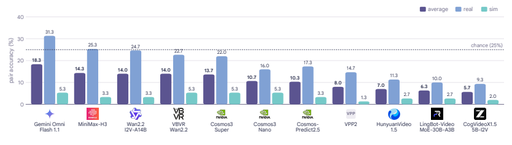
Figure 3 | Video world models rarely pass FlipTest Level 1.We show pair accuracy (%) of 11 video models on real scenes, simulation, and their average. The models are sorted by their average. A frame counts as correct only if both judges (Gemini 3.8 Flash and Gemini 3.6 Flash) read the ground-truth outcome from its video. A pair is solved only if both frames are correct. The dashed line marks chance (25%).
Original paper · CC BY 4.0On real scenes, Gemini Omni Flash 1.1 reaches 31.3%, followed by MiniMax-H3 at 25.3% and Wan2.2-I2V-A14B at 24.7%. Only these top two models beat chance on real scenes, while CogVideoX1.5-5B-I2V drops to 9.3%. On simulated tasks, no model exceeds 5.3%, and four models share that ceiling. Under the strict paired metric, a constant predictor scores 0% and random guessing scores 25%.
The authors trace much of this gap to mode collapse across the boundary. Pooled over clearly judged pairs, predictions are identical for both frames in 72% of real pairs and 89% of simulated pairs. Identical outputs guarantee that at least one rollout in each pair is wrong, so the models can't score well by chance. Figure 6 shows Cosmos3-Super on a simulated seesaw and VPP2 on a real ring toss, each giving one outcome for both frames.
The simulated split holds visual appearance constant within each pair, so it removes those shortcuts. Scale doesn't help much: Cosmos3-Super scores 13.7%, close to Wan2.2-I2V-A14B at 14.0%.
Flips happen on control steps too
Passing a minimal pair could still mean a model flips at every visual change, so the Level 2 control groups test selectivity. The authors measure this with a crossing flip rate (CFR) and a same-side flip rate (SFR), and define selective sensitivity as SS = CFR − SFR. Plotting CFR against SFR puts all 11 video models tightly along the diagonal.
Every 95% confidence interval for these video models straddles zero.
A VLM answering directly from the same first frames behaves differently. Gemini 3.6 Flash flips its prediction on 61% of crossing steps but on only 15% of same-side steps. This gives a selective sensitivity of +0.46, with a 95% CI of [0.36, 0.56]. The authors read this as evidence that the boundary is visible in the first frame, because the VLM sees the same frames as the video models.
Sweeps show no boundary
Level 3 asks where a model's switch happens along a dense sweep, and how sharp that switch is. The ground truth is a step function at m = 0, sampled with 30 states per scene across four simulated tasks and four scenes each. The authors compare three video models, Gemini Omni Flash 1.1, Cosmos3-Super and VBVR-Wan2.2, with the single-frame generator Nano Banana Pro and two direct VLMs.
Both VLMs, Gemini 4 Argon and Gemini 3.8 Flash, bend toward the oracle step at m = 0 with clear S-shaped transitions. Their gaps are +0.62 for Gemini 4 Argon and +0.58 for Gemini 3.8 Flash. The VLM curves rise before m = 0, so they over-predict the event near the threshold. The authors read this as a systematic shift, since the VLM still registers where the boundary lies.
Video models, by contrast, fail to register the boundary at all.
The key finding is that the boundary is recoverable from the initial frame, because the VLM reads it directly. The open question is where along the generation pipeline a video model loses that information. The authors use the three stages of Visual De-animation to locate the loss: perception, dynamics and rendering. A direct VLM bypasses rendering, while a video model keeps all three stages inside one network.
Fixing the outcome label across every predictor lets the authors pinpoint which stage loses the decisive physical state.
Telling the outcome lifts pair accuracy
The question here is whether video models fail to deduce the outcome or fail to render it. The authors state the ground-truth outcome explicitly in each prompt and regenerate all pair rollouts across all models. Relieved of deciding the outcome, Gemini Omni Flash 1.1 rises from 18.3% to 73.7% pair accuracy. Every video model improves, and the scoring still counts unclear rollouts as wrong.
The gain is substantial across the whole field, shown as filled bars next to the neutral-prompt bars.
The authors read this as video models knowing how to draw the future but failing to infer which future unfolds from the first frame. It scores 86.7% on real scenes and 60.7% on simulated ones, so rendering remains imperfect. Reading the state is still the larger failure, because the told-outcome gains don't reach the level of accuracy that a reader of the state achieves.
The direct VLM already reaches 87.3% on real pairs, which the paper contrasts with the 31.3% of the best video model.
The authors fold this result into their overall verdict on video models. That contrast is why the paper locates the bottleneck upstream of the pixel renderer.
Measuring the state recovers the boundary
The Measure agent writes and runs Python image-processing scripts, using NumPy, SciPy, and scikit-image, before it answers.
The direct VLM already beats the best video model on real pairs, scoring 87.3% against 31.3%. Its frame accuracy on sweeps reaches 74.2%, but its errors pile up near the tipping point. Sweep accuracy drops to 38% at steps adjacent to m = 0, and it exceeds 90% only eleven steps away.
Making perception explicit through the Measure agent removes nearly all of this boundary blur. It lifts real-pair accuracy to 93.3% and exceeds 99% across the sweeps. Only three errors appear across all sweep frames.
Feeding those measurements into a physics engine changed only 4 of 761 predictions. The state comes from the frame, so the physics step adds little on top of measurement.
Where the state is lost
The authors split visual prediction into perception, dynamics and rendering, following Visual De-animation. A video world model keeps all three stages inside one network, so its state stays implicit. Giving the ground-truth outcome in the video model's prompt isolates rendering on its own. Because every predictor is scored on the same binary outcome label, the comparison shows which stage loses the decisive state.
On Level 2 controls, Gemini 3.6 Flash flips on 61% of crossing steps but only 15% of same-side steps. That gives a selective sensitivity of +0.46, with a 95% CI of [0.36, 0.56], while every video model stays near zero. The VLM's early, gradual transitions suggest imprecise perceptual estimation near the threshold.
From the same first frame, the VLM tracks the boundary and a measuring agent solves over 93% of real pairs. The authors conclude that video models fail primarily at reading state and only secondarily at rendering. Even when told the ground-truth outcome, the best video model still misses over a quarter of the pairs. Their proposed blueprint has an agent estimate the state, call a dedicated simulator when needed, and pass the predicted trajectory to a video model that renders it.
Limitations of the evidence
Most of the real split is not captured footage: 241 of its 300 frames are counterfactual edits or staged stills. Only 59 frames come from captured footage with recorded physical outcomes. Each real pair comes from a minimal edit, so the ground-truth label is fixed by construction.
Two Gemini judges read the outcome from each generated video, and either judge can flag it as unclear. Unclear rollouts and judge disagreements count as incorrect, because the authors want a planning model to commit to a clear future. For Level 2 and Level 3 the authors keep both judges' labels, and the Level 2 intervals come from 2,000 bootstrap draws.
Level 2 uses 15 control groups per simulated task, 600 frames in total. Real tasks have 10 pairs each, while simulated tasks have 15 pairs each. So the real-scene claims rest on the pair metric alone, since the control and sweep tests stay in simulation.
Paper info
- Authors
- Mi Luo, Lijun Yu, Adams Wei Yu, Ang Cao, Baochen Sun, Ming-Hsuan Yang, Nan Hua, Yuan Hao, Alex Dimakis, Ya Xu, Ed H. Chi, Xuezhi Wang, Yinxiao Liu
- Venue
- arXiv · Preprint
- First published
- 2026-11-15
- Added
- 2026-11-17
- Updated
- 2026-11-15
- Version
- v1
- arXiv
- 2611.19822
- Category
- cs.CV · cs.AI · cs.RO
- Original paper terms
- CC BY 4.0
- What we show
- Paper info, commentary and permitted figures from the original paper
AI commentary is a separate explanation from the original paper and may contain errors. The original paper and figures follow each source's terms of use and any rights noted separately.
Abstract
Video world models promise to predict the future of a scene from its present. Do current models keep this promise? We probe this question counterfactually. When a small change to the present flips the future, such as a box resting a few millimeters before or past a table edge, a model that tracks the state of the world must flip its prediction too. We build FlipTest, a three-level hierarchy of increasingly strict tests over 1,680 initial frames from 10 simulated and 15 real-world tasks. At the base, visual minimal pairs, two nearly identical frames whose true futures differ, test whether predictions change across the boundary; matched controls go further and test whether they change only where the future does; and dense sweeps, the strictest level, locate exactly where they change. All 11 video world models we evaluate fall short. The best averages 18.3% pair accuracy over real and simulated scenes, below the 25% of random guessing. Models flip as often on steps that leave the future unchanged as on steps that change it, and their response stays flat across the sweeps. On the same frames, a vision-language model is selective and traces a near S-shaped curve near the boundary, and a coding agent that measures the image comes close to the true boundary. This implies that the deciding information is in the frame, and video models just miss it. We therefore urge the community to rethink world modeling as pure video prediction. Next-frame prediction must do more than draw plausible pixels; it must also identify the causal states that control future dynamics.
Quote from the paper
Mi Luo, Lijun Yu, Adams Wei Yu, Ang Cao, Baochen Sun, Ming-Hsuan Yang, Nan Hua, Yuan Hao, Alex Dimakis, Ya Xu, Ed H. Chi, Xuezhi Wang, Yinxiao Liu (2026). The Flip Test: Video World Models Fail to Learn the World State. arXiv:2611.19822v1. https://arxiv.org/abs/2611.19822v1
BibTeX
@misc{luo2026flip,
  title = {{The Flip Test: Video World Models Fail to Learn the World State}},
  author = {Mi Luo and Lijun Yu and Adams Wei Yu and Ang Cao and Baochen Sun and Ming-Hsuan Yang and Nan Hua and Yuan Hao and Alex Dimakis and Ya Xu and Ed H. Chi and Xuezhi Wang and Yinxiao Liu},
  year = {2026},
  eprint = {2611.19822},
  archivePrefix = {arXiv},
  url = {https://arxiv.org/abs/2611.19822v1}
}