Paper commentary
ResQAdam: Residual-Preserving Adaptive Optimization for Memory-Efficient Quantization Aware Training
ResQAdam keeps the residual of QAT momentum to save optimizer memory
- Problem Low-rank optimizers such as GaLore and LDAdam degrade in quantization-aware training. They discard the part of the momentum outside the top singular subspace at every step.
- Method ResQAdam keeps one BF16 momentum and runs Adam only on the principal subspace. Instead of storing a second dense state, it adds a sign-only update computed from the residual.
- Results ResQAdam reduces optimizer-state memory by 71% to 74% relative to AdamW. Training loss and perplexity stay close to AdamW in most settings.
Where projection-based optimizers stall in QAT
QAT keeps full-precision latent weights and passes gradients through the quantizer with the straight-through estimator. The memory cost sits in the optimizer, because AdamW stores two FP32 moments, which adds 8nm bytes for each n by m weight matrix.
Figure 1 shows that the same strategy doesn't carry over to QAT. With rank 64 and tuned learning rates, GaLore-AdamW and LDAdam are clearly worse than AdamW.
Under the straight-through estimator, the gradient has to offset element-wise quantization errors. If these corrections sit less in the top-r subspace than in the rest of the update, a projection method drops them at every step. Tuning inside the subspace can't bring those dropped corrections back.
The authors respond by splitting the dense global momentum with SVD, keeping the top-r singular vectors as bases. Their empirical results show that these residual signals matter under QAT, and keeping only their sign recovers most of the lost quality.
Splitting the momentum into two parts
The core idea is to split the momentum, not the gradient, into a part along a few directions and a leftover part, and to treat each with a different rule. Adam is kept for the low-rank part, while the leftover is kept in full but only by its sign. The authors base this on an empirical observation: the residual stays useful even when only its sign is kept.
Every tau steps, the top-r left and right singular vectors of the momentum give \(U_t\in\mathbb{R}^{n\times r}\) and \(V_t\in\mathbb{R}^{m\times r}\). They define a principal subspace of matrices \(U_tAV_t^\top\) with an r by r coefficient matrix A, and the projector \(\Pi_t(X)=U_tU_t^\top XV_tV_t^\top\) splits the momentum. The principal part is \(M^\parallel_t=\Pi_t(M_t)\), the residual is \(M^\perp_t=M_t-M^\parallel_t\), and the two are orthogonal under the Frobenius inner product.
Keeping Adam's second moment for the residual would bring dense state back, so the method keeps only the element-wise sign of the residual. That sign is rescaled to the Frobenius norm of the principal update, giving \(\Delta^\perp_t=\|\Delta^\parallel_t\|_F\,\mathrm{sign}(M^\perp_t)/\|\mathrm{sign}(M^\perp_t)\|_F\). Because the sign acts element-wise, this direction isn't strictly orthogonal to the principal subspace, so the authors treat it as a direction derived from the residual.
What one ResQAdam step computes
Each step folds the STE gradient into the momentum through \(M_t=\beta_1M_{t-1}+(1-\beta_1)G_t\), and the momentum is stored in BF16. The momentum decides where the bases point and what the residual is, but it never normalizes the update. The gradient is projected to \(G^\parallel_t=U_t^\top G_tV_t\), and Adam moments are updated only in that r by r space.
The preconditioned coordinates map back as \(\Delta^\parallel_t=\alpha_rU_t\hat A^\parallel_tV_t^\top\) with \(\alpha_r=\sqrt{nm}/r\), a factor that removes the dependence of the update scale on r.
The two updates are weighted by energy ratios, \(\rho^\parallel_t=\|M^\parallel_t\|_F/(\|M_t\|_F+\epsilon)\) and \(\rho^\perp_t=\|M^\perp_t\|_F/(\|M_t\|_F+\epsilon)\). The fused direction is \(\Delta_t=\rho^\parallel_t\Delta^\parallel_t+\rho^\perp_t\Delta^\perp_t\), and the weights move by \(W_t=(1-\eta\lambda)W_{t-1}-\eta\Delta_t\). The authors call these energy-derived balancing coefficients, not weights that keep an exact orthogonal split, because the sign step breaks orthogonality.
Every tau steps the bases are recomputed by SVD, and the principal Adam states are moved to the new bases with the LDAdam transport rule. For from-scratch runs the authors use r=32 and tau=400, initialize the bases from the first gradient, and suspend refresh for the first 10% of steps. For fine-tuning they use r=64 and tau=200 with no suspension, since the pretrained checkpoint already gives a stable momentum.
Persistent state is about 2nm bytes for the momentum plus a term of order (n+m)r+r^2, against 8nm bytes for AdamW, so the ratio approaches 25% for small r.
From-scratch QAT results
From-scratch QAT tests ResQAdam against AdamW on Llama-style models pretrained at 200M and 430M scales. The two training frameworks, QuEST and CAGE, differ in their gradient-estimation and optimization strategies. Each run quantizes weights and activations to W2A2, W2A16 or W4A4. Across these settings, the ResQAdam training loss closely overlaps the AdamW curve from initialization to the final iterations.
The ResQAdam curves show no divergence, which the authors take as evidence of stable low-bit pretraining.
For QuEST at 430M under W2A2, WikiText-2 perplexity is 39.12 for AdamW and 41.48 for ResQAdam. At W2A16 the order flips, with ResQAdam at 34.66 against 34.74 for AdamW. In the same table, the optimizer state drops from 3.54 GB to 0.94 GB, a reduction of 73.4%. For CAGE at 430M under W4A4, WikiText-2 perplexity moves from 34.55 for AdamW to 34.13 for ResQAdam.
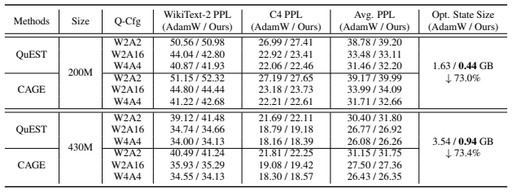
Table 1 : Language modeling performance comparison across different from-scratch QAT methods. Values in each cell are formatted as AdamW / ResQAdam (Ours).Q-Cfgdenotes the quantizer configuration, whereWxandAxindicatex-bit weight and activation quantization, respectively. Opt. State Sizereports average optimizer state size for each optimizer during the training, computed only over non-embedding and non-LM-head parameters.
Original paper · CC BY 4.0 · Liqun Ma, Shengkun Tang, Liangyu Wang, Lin Zhao, Wei Luo, Xinjun Niu, Spandan Tiwari, Ashish Sirasao, Kun Zhang, Zhiqiang Shen · ResQAdam: Residual-Preserving Adaptive Optimization for Memory-Efficient Quantization Aware Training · Original paper figure · Extracted the figure area from page 5 of the original PDF.The authors say ResQAdam largely keeps AdamW-level language modeling quality in from-scratch QAT. For both QuEST and CAGE, ResQAdam reaches perplexities close to full-state AdamW. In several cases ResQAdam is slightly better than AdamW. At 200M under QuEST W2A2, AdamW reaches 50.56 on WikiText-2 against 50.98 for ResQAdam. The paper's overall memory saving is 71% to 74% relative to AdamW.
QAT fine-tuning results and their spread
Table 2 covers three fine-tuning recipes applied to Llama 3.2-1B, Qwen3 4B-Base and Llama 2-7B. The authors also score zero-shot accuracy on HellaSwag, PIQA, ARC, WinoGrande and MMLU, alongside perplexity. They add LLM-QAT, which distills data-free from the full-precision model, and the Block-AP stage of EfficientQAT.
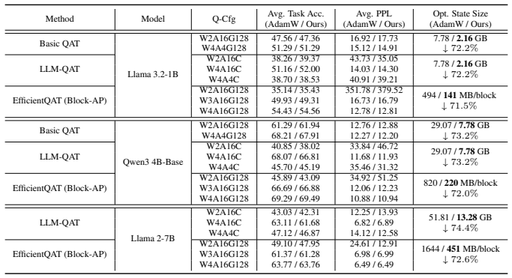
Table 2 : Performance and memory footprint comparison between ResQAdam and standard AdamW across diverse QAT fine-tuning frameworks. Values in each cell are formatted as AdamW / ResQAdam (Ours).Q-Cfgdenotes the quantizer configuration:WxandAxindicatex-bit weight and activation quantization, respectively;G128represents group-wise quantization with a group size of 128; andCdenotes channel-wise quantization.Opt. State Sizereports average optimizer state size of AdamW / ResQAdam during the training , computed only over non-embedding and non- LM-head parameters.
Original paper · CC BY 4.0Under Basic QAT at W2A16G128 on Llama 3.2-1B, average task accuracy is 47.56 for AdamW and 47.36 for ResQAdam. Average perplexity rises from 16.92 for AdamW to 17.73 for ResQAdam, so accuracy barely moves while perplexity grows slightly. At W4A4G128 on the same model, both optimizers reach 51.29 average accuracy. Optimizer-state memory drops from 7.78 GB to 2.16 GB, a 72.2% cut for this model.
The spread is wider in the EfficientQAT Block-AP rows at W2A16G128. On Qwen3 4B-Base, perplexity moves from 34.92 for AdamW to 51.25 for ResQAdam. On Llama 2-7B under the same Block-AP setting, ResQAdam lowers perplexity from 24.61 to 12.91. For fine-tuning, the authors set rank 64 and refresh interval 200, with no warm-up suspension.
The closeness claim holds most firmly for milder quantization, such as W4A4G128 on Llama 3.2-1B. The W2A16 block-wise rows carry the bigger swings. Across these settings, ResQAdam reduces optimizer-state memory by 71% to 74%.
Ablations and the rank and refresh settings
Principal Update Only keeps the Adam-preconditioned update in the principal subspace and removes the sign correction from the residual. Residual-Sign Only does the reverse, using the normalized sign of the orthogonal residual and dropping the Adam principal update. Gradient-SVD Bases computes the bases from the instantaneous gradient instead of the momentum, and Global-Momentum Sign applies a sign to the whole momentum.
The authors kept only lightweight variants, because heavier variants would erase the memory or throughput advantage over AdamW.
Principal Update Only performs poorly across all quantization settings, so updates confined to the principal subspace don't suffice for QAT. Residual-Sign Only performs much better, especially under W2A2 and W2A16, which shows the orthogonal residual carries useful correction signals. Residual-Sign Only isn't consistently better than the full method, so the Adam-preconditioned principal update still adds low-rank structure.
Gradient-SVD Bases underperforms ResQAdam, particularly under W2A2, which supports taking bases from the time-smoothed momentum. Global-Momentum Sign falls short, which shows that a monolithic sign update loses the benefit of separating principal and residual parts. Across the evaluated settings, the full ResQAdam achieves the best perplexity.
Rank 4 gives the highest perplexity in all three settings, reaching 25.2 at W2A16 compared with 19.8 at rank 64. For ranks 16 and above, perplexity doesn't fall monotonically with r, and it varies by at most 1.8 across r from 16 to 256. Rank 256 gives the lowest value in all three settings, while the main from-scratch experiments use r = 32.
Training converges for every τ from 50 to 2000, and the best interval differs across settings. The best τ is 400 at W2A16, 100 at W4A16 and 50 at W4A4, and perplexity shows no consistent trend with τ. The authors use τ = 400 for from-scratch QAT, which lies within 0.9 of the best interval in every setting.
The authors also track the energy share of the principal part right after each refresh, for seven weight matrices of a middle layer. A substantial part of the momentum still lies outside the principal subspace even right after a refresh. This supports the design in which a full-space residual correction keeps the optimization signal that lies outside the low-rank subspace.
Memory and throughput cost
Table 3 measures optimizer-state memory, total peak memory and throughput for AdamW and ResQAdam on three LLMs. All runs use Basic QAT with W4A4G128, a context length of 4096, and a single NVIDIA H200 GPU. The micro-batch size is 1, with 128 gradient accumulation steps, and ResQAdam uses a projection rank of r = 64. The optimizer-state count covers only the transformer backbone, so the embedding and language modeling head layers stay out.
On Llama 3.2-1B, optimizer state drops from 7.78 GB to 2.16 GB, a 72.2% cut. Qwen2.5-1.5B falls from 10.48 GB to 3.01 GB, and Qwen3 4B-Base falls from 29.07 GB to 7.78 GB.

Table 3 : Comparison of optimizer-state memory, total peak memory, and training throughput across different models. Values in each cell are formatted asAdamW / ResQAdam, with relative changes in parentheses.
Original paper · CC BY 4.0Total peak memory counts weights, activations, gradients and optimizer states during training. Across the three models, total peak memory falls by 15.3% to 19.5%. On Llama 3.2-1B, peak memory drops from 33.33 GB to 28.24 GB.
The analytic persistent-memory ratio is roughly 2nm plus the low-rank overhead, over 8nm, which is about 25%. That estimate keeps only the BF16 momentum, the bases and the principal states, with no dense second moment. For small r relative to min(n, m), the ratio approaches 25% of AdamW. The measured reduction is 71% to 74%, so the savings fall short of the analytic value.
The authors attribute the gap to the bases, which are not negligible for the smaller matrices. The introduction puts the overall cut at around 75% of AdamW's average memory footprint.
Against GaLore, LDAdam and AdaFactor
GaLore and LDAdam project the gradient onto a rank-r subspace, so their Adam states stay small. Figure 1 shows this gap for both from-scratch training and fine-tuning, with W2A16 quantization at group size 128. The authors tuned each optimizer's learning rate by grid search and reported the best result.

Table 4 : Perplexity comparison of memory-efficient optimizers under diverse QAT paradigms and quantization configurations. Projection-based optimizers use rank 64. For a fair comparison, all optimizers are tuned with a grid search over learning rates, and the best result is reported.
Original paper · CC BY 4.0The authors explain the gap with a hypothesis about the QAT update itself. Under the STE, the corrections are less concentrated in the top-r subspace than the rest of the update. A projection-based optimizer therefore discards them at every step, and tuning inside the subspace doesn't recover them.
Table 4 compares ResQAdam with GaLore-AdamW, GaLore-AdamW8bit, LDAdam and AdaFactor, with every optimizer tuned by grid search over learning rates.
The authors read these gaps against their hypothesis about the low-rank subspace. Replacing the second moment with a factorized approximation, as AdaFactor does, also loses part of the correction QAT relies on. Fine-tuning results depend on the bit width, because quantization error is small at W4A4G128. The sensitivity study used the 297M model, where rank 4 gave the highest perplexity, reaching 25.2 at W2A16 against 19.8 at rank 64.
Where the results stop and what was left untested
The accuracy evidence covers two from-scratch frameworks at 200M and 430M, plus three fine-tuning recipes on three LLMs. The ablations and sensitivity runs use only a 297M model, so the component findings come from one model size.
The clearest weak case is EfficientQAT Block-AP on Qwen3 4B-Base at W2A16G128, where ResQAdam reaches 51.25 perplexity versus 34.92 for AdamW. LLM-QAT on the same model at W2A16C also rises, from 33.84 for AdamW to 46.72 for ResQAdam. The same EfficientQAT setting on Llama 2-7B goes the other way, with perplexity falling from 24.61 to 12.91.
Memory and throughput were measured under one fine-tuning setup, Basic QAT with W4A4G128 on a single NVIDIA H200 GPU. Throughput fell by less than 2% in all evaluated cases, but the authors ran only that one configuration. Residual energy was recorded only right after refreshes, so the measured share is a lower bound for projection methods.
Rank was varied only from 4 to 256, and refresh intervals only from 50 to 2000 steps. They didn't test ranks or refresh intervals outside those ranges. The sensitivity runs fixed one hyperparameter at r=64 or τ=400 while varying the other, so their joint effect wasn't measured. From-scratch pretraining covered only the 200M and 430M scales, so larger pretraining runs weren't tested.
Paper info
- Authors
- Liqun Ma, Shengkun Tang, Liangyu Wang, Lin Zhao, Wei Luo, Xinjun Niu, Spandan Tiwari, Ashish Sirasao, Kun Zhang, Zhiqiang Shen
- Venue
- arXiv · Preprint
- First published
- 2026-11-6
- Added
- 2026-11-9
- Updated
- 2026-11-6
- Version
- v1
- arXiv
- 2611.08924
- Category
- cs.LG · cs.CL
- Original paper terms
- CC BY 4.0
- What we show
- Paper info, commentary and permitted figures from the original paper
AI commentary is a separate explanation from the original paper and may contain errors. The original paper and figures follow each source's terms of use and any rights noted separately.
Abstract
Quantization-aware training (QAT) is the most reliable way to obtain accurate low-bit large language models (LLMs), but training with AdamW keeps two dense FP32 states for every weight matrix. We find that low-rank memory-efficient optimizers such as GaLore and LDAdam degrade substantially in QAT. A considerable part of the QAT momentum lies outside its top-r singular subspace, and projection-based methods discard this part at every step. We further observe that this residual remains useful when only its sign is kept. Based on these observations, we propose ResQAdam. It keeps a single BF16 momentum, applies Adam only to the r x r coordinates of the principal subspace, and adds a normalized sign update computed from the residual. We evaluate ResQAdam with two from-scratch QAT methods and three QAT fine-tuning pipelines, with weights quantized down to 2 bits. It reduces optimizer-state memory by 71% to 74% relative to AdamW, stays close to AdamW in most settings, and lowers training throughput by less than 2%.
Quote from the paper
Liqun Ma, Shengkun Tang, Liangyu Wang, Lin Zhao, Wei Luo, Xinjun Niu, Spandan Tiwari, Ashish Sirasao, Kun Zhang, Zhiqiang Shen (2026). ResQAdam: Residual-Preserving Adaptive Optimization for Memory-Efficient Quantization Aware Training. arXiv:2611.08924v1. https://arxiv.org/abs/2611.08924v1
BibTeX
@misc{ma2026resqadam,
  title = {{ResQAdam: Residual-Preserving Adaptive Optimization for Memory-Efficient Quantization Aware Training}},
  author = {Liqun Ma and Shengkun Tang and Liangyu Wang and Lin Zhao and Wei Luo and Xinjun Niu and Spandan Tiwari and Ashish Sirasao and Kun Zhang and Zhiqiang Shen},
  year = {2026},
  eprint = {2611.08924},
  archivePrefix = {arXiv},
  url = {https://arxiv.org/abs/2611.08924v1}
}