Paper commentary
MarathonTS: a benchmark of long synthetic time series from window assembly and long-series generators
MarathonTS benchmarks long synthetic time series from assembled windows and direct generators
- Problem Window generators cannot make series much longer than their training window.
- Method MarathonTS gives both routes the same job: return a long series from a training part. Assemblers choose, order and join windows from a fixed pool, while long-series generators build it directly.
- Results Window choice mattered more than seam processing, and no method trained downstream models as well as real data. The top tier replicated on other hardware, but exact places did not.
Why long synthetic series are hard to get
Generative models for time series are usually trained on windows of a fixed, short length. Forecasters, rare-event models and stress tests need a series far longer than any such window. A window generator can't simply produce that series, because its window length is fixed at training time.
The first route stitches short generated windows into one series, and it has three decisions to make. The second route lets a long-series generator produce the whole series directly, for example by extending it window by window. Direct generation avoids the seams of stitching, yet chunked generation can still introduce boundaries. The series may also drift, smooth out, or reproduce data seen in pretraining.
Because they score independent windows, they can't see the seams or the structure longer than a window.
MarathonTS answers this gap with one common task for both routes. The benchmark is the first open one to compare assembly with long-series generators under one protocol, and to evaluate whole long series against a later real reference.
One protocol for both families
The authors fix the task so that every method gets the same job: read only the training part of a series and return one long series. Each method returns a series of length K times the training window, in the same channels, and approximately as long as the training part. Within each of the two window pools, the assemblers read the same windows, so the comparison isolates selection, order and seam processing.
They don't let assemblers draw on extra windows, so a difference in results can only come from how the windows are chosen, ordered or joined.
The random path, K windows in random order, serves as the control, so any assembler's effect is measured against what other windows of the same pool give.
That cost is the jump at the seam, which keeps the solvers comparable without borrowing any criterion from the proprietary methods. The matched-block bootstrap draws its next window with a probability that decays with the jump, using the median jump as bandwidth.
How assembly chooses and joins windows
Assembly makes three decisions: which windows to take, in what order to place them, and how to process the seams between them. The benchmark fixes the window pool to either the VAE or the zEDGE generator and varies only these decisions inside that pool. Assemblers in the selection group draw K windows from a pool of N windows without repetition.
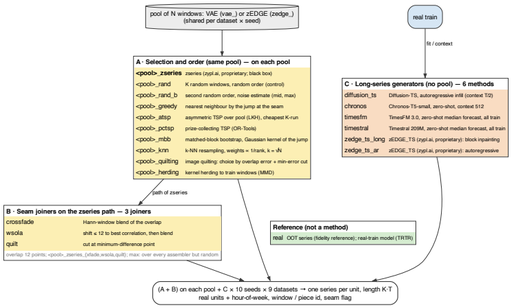
Figure 4 : The compared methods. Groups A and B take windows from the same pool, so they differ only in which windows they pick, in what order, and how seams are handled. Group C generates long series directly. Every method returns one series of lengthK·Tper (dataset, seed).
Original paper · CC BY 4.0 · Varshavskiy, Ilyas, Shulgin, Sergey, Khalilbekov, Shuhrat, Boboeva, Bonu, Azimi, Azizjon · MarathonTS: a benchmark of long synthetic time series from window assembly and long-series generators · Original paper figure · Extracted the figure area from page 11 of the original PDF.The random path is the control: it takes K windows in random order, so any other assembler is judged against just other windows from the same pool.
The matched-block bootstrap chains over the pool, drawing the next window with a probability proportional to exp(−½(dij/h)²), with h set to the median jump. Image quilting draws the next window at random among those whose 12-point overlap error is within 1.1 times the best, then cuts the overlap at the point of minimum error. Kernel herding greedily selects K windows that minimise the MMD to the training windows and then shuffles them, so it changes the selection but not the order.
The zseries assembler is proprietary and evaluated as a black box, so its code and description are not released.
A seam joiner processes the 12-point overlap between neighbouring windows, with crossfade blending it using a Hann window. The joiners are applied to the zseries path in profiles min and mid, which keeps the seam comparison on one assembly.
Long-series generators as the second route
The direct generators skip the window pool and build the K·T series by infilling, autoregressive continuation or median forecasting. It grows the series by autoregressive infilling, so the first window is generated unconditionally.
Chronos continues the last 512 training values, sampling 64 points at a time with the default sampling of its library. TimesFM and Timestral are used in their median-output configurations, so their series is a deterministic median forecast. Because the median contains no sampling noise, both return the same series for every seed. TimesFM takes up to 15 360 points of context and produces its K·T forecast in one pass, without seams.
The calendar comes from three different sources across the direct generators.
Judging the whole series
Every series in MarathonTS is judged on three axes: fidelity, utility and cost, with memorisation ranked apart from fidelity. All series share the length K·T and go through the same evaluation code in real units. Fidelity is scored against three real references, and Val is the primary one because it follows train in time and no method has used it.
The OOT series is also scored as a pseudo-method real, on the first |OOT| points, so that its length matches the synthetic series. A shift in time can place OOT farther from val or train than a synthetic series, so a method can beat the real series on a metric.
The 83 metrics fall into 12 groups, and the seam group F5 checks jumps at seams, change points at seams and a seam classifier. Group F7 covers structure longer than a window, such as rolling statistics over one week and one month, and drawdowns. Memorisation sits in group F10, which is computed once against train and ranked separately from fidelity.
Utility trains a downstream model on the synthetic series only (TSTR) and on the real train split (TRTR). The benchmark has 14 tasks in nine groups, eight classification and six regression, and the binary tasks use thresholds fixed on real train. Labels are computed on each synthetic series with the real-train thresholds, so a method with too few tail events also gets too few positive labels.
Noise is the between-seed spread of the method with the larger spread, and it serves as both the practical threshold and the equivalence margin. TimesFM and Timestral have no spread of their own, so the margin for their comparisons comes from the other method. A per-dataset verdict of better or worse needs a significant one-sided Wilcoxon test after correction and an effect above the noise.
Same means equivalence shown by TOST, not the absence of a significant difference.
What the leaderboard shows
zedge_quilting has the best mean rank in the main leaderboard, 8.27 over nine datasets, with a probability of being first of 0.85. Its 95 % two-level bootstrap interval runs from 7.35 to 9.20, so its lead over the next places is not sharply separated. The first eleven places go to the methods of the zEDGE pool and to zEDGE_TS, and all of them sit in the top tier.
The best open method is vae_herding, in place 12, which lies outside the top tier. Diffusion-TS and Timestral also fall outside the tier, while vae_zseries, vae_quilting, TimesFM and Chronos stay inside it. The fidelity and utility ranks of the methods agree with a Kendall tau of 0.88, so the two domains order the methods alike.
The first place doesn't depend on the leaderboard choices: its Kendall tau against the leaderboard lies between 0.92 and 0.98 across the fixed variants. With ordinary average ranks, the first place stays the same, but zedge_rand leaves the top tier, which then holds 14 methods. Under 2 000 random weights of the criteria, zedge_quilting is first in 99.7 % of the draws.
Does the ranking reproduce on other hardware
The replication run repeats the benchmark in profile min on another hardware and software stack. The main run used one NVIDIA H200, while the replication run used one NVIDIA L4. The replication covers the methods of the VAE pool and the four open long-series generators, but not the zEDGE methods. The fingerprints of all 1 440 common series match, so the generated inputs agree between the two runs.
The replication gives similar rankings for the 13 ranked methods of the VAE pool and the open long-series generators. Because the places within the tier are not separated by the tests, the authors read the results as tier membership.
The retrained generators differ between the two stacks, so the replication can't isolate the effect of the hardware. The replication doesn't cover the zEDGE pool or zEDGE_TS, which lead the main leaderboard. The VAE pool's assemblies stay in the comparison, and the conclusions about assembly remain conditional on that pool.
The pre-specified contrasts
The confirmatory family has ten tests, all on TSTR with the linear model and scored on OOT. Two tests cover the classification task U2.1 and two cover the regression task U2.6 at h = 24. The Friedman test (C1) separates the methods in both cells, with p = 0.012 for classification and 1.4·10⁻⁷ for regression.
Its Holm-corrected p-value of 0.14 is too large, so the verdict stays inconclusive. A verdict of better or worse needs a one-sided test that is significant after correction and an effect that exceeds the noise. In the regression cell, C4 reaches a Holm-corrected p-value of 0.03, but its verdict is also inconclusive.
The window selection contrast (C3) compares the assemblers with the random path, and on U2.1 it has an effect of 0.06. Two datasets are better and none is worse, but the Holm-corrected p-value is 1.00. On U2.6 the same contrast gives an effect of 0.61, with three datasets better and one worse, and a Holm value of 0.39.
The long-series contrasts (C2) compare Diffusion-TS and Chronos with the assembly median. On U2.1, Diffusion-TS gives an effect of 1.89 and Chronos gives 0.08, with Holm values of 0.49 and 1.00. Descriptively, the seam joiners applied to the zseries assembly often reduce its utility compared with the same assembly without them.
The gap to real data and memorisation
Utility asks how far a model trained on synthetic series falls short of one trained on real series, and the answer is the transfer ratio. The transfer ratio is significantly below 1 for every method, so no method trains downstream models as well as real data. The best methods come within a few per cent of the real series, so the gap is small for them but it remains open.
Memorisation is checked by group F10, which is computed once against train and ranked separately from fidelity. A series can look faithful by copying train, so mixing memorisation into fidelity would reward such a copy. The first F10 metric is the absolute log ratio of median distances to the closest training window, from synthetic windows and from real val windows.
The signed log ratio of the distance to the closest training window, reported in section K, shows whether windows sit closer to train than val windows.
TimesFM and Timestral sit slightly closer to train than the val windows, with intervals below 0. The near-copy flag is raised for no method, with Friedman p equal to 0.92.
What the results do not cover
The main run uses profile min, where the last 10 000 hours of each dataset give K = 30 windows, about seven months. That length suffices for seams and structure of several weeks, but it doesn't reach yearly seasonality or slow regimes. The scaling to the long series of profile max, with K up to 519, isn't tested in this run.
In profile min, the VAE and Diffusion-TS models are trained once per dataset, so the seeds don't capture training variance. A per-dataset conclusion therefore depends on the one trained model. The second random path isn't run, so the noise level comes from the spread between seeds of the random path. That noise level also sets the equivalence margin, which makes superiority verdicts conservative and the equivalence region wide.
A Holm procedure over every pair of methods therefore rejects no pair. The moderator analysis of RQ7 has nine points, so it stays exploratory. The tests don't separate the places within the top tier, so the paper reads conclusions as tier membership.
The pool conclusions hold only for the β-VAE and zEDGE pools, with one pool size of N = 300. The VAE decoder ends with a sigmoid, so its windows reach only 0.80 to 0.98 of the train range. A fair comparison with a common valid calendar would require running the utility stage again.
Paper info
- Authors
- Varshavskiy, Ilyas, Shulgin, Sergey, Khalilbekov, Shuhrat, Boboeva, Bonu, Azimi, Azizjon
- Venue
- arXiv · Preprint
- First published
- 2026-11-13
- Added
- 2026-11-16
- Updated
- 2026-11-13
- Version
- v1
- arXiv
- 2611.18190
- Category
- cs.LG
- Original paper terms
- CC BY 4.0
- What we show
- Paper info, commentary and permitted figures from the original paper
AI commentary is a separate explanation from the original paper and may contain errors. The original paper and figures follow each source's terms of use and any rights noted separately.
Abstract
Many applications of synthetic time series require a series that is much longer than the windows on which a generative model is trained. Such a series can be assembled from a pool of short generated windows, which requires deciding which windows are taken, in what order, and how their seams are processed, or it can be produced directly by a long-series generator. This study presents MarathonTS, to our knowledge the first open benchmark that compares both families under one protocol. Every method produces a series of the same length on 9 open hourly datasets with 10 seeds. The series is evaluated by its fidelity to the real data (83 metrics in 12 groups, against three real references: train, validation and an out-of-time split), by its utility (models are trained on the synthetic series only and tested on real data, TSTR against TRTR, in 14 classification and regression tasks), by its memorisation of the training data and by its computational cost. The statistical analysis is carried out as a separate stage that reads the published tables and gives the rankings of every method in every slice, the answers to the research questions with tests and uncertainty, and the results of a pre-specified confirmatory family. In the main run, the methods differ in both confirmatory cells; the choice of windows matters more than the processing of their seams, which does not improve the series, and no method trains the downstream models as well as the real series. The top tier of the leaderboard is reproduced on other hardware, whereas the exact places within it are not. For the reproducibility of the study, the code, the data hashes and all results are publicly available (links below).
Quote from the paper
Varshavskiy, Ilyas, Shulgin, Sergey, Khalilbekov, Shuhrat, Boboeva, Bonu, Azimi, Azizjon (2026). MarathonTS: a benchmark of long synthetic time series from window assembly and long-series generators. arXiv:2611.18190v1. https://arxiv.org/abs/2611.18190v1
BibTeX
@misc{ilyas2026marathonts,
  title = {{MarathonTS: a benchmark of long synthetic time series from window assembly and long-series generators}},
  author = {Varshavskiy, Ilyas and Shulgin, Sergey and Khalilbekov, Shuhrat and Boboeva, Bonu and Azimi, Azizjon},
  year = {2026},
  eprint = {2611.18190},
  archivePrefix = {arXiv},
  url = {https://arxiv.org/abs/2611.18190v1}
}