Paper commentary
Energy-preserving Bayesian model reduction: closed-form structured posteriors and probabilistic stability certificates for quadratic operator inference
Energy preservation constraints make Bayesian reduced models provably stable
- Problem Bayesian operator inference gives positive probability to reduced models with unbounded dynamics. Current checks only simulate a few draws over a finite horizon, so they cannot certify global boundedness.
- Method The method conditions the Gaussian posterior on energy preservation with one Kalman-type update. Unconstrained draws are corrected by the same gain, so constrained samples are exact.
- Results Every draw of the constrained posterior gives a bounded trajectory on a forced viscous Burgers' equation, Korteweg-de Vries and a two-dimensional Burgers' equation. Unconstrained draws often diverge.
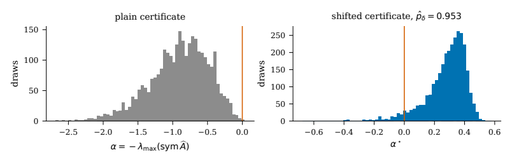
Figure 3 : Problem 1: the two certificates over Ns = 3000 draws of the constrained posterior. The plain certificate of (3.8) is negative on all but two draws; the shifted certificate (3.11) is positive on95.33%of them. The vertical line marks the thresholdδ= 0.
Original paper · CC BY 4.0 · João Victor Galvão da Mata, Mengwu Guo · Energy-preserving Bayesian model reduction: closed-form structured posteriors and probabilistic stability certificates for quadratic operator inference · Original paper figure · Extracted the figure area from page 23 of the original PDF.Why an unconstrained posterior is not enough
Bayesian operator inference returns a closed-form Gaussian posterior over the reduced operators. A non-degenerate Gaussian posterior gives full support over the operator coefficients, so some draws describe models with unbounded dynamics. Choosing the prior hyperparameters alone therefore cannot rule those models out.
Current practice screens hyperparameters by simulating a few posterior draws and rejecting any trajectory that exceeds an amplitude over a finite horizon. That screen does not certify global boundedness, and it carries no guarantee for new inputs, new initial conditions or later data updates. The question the paper takes up is whether the structure known from the physics can be written into the posterior itself.
Energy preservation as a linear constraint
Energy preservation means the quadratic term moves energy among the reduced coordinates without creating or destroying it. For data-driven models, this becomes a set of linear equality constraints on the quadratic-operator coefficients.
The deterministic versions of two of these readings were already known, so the new part is the probabilistic reading and the closed-form covariance. Since the posterior is exactly the same in all three readings, the constraint can be applied as a post-processing step after the usual regression.
How the constrained posterior is computed
The constraint matrix C has one row per cubic monomial of the reduced state, and it is built from the reduced dimension r alone. Each row has at most three nonzero entries, so the matrix stays sparse even for larger r.
The update computes the gain from the prior covariance through a Kalman form, \(K = \Sigma C^{\top}(C\Sigma C^{\top})^{-1}\), and corrects the mean by \(\mu_c = \mu - K C\mu\). The Cholesky factor of the small matrix \(C\Sigma C^{\top}\) is the only dense step, and the covariance is corrected only when it is needed. Each draw from the unconstrained posterior is corrected by the same gain, so constrained samples are exact without factorizing the constrained covariance.
The authors choose the prior scales by maximizing the marginal likelihood, instead of by searching over simulated trajectories.
Stability bounds and a probabilistic certificate
If the symmetric part of the linear operator is negative with rate α > 0, the energy decays, and bounded inputs give an ultimate ball of radius R = K(ū)/α. The decay rate of each draw is computed as α = −λmax of the symmetric part of the sampled linear operator.
The linear part is often indefinite about the origin, so the authors measure the energy about a shift m instead. Choosing m by a semidefinite program maximizes the certified decay rate, and a certificate exists when the optimal value is negative.
The authors estimate the posterior probability of certified stability from the draws and bound it with an exact Clopper–Pearson interval. The posterior restricted to certified draws is then sampled exactly by rejection, and the moments of the certified predictions are finite. Checking one draw costs an eigenvalue problem of size r, compared with O(10) ODE solves per hyperparameter in simulation screening.
Conservative systems constrain the linear part too
For conservative systems the symmetric part of the linear operator is zero, so there is no decay rate to certify. Requiring the sampled linear operator to be skew-symmetric adds rows to the same constraint matrix, and the closed-form update stays unchanged.
Under both constraints, Theorem 6.1 bounds the reduced state by its initial norm plus K(ū) t, so growth is at most linear in time. When the constant term and input vanish, the reduced energy is conserved exactly. The certificate is empty in this class, because the decay rate is exactly zero for every draw.
What the experiments show
On the forced Burgers problem with r = 10, each posterior was summarized over 60 draws. Every draw of both constrained posteriors integrated to t = 30 at every parameter value. The unconstrained baseline kept 60, 0, 0, 13, 15 and 14 surviving draws across the six parameter values, so its error was computed on fewer trajectories.
At the parameter value (0.50, 1.2), the energy-preserving posterior had a prediction-window error of 0.2418, and the doubly constrained one had 0.1248. The projection error at r = 10 is between 0.7 and 3.4 percent, so the constrained models are still above the basis floor, and the gap is due to inference.
For the energy-preserving posterior, the median draw changes the reduced energy over the window by between 7 percent and a factor of 2.6. The doubly constrained posterior changes it by between 1 and 7 percent, which is what theorem 6.1 predicts once both quadratic forms vanish.
At the held-out value (0.55, 0.1), the constrained posterior had a prediction-window error of 0.1243, while the baseline had 10.63 and kept only 36 of 200 draws.
The posterior field error at the held-out value is 0.013 at t = 2, 0.116 at t = 3 and 0.249 at t = 4. The error is small on the scale of the solution until the field steepens, which is where most of the remaining error sits.
The plain stability test fails on all 3000 draws, because two of the six eigenvalues of the symmetric part are positive in every draw. The shifted test succeeds on all of them, with an estimated certified probability of 1.0000 and a Clopper–Pearson 95 percent interval of [0.9988, 1]. Every constrained trajectory loses energy at every step, while the reference solutions also decrease monotonically.
Limitations
Conservative systems lose the certificate, so their stability rests on the linear growth bound alone. At r = 6 the posterior uncertainty over the operator is small compared with the projection error, which the posterior does not model. For substantially larger r, the reduced parametrization would need solvers that exploit the Kronecker structure, and this is not tested here.
Weighted energies with an unknown weight matrix are left to future work, because the constraint then becomes bilinear.
Paper info
- Authors
- João Victor Galvão da Mata, Mengwu Guo
- Venue
- arXiv · Preprint
- First published
- 2026-11-20
- Added
- 2026-11-24
- Updated
- 2026-11-20
- Version
- v1
- arXiv
- 2611.27794
- Category
- stat.ME · eess.SY · math.NA · stat.ML
- Original paper terms
- CC BY 4.0
- What we show
- Paper info, commentary and permitted figures from the original paper
AI commentary is a separate explanation from the original paper and may contain errors. The original paper and figures follow each source's terms of use and any rights noted separately.
Abstract
Bayesian operator inference learns reduced-order models (ROMs) with polynomial structure from state data and returns a closed-form Gaussian posterior over the reduced operators. That posterior is unconstrained, so it gives positive probability to operators with unbounded dynamics, and current practice controls this only through finite-horizon simulation tests on a few samples. We show that energy preservation of the quadratic operator is a set of linear equality constraints, which can be imposed exactly inside the Bayesian formulation without losing the closed form. In particular, the constrained posterior follows from one Kalman-type update of the unconstrained one, and its samples are obtained exactly, by the same correction applied to unconstrained draws. Under this structure, global boundedness for all initial conditions and bounded inputs reduces to a linear matrix condition on the symmetric part of the linear operator. The simulation test is then replaced by a probabilistic stability certificate: the posterior probability that the ROM is globally bounded, estimated with exact confidence bounds; the posterior restricted to certified models is then sampled exactly by rejection. For energy-conserving systems, the linear part can be constrained to be skew-symmetric as well: every draw then grows at most linearly in time, and conserves energy exactly when unforced. On a forced viscous Burgers' equation, the Korteweg-de Vries equation and a two-dimensional viscous Burgers' equation, every sample of the constrained posterior integrates to a bounded trajectory, where up to all unconstrained draws diverge, and beyond the observation window the former is also the more accurate of the two.
Quote from the paper
João Victor Galvão da Mata, Mengwu Guo (2026). Energy-preserving Bayesian model reduction: closed-form structured posteriors and probabilistic stability certificates for quadratic operator inference. arXiv:2611.27794v1. https://arxiv.org/abs/2611.27794v1
BibTeX
@misc{mata2026energy,
  title = {{Energy-preserving Bayesian model reduction: closed-form structured posteriors and probabilistic stability certificates for quadratic operator inference}},
  author = {João Victor Galvão da Mata and Mengwu Guo},
  year = {2026},
  eprint = {2611.27794},
  archivePrefix = {arXiv},
  url = {https://arxiv.org/abs/2611.27794v1}
}