Paper commentary
Bernoulli On-Policy Distillation: Don't Ignore High-Confidence Student Tokens
Bernoulli OPD restores learning signal on confident tokens during student distillation
- Problem Standard sampled reverse-KL on-policy distillation barely updates tokens the student already predicts confidently. Its gradient shrinks by a factor of one minus the student probability, so even when the teacher disagrees, those tokens get almost no update.
- Method Bernoulli OPD treats each sampled token as a yes-or-no event and matches the teacher and student probabilities with binary cross-entropy. Its gradient is the probability gap, so disagreement stays visible at high student confidence.
- Results On the five-benchmark average, Bernoulli OPD scores 51.76 with a Qwen3-1.7B student, compared to 44.38 for Vanilla OPD.
Where sampled OPD starves confident tokens
Sampled reverse-KL on-policy distillation lets the student write its own responses while a stronger teacher scores each visited token. For a sampled token, the paper writes A_t = log p_T - log p_S for the teacher-student log gap. The logit gradient of the sampled token equals -A_t(1 - p_S), so the update depends on the student's own confidence as well as on disagreement.
The factor 1 - p_S shrinks toward zero as the student grows sure of that token. A token the teacher still disagrees with can therefore receive only a tiny update.
This would matter little if confident tokens were rare, but they make up most of the sampled tokens in the primary setting. About 72.0% of sampled tokens have student confidence above 0.9. That region receives only 2.4% of the gradient mass under Vanilla OPD, compared with 46.5% under Bernoulli OPD. The authors ask whether this small share means those tokens carry little useful teacher supervision.
A diagnostic run gives part of the answer. Training Vanilla OPD on only the tokens with pS above 0.9 still improves AIME24 Avg@8 over training, though it stays below training on all tokens.
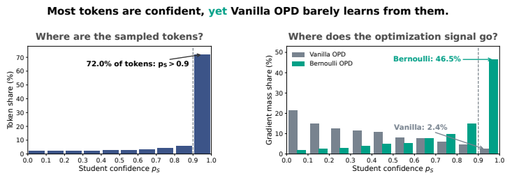
Figure 1 .Token distribution and gradient allocation across student-confidence regions.In our primary setting, about 72% of sampled tokens are high-confidence with pS >0.9 . However, this region receives only about 2.4% of the total gradient mass under vanilla OPD, compared with about 46.5% under Bernoulli OPD. The contrast between token frequency and gradient allocation highlights the strong confidence-dependent suppression induced by vanilla sampled reverse-KL OPD.
Original paper · CC BY 4.0A probability-gap loss that stays bounded
Bernoulli OPD swaps the sampled log-ratio for a binary view of each sampled token against the rest of the vocabulary. The loss compares the teacher and student probabilities of that event with binary cross-entropy. Written out, the loss is L_Bern,t = -p_T log p_S - (1-p_T) log(1-p_S), where p_T and p_S are the probabilities of the sampled token.
Differentiating with respect to the sampled token's logit gives p_S - p_T, and no extra 1-p_S factor appears. Because the probability gap lies in [-1, 1], the update stays bounded and avoids the large scale of log-probability ratios. When teacher and student agree, the update vanishes; when they disagree, the correction stays visible even at high student confidence.
GC-OPD sits in between as a diagnostic control: it swaps the log probability for the log odds, keeps the log gap, and removes the 1-p_S factor.
Figure 3 compares the mean per-token gradient proxy and gradient-mass share of Vanilla OPD, SuRe, GC-OPD and Bernoulli OPD on the same fixed rollouts. The authors read the figure as Bernoulli OPD shifting substantial mass toward the high-confidence region, while SuRe further emphasizes low-confidence updates. Table 1 places these gradients side by side and marks whether each method removes the log gap and the 1-p_S factor.
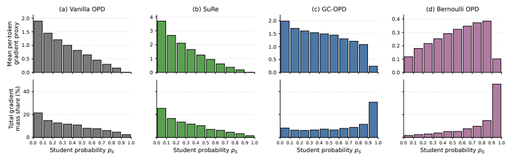
Figure 3 .Gradient allocation under different OPD objectives.All methods are evaluated on the same fixed student rollouts. The top row shows themean per-token gradient proxyacross student-confidence bins, and the bottom row shows the correspondingshare of total gradient mass. Compared with (a) Vanilla OPD, (b) SuRe further emphasizes low-confidence updates, whereas (c) GC-OPD and (d) Bernoulli OPD substantially restore gradient contribution in high-confidence regions. Top-row y-axis scales differ across objectives; the bottom row reports normalized gradient-mass shares.
Original paper · CC BY 4.0 · Mingyu Cao, Yaokai Jin, Shiwei Liu, Lu Yi · Bernoulli On-Policy Distillation: Don't Ignore High-Confidence Student Tokens · Original paper figure · Extracted the figure area from page 4 of the original PDF.What one training run does
One iteration starts with the student sampling responses to training prompts drawn from DAPO-Math-17K. The frozen teacher then assigns its probability to each student-sampled token in the same context. The teacher is frozen, so the sampled trajectory stays fixed within each optimization step. The Bernoulli loss is computed token by token from the teacher and student probabilities of the sampled token.
Its gradient with respect to the sampled-token logit is pS minus pT, so the update follows the probability gap. Every method in a setting shares the same student start, prompts, generation mode and optimization setup, and only the objective changes.
Checkpoints are scored on AIME24 with Avg@8, and the best one is kept. The final evaluation runs the selected checkpoint on AIME24, AIME25, HMMT25, AMC23 and MATH500. The first four benchmarks are reported with Avg@32, and MATH500 with Avg@4. The reported five-benchmark averages come from these final scores.
The Balanced Bernoulli variant is a diagnostic branch that multiplies each token's Bernoulli loss by a bin weight. Its weight is the mean bin mass divided by the bin mass, raised to the power beta, where each bin mass sums the absolute gap between student and teacher probabilities. The paper uses ten bins, beta equal to 0.5, and clips the normalized weights to 1/5 to 5.
Because the weight is detached, the sampled-token gradient is the weight times pS minus pT. This branch tests whether flattening the gradient across confidence bins helps, and the paper treats it only as a mechanism control.
Gains across four teacher settings
Bernoulli OPD beats Vanilla OPD in all four teacher-student settings, with gains ranging from 0.98 to 7.38 points. The primary setting pairs Qwen3-4B-Instruct-2507 as teacher with Qwen3-1.7B as student, and it moves the five-benchmark average from 44.38 to 51.76. Table 2 lists the per-benchmark scores behind each average, covering AIME24, AIME25, HMMT25, AMC23 and MATH500.
The Qwen3 students are evaluated in non-thinking mode, while the DeepSeek-based students run in thinking mode.
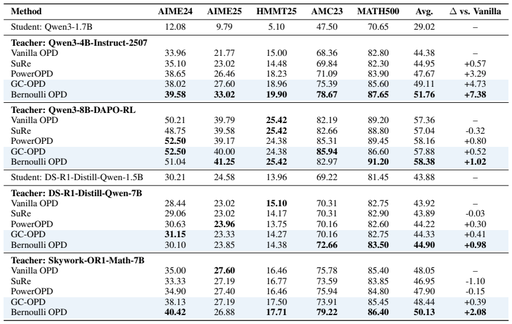
Table 2 .Main results across four teacher settings.The first four benchmarks use Avg@32 and MATH500 uses Avg@4. GC-OPD is a diagnostic variant, while Bernoulli OPD is our main proposed objective.
Original paper · CC BY 4.0With Qwen3-8B-DAPO-RL as teacher, the gap is much smaller, at 57.36 for Vanilla OPD against 58.38 for Bernoulli OPD. With the DeepSeek-R1-Distill-Qwen-1.5B student, the gain is 0.98 points when DeepSeek-R1-Distill-Qwen-7B is the teacher. The same student reaches a 2.08-point gain when Skywork-OR1-Math-7B is the teacher. In the primary setting, PowerOPD is the strongest competing objective, with a 47.67 average.
Baselines like SuRe trail Bernoulli OPD in every setting, and in the Skywork-OR1-Math-7B setting SuRe falls below Vanilla OPD.
The authors ran the primary comparison with three independent training seeds, and the gap held across all of them. Appendix D reports the seed-level numbers for this comparison. The authors attribute the gain to restored signal on confident tokens, based on the gradient analysis rather than on accuracy alone.
Ruling out flatter allocation and bigger steps
Balanced Bernoulli OPD tests whether a flatter gradient allocation across confidence bins would help the student. It reweights each Bernoulli update by the aggregate gradient mass in its confidence bin, with B set to 10 and β set to 0.5. The change to the five-benchmark average is +0.11, +0.27 and +0.06 points in three settings. With the Skywork-OR1-Math-7B teacher, Balanced Bernoulli OPD falls 0.92 points below standard Bernoulli OPD.
A second worry is that Bernoulli OPD gains come from simply taking bigger optimization steps. The scale-matched variant rescales its loss at initialization so that its full-model gradient norm matches vanilla OPD. Unscaled, Bernoulli OPD has a full-model gradient norm of 9.993, compared to 8.139 for Vanilla OPD. The scale-matched variant brings that norm to 8.138, and its one-step policy move of 0.00892 stays close to 0.00891 for Vanilla OPD.
Its high-confidence gradient mass stays at 39.42%, so the confidence-dependent allocation survives the rescaling.
Scale-matched Bernoulli reaches an average accuracy of 52.58 on the five benchmarks. They use scale matching only as a diagnostic control, because it needs calibration against vanilla OPD.
How the trained student's confidence moves
The authors ask whether the objectives change which confidence bins the trained student's tokens occupy. Under fixed-rollout rescoring, every model sees the same prefixes and target tokens, so the comparison isolates the objective. Vanilla OPD, SuRe, and PowerOPD induce substantially smaller changes in the same setting. Under on-policy generation, the same pattern becomes more pronounced, and Bernoulli OPD substantially reduces the concentration of tokens in the 0.9 to 1.0 bin.
The authors argue that restoring gradient on confident tokens doesn't mean raising their confidence, because teacher corrections can also reduce excessively confident predictions.
On MATH500, the authors sample 8 responses per problem and define confidence as the fraction of samples in the majority answer cluster. Figure 5 compares each method with Vanilla OPD on majority-answer accuracy and Expected Calibration Error (ECE). Bernoulli OPD gives the most favorable point-estimate trade-off, with higher answer consistency accuracy and lower calibration error.
The authors read this as redistribution that doesn't cost answer-level calibration.
To test whether the gain comes from copying the teacher globally, the authors measure policy movement on fixed Base rollouts. They report drift from the initial student against the change in Top-20 teacher vocabulary overlap, for two teacher-student settings. Vanilla OPD and SuRe show stronger increases in teacher overlap, yet they reach weaker downstream performance.
In the primary Qwen3-4B-Instruct-2507 to Qwen3-1.7B setting, all three objectives show a sharp but transient rise in response length and truncation early in training. Bernoulli OPD maintains higher AIME24 validation accuracy over most later checkpoints, after its length and truncation have fallen substantially. So the gain can't be explained solely by generating longer responses.
Teacher dependence and open questions
The gain from Bernoulli OPD changes a lot with the teacher, and the paper does not fully explain why. With the Qwen3-4B-Instruct-2507 teacher, the five-benchmark average rises from 44.38 to 51.76, while the Qwen3-8B-DAPO-RL teacher gives only 1.02 points. On the same Qwen3-1.7B rollouts, both teachers give Vanilla OPD about 3% of gradient-proxy mass in the highest-confidence region.
Bernoulli OPD raises that share to about 47-49% for both teachers, so the size of suppression alone does not predict the gain. The authors suggest that the quality of the recovered correction may matter as well as its magnitude.
On fixed rollouts, the 4B-Instruct teacher gives slightly more outcome-aligned Bernoulli signals. The authors call this difference statistically inconclusive. One possible factor they name is teacher provenance. Qwen3-4B-Instruct-2507 is a newer instruction-tuned checkpoint, whereas Qwen3-8B-DAPO-RL is further RL-trained from the same Qwen3 base generation as the student.
The balanced variant didn't give a consistent gain, so the teacher gap is still unexplained. PowerOPD was run under two configurations, and the paper reports the better one for each setting. So its baseline depends on that choice, which makes the comparison less clean. MATH500 is scored with Avg@4 while the other four benchmarks use Avg@32, so its scores rest on fewer samples per problem.
Paper info
- Authors
- Mingyu Cao, Yaokai Jin, Shiwei Liu, Lu Yi
- Venue
- arXiv · Preprint
- First published
- 2026-11-1
- Added
- 2026-11-3
- Updated
- 2026-11-1
- Version
- v1
- arXiv
- 2611.02093
- Category
- cs.LG
- Original paper terms
- CC BY 4.0
- What we show
- Paper info, commentary and permitted figures from the original paper
AI commentary is a separate explanation from the original paper and may contain errors. The original paper and figures follow each source's terms of use and any rights noted separately.
Abstract
On-policy distillation (OPD) trains a student language model on its own trajectories using token-level supervision from a stronger teacher. We show that standard sampled reverse-KL OPD systematically suppresses updates to high-confidence tokens, such that their weak gradient contribution does not necessarily imply weak or uninformative teacher supervision. We introduce Bernoulli On-Policy Distillation (Bernoulli OPD), which directly matches the teacher and student probabilities for that token. This yields a bounded probability space correction that preserves teacher-student disagreement while avoiding the additional confidence-dependent suppression induced by vanilla OPD. Fixed-rollout analyses show that Bernoulli OPD substantially restores optimization signal to high-confidence tokens while remaining sensitive to teacher-student disagreement. We further analyze the resulting model behavior through confidence distributions, answer calibration, policy movement, and training dynamics, showing that Bernoulli OPD's gains cannot be explained simply by longer reasoning, larger optimization steps, or more uniform imitation of the teacher. Code is available at https://github.com/duterscmy/Bernoulli-OPD.
Quote from the paper
Mingyu Cao, Yaokai Jin, Shiwei Liu, Lu Yi (2026). Bernoulli On-Policy Distillation: Don't Ignore High-Confidence Student Tokens. arXiv:2611.02093v1. https://arxiv.org/abs/2611.02093v1
BibTeX
@misc{cao2026bernoulli,
  title = {{Bernoulli On-Policy Distillation: Don't Ignore High-Confidence Student Tokens}},
  author = {Mingyu Cao and Yaokai Jin and Shiwei Liu and Lu Yi},
  year = {2026},
  eprint = {2611.02093},
  archivePrefix = {arXiv},
  url = {https://arxiv.org/abs/2611.02093v1}
}