Paper commentary
A Think Block Is Conditioning, Not a Plan
Think blocks in image generators work as specifications, not executed plans
- Problem Published reasoning gains compare a model with reasoning against one without, so they cannot show what the text contributes.
- Method The authors keep the generator, sampler and seeds fixed and swap only the contents of the think block.
- Results An 8B model's one sentence scored 1.24 on WISE, against 1.27 for the model's own reasoning.
Where reasoning gains fall short
Unified multimodal models now write a short planning passage before they render an image. That premise treats the passage as a plan that the generator then carries out. The premise has never been tested by intervention, so the gains alone can't show what the passage does.
Published evidence compares a score with reasoning against a score without it.
Rewarding brevity removes 54% of an autoregressive generator's reasoning tokens at no cost in quality. That result is hard to reconcile with the tokens being a plan that is executed. The filler arm keeps the token count fixed and deletes the content instead, so the comparison is direct.
Image generation differs from language modelling, because the passage must cross a conditioning channel before the renderer reads it. A substitution design therefore measures what the think block's contents are worth to the renderer. It does not measure whether producing those contents required reasoning, so the authors don't claim reasoning is unnecessary.
Substituting the think block
The method keeps the generator, sampler and seeds fixed and changes only what the think block says. Every arm therefore removes one candidate mechanism while the others stay in place, so any change in the image traces back to the block's contents. A think block does three jobs at once: it occupies the channel with tokens, it identifies a referent, and it elaborates.
The authors write the block as t = (ι, ε), where ι is the identification and ε the elaboration, and hold one part fixed while varying the other. A content-free filler block of matched length isolates occupancy, and the bare noun phrase isolates identification. The benchmark's reference description keeps identification with a short elaboration, and that description followed by the model's own prose isolates the elaboration.
The quantity of interest is the plan value V(t|p), the gap in expected judge score between conditioning on the block and conditioning on an empty block. The judge scores each image against the user prompt and never sees the think block, so the score reflects only the rendered picture. Published ablations estimate this same quantity for the block the model writes for itself, which the authors call T(p).
The renderer receives c = E(p, t), the encoder output for the user prompt and the block together. Filler is the benign-perturbation control that Yang et al. argue for, with token count fixed and content deleted. The authors keep the think-block arms separate from the prompt, so a difference between arms cannot come from changing the user prompt.
Stratifying prompts on the model's own one-line identification turns the substitution arms into causal contrasts within each stratum. Because the stratifying variable is pre-treatment, the contrast isolates the think-block content and not the difficulty of the prompts. Proposition 1 gives a second handle: if the encoder reads only a prefix of K tokens, any content past that point has zero effect.
That prediction can be tested by moving a sentence rather than rewriting the block, which Section 8 does on the CLIP-conditioned generator.
The authors also stratify on an outcome, the unaided generator's score on a held-out seed, which Proposition 2 does not cover. A composition-driven effect would show no concentration on prompts the generator already gets right, since a correctly named object can still be arranged better.
What the think block contributes on WISE
The model's own 131-word reasoning lifted WISE consistency by +0.40±0.06 over the no-plan arm. The benchmark's own reference description reached +0.64±0.06 from only 37 words. The gain therefore tracks what the block says, not how many tokens it uses.
Filler of the same length as the model's reasoning scores 0.83, so occupying the channel with photographic language is worth nothing. Filler can even dilute the prompt, so length alone doesn't explain the gain.
One sentence from Qwen3-8B, a model that never saw the generator, scored 1.24 against 1.27 for the model's own reasoning. The paired difference is −0.04±0.04, so a 4.4× cut in reasoning tokens costs nothing measurable. A bare noun phrase from the same 8B model scores 1.07, recovering only half the gain. That points to identification plus a little visual description as what the renderer uses, not the noun alone.
Figure 1 plots the same WISE scores against the length of each think block. Scores track what each block says, and the length of the block adds little. Figure 2 holds one prompt and one seed fixed while swapping four think blocks. Where the model names the referent correctly, its reasoning helps, but where it misnames the referent, the reference description repairs the image.
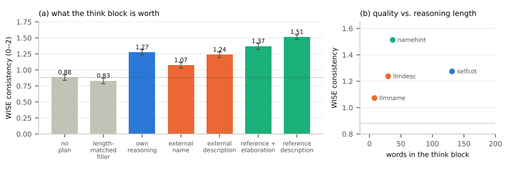
Figure 1 . (a) WISE consistency for each substitute think block, with standard errors; the dotted line is the no-plan baseline. (b) The same scores against the length of the think block: quality is set by what the block says, not by how long it is.
Original paper · CC BY 4.0 · Jian Xu, Delu Zeng, Qibin Zhao · A Think Block Is Conditioning, Not a Plan · Original paper figure · Extracted the figure area from page 4 of the original PDF.When identification decides the gain
The model's own one-line identification named the referent correctly on 53% of the 175 prompts that were judged. That answer comes from one call shared across arms, so it counts as pre-treatment. Because of that, the contrasts within each identification stratum are causal effects of the think-block content. Writing its own name added +0.33±0.08 when the name was right and +0.05±0.05 when it was wrong.
A wrong name therefore costs little, and the name's value depends on being correct. Supplying the correct referent on prompts the model cannot name gave +0.56±0.10, close to the +0.67±0.09 on prompts it can name. The authors read this as the pattern a conditioning account predicts, not the pattern a reading where the model already had the knowledge would predict.
Each prompt then contributes one observation, so it can't fall into two strata. Where the unaided generator fails, the model's own reasoning gained +0.61±0.11 and the reference description gained +0.99±0.11. Where the generator already succeeds, the same two arms gained −0.07±0.07 and +0.00±0.07. So the gain concentrates where the unaided generator fails to name the referent.
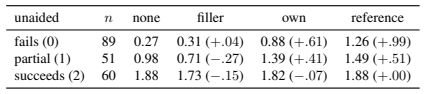
Table 3 . WISE consistency within strata. Each prompt is assigned to a stratum by its no-plan score on seed 1 and every arm is read on seed 2, so each prompt appears once. Parentheses give the paired gain with its standard error.
Original paper · CC BY 4.0Filler gave +0.04±0.08 in the failing stratum, which bounds how much regression to the mean could contribute. In the upper two strata, filler is negative, at −0.27±0.11 and −0.15±0.07. So the content arms come out conservative rather than inflated.
The next step repeats the same substitution on two other generators. T2I-R1 is trained with reinforcement learning, and Qwen3-8B plans for a frozen SDXL that reads only 77 CLIP tokens.
Architectures and the encoder window
The substitution moves to two further generators: T2I-R1, which is trained with reinforcement learning, and Qwen3-8B planning for a frozen SDXL. T2I-R1's own plan gains +0.27±0.05 on WISE, while the reference description reaches +0.76±0.05 on the same benchmark. Across the three generators, length-matched filler is negative and the reference description is the best block, ahead by 0.41 to 0.76 points.
An external sentence from the 8B planner matches the generator's own plan, so the authors claim equality rather than superiority. Under the first judge, the external sentence scores +0.13±0.06 on the reinforcement-learned pipeline and +0.11±0.05 on the planner pipeline. A second judge from a different family reverses that advantage, giving +0.00±0.05 and +0.05±0.05 on the two pipelines.
SDXL's text encoder reads 77 CLIP tokens, while the planner's plans have a median length of 117 such tokens. The planner front-loads its identification, naming the referent by token 3 in half its plans and by token 37 in all of them. Cutting each plan at 75 CLIP tokens changes the paired difference by only +0.002±0.005.
A single identifying sentence scores +0.295±0.040, a paired +0.003±0.039 over the fitted plan. The abstract reports the same contrast with a standard error of ±0.044, so the two error figures don't match. The authors read this as identification being the ceiling, so the headroom is identification accuracy rather than plan engineering.
Which fields reach the image
The authors built 20 scenes with deliberately under-specified user prompts, such as a tidy kitchen counter under daylight. Each scene is generated from the reference plan, a one-field edit, a meaning-preserving paraphrase and a field-free plan, with three seeds each.
Colour gets through on all three generators: stating it raises compliance by 0.58, 0.53 and 0.45. Editing the colour moves the image with probability 0.67, 0.75 and 0.53. T2I-R1 has the largest left/right intervention effect, 0.43, against 0.20 and −0.02, yet its plan effect is only 0.07. The authors read that pattern as sensitivity to wording without sensitivity to meaning.
Writing that there is no bottle in the scene lowers compliance below saying nothing about bottles, on both architectures. The request for the object works instead, raising compliance by +0.37 and +0.27 on the two architectures. Moving four sentences behind 71 words of boilerplate drops SDXL colour compliance from 0.67 to 0.20, the no-plan prior of 0.22.
The same move lifts the long-context unified model from 0.80 to 0.95, because nothing falls outside its context.
To separate the channel from the generator, the authors write the same four clauses into the user prompt. Moving a field into the prompt still doesn't rescue it: exactly two objects reach 0.43 compliance against a prior of 0.18. A left-right arrangement reaches 0.70 against 0.55, and an absent object does worse than an unmentioned one, 0.73 against 0.83.
When the prompt already names the composition
GenEval prompts already name the composition, as in 'a photo of two dogs', so a think block has little left to supply. Across 2040 scored images, the model's own reasoning moved the score from 0.880 to 0.904, a gain of +0.023±0.011. Filler of matched length scored −0.015±0.012 against the same baseline. Counting stayed at 0.47 in every arm, while position was the largest single-tag effect, rising from 0.848 to 0.914.
GenEval's no-plan baseline already sits at 0.880, which leaves only 0.120 of its range. WISE leaves 1.118, so a cross-benchmark ratio would compare two very different amounts of room. That gives a factor of 1.8, where a full-range normalisation would give 8.5, so the authors rest nothing on the ratio.
Inside GenEval the tasks leave very unequal room, which makes the per-task comparison the cleaner one. Counting leaves 0.553, and reasoning recovers 4.8% of it. Position leaves 0.152, and reasoning recovers 43.3% of it. The task with the most room to gain gains the least, which the authors tie to the field measurements of Section 8. Attribute binding is absent from their sample, a limit of the sample rather than of the benchmark, and the per-task table sits in the supplement.
The field study asks which parts of a plan reach the image, using 20 scenes with a deliberately under-specified user prompt.
Judge reliability: cross-family rescoring and the annotator check
The paper's numbers are all arm-to-arm differences from one automatic judge, so the judge's reliability comes first. A judge from a different model family rescored all 3110 WISE images. The two judges agree within one point on 0.968 of cases, and no pair of arms swaps order. Measured against their majority label, the judge reaches κ= 0.729, which is higher than any single human pair.
The third check is the one that cost the authors a claim. Filler, the model's own reasoning and the reference description all replicate under human scoring. The gap between the reference description and the model's own reasoning does not replicate: the judge gives +0.38±0.11, while the annotators give +0.03±0.11. The annotators' interval excludes the judge's estimate, so the judge overstates that gap.
The authors therefore claim equality between those two arms, not superiority. They apply the same equality claim to the external sentence in Section 6.
Limitations: what remains untested
Asked directly, Qwen3-8B names the referent on 0.493 of the 215 prompts. The interval reaches +0.11, so reasoning may buy more identification accuracy than this measurement shows. The authors don't generalise this result: one model is not a class of models. Nothing here bears on prompts that need genuine multi-step inference, and that case stays untested.
Systems that pass structured control rather than text are untested. The authors name the coordinate-carrying chains of Fang et al. as one example. Their analysis predicts the decomposition should not hold for such systems, because the interface bypasses the text channel that the paper measures. Latent-space reasoning has no text block to substitute, so the method doesn't apply to it.
The judges and GenEval rules are reimplementations, so absolute values can't be compared with published leaderboards. The field study covers four fields and twenty scenes. The GenEval sample omits attribute binding, so that task is not covered. SDXL is not a recent architecture, and its 77-token encoder sets how far the channel result transfers.
The only arm that beats a generator's own plan everywhere is the benchmark's own description, which is an oracle.
Paper info
- Authors
- Jian Xu, Delu Zeng, Qibin Zhao
- Venue
- arXiv · Preprint
- First published
- 2026-11-14
- Added
- 2026-11-17
- Updated
- 2026-11-14
- Version
- v1
- arXiv
- 2611.19341
- Category
- cs.CV
- Original paper terms
- CC BY 4.0
- What we show
- Paper info, commentary and permitted figures from the original paper
AI commentary is a separate explanation from the original paper and may contain errors. The original paper and figures follow each source's terms of use and any rights noted separately.
Abstract
Generative models increasingly write a chain of thought before drawing, and report large gains from doing so. We ask what that text contributes, by substitution rather than ablation: holding the generator, sampler and seeds fixed, we replace the think block with controlled alternatives and measure the image. Across a unified model with a think mode, a reinforcement-learned reasoning generator, and a planner driving a frozen diffusion model, the same picture emerges. Content-free prose of matched length is worth nothing or less ($-0.05$ to $-0.15$). One sentence from an unrelated 8B model, naming the subject and a few identifying details, matches the generator's own plan in three to six times fewer conditioning tokens. The value sits where the referent is in doubt: writing down a name is worth $+0.33$ when it is right and $+0.05$ when it is wrong, and where the generator already succeeds the whole effect is $-0.07 \pm 0.07$. Cutting a plan at the text encoder's window leaves 272 of 286 images byte-identical, and a plan rewritten to fit that window ties a bare identification ($+0.003 \pm 0.044$), so a plan contains nothing the identification does not already supply. Field-level interventions find only colour executed reliably, and a control writing the same sentences into the user prompt shows that limit belongs to the generator rather than to the planning channel. Two judges and two annotators replicate the central contrasts. A think block earns its keep as a specification of what to draw, not as a plan that is carried out.
Quote from the paper
Jian Xu, Delu Zeng, Qibin Zhao (2026). A Think Block Is Conditioning, Not a Plan. arXiv:2611.19341v1. https://arxiv.org/abs/2611.19341v1
BibTeX
@misc{xu2026think,
  title = {{A Think Block Is Conditioning, Not a Plan}},
  author = {Jian Xu and Delu Zeng and Qibin Zhao},
  year = {2026},
  eprint = {2611.19341},
  archivePrefix = {arXiv},
  url = {https://arxiv.org/abs/2611.19341v1}
}