Paper commentary
MoETok: Sparse Expert Routing for 1D Visual Tokenizers
MoETok routes each visual token to a few specialized experts
- Problem Dense 1D tokenizers pass every query through one shared feed-forward network, even though queries play different roles. Semantic supervision splits queries into a small Content group and a larger Detail group, so one shared path fits them poorly.
- Method MoETok keeps the shared self-attention and swaps each dense feed-forward network for a pool of experts. A learned router picks two of four experts for each visual token from its current representation.
- Results On ImageNet, MoETok reaches rFID 0.76 against 0.82 for the matched dense tokenizer. It improves reconstruction, semantic representation, and autoregressive generation over dense tokenizers under matched supervision and active computation.
What 1D tokenizers leave unexplained
Query-based 1D tokenizers represent images as compact sequences of learnable queries instead of spatially arranged latent grids. TiTok introduced this formulation, and later methods add semantic supervision to improve representation quality and scaling. These gains are measured on the complete token sequence, so the role of each individual query stays open.
The authors ask how individual learnable queries gather and encode image information, using encoder attention analysis and per-query linear probe evaluation.
In a dense tokenizer, every token passes through one feed-forward network (FFN) in each encoder layer. Semantic supervision splits the queries into groups with different jobs, so they aren't interchangeable. Most queries instead attend to stable spatial regions. The authors therefore argue that parameter capacity should follow the different information roles of visual tokens.
MoETok keeps the shared self-attention and swaps each dense FFN for a pool of experts. A learned router picks a small subset of experts for each visual token from its current representation.
The experiments cover Small, Base, and Large architectures with 64 and 256 tokens. In each comparison, MoETok is set against a dense tokenizer under matched supervision and active computation.
Content and Detail queries under semantic supervision
The first step is a per-query score built from how attention varies across images. Here A is the query-to-patch attention normalized over patch positions, and U is uniform attention. Averaging over encoder depth gives one value per query, and a high value means the query's attention shifts with image content. A linear probe is trained on the complete bottleneck and frozen, so each query's per-query linear probe score is the accuracy drop when that query is masked.
Without semantic supervision, queries show low attention variance and small classification effects. The authors split the queries at a fixed midpoint of 0.5 on the score, calling the group above it Content and the rest Detail. They describe the Content group as small and the Detail group as the larger remainder. Each Content query's attention follows foreground objects, while Detail queries stay on stable spatial regions.
In the Dense tokenizer, all 256 queries give a linear probe of 69.80 and rFID 1.52. The 2 Content queries alone give a linear probe of 66.97, which is 2.82 lower than the full set. Decoding from the 254 Detail queries gives rFID 1.56, while decoding from Content queries alone fails with rFID above 300. MoETok shows the same split with a larger Content subset: 20 queries reach a linear probe of 76.01, compared to 74.05 for all 256.
Because the Content subset size differs between the two models, each model's rows are read against its own full set.
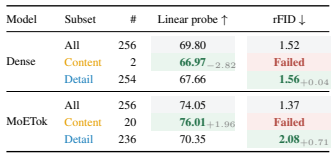
Table 1 :Complementary subset functions. Contentsubsets retain strong semantic infor- mation;Detailsubsets preserve reconstruction. Content-only decoding fails (rFID>300).
Original paper · CC BY 4.0The average was taken across 50,000 validation images. Masking Detail queries changes reconstruction in the regions their attention covers, while the illustrated Content query has little effect. Together, these interventions connect the attention patterns to the semantic and reconstructive roles. These findings motivate giving each token its own subset of experts from a larger pool, at active computation comparable to dense processing.
Routing each token through a few experts
MoETok starts from patch embeddings, appends learnable queries, and passes both through a transformer encoder. Each layer keeps the shared self-attention, so the change stays inside the feed-forward part of the block. The dense feed-forward network in every encoder layer gets swapped for a sparse mixture-of-experts layer.
A router turns each token's layer-normalized state into a probability for every expert. Top-k selection then keeps a small subset, and the default setting keeps two of the four experts per token. The router keeps the selected routing weights and renormalizes them before the expert outputs are combined. The weighted expert outputs are added to the residual state, so each token's update uses only part of the pool.
The router sees no role labels, and it learns its preferences from the reconstruction and semantic objectives.
Patch tokens and query tokens share one expert pool within each layer, so routing covers both kinds of token. Expert choices come from the training objectives instead of hand-set rules for patches or queries. Loss-free balancing makes expert use more uniform, but it lowers reconstruction, semantic representation, and generation.
Figure 3 places a standard ViT block beside the sparse MoE layer that replaces its shared feed-forward block. Because the residual structure stays the same, the modification is confined to the expert part of each layer.
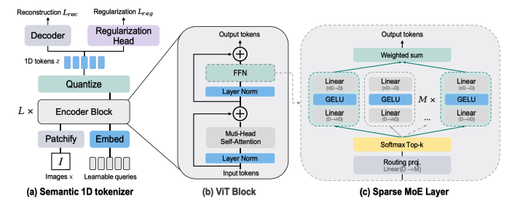
Figure 3 : MoETok adapts token processing through sparse expert routing. (a) A 1D tokenizer learns with reconstruction and feature regularization. (b) A standard ViT block. (c) A sparse MoE layer replaces the shared FFN with token-dependent expert selection and weighted aggregation.
Original paper · CC BY 4.0 · Jiahao Guo, Bao Tang, Haoxiang Cao, Jingfeng Yao, Bo Li, Wenyu Liu, Kun Gai, Changqian Yu, Xinggang Wang · MoETok: Sparse Expert Routing for 1D Visual Tokenizers · Original paper figure · Extracted the figure area from page 5 of the original PDF.Three losses and a frozen teacher
MoETok trains with three losses: reconstruction, vector quantization, and visual feature regularization. The total objective adds the three terms, each weighted by its own λ term: λrec times Lrec, λvq times Lvq, and λreg times Lreg. The λ terms set how strongly each loss pulls on the shared training signal relative to the others. The reconstruction term follows GigaTok, so the authors reuse an existing recipe rather than design a new one.
Quantization uses StableVQ, which turns the projected final query states into the discrete visual token sequence.
The feature regularization term supervises features decoded from the quantized query sequence, not the raw encoder states. Its target is the frozen SigLIP2-L feature, the default teacher across the experiments. Because the teacher stays frozen, the regularization shapes the tokenizer while the teacher itself doesn't change. Visual feature regularization is used under the same setting for the Dense baselines, so the comparison stays matched.
The experiments use 256 queries, four experts, and two activated experts per token by default.
MoETok's router gets no role labels, so any split of query and token roles has to come from these objectives. The authors then check the resulting routing by counting Top-1 expert assignments per layer.
Do the experts specialize by token role
The authors count Top-1 expert assignments per layer to see how the router spreads tokens across the expert pool. The effective expert count Neff,ℓ runs from 1, for complete concentration, to M, for uniform expert use. Routing is compared across roles rather than across images, so the measure isolates whether the router separates token roles.
Expert use broadens from the middle of the encoder onward, as the utilization plot shows across layers 1 to 12. At the layer 5 peak, distinct experts preferentially process Patch, Detail and Content tokens. The depth pattern persists when the expert pool expands, which the authors take as a stable property of the routing.
In 1D tokenizers, loss-free balancing from DeepSeek-AI (2024) makes expert use more uniform. That uniformity comes with lower reconstruction, semantic representation and generation, so the authors favor task-driven allocation across layers. The attention-variance comparison ties this routing to the bottleneck. In the Dense model, attention variance drops sharply at the final encoder layer.
MoETok keeps query attention image-adaptive near the discrete bottleneck, which the authors read as the link to role-specialized routing.
Patch-based and query-based routing
The authors compare sparse routing in a patch-based 2D tokenizer and a query-based 1D tokenizer, with each dense and MoE pair matched in active FFN capacity. The patch-based variant routes only patch tokens, while the query-based variant routes both patch and query tokens. Training schedule and objectives are shared across each pair, so the comparison isolates the routing choice.
In the query-based pair, the linear probe rises from 48.72 for the dense tokenizer to 60.22 for MoETok with patch and query routing. Under the same setting, gFID without guidance falls from 10.35 to 9.59. Patch-only routing gives a smaller semantic gain, with a linear probe of 44.26 compared to 41.83 for the dense patch-based tokenizer.
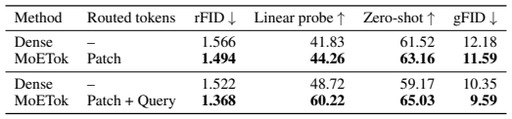
Table 2 :1D tokenization amplifies the semantic benefits of expert routing. Each pair matches active FFN capacity; gFID is evaluated without guidance.
Original paper · CC BY 4.0The authors tie this to GigaTok's findings on query-based generation. They take the larger semantic gain in the query-based setting as consistent with the heterogeneous query roles identified in their analysis. Figure 5 extends the comparison across Small, Base and Large models at 64 and 256 tokens.
Scaling across model sizes and token counts
MoETok's advantage over Dense holds across Small, Base and Large scale variants at both 64 and 256 tokens. Every Dense and MoETok pair shares the same supervision and quantizer, and the comparison is made at comparable forward computation. Across these settings, MoETok shows higher linear probe and zero-shot Top-1 accuracy than Dense. Figure 5 plots these curves against forward GFLOPs for all three sizes.
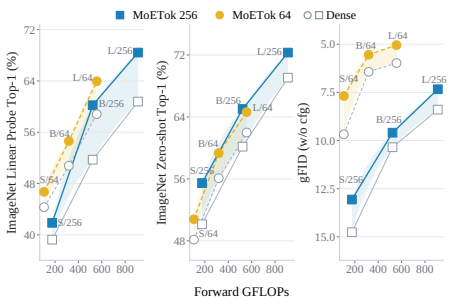
Figure 5 :Performance–compute scaling.MoETok achieves stronger semantic representation and unguided generation than Dense at comparable forward computation across Small, Base, and Large models at both 64 and 256 tokens.
Original paper · CC BY 4.0The advantage persists when the token count drops fourfold, from 256 to 64, which shows that sparse routing helps 1D representations at different compression levels. Unguided gFID also improves as model capacity increases, so the scaling benefit carries from semantic representation into autoregressive generation. Table 3 then examines where routing is placed in the encoder, which the scaling sweep itself does not vary.
Expert depth, width and count
Routing depth decides which encoder layers get experts, and the paper finds that full-depth routing gives the strongest semantics. Routing only the late four encoder layers gives a linear probe of 51.21, compared to 46.85 for routing the early four. The authors tie the late-layer advantage to specialization in the middle and output of the encoder.
The expert sweep varies expert width, expert count, and Top-k, which controls per-expert capacity, the expert pool, and active computation. Eight experts with top-2 routing reach gFID 8.99, compared to 9.59 for four experts with top-2.
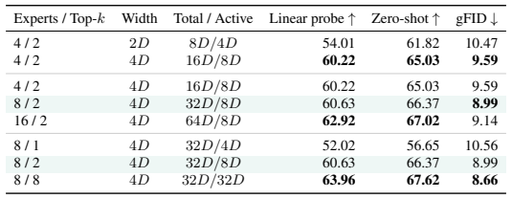
Table 4 :Expert design for 1D tokenizers.We vary expert width, expert count, and Top-k. E8/T2 balances representation, generation, and computational cost.
Original paper · CC BY 4.0ImageNet reconstruction, representation and generation
Under matched visual feature regularization, MoETok is compared to a Dense (GigaTok) tokenizer at 256 tokens. MoETok scores rFID 0.76 on ImageNet, compared to 0.82 for the Dense tokenizer. Its zero-shot Top-1 accuracy is 80.4, compared to 78.5 for Dense. The authors read the reconstruction and semantic gains together, as consistent with the Content and Detail roles.
Among the 1D tokenizers in Table 5, MoETok's rFID of 0.76 is below GigaTok-XL-XXL's 0.79 and GigaTok-B-L's 0.81. With the larger 775M generator, MoETok scores gFID 1.61 without guidance and 1.39 with guidance.
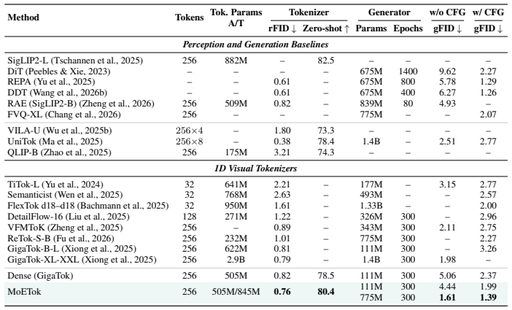
Table 5 :ImageNet reconstruction, recognition, and generation.MoETok combines strong se- mantic representations with high-quality reconstruction and generation in a single 1D tokenizer.
Original paper · CC BY 4.0The authors argue that the larger prior makes better use of the same learned visual representation. The B and XL LlamaGen priors were trained for 300 epochs.
Unified understanding and generation
The unified model starts from Qwen3.5-4B. The authors extend its vocabulary with MoETok visual tokens. Training minimizes next-token cross-entropy on text and visual tokens. The authors evaluate the model on seven understanding benchmarks and four generation suites.
Among the understanding results, the 4B model holds its own against larger discrete systems. On MMB, MoETok scores 75.6, compared to 85.0 for BAGEL. On POPE, MoETok reaches 85.5, which is close to the 85.8 of VILA-U, a 7B discrete model.
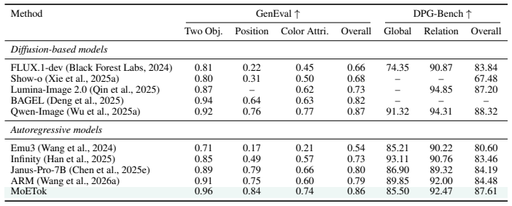
Table 7 :Text-to-image generation on GenEval and DPG-Bench.
Original paper · CC BY 4.0On DPG-Bench overall, MoETok scores 87.61, compared to 88.32 for Qwen-Image. Among the autoregressive models in that table, the next best is ARM at 84.48. On overall GenEval, MoETok scores 0.86, which leads the autoregressive rows. Janus-Pro-7B comes closest among those rows, at 0.80.
On WISE, MoETok has the highest score among the autoregressive models in all six domains. On GenEval2 GM, MoETok scores 40.04, compared to 33.80 for Qwen-Image. BAGEL + CoT reaches 23.10 on the same metric, while the closed Gemini model reaches 44.60.
Where the tests stop
The tokenizer experiments train on ImageNet at 256×256 resolution, and the paper reports no other dataset for them. Cross-dataset validation appears only in Appendix B.1, so the query-role findings aren't checked elsewhere in the main text. The tables report one value per row, so the spread across runs isn't shown.
MoETok's zero-shot Top-1 of 80.4 sits below the 82.5 that SigLIP2-L reaches in Table 5. On MMB, the unified model scores 75.6, while BAGEL scores 85.0. The unified model starts from Qwen3.5-4B, and the paper doesn't test larger language backbones.
The link between routing and attention variance is the authors' interpretation, not a tested causal result. Figure 4 compares attention variance only between Dense and MoETok across layers. The routing analysis covers MoETok's own layers and doesn't extend to other 1D tokenizer designs. The analysis uses Top-1 expert assignments, so the weights of the second selected expert aren't examined.
The expert sweep in Table 4 keeps 256 queries, which matches the default setup. Expert counts above 16 and Top-k values above 8 don't appear in the sweep. The scaling study covers Small, Base, and Large variants at 64 and 256 tokens only.
Paper info
- Authors
- Jiahao Guo, Bao Tang, Haoxiang Cao, Jingfeng Yao, Bo Li, Wenyu Liu, Kun Gai, Changqian Yu, Xinggang Wang
- Venue
- arXiv · Preprint
- First published
- 2026-10-30
- Added
- 2026-11-7
- Updated
- 2026-10-30
- Version
- v1
- arXiv
- 2610.41992
- Category
- cs.CV
- Original paper terms
- CC BY 4.0
- What we show
- Paper info, commentary and permitted figures from the original paper
AI commentary is a separate explanation from the original paper and may contain errors. The original paper and figures follow each source's terms of use and any rights noted separately.
Abstract
Modern visual tokenizers aim to preserve fine-grained visual details while learning high-level semantic representations for downstream generation and understanding. Query-based 1D visual tokenizers encode images into flexible latent sequences, yet how individual learnable queries gather and encode image information remains poorly understood. We reveal that these queries spontaneously develop complementary roles under semantic supervision: a small set of Content queries captures high-level semantic information, while a larger set of Detail queries preserves fine-grained visual details for reconstruction. To adapt token processing to these heterogeneous roles, we introduce MoETok, a 1D visual tokenizer that routes tokens through sparsely activated experts. Jointly optimized with reconstruction and semantic objectives, the router learns role-specialized processing paths adapted to each token's representation. Across model scales and token budgets, MoETok consistently improves reconstruction, semantic representation, and autoregressive generation over dense tokenizers under matched supervision and active computation. On ImageNet, it combines strong reconstruction and semantic representation with state-of-the-art class-conditional generation within the 1D tokenizer family. We further validate MoETok at scale in a unified autoregressive model jointly trained for understanding and generation with a next-token cross-entropy objective. The resulting model combines competitive visual understanding with state-of-the-art generation among unified discrete models, matching or surpassing diffusion-based models such as BAGEL and Qwen-Image on benchmarks including DPG-Bench (87.61), GenEval2 (40.04 GM), and WISE (0.49).
Quote from the paper
Jiahao Guo, Bao Tang, Haoxiang Cao, Jingfeng Yao, Bo Li, Wenyu Liu, Kun Gai, Changqian Yu, Xinggang Wang (2026). MoETok: Sparse Expert Routing for 1D Visual Tokenizers. arXiv:2610.41992v1. https://arxiv.org/abs/2610.41992v1
BibTeX
@misc{guo2026moetok,
  title = {{MoETok: Sparse Expert Routing for 1D Visual Tokenizers}},
  author = {Jiahao Guo and Bao Tang and Haoxiang Cao and Jingfeng Yao and Bo Li and Wenyu Liu and Kun Gai and Changqian Yu and Xinggang Wang},
  year = {2026},
  eprint = {2610.41992},
  archivePrefix = {arXiv},
  url = {https://arxiv.org/abs/2610.41992v1}
}